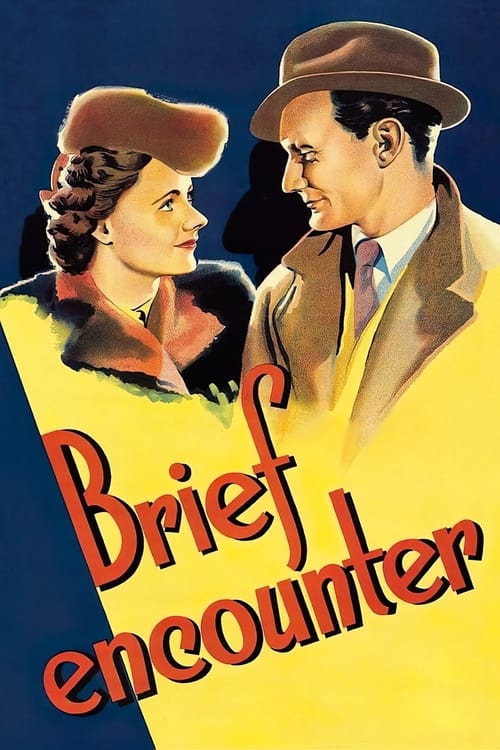
Brief Encounter
1945 · David Lean
For when you need a good cry that earns it — a rainy-evening film about longing and duty, best watched alone with tea and no plans afterward. Comfort viewing that hurts, in the best way.
What it's about
A married suburban housewife's ordinary Thursday shopping trips are upended when a chance meeting at a railway station café grows into a weekly friendship with a married doctor — and then into something neither of them planned. Told in flashback as she sits at home with her husband, it follows two decent people wrestling with a love they never asked for and can't easily act on.
The experience
Quiet, aching, and impossibly tender — almost nothing 'happens,' yet every glance and unsaid sentence lands like a blow. It builds to one of the most devastating slow heartbreaks in movies, all in under ninety minutes.
Performances
Celia Johnson gives one of the great screen performances, most of it in her enormous, guilt-stricken eyes and clipped narration; Trevor Howard matches her with warmth that never tips into slickness. Together they make restraint feel like passion.
The craft
David Lean turns a railway junction into a whole emotional world — steam, shadows, and expresses roaring through the night — with luminous black-and-white photography and a swooning Rachmaninoff piano concerto carrying the feelings the characters won't speak. The inner-voice narration was daring for its time and still cuts deep.
Why it matters
It became the defining British film about repressed love and the standard against which screen romances of restraint are measured, touchstone material for filmmakers ever since.
Snapshot
Brief Encounter is a 79-minute British drama produced by Cineguild and released through the Rank Organisation in November 1945. It stars Celia Johnson as Laura Jesson, a suburban housewife who develops a chaste but emotionally consuming attachment to a married doctor, Alec Harvey (Trevor Howard), during their chance weekly meetings at a provincial railway junction. The film's characteristic mode is one of extreme emotional compression: desire is never consummated, yet the film renders its suppression as devastating as any act. Adapted from Noël Coward's 1936 one-act play Still Life, the film transforms a brief theatrical sketch into one of the defining works of British cinema — a study in restraint that paradoxically generates enormous feeling. The concurrence of its release with the immediate postwar moment, when millions of British women were renegotiating the boundaries of domestic life, gave it a cultural charge that has only sharpened with time.
Industry & production
Cineguild was a production company formed in 1944 by director David Lean, producer Anthony Havelock-Allan, and cinematographer-turned-producer Ronald Neame, operating under the umbrella of J. Arthur Rank's expanding British film empire. Brief Encounter was the fourth collaboration between Lean and Coward, following In Which We Serve (1942), This Happy Breed (1944), and Blithe Spirit (1945). By the time Brief Encounter went before cameras in early 1945, the partnership had refined its working methods: Coward provided the source material and co-wrote the screenplay but ceded directorial control entirely to Lean, a division of labor that freed Lean to develop a cinematic language markedly more expressive than anything Coward's theater demanded.
Principal photography took place at Denham Studios in Buckinghamshire, with the crucial exterior and refreshment-room sequences shot on location at Carnforth railway station in Lancashire. Carnforth was selected partly for logistical practicality — its relative distance from London meant fewer wartime blackout restrictions complicated night shooting — and the industrial atmosphere of the station, with its steam, soot, and ceaseless movement, proved atmospherically ideal. The budget was modest by contemporary standards, and the film's apparent simplicity of means was a creative constraint Lean turned to advantage. The production was completed in a matter of weeks; the film's intimacy reads, in retrospect, like a function of that compression.
Technology
Brief Encounter was shot on standard 35mm, with cinematography by Robert Krasker, who would later win the Academy Award for his work on Carol Reed's The Third Man (1949). Krasker brought a conspicuously European — specifically Central European expressionist — sensibility to the photography, deploying deep shadows, low-key interior lighting, and a characteristic fog and steam aesthetic that transforms Carnforth station into an almost dreamlike interstitial space. The film relies heavily on available-location texture combined with controlled studio lighting, a synthesis that sustains its dual register of the mundanely real and the psychologically heightened.
There is no exceptional technical innovation in Brief Encounter in the mode of deep-focus cinematography that contemporaries like Orson Welles and Gregg Toland were developing in Hollywood. The film's technical choices are fundamentally conservative — the innovation is in their precise deployment in service of psychological subjectivity rather than spatial spectacle. The recording of Rachmaninoff's Second Piano Concerto, performed by Eileen Joyce and used throughout the film, was integrated with unusual care into the sound design, anticipating techniques of musical counterpoint that later became standard in art cinema.
Technique
Cinematography
Krasker's cinematography is organized around a tension between enclosure and exposure. Interior spaces — the refreshment room, borrowed flats, the railway carriage — are rendered in high-contrast chiaroscuro that codes them as psychically charged, even dangerous. The exterior world is shot with a harder, more documentary clarity, particularly in the brief sequences depicting Laura's suburban home. Steam from passing trains functions as a visual correlative for repressed feeling: it obscures, billows, temporarily blinds — a physical language for everything the characters cannot say. The film's palette favours deep blacks and silvery grays, a monochrome that reads simultaneously as the drabness of quotidian English life and as the formal elegance of a literary world removed from mere realism.
Editing
Lean had trained as an editor and edited several of his own early films; Brief Encounter bears this throughout. The cutting is exceptionally precise in its management of interiority: close-ups of Johnson's face are intercut with subjective POV shots and, crucially, with Laura's fantasy sequences — brief, melodramatically lit visions of the life she imagines she might have led with Alec. These inserts are cut into the film's otherwise restrained visual surface with a suddenness that registers as psychological intrusion rather than directorial commentary. The film's circular structure — beginning and ending in the same moment, the scene of Dolly Messiter's interruption — is organized in the editing as much as in the script, creating the impression that the entire film is a mental loop, endlessly rehearsed.
Mise-en-scène / staging
The staging systematically exploits the railway junction as a space of liminality: every meeting is bracketed by arrivals and departures, and the couple's relationship exists, formally, in the intervals between trains. The refreshment room, presided over by Myrtle the garrulous manageress (Joyce Carey) and her assistant Albert (Stanley Holloway), functions as a comic counterpoint to Laura and Alec's charged exchanges — their working-class banter providing a Cowardian social texture that prevents the film from tipping into self-pity. Lean stages the central encounters with rigorously controlled blocking: physical proximity is always subject to interruption, and the architecture of the station platform — exposed, public, echoing — renders any gesture of intimacy immediately vulnerable. The physical distance Lean maintains between his leads throughout the film is one of its most studied effects.
Sound
The Rachmaninoff Second Piano Concerto dominates the sound design and performs multiple functions simultaneously. Diegetically, it enters the film through a radio program Laura is listening to at the film's opening; non-diegetically, it swells to accompany the emotional climaxes. The concerto's association with romantic grandeur — the swooningly accessible orchestral Romanticism of the second movement in particular — becomes an ironic accompaniment to the film's rigorous suppression of its characters' desires. The gap between the emotional scale of the music and the smallness of the settings creates a sustained, productive dissonance. The sonic texture of the station — rumbling engines, hissing steam, the tannoy — provides an environmental countermelody that periodically cuts through or under the Rachmaninoff, reasserting the mundane world against which the inner life is pressing.
Performance
Celia Johnson's performance is among the most technically accomplished in British film history. She constructs Laura from a precise notation of suppressed gesture: the way she holds her hands, the barely perceptible compression around her eyes, the effort visible in her maintenance of social composure in the presence of Dolly Messiter at the film's beginning and end. Johnson was primarily a stage actress and approached the role with the discipline of that training, but Lean and Krasker's cameras make the finest calibrations of her face legible in ways that stage performance cannot. Trevor Howard, in only his second screen role, brings a quality of earnest decency that is crucial: Alec must never be a seducer, and Howard's relative inexperience before the camera gives him an unaffected quality that reads as moral seriousness. The chemistry between Johnson and Howard is real but governed; the sense of something withheld is mutually produced.
Narrative & dramatic mode
Brief Encounter employs a first-person retrospective narration — Laura addresses her absent husband Fred in her internal monologue — that positions the audience inside a consciousness that is simultaneously confessing and concealing. The narration is unreliable not in the postmodern sense of calculated deception, but in the more nuanced sense that Laura is rationalizing even as she describes: her account of events includes feelings she is perhaps reconstructing, sequences she has reordered, a meaning she is constructing retrospectively. This is an adaptation of the novelistic technique of free indirect discourse, achieved cinematically through voice-over, and it constitutes one of the film's central formal achievements.
The dramatic mode is melodrama in its precise generic sense — a mode that externalizes interior states through heightened aesthetic means — but subject to a specifically British discipline that codes emotional display as excess. Laura's most intense moments of feeling are consistently interrupted, either by other characters or by the imperatives of social convention that she herself internalizes. The film's greatest scene — Alec's departure for South Africa, interrupted by Dolly Messiter's unwanted company — is structured as a denial of catharsis that is itself cathartic. The audience experiences the frustration alongside Laura; the suppression produces the emotion rather than preventing it.
Genre & cycle
Brief Encounter belongs to the tradition of the "woman's picture" — the melodrama centered on female experience and emotional interiority — that was flourishing simultaneously in Hollywood (the films of Douglas Sirk, Max Ophüls's American work) and in British cinema of the mid-1940s. It is, however, a distinctively British inflection of the form, in which the characteristic excess of Hollywood melodrama is relocated inward: the emotional storm is entirely contained within a social surface of perfect propriety. The film connects to a broader cycle of quality British literary adaptations produced under Rank in the 1940s and to a strain of British cinema, running from the 1930s through the 1950s, preoccupied with class, emotional repression, and the maintenance of domestic order under pressure. Its railway setting participates in a broader iconography of trains as sites of encounter, transition, and desire that runs through British fiction from the nineteenth century forward.
Authorship & method
David Lean (1908–1991) came to directing from editing, having cut some of the most important British films of the late 1930s and early 1940s, including 49th Parallel (1941) and One of Our Aircraft Is Missing (1942). Brief Encounter sits at the turning point of his career, between the intimate chamber works of the Coward collaborations and the large-scale prestige productions that would define his later reputation: Great Expectations (1946), Oliver Twist (1948), The Bridge on the River Kwai (1957), Lawrence of Arabia (1962). His signature throughout is a cinematic precision that refuses the merely literary: even in adapting theatrical material, Lean translates rather than transcribes, finding visual equivalents for states that the source text renders verbally. His editing instinct is always present — he cuts with maximum intention.
Noël Coward (1899–1973) as writer and co-producer is co-author in the fullest sense: the film's emotional architecture, its class consciousness, its structural irony, and its particular kind of wit — present in the subplot if largely absent from the central drama — are Coward's. His contribution to the screenplay (alongside Lean and Havelock-Allan) lay in the fidelity to the play's essential compression while sanctioning the expansions that make it cinematic.
Robert Krasker (1913–1981), Australian-born and trained in Europe, brought to Brief Encounter a photographic sensibility formed partly in contact with German Expressionism. His lighting is the film's visual argument — the visual correlative for the emotional temperature Lean and Johnson establish in performance.
The music is not scored but sourced: Rachmaninoff's Piano Concerto No. 2 in C minor (1901), performed for the film by Eileen Joyce, constitutes the film's emotional spine in a way that approaches what would later be called the "found score" technique. Its deployment as both diegetic and non-diegetic sound is an act of musical dramaturgy as deliberate as any original commission.
Movement / national cinema
Brief Encounter is a central document of postwar British prestige cinema, produced within the Rank Organisation's effort to create a commercially viable and culturally credible national cinema capable of competing with Hollywood exports. It belongs to a brief flourishing in the mid-to-late 1940s — alongside Great Expectations, Odd Man Out (1947), and The Red Shoes (1948) — in which British cinema was arguably at its most formally ambitious and internationally legible.
The film also has a complex relationship to the British social realist tradition and the documentary movement associated with John Grierson and Humphrey Jennings. The Carnforth location footage, the attention to working-class social texture in the subplot, and the emphasis on the quotidian material circumstances of ordinary life connect Brief Encounter to that tradition, even as its central concern — the psychology of a middle-class woman — places it in a different cultural register. This double affiliation, to both the documentary impulse and the theatrical-literary tradition, is characteristic of the best British cinema of the period.
Era / period
The film was made and released in the final months of the Second World War and its immediate aftermath. This context is explicitly absent from the film — no character is in uniform, no reference to the war intrudes — but it is structurally present. The social landscape Brief Encounter maps — the suburban domesticity, the rigid maintenance of codes that govern what may and may not be said, the sense that personal desires must be subordinated to larger obligations — had been intensified and complicated by five years of war. For a significant proportion of its original audience, particularly women who had renegotiated the boundaries of their lives during the war years, Laura's situation — desire encountered and renounced — carried a specific historical charge that criticism has continued to excavate.
Themes
The film's dominant theme is renunciation as moral act — the idea that the refusal of desire can constitute a form of ethical seriousness rather than mere timidity. This is a specifically British (and, within that, specifically Cowardian) formulation, in which emotional restraint is figured not as repression but as a kind of honor. The film invites complicated readings: is Laura's return to Fred and her suburban life a triumph of self-knowledge or a capitulation to social pressure? Lean and Coward present it without authorial judgment, and the film's lasting power resides in part in this ambiguity.
Closely related is the film's meditation on the imaginary — on the gap between the life one lives and the life one imagines, and on the role of fantasy (figured here in Laura's melodramatic interludes) in sustaining and threatening ordinary existence. The railway junction, as a site of transit through which one passes on the way to elsewhere, is the film's central spatial metaphor: Laura and Alec's relationship is always in parenthesis, never the destination.
Class is present but not foregrounded: the couple's middle-class respectability is what makes renunciation legible as a choice rather than an impossibility, and the working-class characters' comfortable vulgarity (Stanley Holloway's Albert is cheerfully conducting his own low-stakes courtship) provides a commentary on the main plot without reductive irony.
Reception, canon & influence
Influences on the film
Brief Encounter draws directly from the theatrical tradition of Coward's work in the 1930s — specifically the compressed emotional scenarios of Tonight at Eight-Thirty (1936), of which Still Life was one part. More broadly, it absorbs the French poetic realism of the mid-1930s: the films of Marcel Carné and Jacques Prévert (Quai des Brumes, 1938; Le Jour Se Lève, 1939), with their fatalistic romanticism, night-drenched locations, and working-class textures, are a palpable presence in the film's visual and emotional grammar. American film noir, then in active formation, contributed elements of Krasker's lighting aesthetic. The British documentary movement gave the film its attention to social surface and location texture.
Critical reception and canonical standing
The film's initial British reception was mixed: some early audiences found it difficult to engage emotionally with characters so conspicuously withholding, and it was not an immediate commercial phenomenon. Its reputation was established progressively, through critical reassessment and international exhibition. At the first Cannes Film Festival in 1946 it was among the prize-winning films, and Celia Johnson received an Academy Award nomination for Best Actress at the 18th Academy Awards (1946); David Lean and the screenplay team also received nominations. The film did not win in any category, but the nominations cemented its transatlantic visibility.
The film's canonical status in Britain was formalized by the British Film Institute's 1999 poll of the hundred greatest British films, in which Brief Encounter ranked second, behind The Third Man. Its position in the broader canon of world cinema has been maintained through sustained critical writing, university curricula, and periodic reassessment that has taken increasing account of its gender politics and its relationship to wartime culture.
Legacy and forward influence
Brief Encounter's influence is diffuse and sometimes unacknowledged, but traceable. The film helped establish the emotional registers and formal strategies of what would become a recurring British mode: the cinema of repression and near-miss, in which the highest stakes are internal and the external plot is deliberately anticlimactic. Its descendants include Joseph Losey's The Go-Between (1971), James Ivory's The Remains of the Day (1993), and Joe Wright's Atonement (2007) — films that share its preoccupation with desire refused or deferred and its formal interest in retrospective narration.
The film's most celebrated international inheritor is Wong Kar-wai's In the Mood for Love (2000), which openly acknowledges its debt: the structure of chaste but consuming proximity, the unreliable retrospective narration, the use of music as emotional surrogate, and the formal attention to suppressed gesture all constitute a sustained dialogue with Lean's film. The Rachmaninoff concerto has become culturally synonymous with the film to a degree unusual even in cinema's appropriation of classical music — its second movement now functions almost as a musical shorthand for unconsummated longing.
Brief Encounter has also been the subject of multiple stage adaptations and a television film (1974, with Richard Burton and Sophia Loren), as well as a theatrical stage version by Kneehigh Theatre (2008) that toured internationally, testimony to the durability of its central situation as dramatic material across forms. Its influence on the formal vocabulary of British melodrama — the management of interiority through visual and sonic indirection — continues to inform the work of filmmakers working in that tradition.
A Deleuzian reading
Watch Laura Jesson's face at the refreshment-room table while Dolly Messiter chatters.
The full Deleuzian reading of Brief Encounter →
Reception
Respectable but hardly a smash in 1945 — it shared the Grand Prix at the very first Cannes in 1946 and earned Oscar nominations — then slowly hardened into holy writ: the BFI's 1999 poll ranked it the second greatest British film ever made, and it now tops 'most romantic film' lists on repeat.
How Brief Encounter was received, from release to now →
Influences: the films it descends from and the films it influenced
- Sunrise: A Song of Two Humans (1927) — Murnau's fantasy inserts — expressionistically lit visions of an alternate life cut abruptly into a realist narrative surface — establish the editing technique Lean applies to Laura's romantic reveries, where subjective imagery intrudes on represented reality as psychological necessity rather than authorial commentary.
- La Bête Humaine (1938) — Renoir's filming of the railway yard as an erotically charged liminal space — steam, intervals between arrivals, industrial machinery adjacent to bodies under social pressure — establishes the staging vocabulary Brief Encounter applies to Carnforth station, where the junction's transit logic suspends ordinary social codes.
- Intermezzo: A Love Story (1939) — The prestige genre structure of a brief, unconsummated adulterous attachment between socially constrained individuals who separate out of duty rather than indifference — the romantic interlude that legitimizes desire precisely by renouncing it — is the emotional template Brief Encounter refines with greater stylistic compression.
- Rebecca (1940) — Hitchcock's retrospective female voiceover spoken from a position of irrevocable loss — reconstructing an overwhelming experience through memory that cannot be fully escaped — is the exact narrative architecture Brief Encounter places inside Laura's interior monologue, including the return to a lost space that opens the recollection.
- Dangerous Moonlight (1941) — Hurst establishes the model of a sweeping Romantic piano concerto (Addinsell's Warsaw Concerto, composed to evoke Rachmaninoff) as the affective spine of a British melodrama — orchestral Romanticism as substitute voice for feelings the characters cannot speak — and Lean applies the identical logic using the actual Rachmaninoff Second Piano Concerto.
- Now, Voyager (1942) — Bette Davis's performance grammar in the woman's picture — suppressed desire registered through held breath, averted eyes, and the visible physical cost of self-containment — defines the acting register Celia Johnson inherits and deepens for Laura, encoding female interiority through the discipline of what is not expressed.
- Double Indemnity (1944) — Lean inherits Wilder's device of a retrospective first-person voiceover organized as private confession — a narrator addressing an absent interlocutor while reconstructing a doomed experience — and the circular editing structure that ends by returning to the opening moment, converting the film into a mental loop endlessly rehearsed.
- The Third Man (1949) — Robert Krasker, Brief Encounter's director of photography, transports his chiaroscuro methodology directly — deep shadows, canted framings, atmospheric texture (fog-filled Viennese rubble substituting for Lancashire steam) functioning as psychological environment — and wins the Academy Award for doing so.
- Hiroshima Mon Amour (1959) — Resnais systematizes Brief Encounter's memory-insert technique — present reality interrupted by involuntary images from another time — into a formal method: the fantasy insert becomes flashback-as-trauma-recurrence, the retrospective voiceover becomes direct address, and a transit city replaces the railway junction as the liminal space where past and present collapse into each other.
- Summertime (1955) — Lean reprises his own formal architecture — a woman alone in a foreign space, a doomed romance with a married man, interior monologue registering the gap between desire and social reality — while replacing the railway junction's constriction with Venetian canals as liminal space, expanding the woman's picture grammar into color and landscape.
- The Go-Between (1971) — Harold Pinter's screenplay employs Brief Encounter's circular retrospective structure — an older narrator reconstructing a defining summer from irrevocable distance, the film beginning and closing in the present while the body of the narrative is the remembered past — with an equally elliptical editing rhythm that withholds as much as it shows.
- The Remains of the Day (1993) — Hopkins's performance discipline — the wanted action visibly not taken, the look that does not quite become a declaration, the moment of potential touch deflected — directly inherits Brief Encounter's encoding of British emotional repression through suppressed gesture, within a retrospective structure where a narrator reconstructs a missed life from irrevocable distance.
- In the Mood for Love (2000) — Wong systematically develops Brief Encounter's central formal problem — how to render suppressed desire cinematically — through slow-motion as extended fantasy insert, stairwell and corridor staging as public-exposure blocking, cyclically repeated pre-existing music (Shigeru Umebayashi's 'Yumeji's Theme') as found score, and a circular structure that returns to the originating moment without resolution.
- Atonement (2007) — Wright pushes Brief Encounter's unreliable retrospective narration to its structural limit by eventually revealing that the film's love story has been invented by its narrator to supply an ending she could not achieve in life — making explicit what Brief Encounter implies: that first-person retrospective narration is always an act of wishful reconstruction.
- 45 Years (2015) — Haigh updates the woman's picture grammar — suppressed gesture accumulating across Charlotte Rampling's performance, the uncovering of a past romantic attachment that retrospectively rewrites a life, a final image of a face registering an emotion that cannot and will not be spoken — within British social realism that inherits Brief Encounter's tension between domestic containment and the unbearable pressure of unacted feeling.
- The Apartment (1960) — Lean's staging of a woman trapped in illicit rendezvous within borrowed domestic space — the Godby flat as site of asymmetric romantic exploitation — is the direct formal ancestor of Fran Kubelik's situation; both films use mundane objects (memorized timetables, cracked mirrors) as emotional anchors for an impossible relationship.
- Wild Strawberries (1957) — Lean's first-person voiceover retrospection — a narrator mentally addressing an absent other as she cuts to irrecoverable memory — is the structural armature Bergman adapts for Isak's interior monologue, which drives Wild Strawberries' present/past intercutting.
- The Bridge on the River Kwai (1957) — Lean's deployment of Rachmaninoff's Second Piano Concerto as recurring structural punctuation — not continuous underscoring but a motif that frames and ironizes the action — is the direct formal model for 'Colonel Bogey's' role in Kwai, where the whistled march performs the identical irony-marking function.
- Lost in Translation (2003) — Supplies the unconsummated brief-encounter template — two married-elsewhere strangers whose intimacy is built entirely on restraint and parting rather than romantic payoff, the withheld resolution LiT inherits wholesale.
- Letter from an Unknown Woman (1948) — Ophüls arrives independently at the same architecture: a circular retrospective structure built from a woman's first-person account of a doomed asymmetric romance organized as a document read after her death, with piano music linking memory to irrecoverable desire and desire staged consistently in threshold and transit spaces.
- All That Heaven Allows (1955) — Contemporaneous study of renounced love and middle-class respectability built on suppressed-restraint performance and a surging romantic score, sharing the woman's-picture conviction that repression registered in close-up is the genre's true subject.
- The Hours (2002) — Codifies the 'unlived life' melodrama of restraint: respectable domestic interiors, suppressed longing legible only through held faces and small ritual gestures rather than spoken declaration — the performance register Moore and Streep work in.
Similar films
- In the Mood for Love (2000) — influence & lineage
- 45 Years (2015) — influence & lineage
- Letter from an Unknown Woman (1948) — influence & lineage
- Doctor Zhivago (1965) — same viewing thread
- A Lesson in Love (1954) — same viewing thread
- Double Indemnity (1944) — influence & lineage · often watched together
- The Third Man (1949) — influence & lineage · often watched together
- Before Sunrise (1995) — often watched together
All the films related to Brief Encounter →
Watch it with: curated runs of related films
- Love, Memory, and the Long Journey — A run of love films where a journey — by car, by rail, or through memory — quietly lays bare what two people are, or were, to each other.
Film essays and courses that include it
- The Ache of Distance: Cinema's Language of Longing
- The Wound of Time: Cinema's Elegiac Masters
- The Shape of Longing: How Cinema Reinvented Romance
- The Vow and Its Violation: A Century of Marriage on Screen
- The Grammar of Longing: Cinema's Great Forbidden Love
- This Sceptred Isle: British Cinema's Long Reckoning
- Full Steam: A Century of Trains, Ships, and Planes
- In-Yeon: Impossible Love and the Immigrant Self