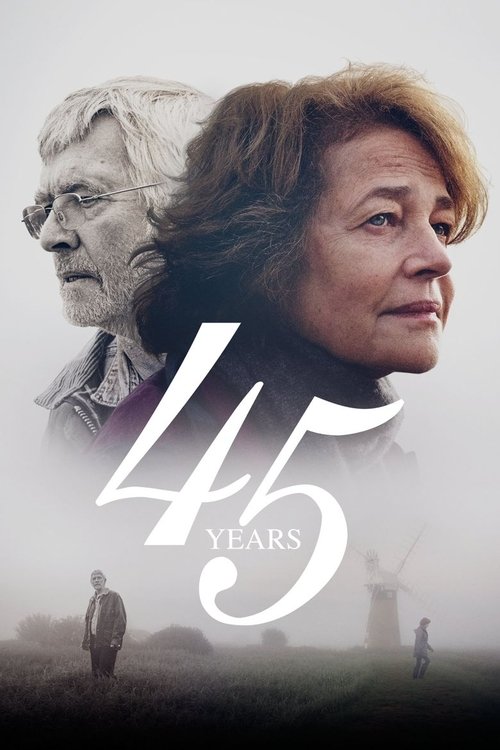
45 Years
2015 · Andrew Haigh
All of Us Strangers was the internet's collective heartbreak of its year, and its total Oscar shutout fueled a loud "queer cinema always gets snubbed" cycle.
For when you want a grown-up film to chew on for days — one that will send you into a long conversation about love, memory, and what partners keep from each other. Deceptively gentle to watch, emotionally not gentle at all.
What it's about
A retired English couple are days away from their forty-fifth wedding anniversary party when a letter arrives: the body of the husband's first love, who died in an Alpine accident half a century ago, has been found preserved in a glacier. Nothing dramatic happens on the surface — walks, errands, party planning — but the news quietly unsettles everything the wife thought she knew about her marriage. The film watches her, across six days, as the ground shifts under a lifetime.
The experience
Quiet, precise, and devastating in slow motion — the tension lives in glances, pauses, and things almost said. It creeps up on you; the final minutes land with a force the gentle surface never warns you about.
Performances
Charlotte Rampling gives a masterclass in showing a mind at work behind a composed face — she and Tom Courtenay both won acting prizes at Berlin, and Rampling earned an Oscar nomination. Some of the film's biggest turns happen entirely in her eyes.
The craft
Andrew Haigh directs with total restraint — natural light, flat Norfolk landscapes, long unhurried takes, no score telling you what to feel — so that every small gesture carries weight. It's a model of how much a film can do by holding still and paying attention.
Why it matters
It became a touchstone of modern British realism and one of the defining portraits of late-life marriage on screen, confirming Haigh as one of the finest observers of intimacy working today.
Snapshot
45 Years is a chamber drama of marriage and memory, set across the six days before a long-married English couple are to celebrate their forty-fifth wedding anniversary. When a letter informs Geoff Mercer (Tom Courtenay) that the body of Katya — a lover who died in a fall into an Alpine crevasse some fifty years earlier — has been found preserved in a melting glacier, the news reactivates a past Kate (Charlotte Rampling) never fully knew, and the long-settled architecture of their life begins to look provisional. Directed by Andrew Haigh from his own adaptation of a short story by David Constantine, the film premiered at the Berlin International Film Festival in February 2015, where Rampling and Courtenay shared the Silver Bear acting prizes; Rampling went on to a Best Actress nomination at the Academy Awards. Spare, observational, and acted in a register of withheld feeling, the film is now widely regarded as a high-water mark of 2010s British art cinema and a defining study of late-life intimacy under pressure.
Industry & production
The film was a small-budget British independent feature produced by Tristan Goligher's company The Bureau, which had also produced Haigh's breakthrough Weekend (2011). It was financed through the apparatus of UK public film funding — the BFI Film Fund and regional support among the named backers — rather than through a studio; the exact financing stack is not something I can reconstruct in full from memory, and I will not invent specific figures or a budget, neither of which is reliably part of the public record I can cite. What is clear is the production's scale: a single principal location region (rural Norfolk), a two-hander at its center, a short shoot, and an aesthetic that turned modest means into an asset. Sales and festival positioning followed the prestige-arthouse route: a Berlinale competition launch, a dual acting prize that generated immediate critical momentum, and subsequent distribution by specialty labels (Curzon/Artificial Eye in the UK and IFC's Sundance Selects in the US, per the standard release pattern for films of this profile). The Berlin awards and Rampling's later Oscar campaign were the decisive industrial events, converting a quiet film into an awards-season presence well out of proportion to its cost.
Technology
45 Years belongs to a generation of low-budget features built around naturalistic, available-light shooting and lightweight camera packages, the conditions that made its intimate domestic coverage economically and aesthetically feasible. I am not certain of the precise capture format — whether it was originated digitally or on film — and rather than assert a specification I cannot verify, I'll note only that the finished image has the muted, grain-soft, low-contrast character associated with naturalistic photography under overcast Norfolk light. The more important technological fact is sociological: this is a film whose subject is partly technological memory. The plot turns on a 1960s artifact (a letter, in German, from a Swiss authority) and on a carousel slide projector in the attic, an obsolescent imaging machine through which Kate finally confronts the visual evidence of Geoff's past. The film is acutely aware that the past is stored in media — letters, slides, photographs, pop records — and that those media can be reopened decades later, much as a glacier yields up a body it has held intact. Technology here is preservation, and preservation is the threat.
Technique
Cinematography
The photography is by Lol Crawley (later the cinematographer of Vox Lux and The Brutalist), and it is among the film's most quietly disciplined elements. The visual scheme favors a wintry, desaturated palette — bare trees, flat skies, the brown-gray of the Norfolk Broads in February — and a naturalism that keeps the lighting motivated by windows and lamps. Crawley and Haigh frequently isolate Kate within domestic space, shooting her through doorways and across rooms so that the house itself reads as both refuge and trap. The recurring motif of Kate walking the dog through wide, denuded landscapes gives the film its few exteriors a sense of solitary exposure against weather. Crucially, the camera tends to hold on Kate rather than cut to what she sees or to Geoff's reaction; the film is photographed from inside her dawning awareness, and the privileging of her face over the dramatic event is a cinematographic decision as much as an editorial one.
Editing
Jonathan Alberts, Haigh's regular collaborator, edits in long, patient takes that resist the reaction shot and the emphatic cut. Scenes are allowed to run past the point of plot information into the residue of feeling — a conversation continues after its content is settled, a silence is held. The film's structure is governed by an onscreen day-count (Monday, Tuesday, and so on toward the Saturday party), a ticking calendar that lends an almost classical unity of time to material that is otherwise undramatic on its surface. The most discussed editorial gesture is the ending: the cut on the anniversary dance, which arrests the film at the precise moment of Kate's recognition rather than resolving it.
Mise-en-scène / staging
The Mercers' house is the film's primary set and its richest text — a comfortable, tasteful, book-and-record-filled home whose every object now reads as a possible omen. Haigh stages the marriage through habit: the making of tea, the shared bed, the routines that a forty-five-year partnership has sedimented. The attic, the locked drawer, the carousel of slides are staged as a buried stratum within the domestic space, literalizing the idea that Katya has been living in the house all along. The anniversary party in the final act — the hired hall, the speeches, the period playlist — functions as a public ritual mounted over a private fracture.
Sound
The film is notable for its near-total refusal of non-diegetic score. There is little or no orchestral underscoring to instruct the audience how to feel; instead the soundtrack is dominated by ambient texture (wind, the dog, household noise) and by diegetic period music, above all the 1950s/60s pop standards that bracket the marriage. The Platters' "Smoke Gets in Your Eyes" — the couple's wedding song, replayed at the anniversary — is the film's central sonic motif, its lyric ("they asked me how I knew / my true love was true") curdling into irony by the finale. The absence of score is itself an expressive strategy: it leaves the actors' faces and the silences between them unmediated.
Performance
The film is, finally, a two-hander carried by performances of extraordinary economy. Rampling builds Kate from micro-expression — a flicker of doubt absorbed, a smile maintained a half-second too long, a gaze that holds while everything behind it reorganizes. Courtenay's Geoff is bluffer, more porous, a man undone by his own re-awakened grief and oblivious to the damage his nostalgia inflicts. The Berlin jury's decision to award both leads recognized a genuinely paired achievement, but the film's gravity is Rampling's; it is structured as the record of a woman discovering that the foundational narrative of her life contained a silent partner.
Narrative & dramatic mode
The film operates in a mode of compressed domestic realism — a near-unity of time (six days), place (one house and its surrounding country), and action (the approach of a party). Its dramaturgy is subtractive: the inciting event (the letter, the recovered body) is almost entirely offscreen and in the past, and the drama consists of its slow seepage into the present. There is no villain and no confrontation in the conventional sense; the conflict is epistemic, a matter of what Kate comes to know and cannot un-know. This aligns the film with a tradition of "minor key" realism in which the catastrophe is interior and the climax is a change of understanding rather than a change of circumstance.
Genre & cycle
Generically the film sits at the intersection of the marriage-in-crisis drama and the emerging cycle of serious "late-life" cinema — films taking aging protagonists and the long perspective of a completed life as worthy of first-rank dramatic treatment, a cycle that includes works as different as Haneke's Amour (2012). It belongs as well to the lineage of the literary chamber adaptation, and to a strain of British realism that here turns away from social-issue subject matter toward the intimate and psychological. Its romance is retrospective and corrosive rather than aspirational, inverting the genre's usual arc.
Authorship & method
Andrew Haigh adapted the film from David Constantine's short story "In Another Country," and the screenplay is an act of expansion — Constantine's spare prose enlarged into a sustained study of a marriage's interior. Haigh's method, continuous across Weekend, this film, Lean on Pete (2017), and the later All of Us Strangers (2023), favors small casts, behavioral observation, withheld exposition, and an emotional realism that trusts the audience to read silence. His key collaborators here form a recognizable authorial unit: cinematographer Lol Crawley and editor Jonathan Alberts, working within the patient, score-averse aesthetic Haigh prefers, and producer Tristan Goligher of The Bureau, who has anchored the production side of Haigh's career. The decision to forgo a conventional composed score and to build the emotional life of the film from period songs and ambient sound is central to Haigh's authorship; so is the choice to photograph the drama almost entirely from Kate's vantage, making adaptation also an act of point-of-view construction (Constantine's story affords its own framing, which the film tilts decisively toward the wife).
Movement / national cinema
The film is a product of 2010s British independent cinema and of the public-funding ecology — BFI and regional support — that sustains it. It can be read against the long shadow of British social realism, but Haigh's interest is less in class and milieu than in interiority and intimacy, marking a turn within that national tradition toward the chamber-psychological. Internationally it travels with the festival art-cinema circuit, and its tonal cousins are continental as much as British — the European tradition of the austere relationship study. Its rural Norfolk setting also locates it in a specifically English landscape cinema of flat horizons, water, and winter light.
Era / period
The setting is contemporary (mid-2010s), but the film is structurally about the intrusion of the deep past — the early 1960s of Geoff's youth — into the present. This doubling gives the film a quiet historical dimension: the recovered body is a relic of a pre-marriage world, and the slides, songs, and letters are the surviving media of that era. There is, too, a faint but deliberate ecological undertone: a glacier melting to release what it had preserved is an image with an unmistakable contemporary resonance, even if the film never foregrounds climate as theme.
Themes
The film's governing theme is the unknowability of the person one has lived beside for a lifetime — the discovery that a marriage rests on an edited history. From this radiate its other concerns: memory as both preservation and threat; retroactive jealousy, which poisons the past rather than the present; the question of whether a life chosen as a substitute can ever have been fully "true"; and the gap between public ritual (the anniversary, the speeches) and private erosion. The glacier supplies the film's master metaphor — the past held intact, frozen, and then released — and the recurring images of preserved media (slides, photographs, the wedding song) extend it. The childlessness of the Mercers sharpens the stakes: there is no third term, no shared creation, to anchor the marriage against the revelation. The film's final, devastating implication is that Kate has spent forty-five years as the second choice and only now perceives it.
Reception, canon & influence
Backward — influences on the film. The most direct source is David Constantine's short story, and the film's literary restraint owes much to that origin. Its formal lineage runs through the European chamber drama of marriage and aging and through the post-1960s tradition of behavioral realism that privileges performance and duration over plot. Charlotte Rampling's own screen history — her long association with European art cinema and with characters of opacity and self-possession — is itself an intertext the film draws upon; casting her is partly a citation.
Reception. Critical response was strong and concentrated on the performances and on Haigh's control of tone. The Berlinale's dual Silver Bears for Rampling and Courtenay set the terms of reception, and Rampling's subsequent Academy Award nomination for Best Actress (in the year Room's Brie Larson won) brought the film a wider audience. The awards run was complicated by controversy over remarks Rampling made during the campaign concerning the era's diversity debate; that episode became part of the film's public story, though it is extrinsic to the work itself. I will not attribute specific box-office figures, which I cannot verify.
Forward — what it shaped. The film consolidated Andrew Haigh's standing as one of the foremost British directors of intimacy, a reputation his later All of Us Strangers would extend, and it stands as a touchstone for the serious treatment of older protagonists in art cinema. It affirmed a model — small cast, no score, patient observation, an actor's face as the site of drama — that has remained influential for subsequent relationship dramas. Above all it is remembered for its ending: the freeze on Kate's face as the wedding song plays, a closing image routinely cited as one of the most quietly shattering final shots of its decade, and the clearest evidence of the film's central argument that a marriage can end without a single thing being said.
A Deleuzian reading
Start with the attic.
The full Deleuzian reading of 45 Years →
Reception
It arrived already garlanded — twin Silver Bears at Berlin 2015 for Rampling and Courtenay — and its stature has only grown since, with the acclaim for All of Us Strangers sending a new wave of viewers back through Andrew Haigh's filmography to rediscover it.
How 45 Years was received, from release to now →
Influences: the films it descends from and the films it influenced
- Scenes from a Marriage (1973) — The chamber two-hander built almost entirely from sustained dialogue scenes in domestic interiors, anatomizing a marriage through performance and duration rather than plotted incident.
- Wild Strawberries (1957) — A late-life protagonist whose settled present is destabilized by a resurfacing lost love, establishing memory as preservation-and-threat rather than nostalgia.
- Journey to Italy (1954) — A marriage quietly cracking observed in near-real-time through behavioral detail and location, plot subordinated to the shifting physical proximity of the couple.
- Tokyo Story (1953) — Domestic routine and aging staged in compositions framed through doorways and thresholds, with the drama located in stillness and what is left offscreen.
- Brief Encounter (1945) — The British grammar of emotional repression in which a respectable marriage is shadowed by an unspoken love, music carrying the feeling the characters refuse to voice.
- The 400 Blows (1959) — The abrupt freeze-frame on a face as the final image, arresting the film at a moment of unresolved emotion rather than resolving it — the direct precedent for the closing freeze on Kate.
- Under the Sand (2000) — Charlotte Rampling's restrained study of a wife in denial about a vanished spouse, the unknowability of a partner read entirely off her opaque, self-possessed face — the persona Haigh casts as intertext.
- Amour (2012) — Late-life cinema confined to a married couple's flat with no non-diegetic score, long takes and domestic duration making an actor's endurance the subject.
- Weekend (2011) — Haigh's own two-hander of intimacy built from behavioral observation, withheld exposition, available light and no score — the method 45 Years scales up to a 45-year marriage.
- Certified Copy (2010) — A couple's relationship played out across a single day in near-real-time, the underlying truth of the marriage left deliberately undecidable.
- Autumn Sonata (1978) — Haigh constructs a two-hander revelation drama where a single letter ruptures a marriage across seven days, with scene rhythm governed by Charlotte Rampling's controlled-implosion performance — each sustained interior scene held until her face completes what the script withholds — applying Autumn Sonata's grammar of the body as the site where suppressed damage finally registers.
- Another Year (2010) — Haigh builds a long marriage's quiet rupture from accreted ordinary domestic rhythm and restrained ensemble intimacy, extending Leigh's naturalist chamber observation.
- All of Us Strangers (2023) — Haigh extends his score-light, face-centered intimacy and the haunting of the present by an unresolved past, sustaining the same trust in silence and the unspoken.
- Aftersun (2022) — A British-independent memory film built on subtractive dramaturgy with a recording medium — the camcorder in place of the slide projector — serving as the threatening archive of a vanished relationship.
- Supernova (2020) — A late-life British two-hander about a couple facing loss, score-sparing and restrained, the drama carried almost entirely by two actors' faces in domestic and travel routine.
- The Father (2020) — Late-life cinema in which memory itself is the antagonist, the interior of an aging mind made the site of drama, extending the older-protagonist seriousness 45 Years helped legitimize.
- A Separation (2011) — A marriage fracturing through an accumulation of small withholdings, behavioral realism that trusts the audience to infer motive from performance alone.
- Blue Valentine (2010) — The dissolution of a marriage rendered through actor-driven, improvisation-grounded two-hander performance and close attention to faces in real domestic time.
- Force Majeure (2014) — A single rupture exposes a marriage's hidden fault lines, the drama kept subtractive — held in glances and silences within ordinary leisure routine.
- After the Storm (2016) — Single-week pressure-chamber structure in which an unspoken historical intrusion undoes present-tense domestic equilibrium without melodramatic confrontation; extended scene duration holds on faces well past the end of spoken exchange to register suppressed feeling — the same slow-disclosure temporal logic After the Storm uses across its typhoon night.
- Past Lives (2023) — Kindred study of the unled life resurfacing — a long-buried alternate love disturbing the present — sustained in long takes and micro-expressive performance, where the drama is entirely subtextual and the camera simply waits.
Similar films
- Amour (2012) — influence & lineage
- All of Us Strangers (2023) — influence & lineage
- Brief Encounter (1945) — influence & lineage
- Tokyo Story (1953) — influence & lineage · same viewing thread
- Carol (2015) — same viewing thread
- Happy Hour (2015) — same viewing thread
- Still Walking (2008) — same viewing thread
- Hamnet (2025) — shared sensibility
All the films related to 45 Years →
Watch it with: curated runs of related films
- The Weight of the Unspoken — A run of quietly shattering films where the largest feelings never get said aloud — love that outlasts reason, grief that gathers over a single family dinner, a long marriage cracked open by one old letter.