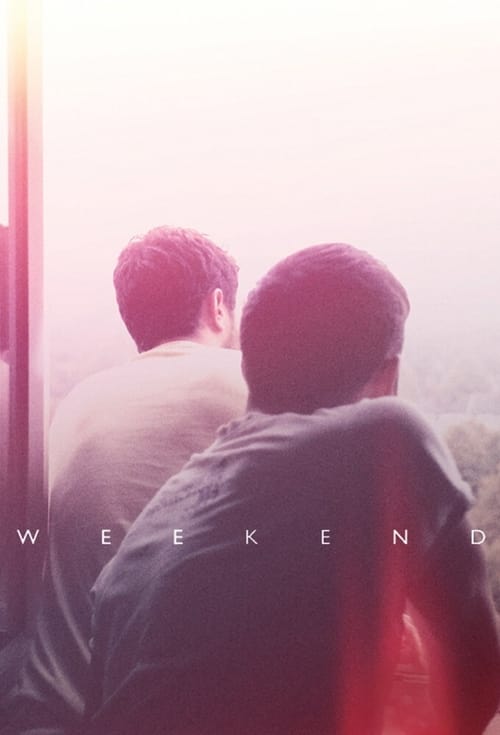
Weekend
2011 · Andrew Haigh
All of Us Strangers was the internet's collective heartbreak of its year, and its total Oscar shutout fueled a loud "queer cinema always gets snubbed" cycle.
For a late night alone or with someone, when you want a love story that feels true rather than swoony — the kind that leaves you tender and a little wrecked in the best way. Comfort viewing for the emotionally honest.
What it's about
After a boozy house party with his straight friends, Russell, a reserved Nottingham lifeguard, heads to a gay club and goes home with Glen, an artist who's louder, pricklier, and more politically charged than he is. The one-night stand doesn't end in the morning. Over one weekend — with Glen due to leave for America on Sunday — the two men talk, argue, and open up in ways neither expected.
The experience
Intimate almost to the point of eavesdropping: long unhurried conversations, real silences, tenderness that never feels staged. It's quiet and low-key, then suddenly you realize how much you care, and the ticking clock of Sunday gives every scene a soft ache.
Performances
Tom Cullen and Chris New carry the entire film as a two-hander, and their chemistry is startlingly lived-in — Cullen all guardedness slowly dissolving, New provocative and vulnerable at once. You never catch either of them acting.
The craft
Andrew Haigh shoots on real Nottingham locations with a patient, observational camera that lets conversations breathe in long takes; the naturalistic sound and gray autumn light make the tower-block flat feel like a world of its own. Made on a tiny budget, it proves how far precise writing and two great actors can go.
Why it matters
One of the defining queer films of the 2010s — it shifted expectations by treating gay intimacy with everyday, novelistic specificity instead of trauma or coming-out drama, and it launched Haigh as a major chronicler of relationships.
Snapshot
Weekend is a British independent romance that compresses the arc of a love story into roughly forty-eight hours. Russell (Tom Cullen), a reserved lifeguard living in a Nottingham tower block, picks up the more voluble, provocative Glen (Chris New) at a gay club on a Friday night; what begins as a one-night stand deepens across the weekend, shadowed by the fact that Glen is due to leave for the United States on Sunday. Andrew Haigh's second feature turned a tiny budget and a two-hander premise into one of the defining queer films of its decade — a work praised for treating gay intimacy with an unforced, novelistic specificity rather than as trauma, tragedy, or coming-out spectacle. It arrived as British social realism and American mumblecore were both cresting, and it fused their vocabularies into something quieter and more emotionally exacting than either.
Industry & production
Weekend is a product of the low-budget British independent sector at the turn of the 2010s, made outside the studio system and largely outside the orbit of the era's franchise economics. It was produced by Tristan Goligher for The Bureau (with the production entity often credited as Glendale Picture Company), companies associated with author-driven, modestly scaled work. The film was shot on location in Nottingham — a choice that grounds it in a specifically English, regional, working-and-lower-middle-class milieu rather than a metropolitan gay London. The production was small enough that Haigh could exercise near-total authorial control, writing, directing, and editing.
The film premiered at South by Southwest in March 2011, where it won the Emerging Visions Audience Award, and its festival run built the word-of-mouth that carried it to international distribution. In the United States it was released through IFC Films' Sundance Selects arm, the kind of specialty distributor that sustained this class of intimate art-house title. Precise budget and box-office figures are not something I can reliably state; what is clear from the record is that Weekend was a commercially marginal production whose impact was disproportionate to its scale — a critical and reputational success rather than a financial event.
Technology
Weekend was acquired digitally, in keeping with the wave of ultra-low-budget features around 2010–2011 for which affordable digital cameras made naturalistic, available-light shooting economically viable. The exact camera and capture format are not details I can confirm with confidence, so I will not assert a specific model. What matters technologically is the ethos: the film exploits digital sensitivity to work in real interiors — a cramped flat, a nightclub, a kitchen at dawn — with minimal supplementary lighting, preserving the texture of practical, ambient light. This is technology in service of a documentary surface, not spectacle. The same economy governs sound, which relies heavily on location recording and the ambient noise of the tower block and the city, reinforcing the sense of overheard, unstaged life.
Technique
Cinematography
The photography, by Ula (Urszula) Pontikos, is the film's most-discussed formal signature. Pontikos and Haigh build a grammar of distance and proximity that mirrors the lovers' oscillation between guardedness and disclosure. Many scenes are staged in wide or medium-wide handheld shots, often observing the two men through doorways, across rooms, or from behind window glass and balcony railings — a watchful, slightly withheld vantage that keeps the viewer at the respectful remove of a neighbor or passerby. The recurring motif of Russell's high-rise flat, seen from outside as one lit window among a grid of anonymous others, visualizes both isolation and the ordinary invisibility of a life. Against this reserve, the film reserves its close-ups for moments of genuine intimacy, so that physical and emotional closeness on screen feels earned rather than assumed. The palette favors muted grays, blues, and the sodium wash of urban night, avoiding any romantic gloss.
Editing
Haigh cut the film himself, drawing on a professional background in the editing departments of large studio productions before he turned to directing — experience that sharpened an instinct for rhythm and withholding. The editing of Weekend is patient and long-take-inclined, letting conversations run at close to real duration so that hesitations, digressions, and silences carry dramatic weight. Scenes are allowed to breathe past the point where a conventional romance would cut away, and the film trusts stillness. The cutting also structures the weekend as a series of discrete encounters separated by ellipses — the drift back to daily routine between meetings — which is what lends the compressed timeline its sense of a whole relationship lived in miniature.
Mise-en-scène / staging
The staging is defiantly domestic and unglamorous: kitchens, beds, sofas, balconies, a bathtub, the interior of a car. Props do real narrative work — most centrally the audio recorder into which Glen invites Russell to speak about their sex, part of an art project in which he collects such testimonies. That device turns the film's own preoccupation with candor and self-representation into a physical object within the frame. Drugs (cocaine, later ecstasy) and alcohol are woven through the mise-en-scène as social lubricants and as ways of lowering the men's defenses, structuring when and how they can speak honestly. The tower block itself is a piece of production design by circumstance: its verticality, its anonymity, and its view over the city externalize Russell's sense of being both hidden and exposed.
Sound
Weekend leans on a naturalistic soundscape — ambient city noise, club sound, the hum of domestic space — over any heavy score. Music tends to be used sparingly and often diegetically, and the film largely resists the emotional cueing of a conventional romantic soundtrack, so that feeling arises from performance and situation rather than from an orchestrated swell. I won't overstate the specifics of the music credits, which I cannot fully verify; the defining choice is one of restraint, letting the quiet of a room register as fully as dialogue.
Performance
The film rests almost entirely on its two leads, and both Tom Cullen and Chris New give performances of remarkable transparency. Cullen's Russell is interior and watchful, a man who came up through the care system (an orphan raised in foster homes, as the film reveals) and who has not fully reconciled his sexuality with an easy public self; his acting is a study in small withholdings and gradual thaw. New's Glen is his foil — verbal, political, armored in irony, using provocation to keep intimacy at bay — and the performance makes the character's bravado legible as its own kind of fear. The rapport between them, built through long dialogue scenes, has the improvisatory looseness of overheard talk while remaining tightly scripted; the chemistry is the film's engine and its argument.
Narrative & dramatic mode
Structurally, Weekend belongs to the "brief encounter" tradition: a romance bounded and intensified by a ticking clock, here the departure that both men know is coming. Its dramatic mode is naturalistic and conversational, closer to a chamber play or a short story than to a plot-driven feature. There is little external incident; the drama is almost wholly relational and verbal, generated by what the men are willing to say and to whom. The film's engine is the tension between Glen's insistence on honesty-as-performance (his recorded testimonies, his critique of straight society's terms) and Russell's more private, tentative self-disclosure. The compressed timeframe converts an ordinary weekend into a complete emotional trajectory — meeting, deepening, reckoning, parting — and the foreknowledge of separation gives every scene an elegiac undertow. The ending is understated and open rather than resolved, refusing both tragic punishment and tidy consummation.
Genre & cycle
The film sits at the intersection of the intimate indie romance and queer cinema. Within the romance genre it is a compressed two-hander in the lineage of the walk-and-talk love story, and within queer cinema it belongs to a post-millennial cycle of naturalistic gay films that deliberately moved away from both the tragic-victim narratives of earlier decades and the stylized provocations of early-1990s New Queer Cinema. Weekend is notable precisely for how it treats its gay romance as a romance first — with the genre's ordinary attention to attraction, timing, and missed chances — while remaining explicit about the ways homophobia and internalized shame shape its characters' choices. It helped define a cycle of low-budget, realist queer features that followed through the 2010s.
Authorship & method
Andrew Haigh is the film's decisive author, and Weekend is best understood as the work in which his method crystallized. Haigh came to directing after years working in film editing, including on large studio productions, and that craft background informs his patient, subtractive sensibility — his willingness to hold shots, to cut on feeling rather than event, and to trust actors in long takes. His debut feature, Greek Pete (2009), a docudrama about a London rent boy, had already shown his interest in blurring documentary observation and dramatic construction, and in the textures of gay life rendered without sensationalism. In Weekend he combined writing, directing, and editing, giving the film an unusual unity of voice.
His key collaborators shaped that voice materially. Cinematographer Ula Pontikos translated Haigh's emotional architecture into the film's grammar of distance and closeness and its available-light naturalism. Producer Tristan Goligher, a recurring Haigh collaborator, secured the conditions for such uncompromised small-scale work. The two lead actors, Cullen and New, are effectively co-authors of the film's texture, given the degree to which it depends on their sustained, seemingly unforced interplay. Where the record is thin — particularly around music and the finer technical credits — I've flagged it rather than fill it in.
Movement / national cinema
Weekend is a British film in dialogue with two traditions. The first is British social realism — the regional, class-attentive, location-shot lineage running from the kitchen-sink cinema of the early 1960s through Ken Loach and, more proximately, the tactile naturalism of Andrea Arnold. Its Nottingham setting, its tower-block milieu, and its refusal of metropolitan glamour situate it firmly in that national tradition of ordinary lives observed closely. The second is the transatlantic influence of American mumblecore, with its low budgets, improvisational-feeling dialogue, and romantic naturalism among young adults. Weekend effectively hybridizes the two: it has the social-realist's rootedness in place and class and the mumblecore film's intimacy and conversational grain, while surpassing much of the latter in emotional precision.
Era / period
The film is a document of its exact moment — Britain around 2011 — and its politics are legible as such. It was made and set at a point when gay life in the UK was substantially more visible and legally protected than a generation earlier, yet before the introduction of same-sex marriage; the characters live inside that in-between condition. Glen's arguments about assimilation, visibility, and straight society's willingness to tolerate rather than embrace gay lives read as the debates of that specific period. The film also belongs to the early-2010s wave of DSLR-era micro-budget filmmaking, when cheap digital tools briefly opened a golden age for intimate, location-based independent features.
Themes
At its center is intimacy and the terror of it — the way genuine connection demands a self-exposure that both men, for different reasons, find frightening. Related themes braid through: the closet and degrees of outness, from Russell's private caution to Glen's confrontational openness; loneliness and the search for belonging, sharpened by Russell's history as an orphan without a family model for love; and the ephemerality of connection, the sense that a profound relationship can be both real and doomed by circumstance. The film is also about representation and testimony — Glen's recorded art project makes the act of speaking one's truth into a subject in itself, raising questions about who gets to narrate gay experience and on what terms. Class, drugs, and the rhythms of ordinary working life provide the material ground on which these larger themes play out.
Reception, canon & influence
Weekend was met with strong, often superlative critical acclaim on release, widely praised for the honesty of its performances and the restraint of its style; it featured on numerous year-end lists and was quickly regarded as one of the finest gay films of its era. (I'll refrain from citing specific scores or takings I can't verify, but the consensus of enthusiasm is well established.) Its festival recognition, beginning with the SXSW audience award, helped convert critical goodwill into a durable reputation.
Looking backward, the film's influences are clear and acknowledged in its form: the compressed, dialogue-driven romance recalls Richard Linklater's Before Sunrise; the realist attention to place and class descends from British social realism and from Andrea Arnold; and the conversational naturalism aligns it with American mumblecore. It also stands in a considered relationship to New Queer Cinema — inheriting that movement's seriousness about gay lives while rejecting its earlier tragic and confrontational registers in favor of tenderness.
Looking forward, Weekend proved a launchpad and a template. It established Andrew Haigh as a major filmmaker; he went on to direct the acclaimed 45 Years (2015) and Lean on Pete (2017), to co-create and direct the HBO series Looking (2014–15), and to return to queer intimacy and memory in All of Us Strangers (2023) — a body of work that reads as a sustained development of Weekend's concerns. More broadly, the film became a reference point for a subsequent cycle of intimate, realist queer cinema, its DNA visible in later British work such as Francis Lee's God's Own Country (2017) and in a wider international turn toward gay romances told with everyday specificity rather than melodrama. Its lasting achievement was to make the case, quietly and completely, that a gay love story could simply be a great love story.
A Deleuzian reading
Early on, Glen takes out a small audio recorder and asks Russell to describe, in his own words, what they did in bed the night before.
The full Deleuzian reading of Weekend →
Reception
A tiny British indie that premiered at SXSW 2011 (winning an audience award) to instant critical love, it's since climbed from festival darling to fixture of the modern queer canon — the film people now point to as the moment New Queer Cinema grew up and got quiet.
How Weekend was received, from release to now →
How to watch Weekend: what to notice on a first viewing
- Notice the small recorder Glen asks Russell to speak into. It is part of an art project collecting men's own accounts of casual sex, and it recurs through the film as a physical object testing how much each man will say. A machine on the bed becomes the clearest measure of how open each man is willing to be.
- Notice how often you watch the men through glass or doorways. Pontikos frequently shoots wide and handheld from outside a room, through a window or a balcony rail, holding you at the distance of a passerby rather than a confidant. You are positioned as a careful neighbor, not an invited guest, for most of the film.
- Notice Russell's flat shown as one lit window among many. The tower block is filmed from outside as a grid of identical, anonymous windows, his own no different from any other lit square in the building. The building shows you isolation and ordinary invisibility in a single wide shot.
- Notice conversations running well past a comfortable length. Haigh lets scenes play out close to real time, keeping hesitations and digressions intact rather than cutting away once the point of a scene has landed. The stillness is where the film actually lives, not the plot points passing through it.
The whole guide to watching Weekend, with the keys for a rewatch →
Influences: the films it descends from and the films it influenced
- Before Sunrise (1995) — Builds a whole romance out of a time-limited brief encounter carried by an unbroken two-hander of walking-and-talking dialogue, the compressed-clock structure and conversation-as-plot grammar Haigh transposes to a single weekend.
- Fish Tank (2009) — Sets the template of handheld, available-light naturalism shooting intimate drama inside a British council tower-block, letting grain and window light do the atmospheric work Ula Pontikos echoes in Weekend.
- Red Road (2006) — Establishes the observational surveillance-distance camera in Glasgow estates — holding characters at a watchful medium remove rather than pushing into coverage — the exact detachment-then-intimacy calibration Weekend adopts.
- Kes (1969) — Founds the British social-realist method of non-melodramatic observation of working-class life in natural light with unstressed performance, the anti-sensational register Weekend inherits and applies to gay life.
- Funny Ha Ha (2002) — The originating mumblecore text: microbudget production and overlapping, hesitant, semi-improvised naturalistic dialogue prizing inarticulacy as truth, the conversational texture Cullen and New sustain.
- My Beautiful Laundrette (1985) — Embeds a gay relationship inside the specific class and social fabric of Thatcher-era Britain rather than isolating it as issue-drama, the social-realist framing of queerness Weekend extends.
- Beautiful Thing (1996) — Stages tender gay romance in a South London council-estate mise-en-scène with everyday domestic specificity instead of tragedy, the working-class ordinariness Weekend refines.
- Presque rien (2000) — Tells a gay love affair through elliptical, time-jumping structure that trusts the audience to bridge the gaps, the fragmentary editing logic Haigh (himself the editor) deploys.
- Happy Together (1997) — A claustrophobic chamber two-hander confining a gay couple's cycles of intimacy and friction to a few rooms, the small-cast pressure-cooker staging Weekend miniaturizes to one flat.
- Before Sunset (2004) — Compresses a romance into a short window of naturalistic, mostly-improvised two-hander conversation ending on ambiguous separation, inheriting the dialogue-driven brief-encounter structure.
- High Art (1998) — Two people in a flat over a compressed span, held in long available-light takes with drug use as ambient texture rather than plot, and an ending that separates them without moral — the post-coming-out chamber two-hander High Art prototyped.
- 45 Years (2015) — Haigh reapplies his own subtractive editing and long-take patience to a chamber two-hander over a compressed span, cutting on emotional weather rather than event exactly as in Weekend.
- All of Us Strangers (2023) — Returns to queer intimacy rendered in available-light naturalism and quiet two-hander closeness, developing Weekend's grammar of distance-and-tenderness toward memory and grief.
- Looking (2014) — Extends Weekend's unforced, non-sensational observation of contemporary gay life into serial form, retaining the handheld naturalism and dialogue-driven intimacy across episodes.
- God's Own Country (2017) — Transplants Weekend's handheld available-light British social realism to a Yorkshire farm, telling a gay romance through terse everyday specificity and physical labor rather than melodrama.
- Aftersun (2022) — Constructs an intimate relationship from available-light, observational-distance fragments assembled elliptically so meaning accretes in the gaps, inheriting Weekend's cut-on-feeling editing sensibility.
- Pillion (2025) — Haigh's naturalistic queer two-hander — long, source-lit scenes of intimacy negotiated in real time — is the realist register Pillion adopts wholesale.
- Cactus Pears (2025) — Builds a ticking-clock two-hander romance on naturalist long-take conversation and minutely interior performance, the time-bound deadline structure Cactus Pears adapts to a mourning ritual.
- Young Hearts (2024) — Low-key queer romance built from natural light and improvisational, near-documentary transparency between two leads, prioritizing intimacy over plot.
- The Way He Looks (2014) — Haigh's intimate two-hander renders queer connection through understated performance and diegetic indie music, proving sustained tenderness needs no melodramatic engine.
- Blue Jean (2023) — Established the naturalistic, near-scoreless mode of British queer intimacy built on diegetic sound and long observational takes that Oakley's restrained-score approach descends from.
- Love in the Big City (2024) — Perfects the chemistry-driven, dialogue-heavy two-hander confined largely to a flat, compressing a relationship into intimate real-time exchanges — the naturalistic two-shot intimacy the film's coupling scenes borrow.
- Blue Film (2026) — The queer two-hander as chamber film: long available-light takes inside a single flat, drama metered by the escalating rate at which each man discloses biography, with sex shot in the same unhurried register as the talk.
- Keep the Lights On (2012) — Charts a gay relationship in elliptical episodic fragments with naturalistic performance and unglamorous domestic texture, sharing Weekend's post-New-Queer-Cinema realist tenderness.
- Stranger by the Lake (2013) — Holds a queer encounter at a fixed observational distance with static naturalistic framing and no score, the watchful chamber-play detachment Weekend also favors.
- Oslo, August 31st (2011) — Haigh's 48-hour time compression achieves the same accumulating-anagnorisis effect as Oslo's one-day structure — both films use the truncated timeline to make each conversation function as a self-portrait the protagonist cannot fully perceive from inside it.
- Moonlight (2016) — Intimacy-through-proximity two-hander of gay desire, where ambient quiet, naturalistic withholding and durational scenes let unspoken feeling accrete rather than be declared.
- Call Me by Your Name (2017) — Naturalistic, near-real-time queer intimacy built from small gestures and restraint, letting tenderness accrue through everyday closeness rather than melodrama.
- And Then We Danced (2019) — Haigh's naturalistic handheld two-hander treats intimacy in near-real-time, unglamorized closeness — the same documentary-grained proximity Akin brings to Merab and Irakli.
- Your Name Engraved Herein (2020) — Builds queer intimacy through the confession-frame — long candid exchanges where the men narrate desire and fear aloud — the intimate disclosure structure the film echoes in its framing device.
- Rye Lane (2023) — Builds a compressed single-encounter British two-hander romance on prickly, improvised-feeling chemistry and long conversational takes, the naturalistic dialogue counterpart to Rye Lane's structure.
- Little French Fish (2020) — Compresses a chamber romance to two days of naturalistic two-hander intimacy shot in close, unhurried takes, letting the relationship form entirely in present tense.
- I Killed My Mother (2009) — Grounds a contemporary queer relationship in confined domestic interiors and unshowy real-time intimacy, a naturalist counterpart to the same emotionally-direct queer wave.
- Before Midnight (2013) — A two-hander assembled almost entirely from available-light conversation in cramped interiors, with dialogue developed through actor workshop and scenes allowed to run past their dramatic usefulness.
Similar films
- All of Us Strangers (2023) — influence & lineage
- Before Sunrise (1995) — influence & lineage
- 45 Years (2015) — influence & lineage
- Happy Together (1997) — influence & lineage
- God's Own Country (2017) — influence & lineage
- Holding the Man (2015) — shared sensibility
- Young Hearts (2024) — shared sensibility
- Twinless (2025) — shared sensibility