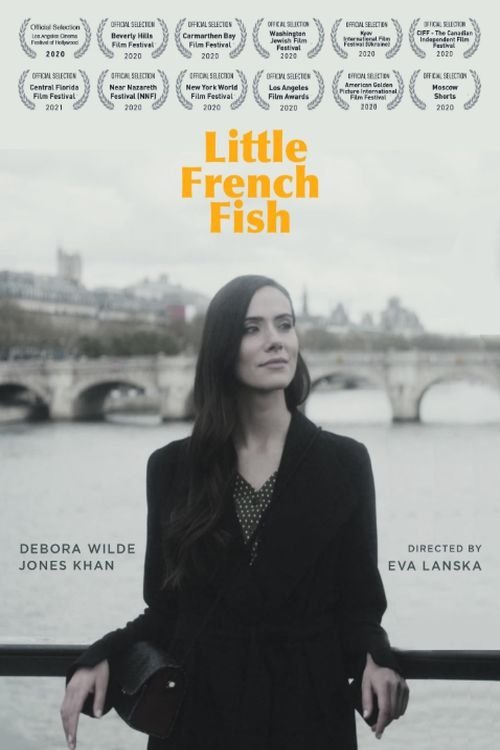
Little French Fish
2020
For a low-key evening when you want a grown-up love story with something on its mind — Paris, strangers, and the question of whether love can outrun inheritance. A gentle watch, not a demanding one.
What it's about
Lea, a painter from an Eastern European Jewish family, and Djamil, a young man from the Middle East, meet by accident in Paris and fall in love. The romance is simple; what complicates it is everything each of them carries into the room — languages, histories, loyalties — and the quiet negotiation by which two people from different diasporas try to build one shared life in a borrowed city.
The experience
Small-scale and intimate, more conversation than event — the pleasure is in watching two guarded people slowly lower their defenses. Unhurried and tender, with an undertow of melancholy about where each of them comes from.
The craft
It works in the classic French register of the city-as-meeting-ground: modest means, faces and talk over spectacle, Paris shot as neutral territory where the displaced remake themselves. The craft is in the intimacy — the film trusts small rooms and long conversations.
Why it matters
A little-travelled film passed hand to hand among curious viewers, it belongs to the ongoing wave of French cinema telling post-migration love stories in the capital.
A chance meeting in Paris — Lea, a painter raised in an Eastern European Jewish family, and Djamil, a young man from the Middle East — becomes the whole architecture of this small, intimate romance. The premise is as old as the city itself: two strangers whose histories should keep them apart discover that love is conducted in the present tense. What the film is quietly about is inheritance — the languages, wounds and loyalties each lover carries into the room, and the delicate negotiation by which two diasporas learn to share one city, one conversation, one future. It belongs to a durable strain of French cinema that treats the capital as neutral ground where the world's displaced meet and remake themselves, running from the New Wave's café courtships to today's post-migration love stories. A little-travelled film, passed hand to hand among curious viewers, it earns its keep the old way: through tenderness, scaled exactly to two people.
A Deleuzian reading
Two people bump into each other in Paris.
The full Deleuzian reading of Little French Fish →
Reception
How Little French Fish was received, from release to now →
Influences: the films it descends from and the films it influenced
- My Night at Maud's (1969) — Builds its entire drama from a single overnight conversation — the Rohmerian method of letting real-time moral and romantic debate between two people stand in for plot.
- Breathless (1960) — The founding Franco-American two-hander shot handheld in real Paris streets, establishing the New Wave grammar of location intimacy and spontaneous, talk-driven courtship this film inherits.
- Cléo from 5 to 7 (1962) — Near-real-time present-tense drift through Paris that turns the city into a neutral stage for one interior crisis, the model for Paris-as-neutral-ground.
- Hiroshima mon amour (1959) — Two lovers confined to a chamber, negotiating displacement and inherited trauma through murmured bedroom dialogue — the template for talk as intimacy across difference.
- A Man and a Woman (1966) — Tight two-hander romance built on shallow-focus close-ups and improvised-feeling talk between two guarded adults, prioritizing texture over incident.
- The Two of Us (1967) — Renders Jewish identity in occupied France through an intimate two-person chamber rather than historical spectacle, locating diaspora in a domestic relationship.
- The Worst Person in the World (2021) — Carries the New Wave's chaptered, present-tense romantic energy into the 2020s with a chamber focus on one couple's evolving talk.
- Past Lives (2023) — Extends the diaspora two-hander — migration and inheritance rendered through restrained, present-tense longing between two people meeting on neutral third ground.
- Before Sunrise (1995) — The walk-and-talk two-hander in a European city, sustaining romance in unbroken present tense through conversation alone — Rohmer's method transposed.
- Before Sunset (2004) — Near-real-time Paris stroll whose present-tense courtship is deepened by the ticking clock of a single afternoon in a shared but foreign city.
- Weekend (2011) — Compresses a chamber romance to two days of naturalistic two-hander intimacy shot in close, unhurried takes, letting the relationship form entirely in present tense.
- Certified Copy (2010) — A walking, talking two-hander whose whole relationship is performed in ambiguous present tense across a neutral European town.
- The Band's Visit (2007) — Stages a cross-cultural, interfaith encounter on deliberately neutral ground, carrying its displacement through restrained chamber-scale intimacy rather than incident.
- Portrait of a Lady on Fire (2019) — A French chamber two-hander that stages desire through sustained looks and hushed dialogue in a closed intimate space, extending the intimate-chamber performance mode.
- Frances Ha (2012) — Explicit New Wave homage — black-and-white, a Paris interlude, jump-cut rhythm — foregrounding character and talk over plot in the Godard/Truffaut idiom.
- In the City of Sylvia (2007) — An observational European-city romance where the neutral urban stage and the act of watchful looking, not dialogue, carry the story.
Similar films
- Le Havre (2011) — shared sensibility
- Little Amélie or the Character of Rain (2025) — shared sensibility
- Azur & Asmar: The Princes' Quest (2006) — shared sensibility
- Crossing (2024) — shared sensibility
- Marona's Fantastic Tale (2020) — shared sensibility
- Fallen Leaves (2023) — shared sensibility
- In Waves (2026) — shared sensibility
- The Little Sister (2025) — shared sensibility