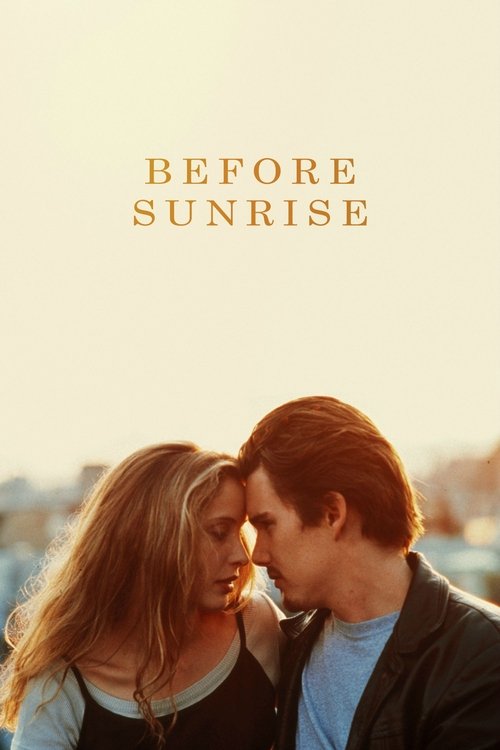
Before Sunrise
1995 · Richard Linklater
For a cozy night in when you want to fall in love — or to remember what it felt like. Pure comfort, but the kind that leaves you wistful for days.
What it's about
Two strangers — an American guy, a French woman — meet on a train and impulsively get off in Vienna to spend one night walking and talking before his flight home. There's no plot beyond the clock: record shops, tram cars, cafés, cemeteries, and a conversation about life and love that keeps deepening as the hours run out, both of them knowing this may be all they get.
The experience
Warm, unhurried, and quietly swoony — it feels like eavesdropping on the best conversation of two people's lives. The romance sneaks up on you, and the ticking clock gives even the lightest banter a bittersweet edge.
Performances
Ethan Hawke and Julie Delpy have chemistry that feels documentary-real — they shaped the dialogue with Linklater, and it shows in every overlapping, stumbling, alive exchange.
The craft
Richard Linklater's audacity is structural: no obstacle, no villain, just long unhurried takes that let conversation breathe, double back, and bloom, with Vienna as a dreamy nocturnal backdrop. The craft hides itself — the walking-and-talking looks effortless precisely because the timing and staging are so precise.
Why it matters
It won Linklater the Silver Bear for direction at Berlin, confirmed him as American cinema's great filmmaker of talk and time, and launched one of the most beloved ongoing love stories in movies.
Two strangers meet on a train and step off in Vienna with nothing but one night and an unspoken agreement to actually talk — and from this near-nothing, Richard Linklater built one of the most beloved romances in American cinema. The audacity is structural: no obstacle, no villain, no plot beyond time itself running out. Just Ethan Hawke and Julie Delpy walking, in long unhurried takes that let conversation breathe and stumble and double back, through record-shop listening booths, tram cars, and cemeteries, while the film quietly asks whether a connection can be complete in itself. Linklater, fresh from Slacker and Dazed and Confused, won the Silver Bear for direction at Berlin, confirming him as the great American filmmaker of talk and time — obsessions that would culminate in Boyhood. Both actors shaped their dialogue with him (formally credited by the sequels), and the film's texture of real thought emerging in real time became a template for two decades of walking-and-talking romances, none of which quite match it. What no one knew in 1995: the ambiguous farewell was not an ending but a hinge, the first panel of a triptych that would check in on these two every nine years.
A Deleuzian reading
Two people stand in a listening booth in a Vienna record shop.
The full Deleuzian reading of Before Sunrise →
Reception
It opened quietly in 1995 — a Silver Bear for Linklater at Berlin, modest box office, filed under 'Gen-X talkie' — and only became THE romance touchstone as the sequels arrived and each rewatch aged with its audience. What looked like a small indie is now the start of one of cinema's most beloved trilogies.
How Before Sunrise was received, from release to now →
Influences: the films it descends from and the films it influenced
- Brief Encounter (1945) — Establishes the compressed brief-encounter template: two strangers meet by chance, connect intensely, and are bound by a departure clock that forces the parting Linklater inherits wholesale.
- The Clock (1945) — A soldier and a woman fall in love while wandering a single city over one continuous day-and-night, the exact spatial-temporal courtship structure of one couple walking a metropolis against a ticking deadline.
- Voyage to Italy (1954) — Dramatizes a relationship through real-time wandering and mundane, uninflected conversation rather than plotted incident, pioneering the walk-and-observe method where talk and place carry the drama.
- My Night at Maud's (1969) — Rohmer builds the entire film from long, unhurried real-time conversation between would-be lovers, treating talk itself as the action — the direct dialogue-driven grammar Before Sunrise adopts.
- The Green Ray (1986) — Naturalistic, semi-improvised talk and a lonely woman's drifting through locations until a chance station encounter and open-ended final beat model both the improv texture and the ambiguous ending.
- My Dinner with Andre (1981) — A feature constructed almost entirely from one sustained real-time two-person conversation, proving a plotless dialogue two-hander can hold a whole film — the formal dare Linklater accepts.
- Annie Hall (1977) — Foregrounds a verbal urban romance where strolling-and-talking replaces incident, and structures love as remembered conversation, the walk-and-talk courtship register Linklater refines.
- Slacker (1990) — Linklater's own roving, plotless method — a drifting camera trailing ambient walk-and-talk — is stripped to a single couple here, the same authorial technique aimed at one pair.
- The Mother and the Whore (1973) — Linklater's near-real-time walking-and-talking structure, where two people's continuous scripted-to-sound-spontaneous conversation IS the film, is the American conversation-cinema that critics trace straight back to Eustache.
- A Special Day (1977) — Builds an entire film on unity of time and place — a single day's walking conversation between two strangers — carrying forward the compressed encounter as complete dramatic structure.
- Boyfriends and Girlfriends (1987) — Extends Rohmer's walk-and-talk staging to feature length, carrying romantic hesitation almost wholly through continuous strolling conversation with Rohmer a stated touchstone.
- The Hero (1966) — Extends the train-bound two-hander in which strangers reach confessional intimacy across a single bounded journey, letting talk carry the whole structure.
- Before Sunset (2004) — Direct sequel that pushes the conceit into true near-real-time (roughly 80 unbroken minutes), sustaining the two-hander walk-and-talk with even longer takes and the same Hawke-Delpy co-authored dialogue.
- Before Midnight (2013) — Completes the triptych with extended long-take argument scenes — including a sustained hotel-room quarrel — that stretch the real-time conversational method to its most demanding staging.
- Boyhood (2014) — Extends Linklater's time-as-medium experiment from a single night to twelve years, shooting the same actors as they physically age — the durational authorship the Before films first floated.
- Lost in Translation (2003) — Builds a transient connection between two strangers abroad, bounded by an imminent departure and sealed with a deliberately unresolved, ambiguous parting rather than romantic consummation.
- Medicine for Melancholy (2008) — An explicit one-day walk-and-talk romance threading two people through a city over a compressed span, openly modeled on Before Sunrise's ambulatory-conversation structure.
- Weekend (2011) — Two strangers connect across a compressed weekend of naturalistic, searching conversation before an enforced parting at a station, transposing the brief-encounter clock and talk-driven intimacy.
- Once (2007) — An unconsummated brief-encounter courtship built from walking Dublin and talking over a few days, ending in tender non-resolution rather than a couple united.
- In Search of a Midnight Kiss (2007) — A single-night walk-and-talk romance across Los Angeles, an overt homage transplanting the two-people-wandering-a-city-until-dawn structure to black-and-white indie LA.
- Drinking Buddies (2013) — Fully improvised, plot-light naturalistic dialogue drives the relationship, carrying the loose walk-and-talk relationship film forward into mumblecore's actor-authored talk.
- Past Lives (2023) — Defines the talk-driven, walk-and-talk encounter romance built on real-time sustained dialogue, where connection is performed through unhurried conversation rather than plot — the two-hander idiom Song deploys in the bar and street scenes.
- Nouvelle Vague (2025) — Supplies the director's own signature method imported here: durational real-time walk-and-talk, naturalistic ambient dialogue, and attention to a precisely felt place.
- Rye Lane (2023) — Establishes the two-strangers-walking-and-talking template where a burgeoning romance unfolds almost entirely through continuous ambulatory conversation across a city, the film's structure dictated by the pair's roaming rather than plot.
- Certified Copy (2010) — A man and woman walk and talk through a Tuscan town as their relationship mutates in real time, extending the Rohmer-Linklater conversational two-hander into shifting, ambiguous role-play.
- Dazed and Confused (1993) — Extends the real-time unity of time and the privileging of unstructured, drifting talk over plot into a two-hander.
- Little French Fish (2020) — The walk-and-talk two-hander in a European city, sustaining romance in unbroken present tense through conversation alone — Rohmer's method transposed.
- Waking Life (2001) — Shares Linklater's walk-and-talk method of staging real-time peripatetic conversation as the film's primary event, with dialogue substantially shaped by the performers.
- A Summer's Tale (1996) — Builds the eventless-yet-charged encounter out of continuous walk-and-talk in real locations, near real-time, a method Linklater has credited to Rohmer's conversational cinema.
- Chasing Amy (1997) — The parallel 1995-era experiment in building an entire relationship out of sustained two-shots of people talking while walking, where the camera's refusal to cut is what makes the intimacy feel earned rather than asserted.
- Metropolitan (1990) — The conversational feature carried to its purest form: a bounded time-frame, no plot beyond whether two people keep talking, and takes long enough that the actors must sustain an argument's real duration — Rohmer's discipline routed through the American indie that Metropolitan made commercially thinkable.
- Kicking and Screaming (1995) — Same-year commitment to a dialogue-first mix with almost no score and no needle-drop punctuation, letting continuous walking two-shots run long enough that the talk itself becomes the shot's subject.
Similar films
- Before Sunset (2004) — influence & lineage · same viewing thread · often watched together
- Before Midnight (2013) — influence & lineage · same viewing thread · often watched together
- Lost in Translation (2003) — influence & lineage · same viewing thread
- Brief Encounter (1945) — influence & lineage · often watched together
- Slacker (1990) — influence & lineage
- Boyhood (2014) — influence & lineage
- The Green Ray (1986) — influence & lineage
- Once (2007) — influence & lineage · same viewing thread
All the films related to Before Sunrise →
Watch it with: curated runs of related films
- Strangers Who Walk and Talk — Watch these back to back for the particular magic of two people, a city, and a few borrowed hours of talk that may not outlast the night.