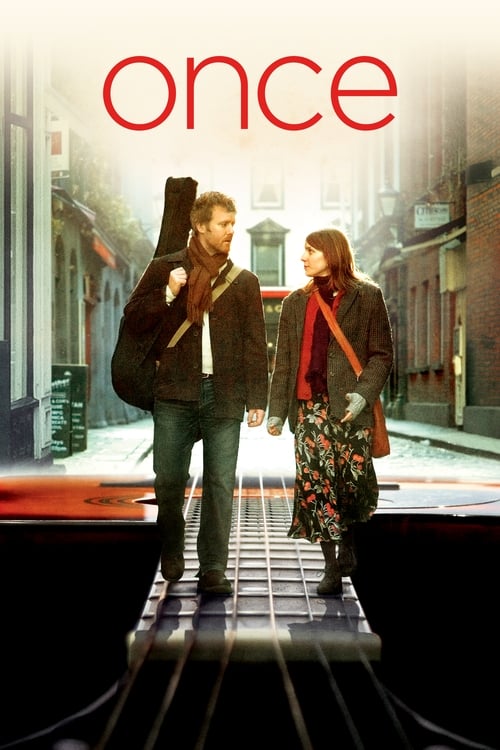
Once
2007 · John Carney
For a cozy night in when you want to fall a little bit in love — or when you're nursing a heartbreak and want company for it. A pure comfort watch for anyone who's ever loved a song more than they could explain.
What it's about
A Dublin vacuum repairman who busks on Grafton Street meets a young Czech immigrant who sells flowers and plays piano when she can borrow one. She pushes him to take his songs seriously; they begin writing and recording together, and over one charged week the music says everything the two of them can't quite say to each other.
The experience
Intimate, scruffy, and quietly swooning — the emotion lives almost entirely in the songs, and when they land they really land. It's tender without being sugary, and it leaves a sweet ache behind.
Performances
Glen Hansard and Markéta Irglová weren't professional actors, and that's the magic — their unguarded, undesigned chemistry feels eavesdropped rather than performed, and they're genuinely singing every note.
The craft
Shot on the streets of Dublin with consumer-grade cameras and a tiny crew, it turns its poverty into intimacy — musical numbers unfold in real rooms and real time, like you're in the corner of the session. 'Falling Slowly' won the Academy Award for Best Original Song, and the whole soundtrack is the film's beating heart.
Why it matters
One of the defining indie sleeper hits of the 2000s, it proved a musical could be naturalistic and tiny and still break hearts worldwide — launching John Carney's run of music films and a Tony-winning stage adaptation.
Snapshot
Once is a seventy-minute-plus film about two people who make songs together in Dublin and then part. It cost very little, was shot largely on the street with a small crew and consumer-grade digital cameras, and starred two musicians — Glen Hansard of The Frames and the Czech singer-songwriter Markéta Irglová — neither of whom was a professional actor. It premiered at Sundance in 2007, where it won the World Cinema Audience Award (Dramatic), and became one of the defining sleeper successes of the late-2000s American independent distribution landscape after Fox Searchlight picked it up. The following year, "Falling Slowly" won the Academy Award for Best Original Song, an outcome that placed a film made for a sum smaller than most studio catering budgets on the same stage as the year's blockbusters.
Its significance is not merely economic. Once proposed a way of making a musical that dispensed with almost every convention the form had accumulated: no orchestration swelling from nowhere, no choreography, no lip-sync to a pre-recorded track, no transition from speech into song that asks the audience to suspend disbelief. The characters are musicians; when they sing, they are singing, and the film simply watches. Carney called this a "video-realist" approach in interviews, and whatever the term's precision, the practice is legible on screen. The songs carry the emotional argument the dialogue withholds, and the film's central romantic gesture — the decision not to consummate — is delivered almost entirely through what the music says and what the people do not.
Neither character is named in the film. The credits list them as "Guy" and "Girl." That anonymity is not coyness; it is the film's structural claim that this is a situation more than a biography, a shape that recurs.
Industry & production
The production history of Once is genuinely small-scale, and the frequently repeated budget figures should be treated with some care — reported sums have varied across sources and the film's own publicity, and the tidy "made for €100,000" formulation that circulated during the awards campaign compressed a more complicated financing picture. What is well established: the film received support from Bord Scannán na hÉireann / the Irish Film Board, was produced by Samson Films (Martina Niland producing), and was made with a crew small enough that principal roles doubled. Carney had been the bass player in The Frames in the band's early years, which is how he knew Hansard; the film was written with Hansard in mind for the male lead, though not initially as its star.
The much-told origin — that Cillian Murphy was attached to play the Guy and departed, in part over discomfort with the singing demands and, per accounts, over the small budget's constraints — is part of the film's standard history and is corroborated across interviews with Carney. Whether the film would have survived the compromises a name lead entails is a counterfactual, but the version that exists depends absolutely on Hansard being a working musician who has busked, and on Irglová, then a teenager, having the unaffected directness she has.
The distribution story is the industrially significant one. Once went to Sundance in January 2007, where it won the World Cinema Audience Award, and was acquired by Fox Searchlight — then the most aggressive and successful of the studio specialty divisions, in the period bracketed by Sideways, Little Miss Sunshine, Juno, and Slumdog Millionaire. Searchlight's platform release strategy — open small, let word of mouth and music sales compound, expand — was ideally matched to a film whose soundtrack was itself a marketing engine. The Oscar for "Falling Slowly" extended the film's commercial life well past its theatrical run and functioned as retroactive validation for the specialty-division model at precisely the moment that model was beginning to contract. Within a few years, several studio specialty labels had been shuttered or absorbed; Once stands near the end of that era rather than at its opening.
The film's afterlife compounded the economics considerably: the stage adaptation, with a book by Enda Walsh, opened off-Broadway in 2011 and on Broadway in 2012, winning the Tony Award for Best Musical. Hansard and Irglová also toured and recorded as The Swell Season, and a documentary about that period followed. The film is thus one of the clearer late-2000s cases of a small independent feature becoming a durable intellectual property across media.
Technology
Once was shot on consumer and prosumer digital video — Sony HD handheld cameras, per Carney and cinematographer Tim Fleming's accounts — and the choice is inseparable from the film's method. This is a specific historical moment in image capture: after DV had democratised production but before the DSLR wave of 2008–2010 (the Canon 5D Mark II arrived the year after Once) and before the Alexa established a digital house style. The cameras Carney used were small enough to be invisible on a Dublin street, which is what allowed the film's most-discussed passages to exist at all.
The consequences are visible in the image: heavy grain and noise in low light, blown highlights against Dublin's gray sky, limited dynamic range, and a shallow but not creamy depth of field. Rather than fight this, the film leans into it. The opening busking sequence and the long-lens street shots have the texture of surveillance or documentary footage, and the film's most famous set piece — the Guy and Girl at the piano in a music shop, playing "Falling Slowly" for the first time — is shot with an unobtrusiveness the equipment made possible.
Equally important is the audio technology. The songs were recorded live on set rather than mimed to playback, which is technically the harder path and requires the sound department to capture usable performance audio in uncontrolled locations. Later films — Les Misérables in 2012 most conspicuously — would make live-sung vocals a promoted feature; Once did it without fanfare because the alternative would have destroyed the premise. The recording-studio sequence, in which the pair and a hastily assembled band cut a demo over a weekend, is a film about the technology of recording as much as it is a scene: it dramatizes the moment when songs made in bedrooms and on streets become fixed objects.
Technique
Cinematography
Tim Fleming's camerawork is defined by restraint under constraint. The film uses long lenses from a distance for much of its street material, keeping the camera far enough back that passersby do not register it; the resulting compression flattens Dublin's Grafton Street into a screen of bodies through which the Guy is glimpsed. Handheld operation dominates, but it is not the aggressive shakycam of the period's action cinema — it drifts, adjusts, occasionally loses and refinds focus. Focus errors are left in.
Coverage is minimal. Long takes are used not for bravura but because cutting a live musical performance into shot-reverse-shot would break the take. In the music shop scene, the camera holds and reframes rather than cutting, so the performance's build is experienced in real time. Interiors are lit close to available light: the Guy's father's flat, the vacuum repair shop, the Girl's cramped apartment with its ancient television, all sit in the same underlit, desaturated register. Color is unglamorous — grays, browns, the sodium-yellow of Dublin at night.
The lone stylistic escalation is the recording-studio sequence, which permits itself a slightly more composed, more mobile grammar, marking the moment the film's world briefly becomes professional.
Editing
Paul Mullen's cutting establishes an unusually clear rule: dialogue scenes are edited conventionally and briskly, and songs are largely not edited at all. The effect is that the film's rhythm alternates between a talky, elliptical connective tissue and long musical plateaus where narrative time stalls and emotional time expands. This is close to how songs function in classical musicals structurally, but achieved with the opposite formal means — the classical number is a construction of many shots, playback, and choreography; here, duration and continuity do the work.
The film also uses montage sparingly and pointedly: the assembly of the recording sessions, and the passage of the demo tape being listened to, compress days without ceremony. The ending's efficiency is notable — the film declines a final reunion scene and instead cuts away, leaving the piano the Guy has bought for the Girl in an apartment we see her in only briefly. The refusal to linger is itself the statement.
Mise-en-scène / staging
The film's spaces are almost entirely real and almost entirely unbeautified: a street, a repair shop, a bus, a beach, a bedsit, a music shop, a bank office, a studio. Props do heavy work — the Hoover the Girl drags behind her like a reluctant dog is both a joke and a precise image of the two characters' shared condition of pulling something broken around. The battered guitar with the hole worn through it is a documentary object: it is Hansard's own instrument, and its wear is the visible record of the labor the film is about.
Staging tends toward two-shots and walking conversations. The film repeatedly places its pair side by side rather than face to face — on the bus, on the walk home, at the piano — which is a spatial rhyme for a relationship that is collaborative before it is romantic and never fully becomes the latter.
Sound
Sound is where Once is most radical. Live-recorded performance means the songs carry room tone, breath, string noise, the imperfection of a voice pushed past its comfortable range. Hansard's singing in particular is characterized by a strained, near-shouting upper register, and the film keeps the sound of that effort rather than smoothing it. Ambient noise is not scrubbed: traffic, footsteps, and weather sit under the music.
The songs — largely drawn from Hansard's and Irglová's existing and in-progress work, with "Falling Slowly" and "If You Want Me" among the best known — are diegetic without exception. There is essentially no non-diegetic score. When the film needs to tell us what a character feels, it puts a guitar or a piano in their hands, or, in the sequence where the Girl walks to a shop at night in her pajamas with a portable CD player, gives her batteries and a Walkman. That scene is a small masterpiece of the film's method: she sings lyrics to an unfinished track, and the confession is only possible because it is technically a rehearsal.
Performance
Neither lead was a trained actor, and the film builds its aesthetic around what non-actors can and cannot do. Dialogue is loose, overlapping, and frequently sounds improvised within a scripted structure; Carney's method reportedly allowed considerable latitude. Hansard's Guy is prickly, self-deprecating, and defensive about failure. Irglová's Girl is direct in a way that reads as cultural — the flat, unhedged declaratives of someone speaking a second language — and the film mines that for both comedy and its most devastating beat: the Czech-language line she delivers, untranslated by subtitle, in answer to whether she still loves her husband. Withholding the subtitle is a directorial decision as much as a performance one, and it is the film's single most quoted formal choice.
Supporting performances are drawn from the same non-professional well, including Hansard's actual mother-figure milieu and musicians playing musicians. Bill Hodnett as the Guy's father supplies the film's quietest scene of reconciliation.
Narrative & dramatic mode
Once is a brief-encounter narrative built on the withheld consummation. Its dramatic engine is not "will they get together" but "will they finish the record," and the film substitutes an artistic goal for a romantic one so that the romantic question can remain permanently unresolved. This is the structure of the workplace-collaboration story more than the love story, and it is why the recording weekend functions as the climax.
The mode is elliptical and anti-climactic by design. Backstory arrives late and sideways: the Girl's husband, the Guy's departed girlfriend in London, the father's grief. Scenes end before their beats complete. The dialogue avoids declaration almost systematically — the characters talk about songs, money, vacuum cleaners, and bus routes, and the songs handle everything else. This division of labor is the film's fundamental dramaturgical proposition: speech for the practical, music for the true.
The ending's structure is worth naming precisely. The Guy leaves for London; the Girl's husband arrives from the Czech Republic; the piano is delivered. The film ends on a wide shot through a window, the camera withdrawing rather than closing in. It is an ending in the tradition of Brief Encounter and its descendants — renunciation as the highest form of the romance — but stripped of that tradition's rhetorical grandeur.
Genre & cycle
Once belongs to the musical, but to a strand of it that had been almost dormant in English-language cinema: the diegetic or "backstage-realist" musical, where all music is performed by characters within the world. Its lineage runs back through the backstage musical and forward through the rock-performance film, but its immediate context is a small cluster of mid-2000s and later films that treat musicianship as labor — one thinks of the general territory occupied by Hedwig and the Angry Inch, Crazy Heart, and later Inside Llewyn Davis, though Once is more romantic and less abject than any of them.
It also sits within the Irish independent tradition and, more broadly, within the mid-2000s American indie ecology of Sundance-to-Searchlight discoveries. The label "mumblecore" was in circulation the same year, and Once shares that movement's tools — cheap digital cameras, non-actors, improvised-sounding dialogue, romantic irresolution — without sharing its milieu or its American suburban self-consciousness.
Carney effectively made the film the first entry in a personal cycle: Begin Again (2013) and Sing Street (2016) rework the same material — music as a means of escape, collaboration as courtship, the refusal of the romantic ending — at increasing budget levels and with professional casts. Once is the austere original of which the later films are more polished variations.
Authorship & method
John Carney wrote and directed. His authorship is bound up with biography in an unusually direct way: he played bass in The Frames, has spoken of the film as drawing on that world, and returned repeatedly to the subject of musicians in subsequent work. His method here — casting musicians, writing loosely, shooting on the street without permits where necessary, recording live — is best understood as a set of solutions to the problem of making music on screen feel true rather than as a general filmmaking philosophy; his later films use conventional techniques when budgets allow.
Glen Hansard and Markéta Irglová are the film's other authors in any meaningful sense. They wrote and performed the songs, and since the songs carry the dramatic burden, the score is the screenplay's other half. "Falling Slowly" predates or overlaps with the film's production and appeared on The Swell Season's self-titled album; this is why its Oscar eligibility was briefly questioned before being upheld. The pair's off-screen relationship, which developed during and after production, has been discussed by both, and it complicates the film's status as fiction in ways the Swell Season documentary later explored.
Tim Fleming shot the film. His approach — long lenses, available light, minimal intervention — is the visual correlate of Carney's casting choices.
Paul Mullen edited, establishing the alternation between conventional dialogue cutting and untouched musical duration described above.
Martina Niland produced for Samson Films, and the film's existence at its scale is a production accomplishment as much as a directorial one.
Movement / national cinema
Once is a Dublin film in a way that few Irish features of its decade were. It arrives near the end of the Celtic Tiger boom — the property-driven expansion that transformed Dublin between the mid-1990s and the 2008 crash — and it is quietly about the underside of that expansion: precarious work, immigrant labor, rented rooms, a bank loan sought and improbably granted. The Girl is a Czech immigrant selling flowers and cleaning houses, and the film's Dublin is a multilingual one, a demographic fact of Ireland in the 2000s following EU accession by Central and Eastern European states in 2004.
Within Irish cinema, the film sits apart from the Troubles-and-history strand that had dominated international perception of Irish film, and apart from the rural-mythic mode. Its clearest predecessor in tone is Alan Parker's The Commitments (1991), also a Dublin music film about working-class musicians and also concerned with the gap between talent and opportunity — though Once is intimate where The Commitments is ensemble comedy. Roddy Doyle's Barrytown novels are the shared substrate.
The Irish Film Board's support is part of a longer policy story about state-funded national cinema producing internationally legible work at low cost, and Once became the Board's most cited success of the period.
Era / period
The film is precisely dated by its technology and its economics. Mid-2000s digital video, the CD single and the burned demo disc, the portable CD player, the pre-smartphone street: all of these are visible and none is nostalgic. The demo is made to be handed to someone in London — the film assumes an industry gatekeeping structure that the streaming era was already beginning to dissolve. Watched now, it documents the last moment when a weekend in a professional studio was the necessary bottleneck between a song and a career.
Its release in 2007 also places it at a specific point in exhibition history: the peak of the specialty-division platform release, the height of DVD revenue, and the moment before the financial crisis reshaped both independent film financing and the Irish economy the film depicts.
Themes
Art as displaced intimacy. The film's governing idea is that the songs say what the people cannot. Every emotional advance in the relationship occurs during or immediately after a performance, and the characters' inability to speak plainly is not a flaw the film corrects but the condition it dramatizes.
Work. Once takes seriously the labor of music: hours of busking for coins, the tedium of a repair shop, the negotiation for studio time, the cost of a demo. It is one of the few musicals in which money is a constant, concrete presence.
Migration and the provisional life. Both leads are living contingently — he in his father's house after a breakup, she in a shared flat with her mother and child, married to a man in another country. The film's Dublin is a place people are passing through.
Renunciation. The refusal of the romantic ending is the film's ethical center. Neither character is punished for it and neither is ennobled by it; they simply choose the thing that lets both continue. The piano is the gift that replaces the embrace.
The unfinished. Songs in progress, a marriage in suspension, a demo that may lead nowhere. The film's title names a fairy-tale opening — "once" — and refuses the rest of the formula.
Reception, canon & influence
Critical reception was strong and, unusually, grew warmer over time rather than cooling. The film was widely praised for its authenticity and its music, and it appeared on a large number of 2007 year-end lists in a year crowded with major American films. The general critical line — that it reinvented the movie musical by subtraction — was established early and has largely held. Dissenting responses tended to find the film thin, its characters underwritten, and its charm dependent on the songs rather than the filmmaking; these criticisms are not unreasonable, since the film's dramaturgy really does delegate most of its heavy lifting to the score.
The Academy Award for Best Original Song in February 2008 is the reception event that matters most. Irglová's acceptance — she was cut off by the orchestra and was brought back on stage after the commercial break to complete her remarks, at the intervention of host Jon Stewart — became one of the more widely circulated Oscar moments of the decade and functioned as a distillation of the film's underdog narrative.
Influences on the film (backward). The most direct is The Commitments (1991) and the Roddy Doyle Dublin it comes from. Beyond that: the brief-encounter romance in the lineage of David Lean's Brief Encounter (1945); the loose, walking-and-talking romantic structure that Richard Linklater's Before Sunrise (1995) had made a template; the Dogme 95 legacy of available light, location shooting, and diegetic-only sound, which Once observes more faithfully in practice than many films that signed the manifesto; and the Nouvelle Vague's original demonstration that lightweight equipment plus real streets is a viable production model. Jacques Demy's all-sung Les Parapluies de Cherbourg (1964) is the great precursor for a musical about lovers who do not end together, though Demy's saturated artifice is the formal opposite of Carney's method.
Legacy (forward). Once is the reference point for the low-budget diegetic musical, and its influence is visible wherever a film asks its cast to sing live in character rather than mime. Carney's own Begin Again and Sing Street extend it directly; the latter is the stronger film in most critical accounts and inherits Once's structural refusal of the romantic ending while reintroducing period pastiche. The Broadway adaptation carried the material to a much larger audience and, in the process, demonstrated the songs' independence from the film's realist frame — the stage version restores theatrical apparatus the film had stripped away, which is itself a useful commentary on what the film was doing.
More diffusely, Once is part of the case history that specialty distributors and festival programmers cited through the late 2000s for micro-budget acquisition: proof that a film with no stars, no genre hook, and a runtime under ninety minutes could return many multiples of its cost. That argument had a limited shelf life — the specialty divisions contracted, and the theatrical path for such films narrowed considerably in the following decade — which makes Once both an exemplary case and a period artifact of a distribution model that no longer exists in the same form.
Reception
A €100k-ish Irish micro-budget film that broke out at Sundance 2007 (winning the World Cinema Audience Award) and became the sleeper hit of the year; it's since settled in as the modern touchstone for the naturalistic musical, the film every 'two people and a guitar' romance gets measured against.
How Once was received, from release to now →
How to watch Once: what to notice on a first viewing
- Notice the long lens holding Dublin street scenes at a distance. Fleming shoots much of the busking material from far enough back that passersby never register the camera, compressing Grafton Street into a screen of bodies. The distance keeps the world documentary-real around two people who are clearly being performed to.
- Watch a song play through without a single cut. In the music shop scene Mullen holds and reframes rather than cutting, so the performance builds in real time instead of being assembled from pieces. You watch the song happen rather than watch it constructed for you.
- Notice how often the pair sit side by side. On the bus, on the walk home, at the piano, Carney keeps placing them shoulder to shoulder rather than face to face. The staging says this is a partnership before it is ever a romance.
- Look at the guitar with a hole worn through it. The instrument is Hansard's own, and its wear is a visible record of years of playing rather than a prop built to look used. An object this worn tells you the music in the film is real labor.
- Listen for the room noise sitting under every song. The songs were recorded live with traffic, breath, and string noise left in rather than mimed to a polished playback track. The imperfection is the point: you are hearing two people actually play, not lip-sync.
The whole guide to watching Once, with the keys for a rewatch →
Influences: the films it descends from and the films it influenced
- Brief Encounter (1945) — Establishes the withheld-consummation romance built on prior obligation, where scenes end on an elided decision — the lovers part without the affair ever being verbalized — a dramaturgy Once reproduces exactly, down to substituting a station platform for a bedroom.
- Shadows (1959) — Improvised from a scenario rather than a script, with untrained performers playing near-versions of themselves and scenes cut before they resolve; Once's unnamed Guy and Girl are cast and directed on the same principle of using the person's actual milieu as the performance.
- Breathless (1960) — Coutard's handheld camera on pushed stock in unpermitted Paris streets, passersby left in frame — the lightweight-rig-plus-real-street production model Once revives on consumer DV, shooting Grafton Street with a long lens so pedestrians never register the camera.
- A Hard Day's Night (1964) — Gilbert Taylor's telephoto, handheld, documentary-style coverage of musicians cast as themselves, stolen among real crowds; Once inherits the long-lens observational grammar for its busking sequences and the idea that a band's own persona is the performance.
- The Umbrellas of Cherbourg (1964) — The precedent for a musical whose lovers do not end together and whose songs carry the emotional information the dialogue refuses; Carney keeps Demy's structural refusal while inverting his method — location realism and available light in place of saturated studio artifice.
- Nashville (1975) — Jim Webb's multitrack location sound let cast members perform songs they had written themselves, recorded live on set rather than mimed to playback; Once's entire method — musicians writing and performing their own material, captured live in the space — descends from this.
- The Commitments (1991) — Cast working Dublin musicians rather than actors and built its scenes around rehearsal rooms, making the band's assembly the dramatic unit; Once takes both the casting policy and the Roddy Doyle Dublin vernacular, then strips out the ensemble comedy.
- Before Sunrise (1995) — Codified the deadline-bounded walking two-hander: long takes tracking a couple side by side through real streets, dialogue rehearsed into an improvised register, with the relationship's consummation deliberately left off the table.
- Italian for Beginners (2000) — Dogme #12 proved the vow's austerity — available light, handheld, on-location direct sound only — could serve gentle romantic comedy rather than trauma; Once observes those production rules more faithfully in practice than most signatories, including the diegetic-only score.
- Dancer in the Dark (2000) — Shot its numbers on banks of fixed consumer DV cameras in real industrial spaces, establishing that a musical sequence could be captured on prosumer digital without a soundstage; Once keeps the DV and the working-class frame and discards the fantasy staging.
- Hustle & Flow (2005) — Low-budget indie that stages the songwriting and the studio recording session itself as the emotional climax — music-making dramatized as process, not montaged.
- Les Misérables (2012) — Recorded every vocal live on set to an earpiece piano feed rather than to playback — the studio-scale adoption of the live-in-character singing principle Once had made a necessity of budget.
- Begin Again (2013) — Carney's direct extension: an album recorded on New York streets with ambient traffic left in the mix, and the split-headphone side-by-side two-shot that openly restages Once's music-shop duet.
- God Help the Girl (2014) — A working songwriter directing his own song cycle, casting singers over actors and forming the band on screen in real Glasgow locations — the musician-as-author production model Once legitimized for financiers.
- Tangerine (2015) — Consumer hardware taken a generation further — three iPhones, non-professional leads recruited from the depicted milieu, guerrilla street shooting — sustaining the micro-budget acquisition case Once had made to specialty distributors.
- Sing Street (2016) — Reuses Once's structural refusal of the romantic ending and its rehearsal-scene-as-plot-engine, while reintroducing the period pastiche and playback polish the earlier film had deliberately withheld.
- Flora and Son (2023) — Stages songwriting as it happens across a guitar lesson, with live vocals and the two players framed side by side rather than in shot-reverse — the music-shop scene from Once rebuilt as an entire film's central device.
- The Ballad of Wallis Island (2025) — Set the modern low-budget template where diegetically performed original songs, not orchestral score, carry the emotional argument of a music-and-loss story — the exact burden placed on Basden's songs here.
- Finding Emily (2026) — Carney's method of letting complete songs play in-scene as the argument the characters cannot have in dialogue, performance covered long, handheld and in available light so the music is diegetic labor rather than score commentary.
- Medicine for Melancholy (2008) — A 24-hour two-hander shot on DSLR-era digital in near-monochrome available light, staged as walks through un-dressed city geography with side-by-side two-shots and scenes that end before the emotional beat lands.
- Inside Llewyn Davis (2013) — T Bone Burnett's rule of complete songs performed live in unbroken takes, with the camera holding for the full number instead of cutting it into montage — the same editing law that lets 'Falling Slowly' play end to end.
- The Banshees of Inisherin (2022) — Diegetic Irish folk and traditional music functioning as primary emotional carrier rather than underscore: the song as a narrative event in which a character's interiority is declared outward, the same deployment *Banshees* applies when Colm plays fiddle alone at the cliff edge — the music doing what dialogue refuses to.
- The Broken Circle Breakdown (2012) — Uses performers who are genuinely musicians delivering full songs as emotional dialogue under naturalistic handheld shooting, the same 'music-as-surrogate-speech' intimacy Broken Circle stages with its band.
- Dinner in America (2020) — Makes diegetic original songs performed by the characters the film's emotional engine — the courtship advances through the writing and playing of music, exactly the device Dinner in America builds its climax around.
- Sore: A Wife from the Future (2025) — Makes a song-forward score the narrative engine, letting numbers do the emotional storytelling — the very technique critics flagged as over-dominant in Sore.
Similar films
- Before Sunrise (1995) — influence & lineage · same viewing thread
- Sing Street (2016) — influence & lineage
- Inside Llewyn Davis (2013) — influence & lineage
- Lost in Translation (2003) — same viewing thread
- The Quiet Girl (2022) — shared sensibility
- Intermission (2003) — shared sensibility
- Bridget Jones's Diary (2001) — shared sensibility
- Fallen Leaves (2023) — shared sensibility
All the films related to Once →
Watch it with: curated runs of related films
- Strangers Who Walk and Talk — Watch these back to back for the particular magic of two people, a city, and a few borrowed hours of talk that may not outlast the night.