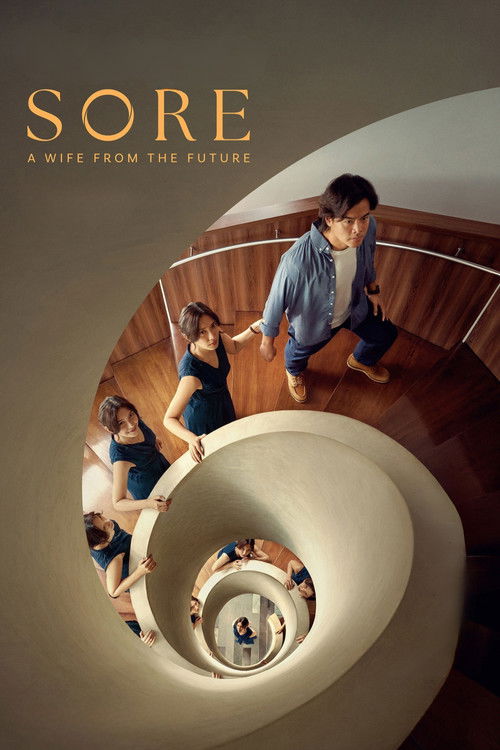
Sore: A Wife from the Future
2025 · Yandy Laurens
For a soft, contemplative night when you want to fall in love and ache a little — the kind of film for anyone who's ever wished they could be looked after. Comfort viewing with a bruise in it.
What it's about
Jonathan is an Indonesian photographer living alone in Croatia, quietly running himself into the ground — cigarettes, drink, bad sleep, no one to answer to. One morning a woman named Sore appears claiming to be his wife from the future, sent back to fix his habits before they kill him young. What starts as an absurd domestic invasion becomes a love story about whether someone can save you, and what it costs them to try.
The experience
Gentle, melancholy, and quietly devastating — a romance that uses its time-travel hook not for puzzles but for feeling. It's unhurried and warm, then it sneaks up on you; expect to be misty-eyed by the end.
The craft
Yandy Laurens expanded his own beloved web series into a feature, and the care shows: the writing treats a fantastical premise with complete emotional sincerity. The coastal Croatian setting gives it a lonely, out-of-time beauty that suits a story about a man adrift.
Why it matters
A remarkable underdog story — born as branded web content, reborn as an acclaimed feature and an Academy Awards submission — and a signal of Indonesian romance cinema's growing ambition.
Snapshot
Sore: A Wife from the Future (Indonesian: Sore: Istri dari Masa Depan) is a 2025 Indonesian romantic science-fantasy feature written and directed by Yandy Laurens, expanded from the 2017 branded web series of the same name that Laurens also created. A photographer named Jonathan, living alone in Croatia, wakes one morning to find a woman, Sore, who claims to be his wife traveling back from the future to save his life: his self-destructive habits — smoking, drinking, poor sleep, no exercise — will otherwise kill him young. The premise's origin as advertising content for a diabetes-friendly sweetener brand is the film's foundational curiosity, and its passage from a corporate YouTube commission into an Academy Awards submission is the throughline of its story. Released theatrically in Indonesia on 10 July 2025 and running 119 minutes, it passed one million admissions within nine days, earned eight nominations at the Indonesian Film Festival (winning Best Director, Best Actress, Best Editing and Best Theme Song), premiered internationally in the Limelight strand at the International Film Festival Rotterdam, and was selected as Indonesia's entry for Best International Feature Film at the 98th Academy Awards, though it was not shortlisted.
Industry & production
The film sits at the intersection of two industrial phenomena: the rise of Indonesian branded content as a legitimate creative form, and the maturation of Indonesia's mainstream film industry into internationally ambitious co-productions. The 2017 web series was produced by Inhype Pictures for Tropicana Slim and released on the brand's YouTube channel — content-marketing that acquired a genuine cult following and, unusually, a lasting reputation. The 2025 feature reconstitutes that IP at feature scale, backed by a consortium of production houses including Cerita Films, Imajinari Productions (Ernest Prakasa's outfit), Miles Films (Mira Lesmana's storied company, a pillar of the post-Petualangan Sherlockan/Ada Apa dengan Cinta? revival of Indonesian cinema), Slingshot Pictures, Studio Artemis and others, with Suryana Paramita credited as producer and a large executive-producer roster. The involvement of Lesmana and Prakasa signals the project's positioning: prestige-adjacent commercial cinema rather than genre exploitation.
Its most quantifiable industrial claim is geographic. Trade and festival coverage describes it as the first Indonesian feature shot in Croatia, with principal photography running roughly September–October 2024 in Zagreb and the Istrian hill town of Grožnjan, supplemented by Jakarta and Finland. Where the original series was filmed in Italy (Petritoli and Ponza), the feature relocates the fable to Croatia — a production choice that at once distinguishes the remake and provides its distinct visual identity. Precise budget figures are not publicly reported, and I will not estimate them.
Technology
Detailed technical specifications — camera systems, lenses, capture format, aspect ratio — are not reliably documented in accessible sources, and I will not invent them. What can be said with confidence is that the film represents a step up in production apparatus from its web-series predecessor: reviewers note "technical upgrades and a more polished artistic touch," consistent with a move from lightweight branded-content production to full theatrical infrastructure with international location logistics. The film is trilingual (Indonesian, Croatian, English), which imposes practical technological demands on sound recording and subtitling workflows across a mixed Indonesian-Croatian crew and cast. Distribution followed a conventional-then-digital path typical of contemporary Indonesian releases: a theatrical window from July 2025, followed by availability through the Letterboxd Video Store from December 2025 — the latter a notable, still-emergent distribution channel that speaks to the film's cultivated cinephile audience abroad.
Technique
Cinematography
Dimas Bagus Triatma (Yoga) photographs the film, and cinematography is broadly regarded as its strongest asset. Critics single out the Croatian settings — the stone lanes of Grožnjan, Zagreb's streets and cafés, Jonathan's apartment as the story's gravitational center — for a polished, painterly handsomeness. That praise, however, is double-edged in the critical record: the Asian Movie Pulse review argues that the "captivating imagery does not always find equal weight with the substance," a recurring verdict that style slightly outweighs the screenplay's stakes. The visual grammar leans introspective and observational, in keeping with Laurens's established preference for unhurried, character-close framing.
Editing
Hendra Adhi Susanto's editing won Best Editing at the Indonesian Film Festival, the film's most concrete craft honor. The material poses a genuine structural challenge: the narrative runs on time loops that progressively shorten, so the cutting must render repetition legible without becoming monotonous — establishing the rules of the loop, then compressing and varying each iteration. That the editing was singled out for the award while some reviewers found the film's dramatic register "repetitive" suggests the loop structure was the central editorial problem, solved well enough to be honored even where the writing strained.
Mise-en-scène / staging
The staging is chamber-scaled and domestic, organized around Jonathan's apartment and a handful of Croatian exteriors. The production design's key expressive burden is the fish-out-of-water intimacy of an Indonesian man and his purported future wife inhabiting a European small-town space — the film uses locale as both romance backdrop and quiet estrangement device. Detailed accounts of production and costume design are thin in available sources, and I will not embellish them.
Sound
The score and song selection are, per the critical record, the film's most contested element. Composer Ofel Obaja Setiawan provides the music, and the film's theme song won Best Theme Song at the Indonesian Film Festival — a marker of how central songcraft is to its emotional design. Yet the same song-forward approach drew criticism: reviewers describe "back-to-back songs that, at times, might feel overly dominant and distracting" rather than subtle underscore. The film thus embodies a familiar tension in emotionally-driven Indonesian popular cinema, where a strong pop-ballad soundtrack is both a commercial asset and a subtlety risk.
Performance
Dion Wiyoko reprises Jonathan from the web series eight years on — a rare continuity of performer across a work's own remake — and is praised for capturing the character's "clumsiness, stubbornness, and idealism." Sheila Dara Aisha inherits the role of Sore from Tika Bravani and won Best Actress at both the Indonesian Film Festival and Festival Film Wartawan Indonesia; critics credit her with bringing "charm" and mystery to a role whose whole affect depends on unexplained foreknowledge. The Croatian supporting cast — Goran Bogdan (an actor of international standing) as Karlo, alongside Livio Badurina and Lara Nekić — lends the setting authenticity, while veteran Mathias Muchus anchors the film's emotional key as Jonathan's father, Seno, the relationship on which the resolution turns.
Narrative & dramatic mode
The film operates in the mode of the therapeutic time-loop fable. Its science-fiction apparatus (a wife sent back through time, cycles that shorten with each pass) is deployed not for spectacle or paradox-puzzle but as a machine for interior excavation. The surface mission — correct bad habits — is a decoy; the loops keep failing until Sore uncovers the real cause of Jonathan's self-destruction: unresolved resentment toward his father. The dramatic movement is therefore from behavioral symptom to emotional root, a structure closer to grief-drama than to genre SF. The much-noted weakness of this design is that the ostensible stakes read as "surprisingly trivial" for a time-travel premise — the genre's usual urgency is traded for a register of quiet self-improvement. The ending pivots to melodrama's most durable figure, the memory-restoring touch: years later, a transformed Jonathan meets a present-day Sore at his photography exhibition, and contact returns her memory — closing the loop as romance rather than paradox.
Genre & cycle
Sore belongs to the international cycle of romantic time-loop and time-travel weepies — a lineage that runs through The Time Traveler's Wife, About Time, and the Korean-drama tradition of destiny-romance, and that in the loop's structural sense converses with Groundhog Day and Palm Springs. Within Indonesian cinema it aligns with the emotionally literate, urban, middle-class romance-drama that Miles Films and its peers have cultivated since the early 2000s. Its most distinctive generic feature, though, is lineage-specific: it is a rare case of a branded-content web series graduating into a canon-seeking feature, and it carries the "wellness fable" DNA of its Tropicana Slim origins into a form that tries to sublimate the health message into genuine drama about mortality and reconciliation.
Authorship & method
Yandy Laurens is the film's authorial center as both writer and director, and Sore is best read within his body of work rather than as a standalone. Laurens built his reputation on emotionally precise, humane, dialogue-driven films — the beloved family drama Keluarga Cemara (2018) and the metafictional romance Jatuh Cinta Seperti di Film-Film (2023), the latter a critical high point notable for its self-aware craft. He is a filmmaker of interiority and restraint whose method favors small ensembles, patient scenes, and feeling over plot mechanics; Sore extends that sensibility onto a larger, international canvas while returning to the very property that launched him in 2017. The continuity of collaborators and cast (Dion Wiyoko above all) makes the feature something like an authorial act of return and revision — a director reworking his own apprentice text with a matured toolkit. His key collaborators here are cinematographer Dimas Bagus Triatma, editor Hendra Adhi Susanto (award-winning), and composer Ofel Obaja Setiawan; biographical detail on these collaborators beyond their credits is limited in accessible sources, and I will not fabricate it.
Movement / national cinema
The film is a product of the mature phase of Indonesia's post-Reformasi film revival — the movement, associated with figures like Mira Lesmana and Riri Riza, that rebuilt a national cinema after the industry's 1990s collapse. Its ambitions are outward-facing: a Croatian shoot, a Rotterdam premiere, a Jogja-NETPAC Asian Film Festival prize, and an Oscar submission all mark it as part of Indonesia's ongoing effort to place its commercial-prestige cinema on the international festival and awards circuit. It also exemplifies a specifically Indonesian development — the porousness between advertising, YouTube web series, and theatrical film — that has become a distinctive feature of the country's media ecology.
Era / period
Made in 2024 and released in 2025, the film is a mid-2020s work shaped by the streaming-and-social era of film consumption: an IP born on YouTube, revived for cinemas, and delivered to global cinephiles via a Letterboxd storefront. Its wellness preoccupation — mortality as the price of modern bad habits — reads as a very contemporary anxiety, and its structure of self-optimization-through-repetition resonates with the loop-narrative vogue of the late 2010s and 2020s. It arrives at a moment when Indonesian cinema is both commercially robust domestically (million-plus admissions in nine days) and increasingly oriented toward international legitimation.
Themes
The film's governing theme is mortality as a function of how one chooses to live — the idea that self-neglect is a slow form of self-harm, and that love intervenes not by grand rescue but by tending to habits. Beneath the wellness surface lies its truer subject: inherited emotional wounds, specifically a son's unresolved resentment toward his father, and the way such wounds metastasize into self-destruction. Adjacent themes include fate versus agency (can a life be rewritten?), the ethics and grief of foreknowledge, memory as the substrate of love, and displacement — an Indonesian man abroad, tended by a figure from a future he cannot see. The residue of its branded-content origin gives it an earnest, almost didactic optimism about self-improvement, which is both its sincerity and, for some critics, its limitation.
Reception, canon & influence
Critical reception was broadly positive, with the consensus figure being "a heartfelt work whose style slightly outweighs its substance" — praise for its images, performances, and emotional sincerity, tempered by reservations about repetitive pacing, an over-dominant song score, and stakes that feel modest for a time-travel premise. Institutional endorsement was strong: eight Indonesian Film Festival nominations including Best Picture, with wins for Director, Actress, Editing and Theme Song, further prizes at Festival Film Bandung, Festival Film Wartawan Indonesia and Jogja-NETPAC, a Rotterdam Limelight berth, and selection as Indonesia's Academy Award submission (not nominated). Commercially it was a clear success, crossing one million admissions within nine days.
Looking backward, the film's influences are its own 2017 web series, Yandy Laurens's prior features, and the international time-loop romance tradition; its wellness spine is inherited directly from its advertising origins. Looking forward, its legacy is best understood in two registers. Industrially, it is a landmark case — the first Indonesian feature shot in Croatia and a proof-of-concept that YouTube branded content can be elevated into an awards-caliber, internationally circulated feature, a template likely to encourage similar IP conversions. Culturally, it consolidates Yandy Laurens's standing as a leading voice of contemporary Indonesian romantic drama. Because the film is recent (2025), its longer-term influence on subsequent filmmakers remains genuinely unsettled, and any confident claim about a lasting stylistic legacy would be premature.
Sources: Wikipedia — Sore: A Wife from the Future; Wikipedia (id) — Sore: Istri dari Masa Depan (web series)); Asian Movie Pulse review; TheWrap; IMDb.
A Deleuzian reading
A man wakes up alone in an apartment in a Croatian hill town, and there is a woman in it who says she is his wife.
The full Deleuzian reading of Sore: A Wife from the Future →
Reception
Opened in Indonesia in July 2025 as a local event film, then spent the rest of the year climbing Letterboxd's global charts — within months it had cracked the platform's highest-rated films and topped its best-of-2025 sci-fi and romance lists, ahead of Hollywood tentpoles with a hundred times its budget.
How Sore: A Wife from the Future was received, from release to now →
How to watch Sore: A Wife from the Future: what to notice on a first viewing
- Watch the loop reset and notice it's gotten shorter. Each time Jonathan wakes up, the cycle Sore is running has compressed a little further, the editing establishing the rules and then taking passes away. The shortening loop is a rhythm problem the film solves through the cut, not through the writing.
- Watch how much of the film happens inside one apartment. Almost the entire story is staged inside Jonathan's flat in a Croatian hill town, the single set carrying the weight of two different timeframes at once. Everything the film knows about time it says by holding two tenses inside one set of walls.
- Listen for the songs arriving back to back. The theme song and a run of pop ballads carry most of the emotional weight, with the score used more like continuous narration than subtle underscore. The music is doing so much telling that it sometimes crowds out the silence the scene actually needs.
- Watch Sore's charm alongside her total, unexplained foreknowledge. Sheila Dara Aisha plays Sore with a mystery underneath the warmth, a woman who already knows Jonathan completely without ever explaining how. The whole affect of the role depends on you never quite being sure what she knows.
The whole guide to watching Sore: A Wife from the Future, with the keys for a rewatch →
Influences: the films it descends from and the films it influenced
- Sore: Istri dari Masa Depan (2017) — The web series is the literal source text Laurens reworks here, carrying over Dion Wiyoko's role and the future-wife-visits-present-husband premise, so the feature is a matured revision of its own apprentice staging.
- Keluarga Cemara (2018) — Establishes Laurens's method of patient chamber-domestic scenes and an inherited father-wound played through restraint rather than incident, the emotional grammar Sore inherits wholesale.
- Jatuh Cinta Seperti di Film-Film (2023) — Perfects Laurens's dialogue-driven, self-aware romantic craft where feeling outranks plot mechanics — the toolkit Sore applies to a time-loop conceit.
- About Time (2013) — Domesticates time travel into a device for reconciliation and a father's farewell, deliberately shrinking sci-fi stakes to the scale of ordinary marriage — the exact wager Sore makes with its modest stakes.
- Groundhog Day (1993) — Codifies the loop-as-moral-therapy structure in which repetition compresses toward self-correction, the template beneath Sore's 'therapeutic fable' and loop-compression editing.
- The Time Traveler's Wife (2009) — Builds a marriage narrated out of chronological order around a spouse who keeps arriving from another point in time, the structural blueprint for Sore's wife-from-the-future conceit.
- Il Mare (2000) — Pairs a cross-time romance with painterly, becalmed location photography and two-hander chamber melancholy, prefiguring Sore's painterly-location cinematography and small-ensemble intimacy.
- La Jetée (1962) — Founds the tradition of a time-crossed love bounded by mortality and told through arrested, image-forward composition rather than mechanism — the austere root of Sore's mortality theme.
- Your Name (2016) — Uses a memory-restoring body/time crossing whose emotional peaks are cued by a pop-song-forward score, the same fusion of memory-restoring touch and dominant song score Sore deploys.
- Eternal Sunshine of the Spotless Mind (2004) — Reconstructs a relationship through the loss and recovery of memory, dramatizing love as something re-accessed by touch and recollection — the mechanic Sore's memory-restoring-touch echoes.
- Palm Springs (2020) — Builds a romance entirely inside the loop and resolves it as an arc of acceptance and self-repair, sharing Sore's wellness-fable use of repetition as couples therapy.
- Call Me by Your Name (2017) — Stages intimacy in sun-warmed, painterly European locations where restraint and atmosphere carry the drama over plot, the tonal and photographic register Sore's Croatia shoot pursues.
- Once (2007) — Makes a song-forward score the narrative engine, letting numbers do the emotional storytelling — the very technique critics flagged as over-dominant in Sore.
- Truly, Madly, Deeply (1990) — Frames a grief-and-mortality romance as therapeutic fable in a confined domestic space, where a returned partner exists to heal the living — Sore's chamber-domestic, self-neglect emotional design.
- The Lake House (2006) — Sustains an epistolary romance between lovers separated across time, privileging longing and quiet two-person exchange over time-travel logic, as Sore does with its future spouse.
Similar films
- Falling in Love Like in Movies (2023) — influence & lineage · same viewing thread
- Lost in Starlight (2025) — same viewing thread
- The Love That Remains (2025) — same viewing thread
- Even If This Love Disappears Tonight (2025) — shared sensibility
- Love Untangled (2025) — shared sensibility
- Joni's Promise (2005) — shared sensibility
- Cactus Pears (2025) — shared sensibility
- Past Lives (2023) — shared sensibility
All the films related to Sore: A Wife from the Future →
Watch it with: curated runs of related films
- Love Among the Lonely — Watch these when you want love written for grown-ups — drifting, grieving, self-destructing people who find or keep each other with no fanfare — and want to feel a deadpan Helsinki karaoke bar and a warm Jakarta romance answer each other.