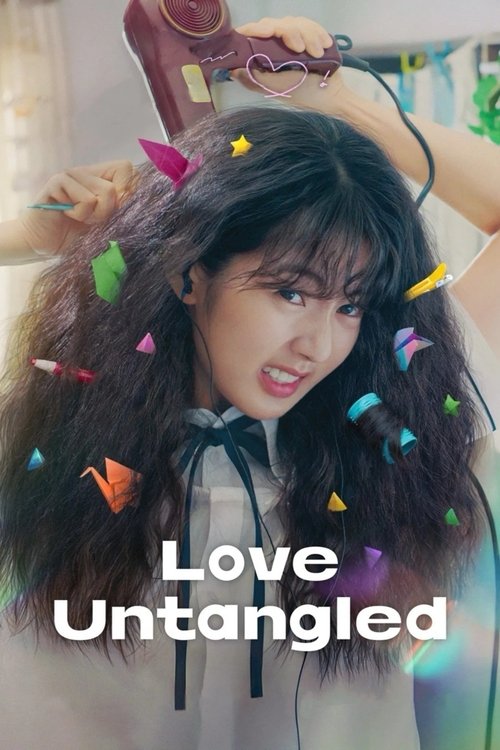
Love Untangled
2025 · Namkoong Sun
For a cozy night in when you want to fall in love a little — pure comfort, zero stress. The right pick when you're craving first-crush butterflies and a soft landing.
What it's about
Busan, 1998. Nineteen-year-old Se-ri has spent her whole life at war with her fiercely curly hair, and she has a plan: straighten it, then confess to the school heartthrob. The arrival of a transfer student from Seoul — whose mother happens to run a hair salon — turns her scheme into something she didn't plan for: an actual first love, messier and better than the one she scripted.
The experience
Warm, breezy, and openly nostalgic, with the pastel glow of late-90s Korea — cassette tapes, school uniforms, seaside light. It's funny in a gentle way and sincere without being sappy, and it moves at the unhurried pace of a long summer.
The craft
Director Namkoong Sun leans into period texture — the 1998 port-city setting is lovingly dressed, and the curly-hair conceit is more than a gag, giving the romance a real theme about accepting the self you keep trying to fix. It's a handsome, sunlit production made for easy home viewing.
Why it matters
One of Netflix's more visible Korean originals of 2025, it carried the beloved Korean first-love nostalgia genre to a global streaming audience.
Snapshot
Love Untangled is a South Korean coming-of-age romantic comedy directed by Namkoong Sun, released by Netflix on 29 August 2025 with a running time of roughly 119 minutes. Set in the port city of Busan in 1998, it follows nineteen-year-old high-schooler Park Se-ri (Shin Eun-soo), whose lifelong self-consciousness about her fiercely curly hair hardens into a plan: straighten the curls, then confess to the school heartthrob, Kim Hyeon (Cha Woo-min). The arrival of a Seoul transfer student, Han Yoon-seok (Gong Myung) — whose mother runs a hair salon offering the era's newest straightening treatments — turns a scheme about access into a genuine first romance. The film sits squarely inside the Korean "first-love nostalgia" tradition while reframing it for the streaming era, and it became one of Netflix's more visible 2025 Korean features, charting in the service's non-English top tier across dozens of territories. Its ambitions are modest and legible: a warm, period-precise crowd-pleaser about the teenage agony of things you cannot control, with the frizzy hair standing in for adolescence itself.
Industry & production
Love Untangled is a Netflix original produced by Bombaram Film, with Lee Kang-jin credited as producer. It belongs to a specific 2025 industry moment: as South Korea's theatrical market continued to contract in the post-pandemic years and multiplex attendance stagnated, Netflix accelerated its investment in locally produced feature films, of which Love Untangled was one of several released that year. The film thus exemplifies a structural shift — mid-budget Korean genre pictures (romance, comedy, coming-of-age) that a decade earlier would have opened theatrically now premiering direct-to-streaming, financed and distributed by a single global platform and optimized for algorithmic discovery rather than a box-office window.
Principal photography took place in and around Busan beginning in September 2024 and running into December of that year, according to press reporting. Casting paired an established leading man with a rising ingénue: Gong Myung, born in 1990 and playing well below his age, and Shin Eun-soo (born 2002), for whom the film functioned as a significant showcase. The production leaned on Busan's coastal geography for its period texture. Notably, the film features special appearances by Gong Yoo, Jung Yu-mi, and Park Jeong-min — a trio of A-list names whose brief presence signals both the production's connections and Netflix's marketing calculus, drawing established-star recognition into a youth-cast picture. The exact nature and length of those cameos is not something the verifiable record details clearly, and I won't overstate them.
Technology
The film's most conspicuous technological dimension is diegetic and thematic rather than a matter of the filmmaking apparatus. Love Untangled is built around period technology as nostalgia object: cassette tapes, bulky camcorders, 35mm still cameras, pagers (beepers), and the comic books of the late 1990s recur as props and plot devices, and the salon's chemical hair-straightening treatment is itself figured as a coveted modern technology promising self-transformation. This is a common strategy in Korean period-nostalgia cinema, where obsolete consumer electronics carry the emotional weight of a vanished analog adolescence.
On the production side, the film was shot and finished to contemporary digital standards for a Netflix feature; the verifiable public record does not specify the capture format, cameras, or color pipeline used by cinematographer Kim Il-hyun, and I will not invent those details. What can be said is that the film's look — discussed below — reflects a deliberate, contemporary digital grade engineered to read as warm, soft, and "vintage" rather than any in-camera period process.
Technique
Cinematography
Photographed by Kim Il-hyun, Love Untangled pursues a soft, warm, faintly dreamlike register consistent with the nostalgia genre. Reviewers singled out its use of warm color and its treatment of Busan's coastal cityscape, with seaside and city backdrops shot to evoke a summery, memory-tinted 1998. The palette functions expressively: warmth and diffusion signal recollection, aligning the image with Se-ri's retrospective, wistful point of view. This is idiomatic for the Korean first-love film, which typically favors golden, slightly hazy light over the crisp naturalism of contemporary-set dramas. Beyond these broadly reported qualities, the finer grammar of the film's shot design — lens choices, camera movement, coverage strategy — is not richly documented in the accessible critical record, so I describe the look in the terms the reception actually supports rather than reconstructing a shot list.
Editing
Cut by Lee Kang-hee, the film runs about 119 minutes and moves at the brisk, episodic clip typical of the teen romantic comedy: a setup of the "straighten-and-confess" scheme, a middle built from escalating salon-access comedy and deepening friendship, and a tonal turn toward drama as Yoon-seok's family circumstances intrude. Several reviews note that the film's rhythm is at its liveliest in its comic and ensemble passages and that the later-act shift toward heavier material (domestic violence in Yoon-seok's home, his relocation to Seoul) and a time-skip reconciliation is the more conventional, less surefooted stretch — a structural observation about pacing more than a claim about specific cuts.
Mise-en-scène / staging
Production and costume design do much of the film's heavy lifting. The 1998 world is assembled from period-specific detail: oversized school uniforms, retro hairstyles, and the era's consumer bric-a-brac, staged so that setting reads as character. The hair salon operates as the film's central space — part comic engine, part sanctuary — organizing much of the staging around grooming, mirrors, and transformation, which literalizes the movie's theme of remaking oneself for love. Se-ri's curls are themselves a mise-en-scène element, a visual signature that the film's blocking and framing repeatedly foreground.
Sound
The score is credited to Kim Tae-seong, and reviewers praised the film's music and "retro touches" as integral to its nostalgic package. The soundtrack draws on the sound-world of the late 1990s, the moment the film's director has described as coinciding with the emergence of first-generation K-pop. Period-appropriate needle-drops and a warm score reinforce the memory-piece atmosphere. The specific song licenses and cues are not comprehensively documented in the sources available to me, so I note the strategy rather than cataloging the playlist.
Performance
Performance is where the film draws its most consistent praise. Shin Eun-soo's Se-ri anchors the picture through what critics described as endearing quirks and physical, almost slapstick expressiveness — a comic-physical lead turn in the tradition of the plucky Korean rom-com heroine. Shin reportedly prepared with Busan-dialect coaching, and her performance was widely cited as the film's chief asset. Gong Myung, considerably older than his character, plays the transfer student with an easy warmth; the age gap between actor and role was acknowledged good-humoredly in press coverage and did not appear to trouble the film's reception. The supporting ensemble (including Cha Woo-min as the crush, plus Yoon Sang-hyeon and Kang Mi-na) fills out a friend-group dynamic that several reviewers found more charming than the central romance itself.
Narrative & dramatic mode
The film operates in the retrospective coming-of-age mode: a first-person-inflected memory piece in which an adolescent's small, all-consuming crisis (the hair, the confession) is treated with total seriousness from inside and gentle irony from without. The dramatic engine is a familiar romantic-comedy misdirection — the heroine pursues one boy while the audience recognizes her true connection with another — layered over a self-acceptance arc in which the external makeover (straight hair) is ultimately revealed as the wrong solution to an internal problem. The director has framed the hair explicitly as metaphor: "that teenage torture over stuff you can't control." The late introduction of genuine hardship (family violence, separation) and a years-later reunion via an arranged blind date pushes the film from pure comedy toward bittersweet romance, a tonal widening that the genre routinely attempts and that this film executes to mixed critical effect.
Genre & cycle
Love Untangled belongs to the Korean youth-romance and "first-love nostalgia" cycle, a durable strain of Korean popular cinema and television that mines the 1980s and 1990s for stories of adolescent longing. Its clearest lineage runs through the nostalgia-romance boom crystallized by films such as Architecture 101 (2012) and Sunny (2011) and the enormously popular Reply television series (notably Reply 1988), all of which fused period reconstruction with the ache of remembered first love. Within that cycle, Love Untangled is a lighter, comedy-forward entry, closer to the sweet high-school romance than to the melancholy adult-retrospective drama. It also participates in a distinct emerging cycle: the Netflix-produced Korean romance feature, a category the platform has been actively cultivating as a reliable, exportable comfort-genre. The premise's makeover-for-love conceit further connects it to a global teen-comedy tradition, though its execution is thoroughly Korean in idiom.
Authorship & method
Love Untangled is directed by Namkoong Sun, who has spoken about a personal connection to the material: she was herself a high-schooler in 1998 and sought to capture what she called the "weird optimism of the era." Press reporting frames the film as a notable pivot for her — from independent, festival-oriented work (the Korea Herald cites an earlier indie drama and festival recognition at Jeonju) toward commercial streaming entertainment. I flag that biographical detail as reported rather than independently confirmed; her full filmography is not deeply documented in the sources I can verify, and I won't embellish it.
Her key collaborators: the screenplay is credited to Ji Chun-hee and Wang Doo-ri, cinematography to Kim Il-hyun, the score to Kim Tae-seong, and editing to Lee Kang-hee, with Lee Kang-jin producing for Bombaram Film. The most legible authorial signature across the finished film is the marriage of period-precise design and a warm, empathetic comic tone centered on a physically expressive young heroine — a sensibility that reads as director-and-designer led as much as writer-led. Given the film's recency and its streaming-release context, sustained auteurist criticism of Namkoong Sun's method is not yet available, and this account treats her authorship as emergent rather than established.
Movement / national cinema
The film is a product of the contemporary South Korean film industry at a transitional moment, and it should be read against the broader Korean Wave (Hallyu) — the sustained international ascent of Korean film and television. It is not part of any avant-garde or aesthetic movement; rather, it represents mainstream commercial Korean cinema migrating onto a global streaming platform. Its national-cinema specificity is strong nonetheless: the Busan setting and dialect, the salon-culture texture, the first-generation K-pop backdrop, and the school-uniform iconography root it firmly in a Korean vernacular of memory. It exemplifies how Korean popular genre filmmaking, having achieved global distribution, now produces mid-budget romances for worldwide audiences while retaining local cultural detail as both texture and selling point.
Era / period
Two time frames matter. The film's setting is 1998 — a pointed choice. In South Korea, 1998 sits in the immediate aftermath of the 1997 Asian financial crisis (the "IMF crisis") and at the dawn of first-generation K-pop and a modernizing consumer youth culture; the director's "weird optimism" invokes exactly this hinge between hardship and hope. The film largely brackets the era's economic trauma in favor of its pop-cultural surfaces, using 1998 as an affectionate memory-scape rather than a site of historical reckoning. The film's production era is the mid-2020s streaming landscape, in which theatrical contraction and platform commissioning reshaped what kinds of Korean films get made and how audiences meet them. Love Untangled is legible as an artifact of both moments: a 1998 remembered from, and packaged for, 2025.
Themes
The governing theme is self-acceptance: the recognition that the curls Se-ri wants to erase are not a flaw to be corrected but a part of herself to be embraced, and that the makeover-for-love premise contains its own refutation. Braided through this are the classic coming-of-age concerns — first love, the gap between the person one pines for and the person one is right for, and the intensity of adolescent feeling over "stuff you can't control." Nostalgia operates as both theme and mode: the film is about memory as much as it is a memory. Secondary strands include friendship and belonging (the friend group that several critics found the film's warmest register) and, in the later acts, family and vulnerability, as Yoon-seok's domestic situation introduces a note of real precarity beneath the comedy. The hair itself is the film's master metaphor, linking the personal (insecurity, control) to the social (conformity, the desire to be seen).
Reception, canon & influence
Love Untangled was a commercial success on its platform, reportedly reaching the top of Netflix's non-English film rankings and charting in the service's weekly Top 10 across many territories for several weeks after its August 2025 release — evidence of the exportability of the Korean comfort-romance. Critical reception was warm but measured. Reviewers consistently praised Shin Eun-soo's lead performance, the cinematography and music, and the affectionate period design, while a recurring criticism held the story to be sweet but ultimately generic, with the darker late-act turn and reconciliation feeling more formulaic than the buoyant comedy that precedes it. Awards recognition exists in the reporting but is thin and, in the sources available to me, not cleanly verifiable, so I decline to assert specific wins.
Influences on the film (backward): it draws directly on the Korean first-love nostalgia cycle — Sunny, Architecture 101, and the Reply television franchise — for its template of period reconstruction plus adolescent romance, and on the broader tradition of the makeover romantic comedy for its central conceit. The director's own 1998 adolescence is, by her account, a primary source.
Its legacy (forward): as a very recent release, Love Untangled has no established downstream influence yet, and it would be premature — and against the evidentiary discipline this dossier observes — to claim one. Its likeliest significance is twofold: as a further proof-of-concept for Netflix's Korean-romance strategy, reinforcing the platform's appetite for exportable youth romances, and as a career-elevating showcase for Shin Eun-soo. Whether it earns a durable place in the canon of Korean coming-of-age cinema or is remembered as a pleasant, well-made entry in a crowded cycle is a judgment the passage of time has not yet made.
Reception
Dropped quietly onto Netflix in late August 2025, it out-performed its modest reviews — debuting at No. 3 on the global non-English film chart and climbing to No. 1 with 8.2 million views in its second week, charting in the top 10 across 61 countries. Critics called it overlong and familiar; audiences called it a comfort watch and kept pressing play anyway.
How Love Untangled was received, from release to now →
How to watch Love Untangled: what to notice on a first viewing
- Notice the warm, hazy light over every Busan scene. Kim Il-hyun photographs the coastal city in a soft, dreamlike register, warmth and diffusion signaling this is memory rather than present-tense reality. The glow tells you before anything else that you are watching someone's remembered summer, not a documentary of it.
- Watch how many scenes happen inside the hair salon. The salon, full of mirrors and grooming, becomes both comic engine and sanctuary, organizing the staging around the idea of remaking yourself. The setting literally stages the film's whole premise: change what's on the outside to try to fix what's inside.
- Watch how physically Shin Eun-soo plays Se-ri's every reaction. Shin leans into slapstick expressiveness and Busan-dialect rhythm rather than understatement, giving the character's embarrassment and hope a full-body comic register. You read her feelings in her whole body before she ever has to say a word.
- Listen for the late-1990s needle-drops threaded through every scene. Period-appropriate songs and a warm score root the film specifically in 1998, the moment just before first-generation K-pop, rather than a generic past. The music dates the memory precisely instead of leaving it in a vague, nostalgic haze.
The whole guide to watching Love Untangled, with the keys for a rewatch →
Influences: the films it descends from and the films it influenced
- Architecture 101 (2012) — Supplies the retrospective first-love memory-piece structure that intercuts a regretful present with a warm-diffused campus past — the named template Love Untangled borrows for its nostalgia framing.
- Sunny (2011) — Establishes the Korean model of reconstructing one specific year through wall-to-wall era pop needle-drops used as an emotional index rather than mere background.
- Reply 1988 (2015) — Sets the obsessive-detail period production design standard — props, set dressing, and domestic texture of a single neighborhood/year — that the film's 1998 reconstruction imitates.
- 200 Pounds Beauty (2006) — Yokes the makeover conceit to a self-acceptance arc carried entirely by a physically expressive comic actress, the exact tonal-structural combination the salon plot reuses.
- My Sassy Girl (2001) — Codifies the Korean romcom's slapstick-capable, physically broad female lead who drives the comic misdirection instead of playing the passive love interest.
- The Classic (2003) — Pioneers the nested device in which a present-day narrator reconstructs a past first love in golden, warm-diffused flashback — the film's cinematographic register for memory.
- American Graffiti (1973) — Originates the period-youth reconstruction scored wall-to-wall by diegetic-radio era pop, plus coastal cruising imagery — the ur-text for the retro needle-drop nostalgia mode.
- Dazed and Confused (1993) — Refines the period-precise ensemble youth reconstruction where costuming, slang, and a curated era soundtrack do the world-building work with a plotless, buoyant tone.
- Grease (1978) — Fuses the makeover-as-climax romance to retro pop in a stylized bygone-youth era, the direct genre ancestor of the salon transformation set to needle-drops.
- She's All That (1999) — Distills the ugly-duckling makeover reveal into a discrete romcom beat — the descent-of-the-stairs transformation — that the hair-salon conceit structurally reproduces.
- Clueless (1995) — Filters the makeover comedy through style-saturated production design and a comic heroine's guiding voice, modeling how design can carry a romcom's authorial signature.
- Steel Magnolias (1989) — Establishes the hair salon as a warm communal women's space where the staging concentrates gossip, confession, and comedy around the styling chair.
- You Are the Apple of My Eye (2011) — Shares the retrospective first-love memory piece narrated from adult regret over a late-90s adolescence, the same East Asian nostalgia-cycle framing.
- Our Times (2015) — Runs the same mid/late-90s first-love nostalgia with retro needle-drops and an ordinary-girl heroine, a parallel regional entry in the same youth-romance cycle.
- Tune in for Love (2019) — Structures a Korean period romance around era radio and pop cues as connective tissue across the late-90s, the same music-as-memory device deployed in warm diffusion.
- 20th Century Girl (2022) — Its nearest contemporary: a Netflix Korean retrospective first-love piece set in 1999 built on period props and warm-diffused adolescence, extending the identical platform-nostalgia craft.
Similar films
- 20th Century Girl (2022) — influence & lineage
- Sunny (2011) — influence & lineage
- Girls Like Girls (2026) — same viewing thread
- Love in the Big City (2024) — same viewing thread
- 18x2 Beyond Youthful Days (2024) — same viewing thread
- Even If This Love Disappears Tonight (2025) — shared sensibility
- Lost in Starlight (2025) — shared sensibility
- Soulmate (2023) — shared sensibility
All the films related to Love Untangled →
Watch it with: curated runs of related films
- The Long Ache of Growing Up — A run of tender films about first love, self-discovery, and the pull of home — watch them close together and the years, cultures, and heartbreaks start to rhyme.