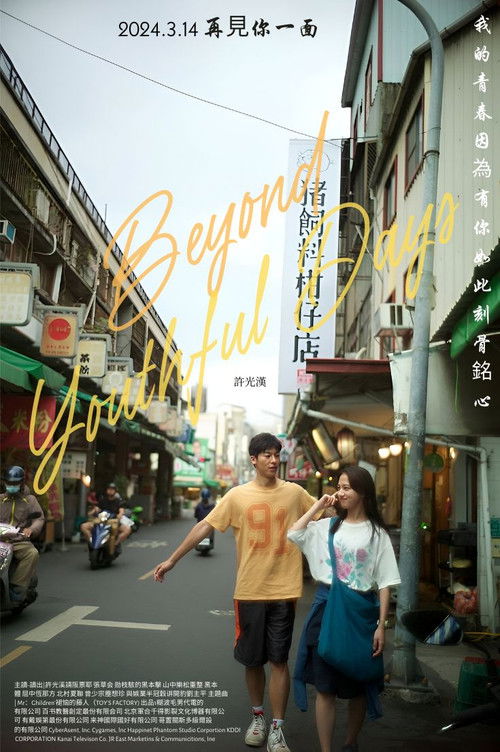
18x2 Beyond Youthful Days
2024 · Michihito Fujii
For when you want a good, cathartic cry about the one that got away, or a slow, scenic travel romance to sink into on a quiet evening. Pure comfort with an ache in it.
What it's about
Jimmy, a 36-year-old Taiwanese game developer who has just lost the company he built, takes a slow solo train trip through Japan, retracing a route tied to Ami, a Japanese backpacker he fell for at eighteen when she drifted into the karaoke parlor where he worked. The film moves between the two timelines — the present-day journey through winter landscapes and the summer when they met — circling a first love that never got its ending.
The experience
Gentle, wistful, and unhurried, like the local trains it rides — it accumulates feeling quietly and then lets it all go at once. Expect a lump in your throat by the final stretch.
Performances
Greg Hsu carries both the bruised 36-year-old and the eager 18-year-old with real charm, and Kaya Kiyohara gives Ami a bright, guarded warmth that makes her linger the way she's meant to.
The craft
Adapted from a real travelogue, the film treats Japan's snow country, small stations, and roadside noodle shops as emotional geography, not postcards; the cross-cutting between timelines is where the storytelling lives. The scenery alone makes a case for the biggest screen you have.
Why it matters
A pan-Asian hit that landed hard with audiences across Taiwan and Japan, it revived the slow-train travel romance for a generation raised on it.
Snapshot
18x2 Beyond Youthful Days is a Taiwan–Japan co-production that threads two timelines around a single, unresolved first love. In the present, Jimmy (Greg Hsu), a thirty-six-year-old Taiwanese video-game developer who has just lost the studio he built, retreats from Tainan to Japan and retraces a route he has carried in memory for eighteen years. In the past, an eighteen-year-old Jimmy meets Ami (Kaya Kiyohara), a Japanese backpacker a few years his senior who drifts into the karaoke parlor where he works. The film is adapted from a 2014 travelogue by Taiwanese game developer Jimmy Lai (writing under the pen name "Blue Fox"), Wandering Journey on Slow Train in Japan, first serialized on the Backpackers travel blog. Its title points to the Seishun 18 Ticket, a real Japanese seasonal rail pass for slow, local-line travel — a fitting emblem for a movie built on deceleration, detour, and the geography of longing. Directed by Michihito Fujii, better known for hard-edged social dramas, the film became one of 2024's notable East Asian commercial hits and earned four nominations at the 61st Golden Horse Awards.
Industry & production
The film is a genuine cross-strait/cross-archipelago co-production, uniting Taiwanese and Japanese financing, cast, and craft. Production is credited to the Taiwanese outfit Jump! Boys alongside Babel Label, the Tokyo company Fujii co-founded and through which most of his features and streaming work have flowed. Japanese theatrical distribution ran through Happinet Phantom Studios; the veteran Taiwanese actor Chang Chen is credited among the producers, a role that positioned the project as a prestige commercial venture rather than an art-house one. The shoot is a travelogue in the literal sense, moving from the warm, sun-worn streets of Tainan in southern Taiwan to the snow country of central and northern Japan — Nagano, Niigata, and the scenic Tadami rail corridor in Fukushima, whose local line is itself a minor pilgrimage destination for rail enthusiasts. That itinerary is not incidental: the film's commercial identity is inseparable from its locations, and it functions partly as an invitation to tourism between the two territories, extending a well-established affection Taiwanese audiences hold for Japan and vice versa.
Commercially the film performed strongly. Per figures reported around its release, it grossed over NT$500 million globally by mid-2024 and stood as the highest-grossing Taiwanese film of the year's first half; in Japan it opened to roughly ¥176 million on its first weekend. Wider pan-Asian tallies have circulated in trade coverage, but I'd treat the most-cited single figures (the NT$500 million-plus global gross and the Japanese opening) as the firmest, and regard rounder regional aggregates as softer.
Technology
The public record on the film's technical package is thin, and I won't invent specifications. What can be said responsibly: like effectively all contemporary Japanese and Taiwanese studio features of its scale, it was finished as a digitally graded work, with a dedicated colorist (Masahiro Ishiyama) and a visual-effects supervisor (Tomi Kuo) credited — the latter almost certainly for invisible, corrective work (season and weather continuity across a long location shoot, period dressing for the 2006 scenes) rather than spectacle. The film's most demanding "technology" is logistical rather than imaging-based: coordinating a two-country shoot across seasons, and staging on and around working local rail lines, where the trains, platforms, and timetables are part of the mise-en-scène. Absent verified camera or lens documentation, claims about format or capture resolution would be speculation.
Technique
Cinematography
Shot by Keisuke Imamura, the film leans on a clean, warm, unshowy naturalism that lets landscape carry emotional weight. Its visual argument is built on contrast: the golden, humid palette of the Tainan sequences against the cold blues and whites of the Japanese snow country. Slow local trains, station platforms, and receding rural roads recur as compositional motifs, framing memory as something literally traveled toward. The cinematography drew specific praise in reviews and was recognized with a Golden Horse nomination — a meaningful marker in a regional context where that award carries real critical authority.
Editing
Cut by Tatsuma Furukawa, the film's structure is fundamentally an editing problem: it braids the present-day journey with the eighteen-years-prior romance, using the adult Jimmy's travel as the associative trigger for flashback. The intercutting is the film's chief dramatic engine, withholding the full shape of what happened between Jimmy and Ami and metering its revelation to arrive as an emotional payoff late in the running time. Critics who found the film "formulaic" were in part responding to the familiar reliability of this two-timeline scaffolding; its defenders credited the same construction with earning its final catharsis.
Mise-en-scène / staging
Two locations anchor the staging. The Taiwanese past centers on a karaoke/KTV workplace — a specific, class-inflected Taiwanese social space — where the young Jimmy's world is small, local, and bounded. The Japanese present unspools across transient non-places: trains, guesthouses, internet cafés, izakaya. The film consistently stages intimacy at a slight, respectful distance, and stages the past as warmer and more saturated than the cooler present, so that period is legible through color and texture as much as through costume or set.
Sound
The score is by Takashi Ohmama, whose music was nominated for Best Original Score at the Golden Horse Awards. The film's most conspicuous sonic gesture is its theme song, "Traveler of Memories" ("Kioku no Tabibito"), performed by Mr. Children — one of Japan's most commercially significant rock acts — which itself earned a Golden Horse nomination for Best Original Song. The choice signals the film's mainstream ambitions and its bid to travel emotionally with a broad Japanese audience. Beyond the songscore, the recurring diegetic soundscape of trains — rhythm, announcement, motion — reinforces the film's identification of memory with transit.
Performance
Greg Hsu (Hsu Kuang-han), the Taiwanese star known regionally from Someday or One Day and Marry My Dead Body, carries the film across two ages, playing both the tentative eighteen-year-old and the depleted thirty-six-year-old man returning to the site of his youth. The role asks him to register disappointment and residual hope simultaneously, and the film rests heavily on his ability to make the older Jimmy's wistfulness read as lived rather than sentimental. Kaya Kiyohara plays Ami as the freer, slightly older traveler whose energy and impermanence define the romance; her performance functions partly as an idealized memory-object and partly as a real person the film gradually complicates. The supporting ensemble is notably strong and cross-national: Joseph Chang as an izakaya owner, Shunsuke Michieda as a young backpacker, and Japanese veterans Haru Kuroki, Hitomi Kuroki (as Ami's mother), and Yutaka Matsushige in roles that stud the present-day journey with brief, grounding encounters.
Narrative & dramatic mode
The dramatic mode is nostalgic melodrama structured as a memory-quest. Its engine is the gap between an idealized past and a diminished present, and its method is the dual timeline, with the present-day road/rail journey motivating each return to 2006. This is a "first love" narrative in the specific East Asian sense — the formative, unconsummated or interrupted romance that organizes a life — crossed with a midlife-reckoning story: the protagonist's professional collapse is what frees and forces him to go looking backward. The film is confessional and interior, privileging mood, coincidence, and delayed revelation over external conflict, and it is willing to risk sentiment in pursuit of catharsis. The travelogue source shows in its episodic, encounter-driven forward movement: the present-day sections advance less by plot than by a series of chance meetings that reflect the journey's emotional theme back at Jimmy.
Genre & cycle
The film sits at the intersection of two recognizable cycles. First, the East Asian first-love nostalgia film, a durable regional commercial genre energized by Taiwanese hits such as Giddens Ko's You Are the Apple of My Eye (2011) and Our Times (2015), which mine youth, school-age or coming-of-age longing, and the ache of the road not taken. Second, the Japanese romance of memory and winter landscape, whose touchstone is Shunji Iwai's Love Letter (1995) — snow country, correspondence, and a love addressed across time and distance. 18x2 explicitly fuses these lineages by making its romance literally cross-cultural (a Taiwanese boy and a Japanese traveler) and by routing its emotional climax through a return to Japanese snow country. One can also situate it in the transnational tradition of the walking-and-talking encounter romance (the Before Sunrise mode), where two strangers' brief shared time is retrospectively magnified into destiny.
Authorship & method
The most interesting authorial fact about 18x2 is that it is a pronounced departure for its director. Michihito Fujii built his reputation on politically and socially charged dramas — The Journalist (2019), which won the Japan Academy Prize's Picture of the Year, its Netflix series adaptation, the yakuza melodrama The Family / Yakuza and the Family (2021), and Village (2023) — work marked by institutional critique and moral darkness. 18x2 redirects that seriousness toward tender, populist romance, and the film's craftsmanship (its patience with silence, its refusal to rush the reveal) reflects a dramatist's sensibility applied to genre material. Fujii adapted the screenplay himself from Lai's travelogue and worked with a mixed Japanese–Taiwanese crew: cinematographer Keisuke Imamura, composer Takashi Ohmama, and editor Tatsuma Furukawa on the technical side, with the Mr. Children theme song as a marquee collaboration. The producing involvement of actor Chang Chen and the backing of Fujii's own Babel Label frame the film as an authored commercial project rather than a work-for-hire — a director of art-house credibility deliberately making a crowd-pleaser without condescension.
Movement / national cinema
The film belongs to the ongoing revival and internationalization of Taiwanese commercial cinema that gathered force after Cape No. 7 (2008), in which Japan-facing subject matter and Japan–Taiwan cultural affinity are recurrent commercial assets. Equally, it belongs to a Japanese moment in which a younger generation of filmmakers — Fujii prominent among them — moves fluidly between theatrical features and streaming platforms and increasingly across national co-productions. 18x2 is thus doubly transnational: in its story (a romance that crosses the strait) and in its production (Taiwanese and Japanese capital, talent, and locations pooled). Its Golden Horse recognition — the premier Chinese-language film award — while distributed theatrically in Japan through a major genre distributor, captures that dual citizenship precisely.
Era / period
Made and released in 2024, the film is a product of the post-pandemic reopening of East Asian travel and the reassertion of the region's mutual tourism and pop-cultural traffic; its very premise — the pleasure and melancholy of crossing between Taiwan and Japan by slow train — reads as timely. Its historical texture, meanwhile, reaches back to roughly 2006 for the flashback romance, an era rendered as analog, pre-smartphone, and slower, in pointed contrast to the burned-out digital-industry present from which the adult Jimmy flees. That contrast — the game developer whose company has collapsed, returning to a hand-drawn, unwired memory — gives the period structure a quiet argument about what has been lost in the intervening years.
Themes
The governing theme is memory as idealization: the film knows that the Ami of Jimmy's recollection is partly a construction, and its journey is as much about testing that image against reality as about recovering it. Adjacent themes include transience and impermanence (the traveler who cannot stay, the seasonal ticket that expires, a sensibility close to mono no aware); the road and the rail line as figures for a life's direction and its detours; midlife failure and reckoning, with professional collapse as the precondition for emotional return; cross-cultural love and the tenderness and limits of communication across language; and the specific melancholy of the road not taken — the way a brief youthful encounter can quietly organize the decades that follow.
Reception, canon & influence
Critical reception was generally positive, with particular praise for the two lead performances and for Imamura's cinematography; the most common reservation, voiced even by sympathetic reviewers, was that the two-timeline first-love structure is familiar to the point of formula. That mixed-but-warm consensus is consistent with the film's institutional recognition: four nominations at the 61st Golden Horse Awards, in Best Adapted Screenplay, Cinematography, Original Score, and Original Song — a craft-weighted profile that matches the film's strengths. Commercially it was a substantial regional success, among the year's leading Taiwanese releases and a solid theatrical performer in Japan. (Contrary to some assumptions, it was not Taiwan's submission for the Academy Award for Best International Feature; Taiwan selected Old Fox for that cycle.)
Looking backward, the film's influences are legible and acknowledged by its very form: the snow-country memory romance of Iwai's Love Letter, the Taiwanese first-love nostalgia cycle of You Are the Apple of My Eye and Our Times, and the encounter-romance tradition of brief, magnified connection. Its source in a real travelogue also ties it to a documentary-of-feeling tradition of first-person travel writing. Looking forward, the film is too recent for a settled legacy, and any claim of decisive influence would be premature. What can be said is that it stands as a conspicuous, successful model for Taiwan–Japan romantic co-production — a template pairing a bankable Taiwanese star, Japanese landscape and craft, and a major Japanese theme song — and as evidence that a director associated with severe social realism can pivot to mainstream romance without loss of control. Whether that model proliferates is a question the next few years, not this dossier, will answer.
A Deleuzian reading
A man sits at the window of a local train in snow country, going nowhere fast, on purpose.
The full Deleuzian reading of 18x2 Beyond Youthful Days →
Reception
A modest-sounding Japan–Taiwan co-production that turned into a genuine word-of-mouth hit across Asia in 2024, riding tearjerker buzz to strong box office in Taiwan and Japan — and it's since settled in as one of the era's go-to 'bring tissues' recommendations.
How 18x2 Beyond Youthful Days was received, from release to now →
How to watch 18x2 Beyond Youthful Days: what to notice on a first viewing
- Notice the gold light of Taiwan against Japan's blue and white. Imamura contrasts the golden, humid palette of the Tainan scenes with the cold blues and whites of Japanese snow country, so you know which time period you're in by temperature alone. Color tells you where and when you are before any date or place name does.
- Watch Jimmy pass through trains, guesthouses, and internet cafes. The present-day story unspools almost entirely through transient, anonymous spaces, trains, guesthouses, small bars, rather than anywhere Jimmy actually belongs. None of these places hold him, which is exactly the point of a man traveling nowhere in particular.
- Listen for the recurring rhythm of trains under the story. The soundtrack keeps returning to the rhythm, announcements, and motion of trains, tying the act of remembering to the physical act of traveling somewhere slow. The film asks you to hear memory as a place you can still catch a train toward.
- Watch Hsu play both the eighteen-year-old and the older Jimmy. Greg Hsu carries the film across two ages, asking his face to hold disappointment and leftover hope at once in the present-day scenes. The way he plays the older Jimmy's wistfulness sets the emotional register for everything the past reveals.
The whole guide to watching 18x2 Beyond Youthful Days, with the keys for a rewatch →
Influences: the films it descends from and the films it influenced
- Love Letter (1995) — The snow-country template of cross-cutting a present-day quest against idealized school-age memory, with soft-focus winter light and associative match-cuts standing in for the emotional bridge between timelines — the film's explicitly cited formal model.
- April Story (1998) — Iwai's minor-key study of an unspoken first-love errand across an unfamiliar place, patient with silence and using gentle diegetic ambience over incident — the same restraint 18x2 applies to its reveal.
- You Are the Apple of My Eye (2011) — Founded the Taiwanese first-love cycle's grammar of an adult-narrator frame reopening high-school memory via wistful voiceover, with the dual-age lead performing both naive youth and rueful present self.
- Our Times (2015) — Cemented the revival's blockbuster structure of a present-day adult reunion cracking open a preserved teenage romance, and the pop-anthem-over-montage payoff 18x2 inherits.
- Cape No. 7 (2008) — The founding commercial-revival model for Japan–Taiwan romance told across two eras, braiding a Japanese voice/letters strand with Taiwanese landscape — the coproduction template 18x2 refines.
- Before Sunrise (1995) — Codified the encounter-romance of two strangers whose brief, magnified connection is staged as a walking travelogue through a place, the city itself pacing the courtship.
- 5 Centimeters per Second (2007) — Built longing out of rail imagery and non-place platforms, resolving in a pop-song montage that collapses years of idealized memory into associative cutting — a direct precedent for 18x2's train soundscape and theme-song climax.
- Lost in Translation (2003) — The foreigner's transient, magnified bond abroad rendered through city-and-landscape-as-mood and a mono-no-aware sense of impermanence, connection framed as something already passing.
- Norwegian Wood (2010) — Memory melodrama in which seasonal landscape and a warm/cold palette carry grief and yearning, the environment doing the emotional work the dialogue withholds.
- In the Mood for Love (2000) — The repeated musical motif and elliptical restraint that turn an unconsummated encounter into an object of retrospective idealization, longing built through recurrence rather than plot.
- Your Name (2016) — A dual-timeline memory-quest whose emotional peaks are architected around a marquee band's theme songs, the pop score functioning as structural device rather than accompaniment.
- Weathering with You (2019) — Extends the marquee pop-song collaboration (RADWIMPS) as a headline selling point fused to weather-and-landscape-as-emotion, the same craft package 18x2 assembles around Mr. Children.
- Suzume (2022) — An episodic road-movie travelogue across Japan's rail lines and abandoned non-places, using transit geography and landscape to externalize the protagonist's interior journey.
- More Than Blue (2018) — Contemporary revival tearjerker deploying a hit pop theme song and a delayed melodramatic reveal, the same crowd-pleasing calibration of withheld information plus musical release.
- Someday or One Day (2022) — A Taiwanese dual-timeline romance that uses a recurring pop song as the diegetic trigger for its era-shifts, weaponizing music-as-memory to move between past and present.
- Café. Waiting. Love (2014) — A Giddens Ko–produced entry in the revival's first-love-nostalgia mode, pairing a bankable young lead with warm episodic vignettes and a marketed theme song.
Similar films
- Love Letter (1995) — influence & lineage
- Your Name. (2016) — influence & lineage
- Suzume (2022) — influence & lineage
- Our Times (2015) — influence & lineage
- Weathering with You (2019) — influence & lineage
- Happyend (2024) — same viewing thread
- Dìdi (弟弟) (2024) — same viewing thread
- Even If This Love Disappears Tonight (2025) — shared sensibility
All the films related to 18x2 Beyond Youthful Days →
Watch it with: curated runs of related films
- The Long Ache of Growing Up — A run of tender films about first love, self-discovery, and the pull of home — watch them close together and the years, cultures, and heartbreaks start to rhyme.