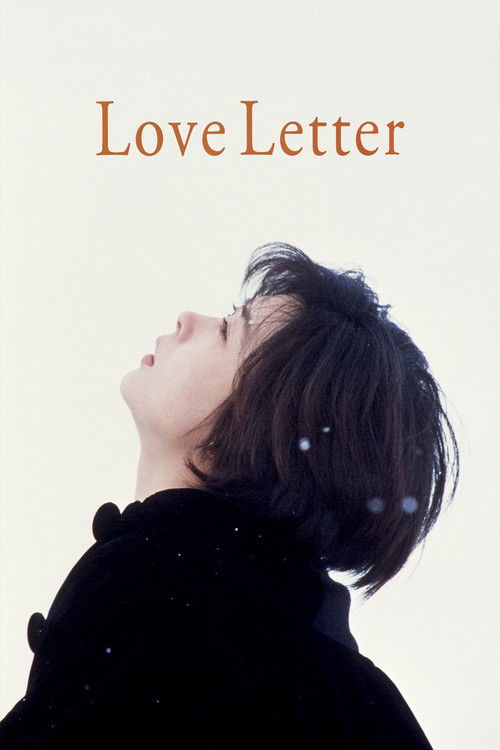
Love Letter
1995 · Shunji Iwai
For a snowy night when you want to feel your heart squeezed slowly — a comfort watch about grief that leaves you cleansed rather than crushed. Reach for it when you miss someone, or want to remember what first love felt like.
What it's about
Two years after her fiancé died in a mountaineering accident, Hiroko still can't let him go — so she mails a letter to his childhood address, a house she's been told no longer exists. A reply comes back, written by a woman who shares the dead man's name: his old middle-school classmate, another Itsuki Fujii. What begins as a strange coincidence becomes a correspondence between two strangers, one excavating her grief, the other slowly rediscovering a boy she barely remembers from the back row of class.
The experience
Quiet, snowbound, and achingly tender — it moves at the pace of letters, with memory surfacing in warm flashbacks that make the past feel closer than the present. It's a film that sneaks up on you: gentle for an hour, then suddenly you're wrecked.
Performances
Miho Nakayama plays both women — the grieving fiancée and the oblivious classmate — and keeps them so distinct in posture and temperature that you never confuse them, even as the film depends on their uncanny resemblance.
The craft
Shunji Iwai shoots winter like a state of mind: white light pouring through windows, breath in cold air, snow that muffles the whole world. The dual-role conceit is handled with elegant restraint, and the epistolary structure lets the film cut between two cities and two timelines without ever feeling tricky. The final stretch earns its emotion visually, not with speeches.
Why it matters
A phenomenon across East Asia — especially in South Korea, where it became a beloved cultural touchstone — and the film that launched Iwai as the defining romantic stylist of 1990s Japanese cinema.
Snapshot
Love Letter is Shunji Iwai's theatrical feature debut, a winter-lit epistolary drama that turns an act of grief into an act of detection. Hiroko Watanabe, unable to release her dead fiancé Itsuki Fujii two years after a mountaineering accident, copies an old address from his school yearbook and mails a letter to a boy she believes is gone. A reply arrives — from a woman, also named Itsuki Fujii, a former middle-school classmate of the dead man who happens to bear an uncanny resemblance to Hiroko herself. Because Miho Nakayama plays both women, the film's central conceit is legible in a single face: the fiancé, we come to understand, loved the living woman partly because she recalled the adolescent girl he could never confess to. From that doubling Iwai builds a two-strand narrative in which correspondence between the two women excavates a buried first love, culminating in one of Japanese cinema's most quoted images — a lending-library card, a pencil portrait, and the belated legibility of a boy's feelings. Restrained, luminous, and structurally precise, the film established Iwai's signature and became a defining text of 1990s East Asian romantic melodrama.
Industry & production
The film emerged from Iwai's apprenticeship in television, music video, and commercials rather than from the studio system. Through the early 1990s he built a reputation directing for TV — the drama Fireworks (Uchiage Hanabi, 1993) in particular drew critical attention and marked him as a talent to watch — and Love Letter converted that reputation into a first cinema feature. It was produced within the independent-leaning, producer-and-agency-driven ecology that characterized much of Japanese filmmaking in the mid-1990s, a period when the majors' output had contracted and distinctive authorial films often reached theaters through smaller distributors and cross-media backing. Precise financing details are not well documented in English-language sources, and I will not invent them. What is securely established is the film's commercial and cultural afterlife: it was a substantial success in Japan and, over the following years, an outsized phenomenon across East Asia, its reach amplified by the fact that its style translated cleanly to the region's booming romance market. Production was anchored in Otaru, Hokkaido, whose snowbound townscape and surrounding mountains are inseparable from the film's identity.
Technology
Love Letter is a celluloid film of the pre-digital moment, shot on 35mm and dependent on photochemical means for its distinctive look. Its "technology," in the meaningful sense, is optical and environmental rather than electronic: the exploitation of natural winter light, heavy diffusion, backlight, and near-overexposure to render snow, window glass, and pale skin as sources of luminosity. This is notable in retrospect because Iwai would later become one of Japanese cinema's early, influential adopters of consumer digital video — All About Lily Chou-Chou (2001) was shot substantially on DV — so Love Letter sits on the analog side of a career that helped bridge the two eras. The film also foregrounds an obsolescent information technology as subject matter: the handwritten letter, the postal address, the school yearbook, and above all the paper lending-library card, whose materiality carries the plot's emotional payload. The drama depends on media that can be lost, mislaid, and rediscovered.
Technique
Cinematography
The photography, by Noboru Shinoda — Iwai's crucial recurring collaborator — is the film's most imitated element. Shinoda favors soft, high-key light, blown-out windows, lens flare, and a milky diffusion that makes snow, breath, and curtains glow. Interiors are lit as if the outside world were seeping in; the female Itsuki's illness scenes and the school-library flashbacks bathe faces in pale, enveloping brightness. This "Iwai aesthetic" (often described in Japanese fan and critical shorthand as Iwai bigaku, an Iwai poetics) is not merely pretty: the overexposure literalizes memory's tendency to bleach and idealize, and the recurring motif of light through glass rhymes with the film's theme of seeing someone indistinctly, through an intervening surface. The Hokkaido exteriors — white fields, gray mountains, a single figure against snow — supply the widescreen austerity against which the interiors' warmth registers.
Editing
The film's architecture is fundamentally an editing problem: it cross-cuts two women in two places, braided with flashbacks to a middle-school past, and it must withhold and then release information about the dead Itsuki so that the audience assembles the love story a beat behind the characters. Cuts frequently work associatively — a gesture, an object, or a name in the present triggering the past — so that the reveal of the boy's feelings feels excavated rather than announced. Iwai is known across his career for close, sometimes hands-on involvement in the shaping and cutting of his films; I would not want to over-specify the exact editorial credit for Love Letter without confirmation, but the montage logic is unmistakably authorial and of a piece with his later work.
Mise-en-scène / staging
Iwai stages the film around thresholds and framing surfaces: doorways, windows, the counter of a school library, the sickbed. The two timelines are visually differentiated — the present's muted domestic and snowbound spaces versus the past's sun-flooded school corridors — yet linked by repeated compositions. The most celebrated staging is exterior and elemental: Hiroko, alone on the snowfield below the mountain where her fiancé died, calling "O-genki desu ka?" ("Are you well?") into the emptiness, the human figure dwarfed by white. Against such openness Iwai sets intimate, cluttered interiors — the female Itsuki's cold-ridden household, the bicycle shed, the library stacks — where the real archaeology of feeling is conducted among ordinary objects.
Sound
The score, credited to Remedios (a project associated with several of Iwai's films), is spare and piano-forward, leaning on a recurring lyrical theme rather than continuous underscoring, so that silence and the sounds of winter — wind, snow, a bicycle — carry much of the mood. Sound design privileges quiet: the scratch of a pen, the rustle of paper, the acoustics of an empty snowfield. The famous mountain call works because the sound field around it is nearly bare, letting a single spoken line ring. I'm not able to verify a definitive attribution for every musical cue and will not fabricate one, but the film's restrained sound-to-image balance is a securely observable feature.
Performance
The film rests on Miho Nakayama's dual role. A major pop star and actress of the period, Nakayama plays both the grieving Hiroko and the living Itsuki, distinguishing them through register rather than makeup — Hiroko's contained sorrow against Itsuki's brisker, wryer, more physically present manner. That the two are one performer is the point: the resemblance is the plot. The adolescent past is carried by younger performers, notably Takashi Kashiwabara as the teenage male Itsuki and Miki Sakai as the teenage female Itsuki, whose muted, embarrassed non-courtship supplies the film's emotional spine. Etsushi Toyokawa plays Akiba, the glassblower who loves Hiroko and finally pushes her toward the mountain and toward release. The performances are calibrated low; the film trusts glance, hesitation, and withheld speech over declaration.
Narrative & dramatic mode
The dramatic mode is epistolary detective-elegy. Its engine is dramatic irony managed through correspondence: Hiroko writes to solve the mystery of her own grief, while the female Itsuki, prompted to recall a classmate she long dismissed as an annoyance, gradually reconstructs a boy's unspoken love — for herself. The two strands are asymmetrical. Hiroko's arc is toward letting go; Itsuki's is toward finding out. The film's information is doled out so that recognition lands late and obliquely, most of all in the closing movement, when a group of schoolgirls returns to the female Itsuki the lending card for Proust's À la recherche du temps perdu (In Search of Lost Time) — a book the boy repeatedly checked out under her name — and turns the card over to reveal, on the reverse, his pencil sketch of her face. The Proustian intertext is not decorative: the whole film is an involuntary-memory machine, feeling reconstituted from an object surviving in an archive. The mode fuses melodrama's emotional aim with a mystery's structure of deferred disclosure.
Genre & cycle
The film is a romantic melodrama in the "pure love" register that dominated East Asian popular cinema and television across the late 1990s and 2000s — first-love stories, terminal or absent beloveds, chaste longing, seasonal landscapes. Love Letter is one of the cycle's fountainheads. It also participates in the Japanese lineage sometimes glossed as iyashikei, the "healing" mode of gentle, consoling narrative. Within Iwai's own filmography it belongs to a strand of lyrical, youth-and-memory romance — later joined by the shorter April Story (1998) — as distinct from his darker portraits of adolescence and violence (Swallowtail Butterfly, 1996; All About Lily Chou-Chou, 2001). Its conventions — the dual/doppelgänger casting, the epistolary confession, the snow, the first love recovered too late — became genre furniture others would borrow.
Authorship & method
Love Letter is a coherent authorial statement. Iwai wrote and directed it, and the film crystallized the concerns and manner that would define him: adolescence and memory; the letter, the tape, the photograph, and other fragile media of feeling; a floating, light-drunk visual style; and narratives that reveal emotion through investigation rather than avowal. His method draws on his cross-media formation — the compression and image-first sensibility of music video and commercials feed the film's lyricism — while resisting their glibness through patience and restraint. The authorship is genuinely collaborative in one respect above all: cinematographer Noboru Shinoda, whose diffused, overexposed photography is so identified with Iwai that the two names are often spoken together; Shinoda shot several of Iwai's key works before his death in 2004. The score credited to Remedios supplies a recurring musical identity across Iwai's mid-career films. On the writing and cutting, the film is essentially Iwai's own. Where individual technical credits (editor, specific music cues) are not firmly documented in the sources available to me, I flag the gap rather than fill it.
Movement / national cinema
The film belongs to the 1990s Japanese cinema of authorial revival, a moment when a generation formed partly outside the shrinking studios — in television, video, and advertising — brought idiosyncratic voices to the feature. Iwai stands with contemporaries who redefined Japanese art and genre cinema in that decade, and Love Letter helped establish him as a leading figure of the group. Nationally, the film is deeply Japanese in its textures — the memorial service, the school system and yearbook, the postal culture, the Hokkaido winter — yet it proved extraordinarily portable. Its most consequential national-cinema story is transnational: in South Korea, where Japanese popular culture was officially restricted until a phased liberalization beginning in 1998, Love Letter circulated by word of mouth and unofficial means and became a landmark, its "O-genki desu ka" line entering the vernacular. It was among the Japanese films whose Korean success helped normalize cultural exchange between the two countries.
Era / period
Love Letter is a mid-1990s film both in its production circumstances and its sensibility. It arrives before the digital turn Iwai himself would help drive, so it is a late flowering of a wholly photochemical romantic cinema. Its diegetic world is analog and slightly nostalgic even for 1995 — handwritten letters, address books, paper library cards, a middle-school past rendered as a sunlit yesterday. The film's melancholy is period-appropriate to a decade preoccupied, across Japanese culture, with memory, loss, and the fragility of connection. Historically it sits at the threshold of the East Asian "pure love" boom that its own success helped ignite, making it feel simultaneously like an endpoint (of celluloid romanticism) and an origin point (of a cycle that would run for over a decade).
Themes
The governing theme is the legibility of feeling across time — how love unspoken in the moment becomes readable only later, through a surviving trace. Nested within it: the double, the idea that we love people as versions of earlier people, embodied in the twinned Itsukis and Hiroko's resemblance to the boy's first love; grief and release, Hiroko's need to stop writing to the dead and turn toward the living Akiba; memory as archaeology, feeling recovered from objects (the yearbook, the card, the Proust volume) rather than recalled at will — an explicitly Proustian conceit; and the missed confession, adolescence figured as a time of near-misses whose meaning is deferred. The film also quietly thematizes illness and mortality doubling across generations (the female Itsuki's father died of a cold-turned-pneumonia; her own fever brings the past to a crisis). Snow and light operate as thematic media throughout — whiteness as both erasure and clarity, brightness as memory's flattering distortion.
Reception, canon & influence
Critically and popularly, Love Letter was received as a striking debut and became one of the most beloved Japanese films of its decade; Nakayama's dual performance and Shinoda's photography drew particular admiration. I don't have reliable confirmation of the film's specific awards tally and will not manufacture one, but its enduring canonical status within Japanese romantic cinema — and within Iwai's body of work — is not in doubt.
Influences on the film (backward): The most explicit is Proust's In Search of Lost Time, whose title and lending card are literal plot devices and whose model of involuntary memory shapes the film's whole method. More broadly the film draws on the deep well of Japanese melodrama and its tradition of restraint, seasonal symbolism, and mono-no-aware pathos, and on the compressed, image-led grammar Iwai absorbed from music video and commercials.
Legacy (forward): Love Letter is a foundational text of the East Asian "first love" romance cycle. Its influence is especially visible in Korean cinema — Kwak Jae-yong's The Classic (2003), among others, works in a closely related epistolary, dual-timeline, first-love-recovered vein — and the film is regularly cited across Korean, Taiwanese, and Chinese romance as a touchstone; its snow-and-letters iconography and its "are you well?" motif became reference points. It also inaugurated the "Iwai aesthetic" that a generation of filmmakers, advertisers, and music-video directors imitated. Iwai himself returned to the film's DNA decades later, reworking its epistolary premise in the Chinese-language Last Letter (2018) and a Japanese Last Letter (2020), a rare case of an auteur openly remaking his own debut's conceit. Within his career the film is the seed of everything that follows — the memory films, the adolescence films, the collaboration with Shinoda — and remains, for many viewers, the definitive Iwai film.
Reception
A hit at home in 1995, it became something much bigger abroad — a phenomenon in South Korea (where its 1999 release rode the first wave of legally imported Japanese cinema) and later China, which gave it a hugely successful theatrical re-release in 2021. What began as a stylish debut is now pan-Asian winter canon.
How Love Letter was received, from release to now →
How to watch Love Letter: what to notice on a first viewing
- Notice how blown out and bright the windows look. Noboru Shinoda floods interiors with soft, high-key light, lens flare, and a milky diffusion that makes snow, breath, and curtains glow rather than simply appear. The overexposed light works like memory itself, bleaching and softening everything it touches.
- Watch how often scenes happen at doorways and windows. Iwai stages both timelines around thresholds, framing surfaces, and a school library counter, so characters keep appearing in or behind something that separates them from us. You're constantly watching people through an intervening surface, seeing them indistinctly rather than plainly.
- Notice the present-day story cut against a school-age past. The editing cross-cuts two women in two places, braided with flashbacks to middle school, and a gesture or object in the present keeps triggering a jump into the past. You end up piecing a love story together a beat behind the characters themselves.
- Watch Miho Nakayama play two women with the same face. Nakayama distinguishes grieving Hiroko from the livelier, wryer Itsuki through register and manner rather than makeup, so the resemblance itself becomes part of the story. One actress playing both women means the resemblance is the plot, not just a coincidence.
The whole guide to watching Love Letter, with the keys for a rewatch →
Influences: the films it descends from and the films it influenced
- Letter from an Unknown Woman (1948) — Builds its entire melodrama around a single posthumous letter as narrative engine, so the emotion reaches its recipient (and us) only in retrospect — the structural dramatic irony of the withheld correspondent that Love Letter reruns with Hiroko and the mistaken addressee.
- Vertigo (1958) — Uses one actress in a dual role as the uncanny double of a lost love and defers the disclosure of her true identity, the same dual-role-plus-deferred-revelation machinery Iwai runs through Nakayama playing both Hiroko and Itsuki.
- Hiroshima mon amour (1959) — Cuts associatively between present tense and involuntarily-triggered memory so that past and present rhyme as images rather than flashback exposition — the associative-crosscutting grammar of remembrance Love Letter adopts to braid its two timelines.
- The Double Life of Véronique (1991) — Has one actress embody two uncanny doubles who never fully meet, shot by Sławomir Idziak in filtered, golden, overexposed diffusion — the exact fusion of the-double motif with light-drunk diffused photography that defines Iwai and Shinoda's look.
- Days of Heaven (1978) — Néstor Almendros and Haskell Wexler's backlit, blown-out natural light — figures dissolving into overexposed haze — is the photochemical antecedent for Shinoda's backlit winter overexposure.
- Late Spring (1949) — Frames domestic drama through doorways, corridors and translucent shoji, pacing it by seasonal ellipsis and mono-no-aware restraint — the threshold-and-surface staging and withheld-feeling economy Iwai inherits from Japanese melodrama.
- Wild Strawberries (1957) — Structures a whole film as an elderly return to an involuntarily-surfacing first love, letting present spaces morph into remembered ones — the Proustian involuntary-memory architecture Love Letter literalizes via the library lending card.
- All About Lily Chou-Chou (2001) — Extends the Iwai/Shinoda aesthetic — backlit green-field overexposure and feeling mediated through fragile media (BBS posts standing in for the letter) — carrying forward the 'legibility of feeling across media' method.
- Last Letter (2020) — Iwai openly reworks his own debut's conceit — a misdelivered correspondence, a dual-generation cast, and a first love recovered through letters — a rare auteur self-remake of the epistolary premise.
- Christmas in August (1998) — Transposes the mono-no-aware restraint into Korean cinema: love that is never spoken and is legible only in gesture, framing and seasonal light — the deferred-avowal grammar Love Letter helped export.
- Il Mare (2000) — Builds a romance entirely from letters exchanged across two separated timeframes, with dramatic irony generated by the temporal gap — the epistolary deferred-disclosure structure inherited directly from Love Letter.
- The Classic (2003) — The explicitly-cited descendant: a dual-timeline first love recovered through a daughter reading her mother's letters, with Son Ye-jin in a dual role as mother and daughter — Love Letter's epistolary, dual-role, memory-recovery template made Korean.
- Secret (2007) — Uses a piano-forward score not as underscore but as the plot's time-crossing device, extending Love Letter's model of a spare recurring musical identity carrying the emotional and temporal logic of the film.
- You Are the Apple of My Eye (2011) — A keystone of the Taiwanese first-love boom Love Letter seeded: adolescence recalled as luminous, backlit nostalgia and a love legible only across the distance of years.
- 20th Century Girl (2022) — Established the East Asian first-love template of memory delivered through analog media — a piece of correspondence to/from the past reopens a buried romance — the exact engine of 20CG's mailed videotape frame.
- I Want to Eat Your Pancreas (2018) — Codifies the memory-triggered Japanese melodrama that withholds a dead loved one's true connection until a late reversal, keyed to snow-season symbolism — the withheld-reveal + seasonal-marker technique Pancreas reuses.
- The Last 10 Years (2022) — Codified the available-light, shallow-focus naturalism and snow/season-as-clock imagery that became the visual grammar of Japanese jun'ai melodrama.
- 18x2 Beyond Youthful Days (2024) — The snow-country template of cross-cutting a present-day quest against idealized school-age memory, with soft-focus winter light and associative match-cuts standing in for the emotional bridge between timelines — the film's explicitly cited formal model.
- Drawing Closer (2024) — Establishes the jun-ai visual grammar Miki inherits wholesale: backlit winter diffusion, blown-out snow-glare, and shallow-focus close-ups carried by a lyrical epistolary montage rather than plot.
- April Story (1998) — Iwai and Shinoda's immediate companion piece: same overexposed diffusion, backlit adolescent tentativeness, and love revealed through a small material trace (a bookstore, a red umbrella) rather than avowal.
- In the Mood for Love (2000) — A parallel East Asian statement of restraint where feeling is made legible through withholding, doorway/corridor threshold staging and Christopher Doyle's diffusion — the same 'emotion revealed by investigation and framing, never avowal' craft.
Similar films
- Letter from an Unknown Woman (1948) — influence & lineage · often watched together
- In the Mood for Love (2000) — influence & lineage
- Hiroshima Mon Amour (1959) — influence & lineage
- Drive My Car (2021) — same viewing thread · often watched together
- Wild Strawberries (1957) — influence & lineage · often watched together
- After Life (1999) — often watched together
- Tokyo Story (1953) — often watched together
- Even If This Love Disappears Tonight (2025) — shared sensibility
All the films related to Love Letter →
Watch it with: curated runs of related films
- The Ache of Almost — Watch these together for the way each circles a love that time, distance, or duty keeps just out of reach — long looks, feelings left unsent, and the life that gets lived instead.