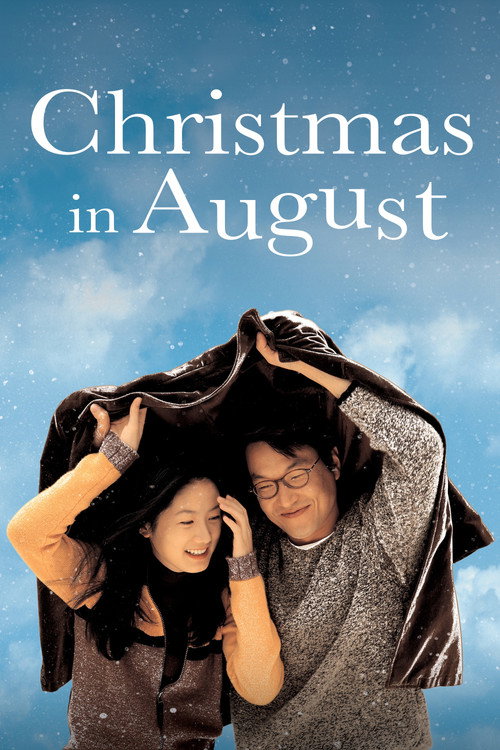
Christmas in August
1998 · Hur Jin-ho
When you need a good cry that's earned rather than manipulated, or a slow, tender film for a still evening — comfort and heartbreak in the same breath.
What it's about
Jung-won runs a small neighborhood photo studio and is quietly dying of a terminal illness — a fact he keeps to himself. Into his last summer walks Da-rim, a young parking-enforcement officer who keeps stopping by to develop her ticket photos, and a shy, unspoken affection grows between two people, only one of whom knows their time is short.
The experience
Gentle almost to a whisper: no big speeches, no melodrama, just small everyday moments — meals, errands, glances — that gather enormous weight because you know what's underneath them. It's the kind of quiet that sneaks up on you and leaves you wrecked in the softest possible way.
Performances
Han Suk-kyu plays the dying photographer with remarkable restraint — cheerfulness worn like a courtesy to others — and Shim Eun-ha makes the young officer's brightness feel like the thing his last summer orbits around.
The craft
Hur Jin-ho's debut works by withholding: the illness is never dramatized, feelings go unsaid, and the camera simply watches ordinary routines until they turn luminous. The photo-studio setting quietly does the film's talking — a place where moments are fixed and kept. It rewards patience, silence, and undivided attention.
Why it matters
A defining film of the late-1990s flowering of South Korean cinema and a touchstone for the country's understated melodrama tradition, it launched Hur Jin-ho as one of its major directors.
Snapshot
Christmas in August (8월의 크리스마스) is the debut feature of Hur Jin-ho and one of the defining works of the South Korean cinema that flowered in the late 1990s. Its premise is deceptively slight: Jung-won (Han Suk-kyu), a photographer in his thirties who runs a modest neighborhood portrait studio, is quietly dying of an unspecified terminal illness. Into his last summer walks Da-rim (Shim Eun-ha), a young parking-enforcement officer who drops by to develop photographs of ticketed cars, and a tentative, unspoken affection grows between them — one she does not know is shadowed by his mortality. The film's title captures its governing paradox: a man in the winter of his life passing through the heat of a Korean summer, holding Christmas (an image of tenderness, of endings that are also gifts) inside August. What distinguishes the film is not its story but its temperament. It is a work of extreme restraint — muted, patient, allergic to the sob-driven excess long associated with Korean melodrama — and it became a touchstone for a quieter, more classical mode of feeling that Korean art cinema would develop over the following decade.
Industry & production
The film arrived at a hinge moment in the Korean industry. The late 1990s saw the old, quota-and-import structure giving way to a new, more capitalized and cinephilic production culture — young directors trained in film theory and abroad, new financing (including so-called "planning" companies and, soon, chaebol and venture capital), and a critical infrastructure eager for a domestic art cinema. Christmas in August belongs to this wave. It was produced through Uno Film, the company associated with producer Cha Seung-jae, which was central to the New Korean Cinema (it had backed Lee Chang-dong's Green Fish, in which Han Suk-kyu also starred). The film was a modest production by design, built around a single principal location — a small photo studio and its surrounding streets — rather than spectacle.
Its release came the year before Shiri (1999) rewrote the commercial ceiling for Korean film, and it stands as a counter-model to that blockbuster turn: proof that intimate, low-budget drama could command serious critical stature and a devoted audience. Precise budget and box-office figures I cannot state reliably here, so I will not invent them; what the record clearly supports is that the film was a critical success and a career-making debut rather than a mass commercial event. Its two leads were among the most bankable actors of the moment — Han Suk-kyu was mid-ascent toward Shiri, and Shim Eun-ha was a leading star of screen and television — which lent an unusually high-profile cast to an otherwise quiet chamber piece.
Technology
Technically the film is conservative by intention. It was shot and finished photochemically on 35mm, in the pre-digital-intermediate era, so its restrained palette and soft, natural light were achieved in-camera and in the lab rather than through digital grading. The production predates the digital sound and effects pipelines that would soon become standard in Korea. The one technological motif that matters is diegetic and thematic rather than industrial: the film is saturated with the apparatus of analog photography — the portrait camera, the developing process, printed images, the studio itself as a machine for fixing time. Photography here is the film's chosen metaphor for what cinema and mortality share: the arresting of a passing moment, the transformation of the living into the remembered. That the protagonist's trade is the making of still images gives the film a self-aware, almost essayistic relationship to its own medium without ever announcing it.
Technique
Cinematography
The cinematography (by Yoo Young-gil) is the film's signature achievement and the clearest statement of its aesthetic. The camera is predominantly static, mounted and composed rather than roving; the film favors the fixed frame, the held shot, and a respectful distance from its actors. Compositions are frequently organized around thresholds, windows, and the geometry of the studio interior, with figures placed within doorways and reflected in glass. Light is natural and diffuse — the flat, humid brightness of a Korean summer — and the palette is desaturated and warm rather than lush. Crucially, the film often lets characters enter and exit the frame while the camera stays put, so that emotion registers in the space a person leaves behind as much as in their presence. This is a cinema of the empty chair, the closed door, the shop seen from across the street. The restraint is not coldness; it is a deliberate withholding that hands the emotional labor to the viewer.
Editing
The editing is unhurried and elliptical. Scenes are allowed to run to their natural rhythm rather than being cut for momentum, and the film trusts silence and dead time — the interval in which nothing "happens" — as dramatic material. Time passes in gaps: the illness advances, the seasons shift, relationships deepen, largely between scenes rather than within melodramatic set pieces. The cutting withholds the conventional signposts of the terminal-illness picture (the collapse, the hospital verdict scene as spectacle), preferring understatement and implication. This elliptical structure is central to the film's dignity; it declines to milk its own premise.
Mise-en-scène / staging
The studio — cramped, sunlit, cluttered with the ordinary bric-a-brac of a small family business — is the film's emotional center and its dominant set. Mise-en-scène is domestic and specific: the shop, the home above or behind it, the father with whom Jung-won lives, the neighborhood streets. Staging tends toward stillness and the small gesture — the pouring of a drink, the eating of a meal, the teaching of an old man how to operate a video player. Objects carry weight: the camera, photographs, the studio's shutters. The film's realism of texture (a lived-in, un-glamorous middle-class Korea) grounds its restraint and keeps the sentiment from floating free.
Sound
The soundtrack is sparing. Ambient sound — cicadas, traffic, the small noises of the shop — establishes the oppressive summer and the ordinariness against which the drama plays. Music is used selectively rather than continuously, avoiding the wall-to-wall scoring that cues an audience when to weep; I cannot confirm the composer's name with certainty here, so I will not attribute the score. Silence is itself a sound-design choice: the film's willingness to let scenes fall quiet is inseparable from its emotional method.
Performance
The performances are the film's other great asset, and they are pitched to its overall aesthetic of understatement. Han Suk-kyu plays Jung-won with a gentle, self-contained warmth — a man who has decided to meet his death with equanimity and courtesy, and who therefore rarely dramatizes his own suffering. The most quoted quality of his work is its smile: an ordinary, kindly demeanor that conceals grief and makes the concealment legible. Shim Eun-ha's Da-rim is bright, forthright, and unaware, and her energy supplies the film's warmth and its ache — she is alive to a future the audience knows he will not share. The chemistry is built from small courtesies rather than declarations; the film's romance is almost entirely a matter of things unsaid.
Narrative & dramatic mode
The film's dramatic mode is anti-climactic by design. It takes the most reliably manipulative of premises — the doomed romance, the dying protagonist — and systematically refuses its melodramatic payoffs. There is no grand confession, no deathbed reconciliation staged for maximum tears; the central relationship never even fully becomes a declared romance. Much of the story is organized around indirection: the audience holds knowledge (his illness) that the beloved does not, which converts ordinary scenes into quiet dramatic irony. The narrative is episodic and seasonal, accreting meaning through repetition and small change rather than through a rising plot. Its emotional climax is displaced onto an image — fittingly, a photograph — rather than a spoken scene. This is melodrama purified into something closer to lyric: feeling produced by structure and absence rather than by incident.
Genre & cycle
Christmas in August is a melodrama and a romance, but it is best understood as a reformation of Korean melodrama, a genre with deep roots in the country's cinema and television. Where the mainstream tradition (and the "trendy drama" of 1990s Korean TV) trafficked in heightened emotion, illness, and tears, Hur's film adopts the same raw materials — terminal illness, thwarted love — and drains them of hysteria. It thus sits at the head of a cycle of restrained, "well-made" Korean art melodramas that would define one strand of the national cinema's international reputation. Within Hur Jin-ho's own body of work it inaugurates a loose, unofficial cycle of romances about time, loss, and emotional reticence, continued most directly in One Fine Spring Day (2001).
Authorship & method
Christmas in August is Hur Jin-ho's directorial debut, and it announces a consistent authorial signature: the primacy of restraint, an interest in the textures of ordinary middle-class life, a fascination with time and impermanence, and a refusal of melodramatic overstatement. Hur, who had worked in the industry before directing, would go on to become one of Korea's foremost directors of the intimate drama, with One Fine Spring Day (2001), April Snow (2005), Happiness (2007), and later historical and commercial films to his name; the reticent, seasonal romance of the debut remains his signature register.
The film is a genuine collaboration. The screenplay is credited to several hands — Hur among them — and the writing team drew on figures active in the New Korean Cinema's writer-director milieu; I will avoid naming individual writers where I cannot verify the credit precisely, but the collaborative, workshop-like authorship is characteristic of the period. The cinematography of Yoo Young-gil is inseparable from the film's identity, translating Hur's reticence into a grammar of the fixed frame and natural light. The casting of two major stars against type — asking them to underplay rather than emote — is itself an authorial decision, and the performances should be read as co-authored by director and actors. It is often noted that the project carried a personal, elegiac charge for Hur; the specific biographical origins are recounted variously and I will not assert a single account as fact.
Movement / national cinema
The film is a landmark of what is usually called the Korean New Wave or New Korean Cinema — the renaissance that followed the country's democratization in the late 1980s and matured through the 1990s. This movement produced a generation of cinephile directors (Lee Chang-dong, Hong Sang-soo, Park Chan-wook, Kim Ki-duk, and others) and a domestic art cinema of new seriousness. Within that movement Hur represents the lyrical, humanist, melodramatic wing — as distinct from Hong's formal games or Lee's social realism — and Christmas in August is one of the movement's most beloved exemplars of quiet feeling. Its international festival travel and critical embrace helped establish the template of the Korean film as an object of art-house prestige in the years just before the industry's global commercial breakthrough.
Era / period
Set and shot in the late-1990s present, the film is a portrait of an unglamorous, everyday urban Korea on the eve of enormous change — made, notably, around the time of the 1997–98 Asian financial crisis that shook the country. It captures a texture of ordinary life (the small family business, the neighborhood, the analog photo studio) that was already beginning to vanish, which lends the film, in retrospect, a documentary poignancy about a passing world of analog craft and modest livelihoods. Its period feeling is therefore double: a story about one man's ending that is also, unintentionally, an elegy for a moment in Korean life.
Themes
The film's central theme is the acceptance of mortality — the possibility of meeting death not with terror or rage but with grace, courtesy, and gratitude. Photography functions as its master metaphor: the fixing of an image is the fixing of a moment against time, and the dying photographer's trade makes literal the film's meditation on memory, impermanence, and how the living survive as pictures. Love here is inseparable from time and loss; the romance matters precisely because it cannot be completed. Secondary themes include the ordinary as sacred (the dignity of small routines and small kindnesses), the ethics of withholding (his refusal to burden Da-rim with his condition), and the transmission of care across generations (his patient attention to his aging father). The title's paradox — winter inside summer, an ending that is also a gift — condenses all of this.
Reception, canon & influence
Critically, Christmas in August was received as a major debut and quickly entered the canon of essential modern Korean films, admired above all for its restraint, its performances, and its refusal of melodramatic cliché; it is routinely cited in overviews of the Korean New Wave and in retrospectives of Hur's career. It won recognition on the domestic awards circuit and traveled internationally on the festival and art-house route, contributing to the growing critical prestige of Korean cinema abroad. (I am not able to enumerate its specific award wins reliably here, so I decline to list them rather than risk error.)
Looking backward, the film's influences are less a matter of direct citation than of tradition and temperament: the long lineage of Korean melodrama and the terminal-illness romance, refracted through an art-cinema sensibility of stillness and ellipsis that invites comparison with the classical Asian humanist tradition (the domestic quietism often associated with Ozu, and the patient realism of contemporary Asian art film) and with the "trendy drama" of 1990s Korean television that Hur was implicitly answering. Looking forward, its legacy is substantial. It set the template for a strand of restrained Korean romantic drama and directly launched Hur's own cycle of reticent love stories. Its reputation as a modern classic has proven durable enough to generate remakes in the region (a Japanese remake in the mid-2000s and, later, a Chinese-language version — I state these as widely reported rather than as details I can fully verify), a strong indicator of its status as a template text. More broadly, it stands as a foundational example of the "quiet" Korean art film — proof, on the eve of the industry's commercial explosion, that understatement could be the most powerful register of all.
Reception
A hit at home in 1998 and a Cannes Critics' Week selection, it's since hardened into the consensus pick for the greatest Korean melodrama — the quiet debut that now regularly tops Korean critics' best-ever lists.
How Christmas in August was received, from release to now →
Influences: the films it descends from and the films it influenced
- Late Spring (1949) — Yoo Young-gil's fixed low, frontal camera and the recurring 'empty frame' cutaways to unpeopled rooms and objects are a direct inheritance of Ozu's tatami-height static setups and pillow-shots, which let feeling register through absence rather than reaction shots.
- Tokyo Story (1953) — The decision to render death through ellipsis and offscreen restraint — the mourning deflected into mundane routine rather than a deathbed climax — descends from Ozu's handling of family loss in understatement instead of melodramatic peak.
- Ikiru (1952) — The structuring dramatic irony of a terminally ill protagonist who conceals his diagnosis and keeps up ordinary work is the same engine Kurosawa built, mortality expressed through routine and small gestures rather than disclosure scenes.
- Dust in the Wind (1986) — Hou's static long-take grammar, diegetic ambient sound in place of underscore, and love registered as absence and waiting supply the New-Cinema realist template Hur adapts to a provincial photo-studio milieu.
- A Time to Live and a Time to Die (1985) — The film's dead-time — holding on a scene after the 'action' is over — and its use of seasonal passage to mark impending death are lifted from Hou's contemplative durational editing.
- Maborosi (1995) — Kore-eda's distant fixed frames, available natural light, and grief handled through ellipsis (the cause of loss withheld, mourning shown only in aftermath) prefigure Christmas in August's exact restraint just three years earlier.
- A Day Off (1968) — Provides the native Korean line: a minimalist, elliptical melodrama of ordinary lives that answers the weepie tradition with stillness and dead air rather than swelling emotion, the modernist restraint Hur revives.
- Love Letter (1995) — Transposes the mono-no-aware restraint into Korean cinema: love that is never spoken and is legible only in gesture, framing and seasonal light — the deferred-avowal grammar Love Letter helped export.
- One Fine Spring Day (2001) — Hur's immediate follow-up literalizes the diegetic-ambience method by making the hero a field sound-recordist, extending the seasonal-episodic romance structure and understated performance of two stars against type.
- Happiness (2007) — Returns openly to the mortality-acceptance register — a convalescent-home romance shadowed by terminal illness — reworking the debut's anti-climactic love-under-a-death-sentence in the same reticent key.
- April Snow (2005) — Continues the author's fixed-frame, natural-light staging and refusal of melodramatic overstatement, building an adultery drama almost entirely from silence, glances, and withheld reaction.
- Failan (2001) — Extends the template of a major star (Choi Min-sik) cast against type into underplayed grief, with love realized only posthumously through letters and photographs — the 'memory as document' craft central to the seed.
- A Moment to Remember (2004) — Inherits the restrained-illness-romance strand Christmas in August legitimized, structuring loss around erasure of memory and the keepsake image, though pushing toward greater emotional release.
- Christmas in August (Japanese remake) (2005) — A near shot-for-shot regional remake that preserves the original's fixed-frame reticence and photo-studio conceit, evidence the film functioned as a reproducible 'template text' for restrained Asian romance.
- Soulmate (2023) — The Korean melodrama of restraint whose still, everyday framing and photographed keepsakes treat memory as tender re-authorship, establishing the understated register Min localizes.
- Man in Love (2021) — The restraint template for mortality melodrama: the dying protagonist who hides his illness to protect the beloved, with grief carried in held close-ups of quiet faces rather than dialogue — the source of the seed's face-lit intimacy over shot-reverse-shot courtship.
- My Sassy Girl (2001) — Korean New Wave's restrained-grief melodrama, where mortality is withheld beneath everyday surface — the buried-bereavement engine MSG hides under farce (grief masquerading as caprice).
- Even If This Love Disappears Tonight (2025) — Pioneers the restrained Korean terminal-romance register built on warm domestic light and photographs/objects as memory relics, the understated props-as-memory tradition the film's golden scheme extends.
- Il Mare (2000) — Shares the era's minimalist grammar — becalmed fixed compositions, muted palette, sparse scoring, romance built on absence and delay rather than confrontation — as a parallel 'quiet' Korean art-romance.
- Poetry (2010) — A cousin in New Korean Cinema restraint: available light, non-underscored soundtrack, understated performance, and a deliberately anti-climactic confrontation with mortality that trusts the withheld gesture over the emotive one.
- Still Walking (2008) — Kore-eda's Ozu-descended domestic quietism — a single-season family gathering shadowed by death, carried by diegetic household sound and dead-time — occupies the same craft space internationally.
Similar films
- Still Walking (2008) — influence & lineage
- Maborosi (1995) — influence & lineage
- A Moment to Remember (2004) — influence & lineage
- Tokyo Story (1953) — influence & lineage
- Late Spring (1949) — influence & lineage
- The Last 10 Years (2022) — shared sensibility
- Tokyo Twilight (1957) — shared sensibility
- Drive My Car (2021) — shared sensibility