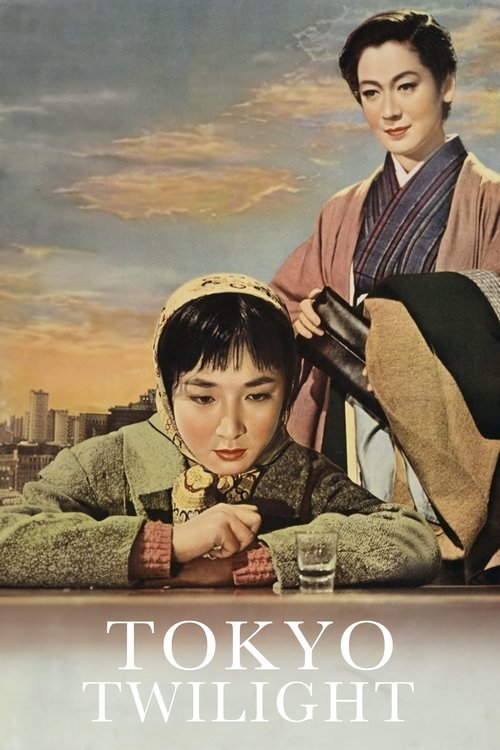
Tokyo Twilight
1957 · Yasujirō Ozu
For a solitary, contemplative night when you want a film that takes sadness seriously — not a tearjerker but a slow, deep ache. This is a challenge, not a comfort watch; save it for when you can give it your full quiet attention.
What it's about
In a wintry postwar Tokyo, a widowed bank official shares his house with his two grown daughters: the elder, who has come home with her baby after fleeing an unhappy marriage, and the younger, unmarried, pregnant, and drifting through mahjong parlors and late-night streets. Into this strained household comes the discovery that the mother who abandoned them years ago is living nearby. What follows is a quiet reckoning with everything the family has never said aloud.
The experience
Slow, hushed, and heavy with things unspoken — the stillness that feels warm in other family dramas here turns cold and aching. It builds a sorrow that creeps up on you and stays long after the lights come up.
Performances
Setsuko Hara plays against her usual radiance as the guarded elder sister, Ineko Arima is devastating as the adrift younger daughter, and Chishū Ryū anchors it all as the father whose gentleness can't quite reach his children. Isuzu Yamada brings a worn, complicated dignity to the long-absent mother.
The craft
Yasujirō Ozu's signature precision — low camera, still frames, rooms composed like held breaths — is turned here toward his darkest material, and the contrast makes every composition feel like grief held rigidly in place. Shot in stark black and white across a raw Tokyo winter, it's a masterclass in how formal restraint can intensify emotion rather than mute it.
Why it matters
The bleakest film of Ozu's late career and long the overlooked one, it has been steadily reclaimed as essential — proof that the cinema's great poet of family serenity could stare directly into family ruin.
Snapshot
Tokyo Twilight (東京暮色, Tōkyō Boshoku) is the bleakest film Yasujirō Ozu ever made, and it stands somewhat apart from the serene domestic dramas — Late Spring, Tokyo Story — on which his international reputation rests. Set across a raw Tokyo winter, it follows a widowed bank official, Shukichi Sugiyama (Chishū Ryū), and his two grown daughters: the elder, Takako (Setsuko Hara), who has returned to her father's house with an infant after leaving an unhappy marriage, and the younger, Akiko (Ineko Arima), unmarried, pregnant, and adrift. Into this already strained household intrudes the discovery that the mother who abandoned the family years earlier, Kisako (Isuzu Yamada), is living in Tokyo, running a small mahjong parlor with the man she ran off with. The film moves toward an abortion and a death, and its emotional register — cold, nocturnal, morally unsparing — is unusual for Ozu. It was his last black-and-white feature; his next film, Equinox Flower (1958), would be his first in color. Long treated as an anomaly or a failure, Tokyo Twilight has since been reclaimed by scholars as one of the most searching works in his late period.
Industry & production
The film was produced and distributed by Shochiku, the studio to which Ozu was bound for essentially his entire career and whose Ōfuna house style — refined lower-middle-class domestic drama, the so-called shomin-geki — he both embodied and refined into something wholly personal. By 1957 Ozu was the most prestigious director on the Shochiku roster and enjoyed a degree of creative autonomy almost unheard of in the Japanese studio system, working slowly, on his own scripts, with a stable recurring company of cast and crew. Tokyo Twilight was made within that settled apparatus.
At roughly 140 minutes it is one of Ozu's longest films, and its length is bound up with its unusually novelistic ambition — two parallel daughter-plots, a buried family history, and a wide gallery of secondary characters (the mahjong-parlour milieu, a police station, ramen shops and bars). The precise commercial performance is not something I can state with numbers I can verify, but the general historical consensus is clear: the film's grim subject matter — a daughter's pregnancy, an abortion, a possible suicide, and a mother who deserted her children — met a cooler reception than Ozu's warmer family films, and it is routinely described as having underperformed relative to his reputation. That reception is often cited as one prompt for Ozu's turn, immediately afterward, toward the lighter, color-saturated comedies of remarriage and generational change that occupied his final years.
Technology
Tokyo Twilight was shot in black and white in the standard Academy aspect ratio (1.37:1), and it is significant precisely as Ozu's last monochrome film. Ozu was famously conservative about technical novelty: he came late and reluctantly to sound, never used the widescreen formats that swept the Japanese industry in the mid-1950s, and adopted color only with his very next picture. That refusal was principled rather than merely cautious — he distrusted the wide frame as ill-suited to his tightly composed, frontal, symmetrical interiors. In Tokyo Twilight the Academy frame is exploited with total control, and the black-and-white cinematography is pushed toward a darker tonal range than is usual for him, with night exteriors, dim bars, and cold winter light doing much of the film's expressive work. The result is sometimes described as the closest Ozu ever came to the visual world of film noir, though the term should be used loosely: the darkness here is atmospheric and moral rather than generic.
Technique
Cinematography
The film was photographed by Yūharu Atsuta, Ozu's regular cameraman of the postwar years, and it is a textbook of the mature Ozu system. The camera sits low — the celebrated "tatami-level" viewpoint, positioned as if a person were kneeling on the floor — and it almost never moves. Tracking shots, pans, and craning, common currency elsewhere in 1950s cinema, are essentially absent. Ozu favoured a single focal length (a 50mm lens) that flattens depth slightly and keeps figures at a consistent scale, and he composed frontally, with characters frequently addressing the lens near-directly in conversation, so that the spectator is placed inside the geometry of the exchange rather than observing it from the side. What distinguishes Tokyo Twilight within this system is the lighting: the winter setting licenses a colder, higher-contrast palette, deep shadow in the bars and back rooms, and a general sense of a city seen after dark.
Editing
Ozu's editing is where his radicalism is most concentrated, and it is fully operative here. He constructs conversations by cutting between near-symmetrical frontal shots of each speaker, often "crossing the line" of classical Hollywood continuity so that eyelines and screen direction follow a graphic logic of his own rather than the 180-degree rule. Transitions between scenes are made by straight cuts — Ozu had long abandoned dissolves, fades, and wipes — frequently mediated by the still, unpeopled shots of corridors, exteriors, signage, and objects that critics have variously called "pillow shots," "cutaway still lifes," or intermezzi. These images are not establishing shots in the ordinary sense; they open small pauses of contemplative empty space between dramatic beats, and in a film this dark they carry a particular weight of desolation.
Mise-en-scène / staging
The staging is rigorously ordered: figures arranged in balanced compositions, doorways and hallways framing receding planes, domestic objects placed with a care that verges on the abstract. Ozu blocks his actors so that they sit or stand parallel to the frame, and he lets scenes play in sustained, quiet takes. In Tokyo Twilight this classical stability is set against a narrative of disintegration, and the tension between the two — impeccable, tranquil form housing a story of shame, abandonment, and death — is central to the film's disquieting effect. The recurring settings (the father's ordered home, the mother's smoky mahjong parlor, the anonymous ramen counters and bars where Akiko drifts) are staged as distinct moral geographies.
Sound
The score is by Takanobu Saitō, one of Ozu's regular late-career composers, and it is deployed sparingly and unobtrusively in the manner Ozu preferred — light, recurring musical motifs rather than the emotional underscoring of melodrama. Much of the film's atmosphere is carried instead by ambient sound and by the pointed use of quiet: the hush of the winter house, the clatter of mahjong tiles, the noise of trains. Trains and railway sound recur throughout Ozu's cinema as markers of transition and modern life, and in Tokyo Twilight they acquire a darker charge given the manner of the film's central catastrophe.
Performance
Performance in Ozu is deliberately understated, and the cast delivers restraint at the highest level. Chishū Ryū, Ozu's perennial screen surrogate for the aging father, plays Shukichi with weary, contained decency. Setsuko Hara — the luminous presence of Late Spring and Tokyo Story — is cast here against her radiant type as Takako, drawn and unhappy, an eldest daughter absorbing the family's sorrows. The film belongs, though, to Ineko Arima as Akiko, whose performance carries the picture's despair, and to Isuzu Yamada as the estranged mother. Yamada, a major star who the same year played the Lady Macbeth figure in Kurosawa's Throne of Blood, brings a hard, ambiguous quality to Kisako that resists both easy condemnation and easy sympathy. The ensemble's flatness of affect — emotion registered in a downward glance, a pause, a small adjustment of posture — is what makes the film's grief land.
Narrative & dramatic mode
Tokyo Twilight operates in the mode of domestic tragedy rather than the elegiac, bittersweet comedy of most Ozu. Its dramatic engine is the return of the repressed: a family that has organized itself around silence about the absent mother is forced to confront her existence, and the buried question of the daughters' parentage and legitimacy corrodes what stability the household had. The plot is structured as two intertwined daughter-stories moving in opposite directions — Takako's toward a fragile, resigned reconciliation with her own marriage and her father, Akiko's toward pregnancy, an abortion, and death. Ozu builds the film through accumulation of small, quiet scenes rather than through crisis and confrontation, so that the tragedy arrives almost obliquely; the emotional catastrophes happen in the spaces between the muted encounters. It is a film about the long half-life of an old wound, and about the impossibility, within this moral world, of a clean reckoning between a mother and the children she left.
Genre & cycle
The film sits within the shomin-geki, the genre of everyday lower-middle-class life that Shochiku cultivated and Ozu perfected, and within his own great postwar cycle of films about parents, marriageable daughters, and the dissolution of the extended family. But Tokyo Twilight is the dark inversion of that cycle. Where Late Spring and Tokyo Story find serenity and acceptance in the passage of generations, this film pushes the same materials — the widowed father, the unmarried daughter, the pressures of marriage — toward tragedy, incorporating subject matter (abortion, adultery, illegitimacy, suicide) that the surrounding films keep offscreen. Critics who note its shadowed lighting and nocturnal city sometimes place it adjacent to film noir or to the darker social melodrama of the period, but it is most precisely understood as Ozu's own genre turned inside out.
Authorship & method
Tokyo Twilight is a fully realized product of Ozu's authorial system and of the small circle of collaborators through whom he worked. The screenplay was written, as almost all his postwar films were, in partnership with Kōgo Noda, his closest creative associate; the two famously composed their scripts together over long, secluded, sake-fuelled writing sessions, building dialogue and structure line by line. The cinematography is by Yūharu Atsuta, who executed Ozu's exacting low-camera compositions for years and became the principal witness to and interpreter of the director's method. The music is by Takanobu Saitō. And the performances come from Ozu's repertory company, above all Chishū Ryū and Setsuko Hara, whose faces are inseparable from the late Ozu style. Ozu's method was one of extreme deliberation and constraint — a self-imposed vocabulary of fixed low camera, 50mm lens, cuts without dissolves, frontal staging, and recurring transitional images — refined across decades into one of the most consistent and recognizable authorial signatures in world cinema. Tokyo Twilight demonstrates that this apparently limited grammar could accommodate material as dark as anything he attempted.
Movement / national cinema
Ozu is one of the three towering figures of classical Japanese cinema, alongside Kenji Mizoguchi and Akira Kurosawa, and Tokyo Twilight comes at the end of the medium's great postwar decade. Where Kurosawa reached outward toward Western genre and dynamic action and Mizoguchi toward historical tragedy and the long, mobile take, Ozu turned inward, toward the contemporary family and a rigorously anti-spectacular formal minimalism. He was long regarded, both inside Japan and by his early Western champions, as "the most Japanese" of directors — an assessment tied to the film's attention to domestic ritual, seasonal feeling, and a Zen-inflected acceptance of transience (mono no aware), though later scholarship has cautioned against reducing his formal radicalism to national essence. Tokyo Twilight belongs to this national tradition while complicating the placid image of it that Ozu's better-known films project.
Era / period
The film is a document of mid-1950s Japan, a society in rapid reconstruction and modernization roughly a decade after the war. That context presses on the story: the anonymity and coldness of the modern city, the mahjong parlors and bars of a commercial nightlife, the pressures on women's lives, and the quiet erosion of the traditional extended family under postwar change. Ozu's late films are all, in part, about that transition — the friction between an older order of familial duty and a newer world of individual desire and mobility — and Tokyo Twilight gives the theme its darkest expression, locating in the modern family not gentle change but a fracture that cannot be healed. It arrived, too, at the exact technological hinge of the industry's shift to color and widescreen, which lends its stark monochrome an elegiac, end-of-an-era quality in retrospect.
Themes
The film's governing theme is abandonment and its inheritance: a mother's desertion, and the way that original absence propagates through the next generation as instability, shame, and self-destruction. Around it cluster Ozu's abiding preoccupations, here darkened — the fragility of the family; the passage of time and the impossibility of undoing the past; the constrained situation of women, especially unmarried daughters, within a judgmental social order. Questions of legitimacy and belonging run underneath the surface, poisoning the daughters' sense of who they are. And unusually for Ozu, the film engages directly with moral and physical extremity — abortion, and a death by train that the film leaves poised between accident and suicide — so that its meditation on transience carries none of the consolation that softens Tokyo Story. It is a film about what cannot be forgiven and what cannot be repaired.
Reception, canon & influence
On release Tokyo Twilight was received as a lesser, more difficult Ozu, and for many years it occupied a marginal place in his canon — admired in parts but held at arm's length for its unrelieved grimness, and overshadowed by the masterpieces on either side of it. The subsequent history is one of steady critical rehabilitation. As Ozu's Western reputation grew from the 1970s onward — driven by the writing of critics and scholars such as Donald Richie, and later by the detailed formal analysis of David Bordwell in Ozu and the Poetics of Cinema and by Paul Schrader's account of Ozu in Transcendental Style in Film — the full range of his work came into focus, and Tokyo Twilight was increasingly recognized as a major, if severe, achievement rather than a misstep. It is now frequently singled out as his darkest and one of his most emotionally daring films.
Influences on the film (backward): the picture grows directly out of Ozu's own three-decade development of the shomin-geki and out of his long collaboration with Kōgo Noda; its immediate lineage is the postwar cycle of family dramas from Late Spring (1949) through Tokyo Story (1953) and Early Spring (1956), whose materials it inherits and darkens. Beyond that, the precise sources are not something the record documents in a way I can specify without speculation.
Legacy (forward): Ozu's overall influence on later cinema is vast and well attested — the German director Wim Wenders made the documentary Tokyo-Ga (1985) as an act of homage, interviewing Chishū Ryū and Yūharu Atsuta; Hou Hsiao-hsien in Taiwan and, in different registers, filmmakers such as Abbas Kiarostami and Jim Jarmusch are commonly discussed in relation to Ozu's static camera, elliptical construction, and contemplative rhythm. The specific downstream influence of Tokyo Twilight as an individual title is harder to trace than that of Tokyo Story, and I would be inventing a lineage to claim particular disciples for it. Its clearest legacy is internal: as the terminus of Ozu's black-and-white career and the proof of how much darkness his serene method could hold, it has become, in the era of his complete reappraisal, one of the essential films for understanding the full moral range of one of cinema's supreme artists.
A Deleuzian reading
A corridor with nobody in it.
The full Deleuzian reading of Tokyo Twilight →
Reception
Japanese critics coolly received it in 1957 — too bleak, too melodramatic for the Ozu they thought they knew — and it long sat near the bottom of his ranked filmography. Now it's the connoisseur's reclamation project: 'dark Ozu' as some fans' secret favorite.
How Tokyo Twilight was received, from release to now →
How to watch Tokyo Twilight: what to notice on a first viewing
- Watch how low and still the camera stays in every room. Ozu shoots from near the floor, as if kneeling, and almost never pans or tracks, keeping every figure the same steady scale throughout. The stillness of the camera makes any small disturbance in the household feel enormous.
- Notice the empty shots of hallways, signs, and rooms between scenes. Ozu drops in these unpeopled images again and again, small pauses that establish nothing and just sit in the empty space between one scene and the next. These pauses start to feel less like breath and more like a house holding something in.
- Watch for deeper shadow in the bars and back rooms than usual. The winter setting brings a colder, higher-contrast look into interiors that would normally stay soft and even in Ozu's other films. The light alone tells you this household is colder than the ones his other films are set in.
- Watch for feeling registered in a lowered glance or a small pause. The whole cast plays grief and shame through tiny adjustments of posture rather than any raised voice or visible tears. You end up reading the family's damage in the smallest physical details.
The whole guide to watching Tokyo Twilight, with the keys for a rewatch →
Influences: the films it descends from and the films it influenced
- The Crowd (1928) — Vidor's dramatization of anonymous white-collar urban failure—an ordinary clerk crushed by economic and familial disappointment—modeled the downward-mobility realism that Ozu absorbed into the shomin-geki, whose Hollywood silents he studied closely as a young director.
- I Was Born, But... (1932) — Established the fixed tatami-level camera and geometric, frontally-composed interiors that Tokyo Twilight inherits wholesale, showing the low-angle grammar already fully formed in the silent period.
- The Only Son (1936) — Ozu's first talkie set the template of sparse, flatly-spoken dialogue over long silences and the theme of a parent confronting a child's disappointing adult life—the muted domestic tragedy Tokyo Twilight darkens further.
- Late Spring (1949) — The first Noda-scripted postwar family drama, it fixed the 50mm lens, dissolve-free straight cutting, and pillow-shot transitions, and cast Setsuko Hara as the serene daughter whose image Tokyo Twilight deliberately inverts.
- Tokyo Story (1953) — Perfected the frontal address in which actors speak almost into the lens and the 'wrong'-side eyeline matches that cross the 180-degree line—the exact staging and editing system Tokyo Twilight operates within.
- Early Spring (1956) — The immediate predecessor, extending the shomin-geki into marital estrangement and infidelity among salarymen, whose bleaker moral register Tokyo Twilight pushes into outright tragedy the following year.
- Stranger Than Paradise (1984) — Built from locked-off single-take tableaux separated by black-frame straight cuts rather than dissolves, with deadpan minimal-affect performance, it transposes Ozu's static framing and elliptical construction into American indie deadpan.
- Tokyo-Ga (1985) — An explicit act of homage that seeks out Chishū Ryū and cameraman Yūharu Atsuta to reconstruct Ozu's exact low-camera setup and 50mm discipline, documenting the very method Tokyo Twilight was shot with.
- The Match Factory Girl (1990) — Kaurismäki's frontal, static, symmetrically composed working-class interiors and blank restrained performances channel Ozu's grammar into a Nordic shomin-geki of quiet, escalating domestic catastrophe.
- Café Lumière (2003) — Commissioned for Ozu's centenary, it consciously deploys the static contemplative long take, recurring train imagery, and low-key domestic drama, directly echoing Tokyo Twilight's train motifs and undramatized family strain.
- Five Dedicated to Ozu (2003) — Five fixed-camera long takes offered as a dedication to Ozu, distilling his static frame and pillow-shot contemplation of empty space and passing time into pure durational observation.
- Still Walking (2008) — A family-reunion drama built on low interior compositions, tatami-level framing, and buried grief surfacing through mundane household ritual—the closest contemporary continuation of Ozu's Noda-scripted domestic-tragedy structure.
- Floating Clouds (1955) — A contemporaneous Shochiku-adjacent domestic drama of a woman's slow ruin, sharing Ozu's restrained-affect performance style and unrelieved fatalism while trading his static grid for a comparably austere study of postwar female suffering.
- When a Woman Ascends the Stairs (1960) — Extends the same understated shomin-geki portraiture of a woman trapped by money, family and disappointment, with an interior chamber-drama rhythm and suppressed emotion that parallel Ozu's method from an adjacent craft tradition.
- Jeanne Dielman, 23 quai du Commerce, 1080 Bruxelles (1975) — Akerman's fixed, frontal, symmetrical framing of domestic space at a low locked-off height, holding on ritualized household action until repression erupts, is the European heir to Ozu's static-camera domestic tragedy.
- An Autumn Afternoon (1962) — Ozu's final film, reprising the identical Noda-scripted marriage-and-solitude structure with the same fixed 50mm low camera and restrained repertory performances, it is Tokyo Twilight's late-career twin recast in color.
Similar films
- Tokyo Story (1953) — influence & lineage · same viewing thread
- An Autumn Afternoon (1962) — influence & lineage · same viewing thread
- Still Walking (2008) — influence & lineage · same viewing thread
- Late Spring (1949) — influence & lineage
- Floating Clouds (1955) — influence & lineage
- When a Woman Ascends the Stairs (1960) — influence & lineage
- Tokyo Sonata (2008) — same viewing thread
- Maborosi (1995) — same viewing thread
All the films related to Tokyo Twilight →
Watch it with: curated runs of related films
- The Weight of the Unspoken — A run of quietly shattering films where the largest feelings never get said aloud — love that outlasts reason, grief that gathers over a single family dinner, a long marriage cracked open by one old letter.