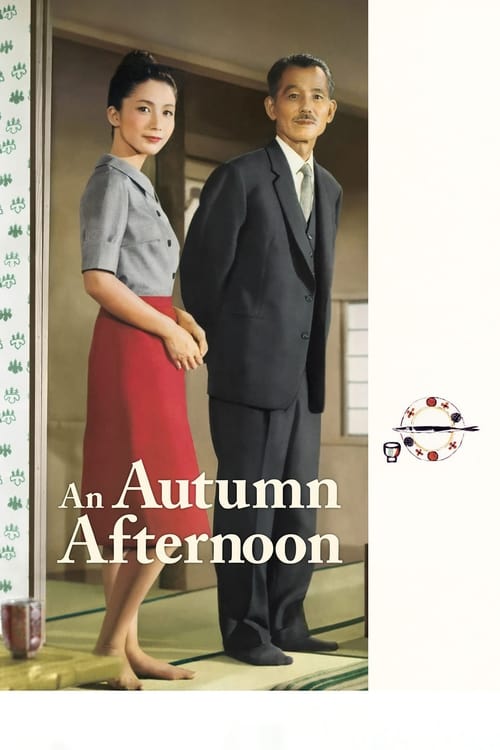
An Autumn Afternoon
1962 · Yasujirō Ozu
For a contemplative evening when you want something calm that still leaves a lump in your throat — a film about letting go, best watched when you're ready to think about your own parents or children. Comfort viewing on the surface, with a deep undertow.
What it's about
An aging widower in postwar Tokyo lives comfortably with his grown daughter, who keeps house for him. Over evenings of drinking with old friends and encounters that show him what lonely old age looks like, he slowly accepts that she deserves a life of her own — and sets about arranging her marriage, which means arranging his own solitude. It was Ozu's final film, and it feels like it.
The experience
Gentle, funny, and quietly devastating — the sadness arrives sideways, through small talk, bar-room banter, and what goes unsaid between father and daughter. It moves at the unhurried pace of daily life, and then a late scene lands with a weight the whole film has been carefully preparing.
Performances
Chishū Ryū, Ozu's lifelong leading man, gives one of the great performances of restraint: a father whose love and loneliness surface only in the smallest shifts of expression, culminating in a final scene of quiet heartbreak.
The craft
Ozu's signature style is at its most refined — the low, still camera at seated eye level, compositions of corridors and bar interiors in carefully placed color, scenes built from repetition and rhythm rather than drama. Everything important happens in the cut and the pause; it teaches you to watch differently within twenty minutes.
Why it matters
As Ozu's last completed film before his death, it stands as one of cinema's great farewells, and its father-daughter story distills themes he explored across decades. It remains a touchstone for filmmakers drawn to stillness, routine, and family as subject matter.
Snapshot
An Autumn Afternoon (Japanese title Sanma no aji, literally "The Taste of Pacific Saury") was the last film Yasujirō Ozu completed before his death in December 1963, and it stands as one of the most quietly resonant valedictions in world cinema. Produced by Shochiku and released in November 1962, it distills a set of concerns Ozu had circled for more than a decade — the aging parent, the daughter who must be released into marriage, the slow dissolution of a household — into an autumnal register shadowed by loneliness and the passing of time. Chishū Ryū, Ozu's lifelong screen surrogate, plays Shuhei Hirayama, a widowed salaryman who comes to understand that his devoted daughter Michiko should not spend her life caring for him. The film's Japanese title names a seasonal fish that never appears on screen; the "taste" is metaphorical, the bittersweet flavor of late autumn and late life. It is a film about doing the right and necessary thing and being left, at the end, alone with a bottle.
Industry & production
The film was made within the Shochiku studio system, the company to which Ozu had been contracted since the silent era and which had cultivated the shomin-geki — the drama of ordinary lower-middle-class life — as a house specialty. By 1962 Ozu was the studio's most prestigious veteran director, working with a small, stable production family: co-writer Kōgo Noda, cinematographer Yūharu Atsuta, and a recurring stock company of actors. The screenplay, as with all of Ozu's late work, was written with Noda over a long, ritualized collaboration — the two men were known to draft at Noda's mountain villa at Tateshina over months of talk and drink, measuring progress by the number of sake bottles emptied. This was the final screenplay of that partnership; Noda outlived Ozu but the collaboration ended here.
The production coincided with personal loss: Ozu's mother, with whom he had lived his entire adult life, died in early 1962, and the film's meditation on solitary old age has often been read against that biographical fact, though one should be cautious about collapsing the work into the life. Ozu himself would die on his sixtieth birthday, 12 December 1963, roughly a year after release, making An Autumn Afternoon an inadvertent last testament rather than a planned farewell.
Technology
The film was shot in color — Agfacolor stock, the process Ozu had adopted beginning with Equinox Flower (1958) and used for the remainder of his career. Crucially, Ozu shot in the standard Academy aspect ratio (1.37:1) at a moment when the Japanese industry, Shochiku included, had largely converted to anamorphic widescreen formats to compete with television. Ozu's refusal of the wide frame was a deliberate technological holdout: the boxy ratio suited his frontal, architecturally partitioned compositions, and he reportedly regarded the elongated screen as ill-fitted to the human figure and the domestic interior. The result is that his final films look, formally, out of step with their moment by design — color modernity housed in a "classical" frame.
Technique
Cinematography
Yūharu Atsuta, Ozu's camera operator and cinematographer of long standing, executed the director's rigorously codified visual system. The camera sits low, at roughly the eye level of a person kneeling on a tatami mat, and — famously — almost never moves. There are no tracking shots, no pans, no craning; the film is built entirely from fixed setups. Color, in this late work, becomes a precise instrument: against the muted grays, browns, and beiges of offices, corridors, and bars, Ozu places saturated accents — a red kettle, warm signage, spots of primary color — that organize the eye within the still frame. Depth is constructed through nested doorways and receding planes of domestic architecture rather than through camera movement. The cumulative effect is contemplative and pictorial, each shot composed to be held and read.
Editing
Ozu's cutting is as distinctive as his framing. He works almost exclusively in straight cuts, eschewing the dissolves, fades, and wipes that were standard punctuation in mainstream cinema; transitions between scenes are managed instead by cutaways to unpeopled spaces — corridors, exteriors, rooftops, signage — the "still lifes" or transitional shots that scholars, following Paul Schrader and Noël Burch, have variously described as tonal pauses or "pillow shots." Within dialogue scenes Ozu systematically violates the Hollywood 180-degree rule, cutting across the axis so that conversing characters seem to look in the same direction and frequently address the lens near-frontally. The rhythm is measured and symmetrical, a montage of static tableaux whose regularity is itself expressive.
Mise-en-scène / staging
The staging is governed by geometry. Figures are arranged in balanced, often frontal arrangements, seated at tables and in rows, their bodies aligned with the rectilinear grid of Japanese interiors — sliding doors, window frames, hallways. Ozu maintains a consistent graphic logic across cuts so that objects and bodies hold their compositional weight. The recurring settings — the office, the family home, and above all the bars and restaurants where the men drink and talk — become a network of similar boxes through which the characters circulate. Props are placed with near-ceremonial care, and the famous emptied domestic spaces at scene's end carry as much dramatic charge as the performances.
Sound
Kōjun Saitō's score is spare and recurrent, a light, slightly melancholic musical motif that returns to bind the episodic structure and to color transitions. Ozu uses music sparingly within scenes, letting dialogue and ambient quiet dominate. One of the film's most discussed uses of sound is the "Warship March" (Gunkan māchi) sequence, in which Hirayama, in a bar, encounters a former subordinate from his navy days; the martial tune summons the vanished world of wartime Japan and its defeat, and the two men half-jokingly wonder what would have happened had Japan won the war. Sound here does historical and emotional work at once, folding national memory into a barroom encounter.
Performance
Ozu's performance style is restrained to the point of stylization: actors deliver lines with measured evenness, minimal gesture, and frequent direct address toward the camera. Chishū Ryū, then in his late fifties, anchors the film as Hirayama with a weathered gentleness, his stoicism cracking only in the final scenes. Shima Iwashita, early in her career, plays the daughter Michiko with a poised reticence that makes her eventual acquiescence to marriage quietly devastating. The ensemble — Mariko Okada as the sharp, modern young wife Akiko, Nobuo Nakamura and Kuniko Miyake among the drinking companions, and Eijirō Tōno as Hirayama's derelict former teacher, "the Gourd" — works within Ozu's tightly controlled key, where feeling registers through inflection and stillness rather than display.
Narrative & dramatic mode
The film's dramatic mode is elliptical, episodic, and undemonstrative. Its ostensible plot — a father arranging his daughter's marriage — advances through conversations, drinking parties, and small social occasions rather than through crisis or confrontation; the decisive events (the marriage negotiation, the wedding itself) largely occur offscreen. Ozu structures the film around parallels and mirrors: Hirayama's own situation is refracted through "the Gourd," an old schoolteacher whose failure to marry off his daughter has left her a bitter, aging caretaker — a warning of what Michiko might become. A subplot involving Hirayama's married son Kōichi and his wife's petty consumer desires (a set of golf clubs, a refrigerator) grounds the film in the material texture of a modernizing, appliance-buying Japan. The dominant tone is one of gentle irony shading into elegy: the "right" outcome is achieved, and it empties the house.
Genre & cycle
An Autumn Afternoon belongs to the shomin-geki, the genre of everyday middle- and lower-middle-class domestic life that Ozu did more than anyone to define. More specifically it participates in the marriage-and-family cycle that runs through his postwar work — a group of films, several sharing titles evoking the seasons, that repeatedly stage the departure of a daughter and the loneliness of the parent left behind. It is frequently and rightly compared to Late Spring (1949), which shares the widower-marries-off-daughter premise and even the actor Chishū Ryū in the father's role; An Autumn Afternoon revisits that material from a colder, more solitary vantage, with the mother already dead and the father's isolation more absolute. The film thus reads as both a self-contained drama and the closing statement of a lifelong genre project.
Authorship & method
This is Ozu cinema in its most concentrated late form, and its authorship is inseparable from his method. The screenplay was co-written with Kōgo Noda, his collaborator on every film from Late Spring onward, whose ear for the rhythms of ordinary speech and structural sense of the family drama shaped the whole. Yūharu Atsuta operated the camera and realized Ozu's exacting low, static compositions. Kōjun Saitō composed the recurrent score. Editing, framing, and staging all conform to the personal grammar Ozu had refined over decades — the tatami-level camera, the frontal address, the cut-only transitions, the empty spaces. Ozu was famously autocratic on set about the placement of props and the exact delivery of lines, treating the film less as a record of spontaneous performance than as a fully premeditated construction. The consistency of his stock company — actors, writer, cinematographer, composer — makes the late films an unusually pure expression of a single sensibility.
Movement / national cinema
Ozu is one of the three directors (with Kenji Mizoguchi and, later, Akira Kurosawa) most often taken to represent the classical Japanese cinema on the world stage, though his international recognition came largely posthumously. Where the postwar Japanese New Wave (Ōshima, Yoshida, Imamura) — some of it emerging from within Shochiku itself — was in these very years attacking exactly the humanist, studio-bound tradition Ozu embodied, An Autumn Afternoon stands as the serene culmination of that older tradition rather than a response to the insurgency around it. It is a summit work of Shochiku's domestic-drama lineage and of a specifically Japanese mode of storytelling attentive to seasonal feeling, familial obligation, and the textures of daily life.
Era / period
The film is precisely situated in the Japan of roughly 1962: a nation seventeen years past defeat, in the midst of its high-growth "economic miracle," acquiring refrigerators and golf clubs and adopting Western consumer habits. This modernization is woven throughout — in the married son's household economics, in the young wife's assertiveness, in the office milieu — and set against the older generation's memories of the war, made explicit in the navy-veteran barroom scenes. The film registers a moment of transition: the salaryman's world of the present is haunted by the militarist past and quietly anxious about a future in which the family unit is thinning out. That period-consciousness — postwar prosperity shadowed by loss — is central to the film's melancholy.
Themes
The governing themes are aging, solitude, and the passage of time. Marriage functions less as romance than as a social and generational duty whose fulfillment isolates the one who performs it: to do right by his daughter, Hirayama must give her up and accept his own loneliness. The Gourd subplot dramatizes the alternative — the selfishness of keeping a child at home — as a cautionary mirror. Bound up with these are the erosion of traditional family structures under modernization, the tension between individual desire and familial obligation, and the specifically male loneliness of the drinking companions who fill their evenings with talk and sake. Over everything hangs mono no aware, the bittersweet awareness of impermanence that the seasonal title evokes; the final image of the father alone underscores that the natural order of things is also a form of bereavement.
Reception, canon & influence
Within Japan, Ozu was long an esteemed studio master, and An Autumn Afternoon was received as a distinguished late work by a revered director; his death a year later inevitably deepened its reputation as a farewell. Its international canonization, however, was a slower process. Ozu was for years considered "too Japanese" to export, and Western critical discovery came chiefly in the 1970s and after — landmark contributions include Paul Schrader's Transcendental Style in Film (1972), which read Ozu alongside Bresson and Dreyer; Donald Richie's monograph Ozu (1974); and David Bordwell's formalist study Ozu and the Poetics of Cinema (1988). Through these and through repertory programming, An Autumn Afternoon and its companion films entered the international canon, and the film now appears routinely on critical lists of the greatest ever made.
The influences on the film run backward through Ozu's own oeuvre — it reworks the material of Late Spring and the postwar family cycle — and through his lifelong admiration for American cinema, particularly the comedies of Ernst Lubitsch, whose lightness of touch Ozu often acknowledged, however transformed his own style became. The shomin-geki tradition and Shochiku house style are its immediate soil.
The influence forward is considerable and international. Ozu's contemplative style — the static long take, the attention to empty space and the rhythms of the everyday — became a touchstone for a later generation of directors drawn to a cinema of stillness and duration: Wim Wenders paid explicit homage in his documentary Tokyo-Ga (1985); Hou Hsiao-hsien, Abbas Kiarostami, Aki Kaurismäki, Jim Jarmusch, and Claire Denis are among those frequently linked to his example, and the Taiwanese director Kōji Yamada would later remake An Autumn Afternoon's sibling story as Tokyo Family. As Ozu's final film, it carries a particular weight in this legacy: the last, most refined statement of a formal language that has become one of world cinema's enduring alternatives to the conventions of Hollywood continuity.
A Deleuzian reading
There is a shot Ozu keeps cutting to that has no one in it.
The full Deleuzian reading of An Autumn Afternoon →
Reception
Released a year before Ozu's death, it was received in Japan as another quietly masterful late Ozu; over the decades it's been re-framed as his deliberate-seeming farewell, with cinephiles now reading its autumnal melancholy as a career-closing summation.
How An Autumn Afternoon was received, from release to now →
How to watch An Autumn Afternoon: what to notice on a first viewing
- Notice the camera never moves or tracks. Ozu builds the entire film from fixed, low setups, roughly the eye level of someone kneeling, with no pans or craning anywhere. Nothing rushes you toward a feeling. You're left to sit with whatever the frame is holding.
- Notice a single bright red object in each scene. Against muted grays and browns, Ozu drops in one saturated accent, a kettle, a sign, that organizes where your eye goes inside the still frame. One color ends up holding a scene's whole feeling on its own.
- Notice the shots of empty rooms between scenes. Ozu cuts to a corridor, a stairwell, or signage with nobody in it, holding on the empty space for a beat before the next scene starts. The emptiness is given the same weight as any performance in the film.
- Watch how directly characters seem to face the camera. Ozu has people speaking to each other address the lens almost frontally, delivering lines with the same measured evenness no matter what they're feeling. The restraint carries a social role, not a private feeling underneath it.
- Listen for how rarely music plays under a scene. Kōjun Saitō's score is spare and returns only occasionally, leaving ordinary dialogue and quiet to carry most of the film. Feeling has to come through in what people say plainly, since the music mostly stays out of it.
The whole guide to watching An Autumn Afternoon, with the keys for a rewatch →
Influences: the films it descends from and the films it influenced
- Late Spring (1949) — Establishes the exact marry-off-the-reluctant-daughter template and Ryū/Hara configuration that An Autumn Afternoon reworks, down to the vase-and-ceiling pillow shot that holds an unbearable beat before a cut.
- Tokyo Story (1953) — Codifies the tatami-level static camera and cut-only grammar — no dissolves, no dolly — with characters addressing the lens near-frontally across the 180-degree line that this film inherits wholesale.
- I Was Born, But... (1932) — Fixes the low waist-high camera and geometric frontality decades early, staging figures in rigorous parallel lines that become the fixed grammar of the late films.
- Trouble in Paradise (1932) — Source of Ozu's acknowledged debt: the 'Lubitsch touch' of eliding the decisive dramatic event off-screen, letting an object or reaction imply what a cut has withheld — Ozu's elliptical narration transposed.
- Tokyo-Ga (1985) — An explicit homage that films cameraman Yūharu Atsuta demonstrating Ozu's low tripod and pillow-shot method, canonizing the technique it documents.
- Stranger Than Paradise (1984) — Builds vignettes from locked-off static single-take frames separated by black leader — a Western repurposing of the pillow shot as inter-scene breathing space and cut-only rhythm.
- Café Lumière (2003) — A Shochiku-commissioned Ozu centennial tribute that translates the static domestic long take and empty-space transition into trains and Tokyo interiors, holding frames after figures exit.
- Five (2003) — Five extended fixed-frame long takes explicitly dedicated to Ozu, pushing the static-frame-plus-duration principle to its minimalist limit with no cutting at all.
- 35 Shots of Rum (2008) — Openly modeled on Late Spring's father-daughter separation, reproducing Ozu's restraint and the domestic-object motif (the rice cooker) standing in for unspoken emotion.
- Still Walking (2008) — Stages a family reunion in low domestic tatami-level compositions with corridor-and-doorway geometry and elliptical time jumps, extending the shomin-geki household grammar.
- The Match Factory Girl (1990) — Deadpan near-frontal static framing of a working-class figure with minimal camera movement and unadorned cut-to-cut editing, a Nordic descendant of Ozu's restrained frontal address.
- Tokyo Family (2013) — An explicit reverent remake of Ozu's family drama that replicates the low camera setups, generational-visit structure, and cut-only staging as direct tribute.
- Dust in the Wind (1986) — Distant, static wide tableaux of a rural family with trains and elliptical time and events dropped between scenes — the Ozu ellipsis and fixed frame absorbed into Taiwanese New Cinema.
- Eat Drink Man Woman (1994) — Refines the exact patriarch-loneliness Lee borrows: an aging father releasing his daughter into marriage, his feeling displaced into food-and-drink ritual rather than spoken, the gap between table decorum and interior grief held in the actor's face.
- My Sunshine (2024) — Season-as-title and low, static, boxy framing of everyday interiors — the squared-off, ground-level compositional discipline echoed in Okuyama's soft-boxy setups.
- Syndromes and a Century (2006) — Frontal, near-axial framing of seated figures conversing toward the lens plus interstitial 'pillow shots' of empty space — the frontal-interview staging Apichatpong repeats verbatim across his two halves.
- Equinox Flower (1958) — Ozu's first color film, where he pioneers the single red accent (the crimson teapot/kettle) punctuating muted interiors — the precise color-accent strategy carried into An Autumn Afternoon's compositions.
- Late Autumn (1960) — A near-immediate reworking of the same marriage-arrangement material with the same Noda-scripted rhythms of banal male chatter in bars, refined one iteration before this final statement.
- Jeanne Dielman, 23 Quai du Commerce, 1080 Bruxelles (1975) — Frontal, waist-level static tableaux of domestic ritual performed in near-real-time duration — an independently arrived-at parallel to Ozu's geometric frontality and attention to household routine.
- Perfect Days (2023) — Ozu's final film renders an aging solitary man's melancholy through routine and near-frontal, restrained performance — the affective register Wenders hands to Yakusho.
- Tokyo Twilight (1957) — Ozu's final film, reprising the identical Noda-scripted marriage-and-solitude structure with the same fixed 50mm low camera and restrained repertory performances, it is Tokyo Twilight's late-career twin recast in color.
- Our Little Sister (2015) — Seasonal titling as structural device and the ritual of shared meals/drink used to carry emotion that the dialogue withholds — Kore-eda's refusal of melodrama descends from this.
- Yearning (1964) — Ozu's final film shares the era's shomin-geki restraint, using diegetic quiet and eye-level composition to register familial resignation without underscoring.
Similar films
- Tokyo Story (1953) — influence & lineage · same viewing thread
- Still Walking (2008) — influence & lineage · same viewing thread
- Late Spring (1949) — influence & lineage
- Tokyo Twilight (1957) — same viewing thread
- Maborosi (1995) — same viewing thread
- After Life (1999) — same viewing thread
- Perfect Days (2023) — same viewing thread
- Tokyo Sonata (2008) — same viewing thread
All the films related to An Autumn Afternoon →
Watch it with: curated runs of related films
- The Weight of the Unspoken — A run of quietly shattering films where the largest feelings never get said aloud — love that outlasts reason, grief that gathers over a single family dinner, a long marriage cracked open by one old letter.