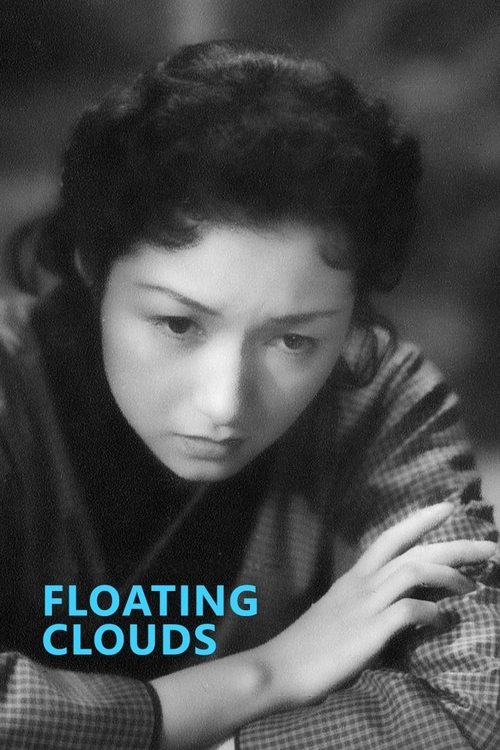
Floating Clouds
1955 · Mikio Naruse
For when you want heartbreak taken seriously — a rainy-evening film for sitting with love's unfairness rather than being consoled about it. Emotionally heavy but never punishing to watch.
What it's about
During the war, in the humid highlands of Japanese-occupied Indochina, a young typist named Yukiko falls in love with Tomioka, a married forestry official who promises to leave his wife. Back in defeated, rubble-strewn postwar Tokyo, she finds him again — and the affair resumes as a long drift of broken promises, poverty, and need, between a woman who cannot let go and a man who offers her almost nothing yet never quite releases her. It's one of Japanese cinema's great portraits of a love that survives everything except itself.
The experience
Melancholy in the deepest register — unhurried, clear-sighted, and quietly crushing, watching two people circle each other through years of disappointment. It doesn't jerk tears; it earns a slow, lasting ache.
Performances
Hideko Takamine gives one of the towering performances of Japanese cinema as Yukiko — devotion, pride, and self-destruction held in a single steady gaze — and Masayuki Mori makes Tomioka's weakness magnetic rather than merely contemptible.
The craft
Naruse's direction is famously invisible: plain compositions and patient cutting that accumulate into overwhelming feeling, with postwar Japan's shabby rooms and wet streets doing the emotional scene-setting. Adapted from Fumiko Hayashi's final novel, it's a model of how restraint can hit harder than melodrama.
Why it matters
Widely regarded as Naruse's masterpiece and the film by which he is measured, it stands at the summit of the Japanese golden age and remains the touchstone for unsentimental screen romance.
Snapshot
Floating Clouds (Ukigumo) is the film by which Mikio Naruse is most often measured, and the one most frequently named as his masterpiece. Adapted from the last, posthumously completed novel by Fumiko Hayashi, it follows Yukiko Koda (Hideko Takamine), a young typist who falls in love with Kengo Tomioka (Masayuki Mori), a married forestry official, during Japan's wartime occupation of French Indochina. In the humid highlands of Dalat their affair carries the lightness of a colonial idyll; back in a defeated, rubble-strewn Japan it curdles into a long, downward drift of broken promises, poverty, betrayal, and illness. Tomioka never leaves his wife, never keeps his word, and never quite lets Yukiko go; she, for her part, cannot detach herself from a man who offers her almost nothing. The film ends not with reconciliation but with death on the rain-soaked island of Yakushima. Understated to the point of severity, it is a study of erotic and national disillusionment in which the collapse of a love affair and the collapse of an empire are made to rhyme. It stands today as one of the central works of the Japanese studio "golden age" and a touchstone of the woman-centered melodrama (josei-eiga).
Industry & production
Floating Clouds was produced and distributed by Toho in 1955, at the studio where Naruse had spent most of his career since the mid-1930s. Naruse had trained at Shochiku in the silent era and moved to P.C.L. (Photo Chemical Laboratory), the company that would be absorbed into Toho; he was, by 1955, a veteran contract director of enormous productivity and modest public profile, working steadily within the studio system rather than as a celebrated auteur in the manner of Kurosawa. The mid-1950s were a commercial and creative peak for the Japanese industry, which was producing hundreds of features a year for a large domestic audience, and Toho's assembly-line efficiency suited Naruse's economical methods.
The picture belongs to a sustained collaboration between Naruse and the writer Fumiko Hayashi's body of work: he adapted several of Hayashi's stories and novels across the decade, including Repast (1951) and Late Chrysanthemums (1954), and Floating Clouds is generally regarded as the summit of that affinity. Hayashi had died in 1951, and the source novel was among her final works, which lends the adaptation an elegiac charge. Precise budget and box-office figures are not something the English-language record documents reliably, and I will not invent them; what is well established is that the film was a critical success rather than primarily a commercial vehicle, and that it consolidated Naruse's reputation among Japanese critics even as his international standing lagged behind that of his contemporaries.
Technology
The film was shot in black-and-white on standard 35mm in the Academy aspect ratio, consistent with mainstream Japanese studio practice of 1955, before the widespread domestic adoption of widescreen and color. There is nothing technologically experimental about the production; its resources are those of a well-run studio — sound stages, back-lot sets standing in for occupation-era Tokyo, and location work evoking the tropical highlands of Indochina and the wet southern island of Yakushima. The interest of the film lies entirely in how conventionally available tools — monochrome cinematography, optical dissolves, a post-synchronized soundtrack — are deployed with restraint. Naruse's technology is, in effect, the technology of transparency: the apparatus is made to disappear so that behavior and duration can be observed.
Technique
Cinematography
The cinematography is credited to Masao Tamai, a frequent Naruse collaborator, and it exemplifies the director's preference for a plain, legible visual field. Naruse favored eye-level or slightly low framings, medium shots that keep the human figure whole and grounded, and a camera that moves only when it must. The monochrome palette is used expressively without becoming ostentatious: the bright, high-key luminance of the Indochina flashbacks contrasts with the gray, rain-darkened tonalities of postwar Japan, so that the visual scheme itself charts the movement from possibility to exhaustion. Rain, mist, and low cloud recur as motifs — the "floating clouds" of the title made literal — and the final Yakushima sequences are among the most physically damp and enveloping images in Naruse's cinema.
Editing
Editing is where Naruse's genius is most often located, and it is famously self-effacing. Akira Kurosawa's much-quoted admiration described Naruse's style as a succession of shots that seem to flow like a calm river whose surface hides a fast, deep current — an observation usually taken to point at the seamlessness of his cutting. Naruse builds scenes from short shots joined so unobtrusively that the joins vanish; the rhythm is even, patient, and unemphatic, refusing the accents that would signal "important" moments. The film's long time-span — years of a relationship — is handled through elliptical transitions and flashbacks to Indochina, so that the past keeps welling up inside the present without melodramatic underlining.
Mise-en-scène / staging
The staging is intimate and constrained: cramped rented rooms, inns, offices, corridors, and trains. Naruse repeatedly places his two leads in confined interiors where physical proximity only sharpens emotional distance. Blocking tends to keep the characters slightly misaligned — one seated while the other stands, one turned away — a spatial grammar of non-reciprocity that expresses the imbalance of the affair. Objects and money (a watch, cash owed and unpaid, a share of a business) circulate through the mise-en-scène as markers of Tomioka's evasions. The environment is never merely backdrop; the shabby textures of postwar scarcity press in on the characters at every turn.
Sound
The score is by Ichirō Saitō, and it works, like the rest of the film, by restraint. Music is used sparingly to inflect rather than dictate feeling, and the film leans on the ambient sound of rain, trains, and interiors to establish its melancholic weather. Dialogue is naturalistic and often laconic; much of the drama's force comes from what is not said, from pauses and half-finished sentences. The relative quiet of the soundtrack is part of the film's ascetic design, withholding the swelling orchestration that a Hollywood melodrama of the period would have supplied.
Performance
The performances are the film's living center. Hideko Takamine's Yukiko is one of the canonical achievements of screen acting in Japanese cinema: she registers devotion, humiliation, resentment, and stubborn hope through minute adjustments of posture and expression, never pleading for the audience's sympathy. Takamine and Naruse worked together many times across his late career, and their understanding is palpable here. Masayuki Mori — familiar from Kurosawa's Rashomon and Mizoguchi's Ugetsu — plays Tomioka as a study in weakness: passive, self-pitying, chronically unfaithful, yet never a cartoon villain. The refusal to caricature him is essential; the tragedy depends on his being ordinary. The supporting playing, including the women Tomioka takes up with and abandons, sustains the same register of unforced realism.
Narrative & dramatic mode
The dramatic mode is that of the melodrama stripped of consolation — a "woman's film" turned toward tragic realism. The narrative is structured as a long decline rather than a rising-and-falling arc: from the moment the lovers return to Japan, the trajectory is almost uniformly downward, punctuated by brief reunions that promise change and deliver only repetition. Naruse threads flashbacks to Indochina through this decline so that memory functions as both refuge and reproach. Subplots — Tomioka's fatal entanglement with an innkeeper's wife, Yukiko's period as the kept woman of an American serviceman, an unwanted pregnancy, the predatory religious huckster who preys on Yukiko — widen the portrait of a society improvising survival amid moral disorder. The mode is anti-cathartic: the film denies the audience the redemptive turn its structure keeps seeming to offer, and its power lies precisely in that denial.
Genre & cycle
Floating Clouds sits within the josei-eiga, the woman-centered drama that flourished in Japanese cinema, and more broadly within the shomin-geki, the genre of everyday life among ordinary people that Naruse shared with Ozu. It is also a postwar picture in a specific cyclical sense: part of a wave of mid-1950s films reckoning with defeat, occupation, and social dislocation. Where some contemporaries treated the war and its aftermath directly and polemically, Naruse absorbs the national catastrophe into the intimate register of a failed romance, making Floating Clouds a distinctive hybrid — a love story that is also a defeat film. Within Naruse's own filmography it belongs to the cycle of Hayashi adaptations and to his recurring subject: women bound to men and circumstances that fail them.
Authorship & method
Naruse (1905–1969) is one of the four directors usually named as the pillars of classical Japanese cinema alongside Ozu, Mizoguchi, and Kurosawa, though he was the last of them to be rediscovered abroad. His authorship is defined by pessimism and economy. A frequently cited remark attributed to him holds that from an early age he felt the world betrays us — a sentiment his films dramatize with unusual consistency. His method was fast, unfussy, and famously reticent on set; he shot economically and edited invisibly, distrusting rhetorical flourish.
He worked here with a remarkable set of collaborators. The screenplay is by Yōko Mizuki, among the most accomplished screenwriters of the era, who shaped Hayashi's sprawling novel into a taut chronicle of decline. Cinematographer Masao Tamai supplied the plain, tonally precise imagery; composer Ichirō Saitō the sparing score. Above all, the film rests on the actor–director partnership with Hideko Takamine, whose collaboration with Naruse spans many of his finest late works and who furnishes Floating Clouds with its emotional gravity. The authorship is thus genuinely shared between director, writer, and star — a studio-era collaboration in which Naruse's sensibility is the organizing principle but not the sole source.
Movement / national cinema
The film is not the product of any manifesto-driven movement; it predates the Japanese New Wave and stands squarely within the classical studio tradition. It belongs to the mid-1950s efflorescence of Japanese national cinema that also produced the mature work of Ozu, Mizoguchi, and Kurosawa and that first brought Japanese film to sustained international attention after Rashomon's festival success earlier in the decade. Naruse's contribution to that national cinema is a strain of unsentimental domestic realism, focused on women and on the textures of ordinary economic life, distinct from Mizoguchi's pictorial grandeur and Ozu's formal rigor. If Ozu is the poet of resignation within the family and Mizoguchi the tragedian of women's sacrifice, Naruse is the chronicler of endurance without redemption.
Era / period
Floating Clouds is a film of 1955 that looks steadily backward at the years from wartime through the occupation, which formally ended only in 1952. Its period consciousness is acute: the black markets, the presence of foreign servicemen, the cheap inns and hot-spring towns, the desperate schemes and religious rackets are all rendered as the fabric of a society remaking itself after total defeat. The Indochina scenes belong to the vanished world of Japan's wartime imperial reach, and their brightness is inseparable from the knowledge that the empire that made them possible has collapsed. The film thus occupies two eras at once — a lost wartime "elsewhere" and a diminished postwar "here" — and its subject is the passage between them.
Themes
Its governing theme is endurance in the face of betrayal: Yukiko's refusal to abandon a man who repeatedly abandons her, and the film's refusal to reward that fidelity. Bound up with this is the parallel between private and national ruin — the defeated country and the failed affair as mirror images of squandered hope. Other themes recur throughout: the economic dependence and vulnerability of women in postwar Japan; memory as both solace and trap, with the Indochina idyll haunting a squalid present; the moral drift of a society under occupation; and the persistence of desire past the point where it can bring any happiness. The title's floating clouds supply the controlling metaphor — lives adrift, without anchor or destination, carried by forces they cannot direct.
Reception, canon & influence
Critically, Floating Clouds was recognized early in Japan as a major achievement and has only grown in stature. It is regularly placed near the summit of Kinema Junpo's periodic polls of the greatest Japanese films, in the company of Tokyo Story and Seven Samurai, and it is routinely cited as Naruse's finest work and as one of the supreme screen performances of Hideko Takamine's career. Naruse's broader international reputation came late — significant Western retrospectives and critical reappraisal arrived decades after his death in 1969 — but Floating Clouds has consistently been the film that anchors that reappraisal.
Its lines of influence run backward first to literature: the film is inseparable from Fumiko Hayashi's fiction, whose focus on struggling women and whose autobiographical melancholy Naruse translated to the screen across multiple adaptations, and it draws on the established traditions of shomin-geki and josei-eiga. Forward, its legacy is felt less through direct imitation than through the model it offers of anti-melodramatic emotional filmmaking — restrained, elliptical, unwilling to console. Naruse's example has been claimed by later admirers among filmmakers and critics who prize austerity of feeling over demonstrative style, and Floating Clouds is frequently the work through which his rehabilitation is argued. The specific downstream attributions are best stated cautiously, since influence of this kind is diffuse rather than documentary; what is not in doubt is the film's status as a canonical text of Japanese cinema and as the definitive statement of one of its great, long-underestimated directors.
Reception
A hit and instant classic in Japan — Kinema Junpo's best film of 1955 — but Naruse stayed nearly invisible in the West for decades, filed behind Kurosawa, Ozu and Mizoguchi until retrospectives from the 1980s onward crowned this as the missing masterpiece of Japan's golden age.
How Floating Clouds was received, from release to now →
Influences: the films it descends from and the films it influenced
- The Neighbor's Wife and Mine (1931) — Codifies the Shochiku shomin-geki grammar of lower-middle-class domestic observation — modest interiors, small economic anxieties dramatized without melodramatic escalation — that Naruse inherits as his baseline register.
- Wife! Be Like a Rose (1935) — Naruse's own early feature that first fixes his signature subject: a woman's quiet disappointment inside the family, staged in eye-level domestic space with cutting kept deliberately undemonstrative.
- Osaka Elegy (1936) — Establishes the unsentimental josei-eiga portrait of a woman degraded by men and money, refusing the consoling arc — the anti-cathartic template Naruse extends to a full chronicle of decline.
- The Only Son (1936) — Ozu's study of thwarted aspiration and economic defeat models the low, eye-level camera and the withholding of catharsis that Naruse shares, disappointment registered in posture rather than dialogue.
- The Life of Oharu (1952) — Its episodic structure of a woman falling through successive stations of betrayal supplies the descent-narrative shape — endurance without redemption — that Floating Clouds compresses into one relationship.
- Repast (1951) — Naruse's first Fumiko Hayashi adaptation, which establishes his method of shaping her prose into a chronicle of marital disenchantment through invisible cutting and a restrained, sparing score.
- Flowing (1956) — Follows directly with an ensemble of declining women in a failing geisha house, extending the same non-reciprocal blocking and economically observed interiors into a group portrait.
- When a Woman Ascends the Stairs (1960) — Later Takamine collaboration that continues the partnership's core craft — a woman's economic endurance amid male betrayal rendered through restrained voice-over and invisible cutting.
- Yearning (1964) — Late Naruse–Takamine work whose anti-cathartic ending and eye-level framing of impossible love make it the most direct formal heir to Floating Clouds within his own body of work.
- Still Walking (2008) — Inherits the shomin-geki mode of everyday domestic observation and buried resentment, dramatizing loss through mundane household routine and eye-level framing rather than confrontation.
- 35 Shots of Rum (2008) — Openly modeled on this lineage of Japanese domestic ellipsis — telling a story of quiet dependency through gesture, restrained scoring, and withheld information instead of expository dialogue.
- Café Lumière (2003) — Extends the non-reciprocal blocking and undemonstrative long-take observation of postwar Japanese domestic cinema, letting emotional currents pass between characters who rarely face or address one another directly.
- Yi Yi (2000) — Carries forward the tradition of undemonstrative, eye-level family observation in which private disappointment accumulates across small scenes without melodramatic release or authorial commentary.
- After the Storm (2016) — Mid-distance framing of a man whose self-image persistently outstrips his circumstances, held without authorial condemnation while the character rationalizes failure; Naruse's formal restraint in sustaining the shot past the moment of self-exposure directly informs Kore-eda's portrait of Ryota.
- The Twilight Samurai (2002) — Models the Shochiku/shomin-geki grammar of economic precarity — worn clothes, ledger-book anxiety, and understated melancholy — that Naganuma's muted palette renders as the visual texture of low-ranking samurai poverty.
- Late Chrysanthemums (1954) — Immediately prior Hayashi adaptation about aging, economically precarious women, using the same terse, unfussy editing and eye-level framing Naruse carries directly into Floating Clouds the following year.
- Lightning (1952) — Key entry in the Naruse–Hideko Takamine partnership, drawing the understated, interiorized performance style — feeling suppressed beneath a composed surface — that reaches full expression in Yukiko.
- Tokyo Story (1953) — Contemporary summit of anti-melodramatic Japanese filmmaking sharing eye-level framing, restrained non-diegetic scoring, and the refusal to underline grief — the same austerity-of-feeling Naruse practices.
- Sansho the Bailiff (1954) — Parallel Golden-Age treatment of suffering and endurance in which emotional devastation is staged in distanced, unemphatic compositions rather than close-up appeals to the viewer.
- Forever a Woman (1955) — Same-year Naruse chronicle of a woman physically wasting toward death, framing decline with the identical refusal of uplift or eroticization.
- Tokyo Twilight (1957) — A contemporaneous Shochiku-adjacent domestic drama of a woman's slow ruin, sharing Ozu's restrained-affect performance style and unrelieved fatalism while trading his static grid for a comparably austere study of postwar female suffering.
- Street of Shame (1956) — Naruse's contemporaneous portrait of a woman's economic dependency staged in unshowy medium shots that refuse uplift — the sibling sensibility locating a woman's fate in her material circumstances.
- Twenty-Four Eyes (1954) — Showcases Hideko Takamine's signature register of restrained, interiorized endurance — the same withheld, aging-into-sorrow performance she gives as Oishi-sensei.
Similar films
- Yearning (1964) — influence & lineage
- When a Woman Ascends the Stairs (1960) — influence & lineage
- Tokyo Story (1953) — influence & lineage
- The Life of Oharu (1952) — influence & lineage
- Sansho the Bailiff (1954) — influence & lineage
- Chikamatsu Monogatari (1954) — shared sensibility
- Forever a Woman (1955) — shared sensibility
- Late Spring (1949) — shared sensibility