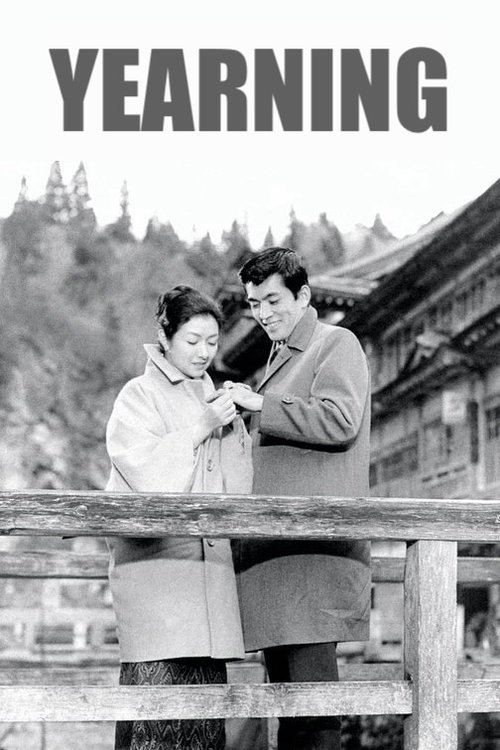
Yearning
1964 · Mikio Naruse
For when you want a grown-up, aching drama that trusts you to read faces — the kind of film you sit with in silence afterward. Not comfort viewing exactly, but deeply rewarding if you're in the mood to feel something real and unresolved.
What it's about
Reiko, widowed by the war, has spent eighteen years running her dead husband's family grocery shop, holding the household together through sheer discipline and self-denial. Now a supermarket has opened down the street, her in-laws are scheming to convert the little store out from under her, and her younger brother-in-law — a charming layabout she's watched grow up — upends her carefully ordered life by confessing he loves her. The film follows a woman squeezed between an economy that no longer needs her and a feeling she cannot allow herself to have.
The experience
Quiet, precise, and devastating by increments — the surface is small shop-front routines and family negotiations, but underneath it's about longing held under enormous pressure. It builds to an emotional force that catches you off guard precisely because everything before it was so restrained.
Performances
Hideko Takamine, Naruse's great recurring lead, gives one of her defining performances as Reiko — decades of suppressed feeling conveyed in posture and glances — and Yūzō Kayama plays against his matinee-idol image as the brother-in-law whose sincerity keeps wrong-footing her.
The craft
Naruse's direction is a masterclass in restraint: everyday spaces — the shop, the train, the family table — photographed and cut with such economy that a held look lands like a thunderclap. It braids an economic story about small shops dying in boom-era Japan with an intimate one, so the social detail and the heartbreak reinforce each other.
Why it matters
One of the crowning works of Naruse's four-decade career and of his long collaboration with Takamine, it stands among the great Japanese dramas of women's constrained lives — a touchstone for filmmakers drawn to emotion expressed through restraint.
Snapshot
Yearning (乱れる, Midareru — literally "to be in disarray" or "to be thrown into confusion") is one of Mikio Naruse's last major films, made for Toho in the penultimate stretch of a four-decade career. It stars Hideko Takamine, the actress most identified with Naruse's cinema, as Reiko, a war widow who has spent eighteen years managing the small grocery shop of her dead husband's family, only to find both her livelihood and her carefully policed emotional life destabilized at once: a supermarket opens nearby and threatens the store, while her younger brother-in-law Kōji (Yūzō Kayama), a dissolute matinee-idol type she has watched grow up, confesses that he is in love with her. The film braids an economic story — the extinction of the family-run shop during Japan's high-growth boom — with a story of forbidden, unactable desire, and drives both toward a devastatingly ambiguous conclusion aboard a train and in a provincial hot-spring town. It is widely regarded, alongside Floating Clouds (1955) and When a Woman Ascends the Stairs (1960), as one of the summit works of Naruse's late maturity.
Industry & production
Yearning was produced and distributed by Toho, the studio where Naruse spent the bulk of his career after earlier stints at Shochiku and P.C.L. By 1964 the Japanese studio system was contracting under the pressure of television and shifting audience habits, and the "program picture" — efficient, mid-budget, genre-anchored — was the industrial norm. Naruse was, by temperament and reputation, the ideal studio craftsman for this environment: fast, economical, undemonstrative, reliably on schedule and on budget. Yearning belongs to the late run of collaborations between Naruse and Takamine, a partnership that had by this point produced a substantial body of work and functioned almost as a repertory understanding.
The casting reflects Toho's roster strategy. Yūzō Kayama was one of the studio's most bankable young stars, then at the height of his popularity as the lead of the light "Young Guy" (Wakadaishō) comedies and shortly to appear in Kurosawa's Red Beard (1965); deploying such a clean-cut idol as a shiftless, drunken, disruptive suitor was a pointed inversion of his screen image and part of the film's charge. The screenplay was written by Zenzō Matsuyama, a leading scenarist of the period (and Takamine's husband), who supplied Naruse with a tightly constructed original scenario rather than one of the Hayashi Fumiko literary adaptations that anchor several other Naruse films. Beyond these headline credits, English-language documentation of the film's below-the-line production — budget, shooting schedule, exact location work — is thin, and I will not invent figures.
Technology
The film was shot in black-and-white anamorphic widescreen (Tohoscope, the studio's 2.35:1 CinemaScope-format system). By 1964 color was increasingly the default for prestige and commercial features, so the decision to work in monochrome reads as a deliberate aesthetic and tonal choice as much as an economic one: black and white suits the film's restraint, its grays of provincial shopfronts and train interiors, and its refusal of anything ornamental. The wide frame is used counter-intuitively — not for landscape spectacle but to isolate figures within domestic and commercial interiors, and above all to organize the long passages set inside moving trains, where the horizontal format lets Naruse stage two people side by side, held in the same shot, unable to face or escape each other. Location shooting on real streets, rail lines, and a hot-spring town grounds the drama in an actual, changing Japan rather than a studio abstraction.
Technique
Cinematography
The photography is functional in the best Naruse sense — legible, unshowy, subordinated to behavior — and it is generally credited to Jun Yasumoto. Compositions favor stable, eye-level framing and medium shots that keep social space intact: the shop counter, the family table, the aisles of the threatening supermarket, the cramped seats of a night train. Naruse's camera rarely announces itself; there are few conspicuous flourishes, little overt camera movement for its own sake. The widescreen frame does the expressive work quietly, placing Reiko within the geometry of doorways, shelving, and windows so that her confinement is architectural rather than editorialized. In the celebrated train sequences, the play of passing light and darkness across the actors' faces supplies almost all the "commentary" the film permits itself.
Editing
Naruse was famous among collaborators for an editorial sensibility that verged on subtraction — a habit of paring scenes to their minimum and cutting on the plainest possible logic of glance, gesture, and reaction. The film's rhythm is even and unhurried, built from short scenes that accumulate rather than from set-piece construction, so that the emotional pressure rises without any single climactic flourish until the final movement. The specific editor of record is not well documented in the English-language literature, and I will not attribute the credit speculatively; the editorial character of the film is best understood as an extension of Naruse's own method.
Mise-en-scène / staging
Staging is where the film's intelligence is most visible. Naruse organizes the household and the shop as a lived economy of obligation — who stands behind the counter, who sits where at meals, who is spatially central and who is marginal — so that Reiko's precarious position as an in-law who "married in," widowed, and still laboring for the family is legible in blocking alone. The supermarket, brightly stocked and impersonal, is staged as a spatial antagonist to the shadowed intimacy of the family store. Objects and thresholds carry the drama: sliding doors, stairwells, shop windows. In the train, the enforced adjacency of the two seats becomes the whole stage, and the impossibility of the situation is expressed as sheer physical proximity without contact.
Sound
Ichirō Saitō's score is used sparingly and without underlining, in keeping with Naruse's general aversion to musical emphasis; the film leans heavily on ambient and diegetic sound — the clatter of the shop, the mechanical rhythm and whistle of the train — to establish mood and to mark the intrusion of the modern. Silence and the withholding of music are themselves expressive tools, particularly in the closing passages, where the absence of scoring leaves the spectator alone with the characters' faces.
Performance
The film is, finally, a showcase for controlled performance. Takamine's Reiko is a masterclass in interiority: dignity maintained at cost, feeling registered in micro-adjustments of posture and expression rather than in outburst. Naruse was celebrated (and, by some actors, found maddening) for giving almost no verbal direction, trusting performers to find restraint on their own; Takamine's Reiko carries the whole ambiguity of the ending in a single held face. Kayama, cast against his idol persona, plays Kōji's aggression and self-pity without asking for sympathy, and the friction between his impulsiveness and her composure is the film's motor.
Narrative & dramatic mode
Structurally the film is bifurcated. Its first movement is a domestic-economic drama: the encroaching supermarket, the in-laws' scheme to convert the family shop and edge Reiko out, the slow revelation that eighteen years of loyal labor may count for nothing. Its second movement is a two-hander of thwarted desire that literalizes itself as a journey — the retreat from the settled house into the transient spaces of train and inn, where social supervision loosens just enough for the unsayable to be spoken and then to curdle. The mode throughout is domestic realism raised to something quietly tragic: no villains in the melodramatic sense, only people trapped by economics, propriety, and time. The ending is deliberately withheld from resolution; Kōji's death is presented obliquely, its intention unclear, and the film closes on Reiko's stricken, unreadable face rather than on any explanation. Meaning is left suspended in behavior.
Genre & cycle
Yearning sits at the intersection of two Japanese generic traditions: the shomin-geki, the drama of ordinary lower-middle-class life, and what is often called the "woman's film" — the strand of Japanese cinema centered on the constrained lives of women, to which Naruse and Mikio Naruse's near-contemporary Kenji Mizoguchi both contributed decisively. Within Naruse's own filmography it belongs to a long cycle of films about women who work, endure, and are quietly ground down by financial dependency and social expectation — a cycle running from Wife! Be Like a Rose! (1935) through Repast (1951), Late Chrysanthemums (1954), Floating Clouds, and When a Woman Ascends the Stairs. It is emphatically not melodrama in the demonstrative sense; its generic signature is understatement.
Authorship & method
The film is a definitive Naruse work — his sensibility is present in every choice toward restraint, economy, and the refusal of catharsis. His method was proverbially self-effacing: minimal camera assertion, minimal directorial explanation, an editor's instinct for what to remove. The authorship is also, crucially, collaborative in a way particular to this stage of his career. Takamine functions almost as co-author: her performances gave Naruse's austerity its human center, and Yearning is unimaginable without her. Zenzō Matsuyama's screenplay supplies the film's clean dual structure and its refusal of a tidy ending. Ichirō Saitō's scoring and Jun Yasumoto's photography realize Naruse's preference for the unemphatic. The result is a film whose "style" is almost a style of disappearance — the more powerful for how little it appears to be doing.
Movement / national cinema
Naruse is conventionally grouped with Ozu, Mizoguchi, and Kurosawa as one of the four pillars of classical Japanese cinema, though he was the last of the four to be recognized abroad. He belongs to no manifesto-driven movement; his work is the mature product of the studio-era Japanese mainstream, closest in spirit to Ozu's domestic focus but darker, more fatalistic, and more centered on economic precarity and female experience. Yearning appeared just as the Japanese New Wave (Oshima, Imamura, Yoshida) was defining itself in explicit reaction against exactly this kind of restrained studio humanism — which makes the film both a late classical statement and, implicitly, a rebuke to the idea that such classicism had nothing left to say.
Era / period
The film is precisely dated to its moment: the mid-1960s, at the height of Japan's postwar "economic miracle." Its central conflict — the supermarket versus the family grocery — is a direct dramatization of the structural transformation then reshaping Japanese retail and domestic life, in which small, relationship-based commerce was being supplanted by scaled, impersonal modernity. Just as important is the film's long backward reach: Reiko's identity is defined by a war that ended nearly twenty years earlier. She is a war widow whose entire adult life has been an act of loyalty to a dead husband and his family, and the film quietly asks what that loyalty was for, now that the society which demanded it is being dismantled by prosperity. The film thus holds two eras in tension — the sacrificial wartime/postwar past and the consumerist boom present.
Themes
The governing themes are duty and its exhaustion; the economic vulnerability of women dependent on family structures they do not control; the collision of tradition with a modernizing, commercializing Japan; and desire that cannot be acted upon without social catastrophe. Time is itself a theme — the eighteen years of unrewarded labor, the impossibility of recovering the past, the sense of a life given over to an obligation the world no longer honors. Above all the film is about repression as a lived condition: the psychic cost of a propriety that forbids not only action but acknowledgment. The Japanese title, Midareru — being thrown into disorder — names precisely what Reiko cannot allow herself to become, and what the film's ending nonetheless enacts.
Reception, canon & influence
Contemporary Japanese reception placed Yearning among Naruse's respected late works, though for decades his critical standing lagged behind that of Ozu, Mizoguchi, and Kurosawa in the West, where his films were slow to circulate. The major reappraisal came later: Audie Bock's writing on Japanese directors in the late 1970s helped introduce Naruse to Anglophone audiences, and a series of international retrospectives from the 1980s onward — culminating in large touring programs in the 2000s — established him as a master of the first rank. Catherine Russell's scholarly study The Cinema of Naruse Mikio: Women and Japanese Modernity (2008) gave the body of work, and films like Yearning, sustained academic treatment. In this reassessment Yearning is routinely cited among his four or five finest films, singled out for Takamine's performance and for the extraordinary restraint of its ending.
Looking backward, the film's influences are best understood as internal to the Japanese studio tradition and to Naruse's own decades of practice: the shomin-geki lineage, the woman's-film tradition it shares with Mizoguchi, and Naruse's long working idiom refined across earlier Takamine collaborations. It is not, so far as the record shows, a literary adaptation, which distinguishes it from much of his output.
Looking forward, its "influence" is more a matter of critical rediscovery than of a traceable school of imitators, and honesty requires saying so. Naruse's general aesthetic — patient, observational, economical, attentive to the textures of ordinary constrained lives — has been claimed as an ancestor by later art-cinema directors of domestic realism, and admirers among filmmakers and critics have repeatedly cited him during the retrospectives of recent decades. But direct, documented lines of descent from Yearning specifically are difficult to substantiate, and I will not manufacture them. The film's enduring standing rests less on what it visibly shaped than on what it perfected: a mode of tragic understatement that later generations came to recognize as one of the great achievements of Japanese cinema.
Reception
Naruse was barely known outside Japan for decades — the 'fourth master' overshadowed by Ozu, Mizoguchi and Kurosawa — and Yearning only found its global audience through the retrospectives and Criterion-era rediscovery that rehabilitated him. It's now routinely ranked among his two or three finest films.
How Yearning was received, from release to now →
How to watch Yearning: what to notice on a first viewing
- Notice who stands behind the counter and who sits at meals. Naruse blocks the household and shop so that Reiko's position as an in-law who married in and still labors for the family reads directly off where everyone is placed. You can see her precarious status in the family before anyone ever mentions it out loud.
- Watch how rarely the camera moves or announces itself. Naruse favors stable, eye-level medium shots that keep the geometry of doorways, shelving, and windows intact around Reiko, so her confinement reads as architecture, not commentary. The plain, steady camera lets the room itself do the work of showing you what confines her.
- Listen for the shop's clatter and the train's whistle instead of music. Ichiro Saito's score stays sparse and unemphatic, so the ordinary sounds of the shop and the train carry the mood and mark the modern world pressing in. The near-absence of music trains you to hear how much this film trusts plain sound over emotion cues.
- Watch Takamine's face for small adjustments, not big reactions. Takamine registers Reiko's feeling in micro-adjustments of posture and expression, dignity maintained at cost, rather than in any outburst or visible collapse. Her control is the whole performance: what she refuses to show is exactly what the film is about.
The whole guide to watching Yearning, with the keys for a rewatch →
Influences: the films it descends from and the films it influenced
- Wife! Be Like a Rose! (1935) — Naruse's own early sound feature establishes the subtractive editing rhythm and eye-level framing of ordinary domestic space that Yearning refines into pure understatement.
- The Only Son (1936) — Ozu's shomin-geki template of the low, static, eye-level camera observing lower-middle-class family economics without directorial commentary is the grammar Naruse inherits and pares further.
- Osaka Elegy (1936) — Mizoguchi's woman's-film centered on a heroine crushed by patriarchal economic obligation supplies the fallen-woman social-critique tradition Yearning channels through restraint rather than melodrama.
- The Life of Oharu (1952) — Mizoguchi's use of blocking and long-shot distance to encode a woman's descending social station is the staging-as-hierarchy method Naruse compresses into intimate medium shots.
- Repast (1951) — Naruse's first Hayashi Fumiko adaptation with Setsuko Hara sets the pattern of a discontented wife rendered through withheld emotion and diegetic domestic sound that Yearning perfects with Takamine.
- Late Chrysanthemums (1954) — Naruse's ensemble study of aging women and money worries develops the sparse, unscored observational sound design and casting-against-type that structure Yearning's austerity.
- Floating Clouds (1955) — The definitive Naruse–Takamine collaboration whose doomed, drifting romance and refusal of catharsis is the direct performance and narrative model Yearning reworks into its widow-and-brother-in-law tragedy.
- When a Woman Ascends the Stairs (1960) — Naruse's TohoScope Takamine vehicle proves anamorphic black-and-white can frame a trapped woman's interiority through eye-level medium shots, the exact widescreen idiom Yearning adopts.
- Scattered Clouds (1967) — Naruse's final film reprises Yearning's premise of forbidden mourning-love and train-adjacency motion, extending the withheld-resolution ending into color widescreen.
- Maborosi (1995) — Kore-eda's debut about a young widow's unspoken grief adopts Naruse's patient eye-level distance, expressive silence, and refusal of catharsis as a self-conscious inheritance of shomin-geki restraint.
- Still Walking (2008) — Kore-eda's domestic-realist family drama enacts Naruse's subtractive-minimalism and blocking-as-social-hierarchy within a single house, the acknowledged modern continuation of the Naruse–Ozu idiom.
- The Makioka Sisters (1983) — Ichikawa's ensemble woman's-film sustains the shomin-geki attention to female interiority and family economic decline, extending the tradition's restrained melodrama into later color cinema.
- Tokyo Story (1953) — Ozu's parallel postwar shomin-geki achieves tragic understatement through subtractive elision and a withheld emotional climax, the same restraint aesthetic Naruse practices in a more mobile register.
- Sound of the Mountain (1954) — Naruse's earlier Setsuko Hara film about suppressed longing between in-laws under one roof rehearses Yearning's exact taboo-desire situation staged through blocking and silence.
- A Woman's Life (1962) — A late Naruse woman's-film sharing Yearning's bifurcated structure of a wife's endurance across shifting family economics rendered in expressive silence.
- An Autumn Afternoon (1962) — Ozu's final film shares the era's shomin-geki restraint, using diegetic quiet and eye-level composition to register familial resignation without underscoring.
- Insect Woman (1963) — Imamura extends the woman's-film survival narrative but inverts Naruse's restraint into earthy naturalism, a contemporaneous descendant reacting against the studio understatement Yearning epitomizes.
- The Ballad of Narayama (1958) — Kinoshita's Takamine collaboration shares the actress's restrained-interiority method and the studio woman's-film's focus on a woman bearing familial economic burden.
Similar films
- When a Woman Ascends the Stairs (1960) — influence & lineage
- Floating Clouds (1955) — influence & lineage
- An Autumn Afternoon (1962) — influence & lineage
- Tokyo Story (1953) — influence & lineage
- The Life of Oharu (1952) — influence & lineage
- Maborosi (1995) — influence & lineage
- The Ballad of Narayama (1958) — influence & lineage
- Still Walking (2008) — influence & lineage