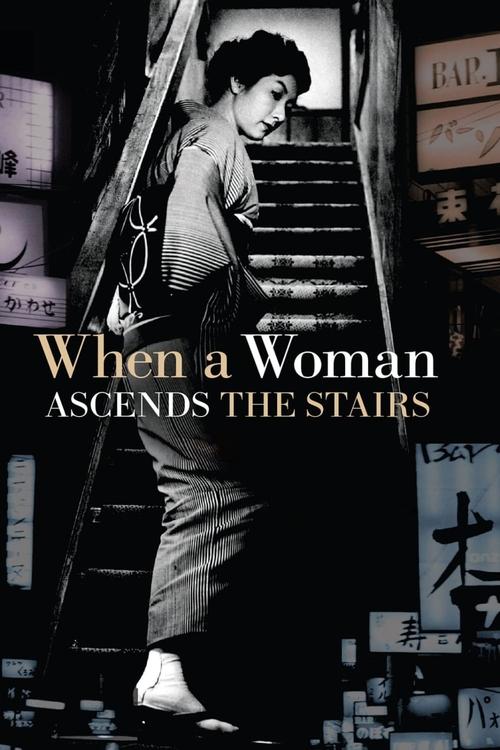
When a Woman Ascends the Stairs
1960 · Mikio Naruse
For when you want a grown-up, melancholy film to sit with — something patient and true about work, money, and loneliness that stays in your head for days. A reflective-evening film, not a pick-me-up, but deeply rewarding.
What it's about
Keiko — 'Mama' to her customers — is a thirty-year-old widow who works as a hostess in Tokyo's Ginza bar district, selling businessmen charm and the illusion of intimacy while carefully selling nothing else. Every yen goes to keeping up the wardrobe and lifestyle the job demands, and to a family that keeps taking. She narrates her own predicament with clear eyes: her options are to marry, to open a bar of her own, or to keep climbing that staircase every night — and each door has a cost.
The experience
Quiet, elegant, and quietly devastating — a film of small transactions and swallowed feelings where the tension comes from watching a dignified woman calculate her survival night after night. It doesn't raise its voice, and that restraint is what breaks you.
Performances
Hideko Takamine is extraordinary as Keiko — a performance of immaculate surfaces and flickering interior exhaustion, letting you see both the professional mask and the tired woman wearing it, often in the same shot.
The craft
Naruse's direction is precision itself: unshowy widescreen black-and-white compositions, a recurring staircase that becomes the film's whole world in one image, and an accounting of money — dresses, debts, tips, rent — so exact the film doubles as sociology. A cool, jazzy score seals its late-night Ginza atmosphere.
Why it matters
Widely regarded as the crowning work of Naruse's late career and a cornerstone of Japanese cinema's great tradition of women's stories, its clear-eyed portrait of emotional labor and economic precarity has only grown more contemporary.
Snapshot
Onna ga kaidan o agaru toki is Mikio Naruse's anatomy of the Ginza bar trade, told through Keiko Yashiro — "Mama" to her customers — a thirty-year-old widow who has spent five years selling company men the illusion of intimacy without selling them anything else. Running roughly 111 minutes in black-and-white TohoScope, it is at once the most sociologically precise film of Naruse's late period and one of the most formally austere: a study of a woman whose entire capital is her reputation, her wardrobe, and her ability to climb a narrow staircase every evening wearing a face she does not own.
The film arrived at a hinge moment. Japan in 1960 was convulsed by the Anpo protests over the U.S.–Japan Security Treaty and, months later, oriented toward Prime Minister Ikeda's Income Doubling Plan; the high-growth economy that would define the decade was assembling itself. Naruse's response was not to film the streets but to film the expense account — the corporate entertainment budget on which the Ginza's hostess bars ran, and the credit economy that ran beneath it. Almost every scene in the picture involves a sum of money: a bar tab, a loan, a dowry, a funeral contribution, a hospital bill for a nephew. What looks like melodrama is closer to accounting.
Hideko Takamine, in the seventeenth of her collaborations with Naruse, gives a performance built almost entirely from withholding. The title's ascent is the film's central irony: the stairs go up, the life does not.
Industry & production
The film was produced at Toho, where Naruse had been under contract since 1935, when he left Shochiku for the P.C.L. studio that became Toho. (The widely repeated account of that departure has Shochiku head Shiro Kido dismissing him with the remark that the studio did not need two Ozus — an anecdote that has hardened into legend and should be treated as such.) By 1960 Naruse was a senior company director with roughly three decades of studio work behind him, valued for efficiency: he shot fast, shot little, and finished on schedule, which bought him unusual latitude in choosing material.
The industrial context matters. Japanese admissions had peaked in 1958 and were beginning their long slide as television spread; the studios responded by increasing output, so 1960 sits at a strange summit of production volume and declining audience. Toho's programming leaned on genre — Kurosawa's The Bad Sleep Well, Honda's science fiction, comedy series — and Naruse's women-centered dramas occupied a mid-budget, star-driven niche justified by Takamine's box-office standing. Takamine was by then one of the biggest stars in Japan and had considerable control over her assignments; the Naruse–Takamine pairing was itself a production unit in all but name.
The screenplay came from Ryūzō Kikushima, an original story rather than the Hayashi Fumiko adaptation that had supplied so much of Naruse's postwar work (Repast, Late Chrysanthemums, Floating Clouds). Kikushima was primarily a Kurosawa collaborator — Stray Dog, Yojimbo, and, in the same year, The Bad Sleep Well — and this appears to have been his only script for Naruse. The pairing is revealing: Kikushima's recurring subject is the vertical architecture of money, which he would push to its most schematic in High and Low (1963). Here the vertical is a flight of bar stairs.
Detailed production records for the shoot — schedule, budget, location permissions on the Ginza — are not well established in English-language scholarship, and it would be invention to supply them.
Technology
Naruse shot in TohoScope, the studio's anamorphic widescreen process, at roughly 2.35:1, and in black and white. Both choices are meaningful. Color had arrived in his work with Summer Clouds (1958), and by 1960 color scope was the prestige default; returning to monochrome for a night-world picture was a deliberate retrenchment toward tonal control. The Ginza at night is a subject of blacks, whites, and reflected neon, and the film exploits high-contrast interiors — practicals on bar counters, backlit signage, the pooled light of a hostess's face — that color stock of the period would have flattened.
The anamorphic frame posed a real problem for a director whose grammar was built on tight domestic spaces. Critics have long observed that the wide frame suits Japanese interior architecture, with its horizontal registers of tatami, fusuma, and low furniture, and Naruse's staging exploits exactly that: figures distributed laterally across a room, separated by empty width rather than by cutting. But the film's signature space, the staircase, is aggressively vertical, and shooting it in scope means the frame is mostly wasted wall — a formal joke at Keiko's expense, the width of the image mocking the narrowness of her ascent.
Technique
Cinematography
Masao Tamai, a Toho veteran who shot much of Naruse's postwar output as well as Godzilla (1954), photographed the film. His work here is functional in the best sense: camera height near eye level, few conspicuous angles, and lighting that reads as source-motivated even when it is not. The bars are lit as if by their own lamps; the domestic interiors of Keiko's family are flat and unglamorous by comparison, so that the film's two economies are separated by exposure as much as by geography. Location work on the Ginza — neon, vertical signage, wet pavement — gives the picture a documentary underlayer that Naruse rarely sought so directly.
The recurring setup is the staircase: the camera placed so that Takamine climbs toward or away from it, the ascent presented frontally, without embellishment. Repetition does the work that emphasis would ruin.
Editing
Naruse's cutting is the most discussed and least documented aspect of his method. He was known for shooting minimal coverage, which meant the film was substantially determined at the camera; the credited editor's discretion was correspondingly narrow, and the historical record on the specific division of labor here is thin. What is visible on screen is an extreme ellipsis: scenes begin after their premise has been established and end before their consequence is stated. A confrontation is set up, then dropped; the next scene reveals its outcome obliquely, through a change in someone's finances or address. Transitions are frequently made on movement or on the departure of a figure through a door, so that the film seems to be continuously leaving rooms.
The effect is a narrative that accumulates rather than builds. Kurosawa's often-quoted description of Naruse's style — a great river with a calm surface and a violent current beneath — is a description of this editing above all.
Mise-en-scène / staging
Naruse's longtime art department gave him a set of interiors that function as economic diagrams: the bar as a lit box that customers enter horizontally and hostesses enter vertically; Keiko's rented room, small and provisional; her brother's house in a poorer district, cramped and cluttered with the evidence of dependents. The film's geography is a hierarchy, and Keiko commutes through it nightly.
Costume carries the argument. Keiko works in kimono while the younger hostesses — Junko conspicuously — wear Western dress. The kimono is not nostalgia; it is a product position. It marks Keiko as the traditional, expensive, restrained article in a market moving toward something faster and cheaper, and it costs money she does not have. Her wardrobe is simultaneously her means of production and her largest liability, a contradiction the film states in almost balance-sheet terms.
Staging within scenes favors distance: Naruse separates two people talking by the full width of the frame and lets the space between them do the emotional work. Thresholds, corridors, and stairs are where the film's decisions are actually made.
Sound
Toshirō Mayuzumi's score is the film's most surprising element. Mayuzumi was a serious modernist composer — his concert work of the 1950s put him among the most adventurous figures in Japanese music — and for the Ginza he wrote in a jazz and blues idiom, muted brass over a lounge pulse, that hovers between diegetic bar music and commentary. The score's cool, slightly soiled tone refuses to weep for Keiko; it simply keeps playing, the way the bars keep opening.
Against this, the film uses Keiko's first-person narration sparingly and pointedly. She opens the film as an analyst of her own trade, describing its economics with a clarity no one in the story ever hears, and the narration thins as her situation deteriorates — the voice that explained everything runs out of things it can afford to say. The domestic scenes are notably quiet; the contrast between the bars' clamor and the silence of the rooms where money is actually counted is one of the film's steadiest structural devices.
Performance
Takamine's Keiko is a study in the maintenance of a surface. The performance is organized around a professional smile that she puts on and takes off as a physical act, and around the small failures of that smile — a beat of delay, a fractional hardening — that constitute the film's real drama. When the body finally breaks, it breaks internally and off-schedule: an ulcer, blood, a collapse that is treated as an interruption of work rather than as a climax.
Around her, Naruse cast for texture. Masayuki Mori, the actor of Rashomon and Ugetsu, plays the bank manager Fujisaki with a mildness that turns out to be the film's cruelest instrument; Tatsuya Nakadai, a year before Yojimbo, plays the bar manager Komatsu in a subdued, watchful register unlike the roles that would make him famous; Daisuke Katō supplies the geniality of a suitor whose finances are fiction; Reiko Dan's Junko is the market's next generation, cheerfully ruthless. Keiko Awaji's Yuri, the hostess whose debts end her, is the film's warning that the trade has an exit clause.
Narrative & dramatic mode
The film is episodic and cyclical rather than causal. Its ostensible plot — Keiko wants to open her own bar, and needs capital, which means either a patron or a husband — is a frame on which the picture hangs a sequence of transactions: a colleague's suicide and the creditors who follow it; a marriage proposal that collapses when the suitor proves to be already married and financially fraudulent; an aging industrialist willing to back her only on the older terms of patronage; a night with Fujisaki that ends with the discovery of his wife and his transfer to Osaka; a subordinate's declaration of love that she cannot afford to accept.
None of these resolves. The dramatic mode is melodrama stripped of its compensations — no catharsis, no punishment of villains, no arrival. What remains is duration. The film opens with an ascent and closes with one, and the second is not a return to equilibrium but the discovery that there was never anything but the stairs. Naruse's refusal of climax is not coldness; it is a claim about what this life actually consists of.
Genre & cycle
The film belongs to two overlapping traditions: the josei eiga, or woman's film, and the shomin-geki, the drama of ordinary lower-middle-class life. More narrowly, it joins the long Japanese cinema of the mizu shōbai, the "water trade" of bars, geisha houses, and licensed quarters — a lineage running from Mizoguchi's Sisters of the Gion (1936) through Women of the Night (1948) to Street of Shame (1956), and including Naruse's own Late Chrysanthemums (1954) and Flowing (1956), both studies of aging women in the geisha economy.
What distinguishes this entry is its date. The Anti-Prostitution Law, enacted in 1956, came fully into force in April 1958, closing the licensed quarters and displacing that economy into bars and cabarets. When a Woman Ascends the Stairs is a film about the successor institution: legal, respectable, corporate-financed, and — as Naruse shows — structurally identical in what it extracts from the women who staff it. Keiko's insistence that she does not sleep with customers is both a genuine moral position and a marketing differentiator, and the film is honest enough to present it as both.
Authorship & method
Naruse (1905–1969) began at Shochiku in the late silent era with films of remarkable formal severity — Apart from You and Every-Night Dreams (both 1933) — and had his first international exposure with Wife! Be Like a Rose! (1935). After a fallow wartime and immediate-postwar stretch, his career restarted with Repast (1951) and the Hayashi Fumiko cycle that followed, and he worked steadily at Toho until Scattered Clouds (1967). The remark most often attributed to him — that from his earliest youth he had thought the world we live in betrays us — is quoted so consistently that it has become the standard gloss on his work, and it fits this film exactly.
His method was anti-expressive. No signature camera move, no rhetorical device, minimal coverage, and a preference for material about women whose options narrow rather than open. Where Ozu's style announces itself, Naruse's disappears, which is a large part of why his Western reputation lagged decades behind his peers'.
The key collaborators here are Takamine, whose partnership with Naruse across the 1950s constitutes one of the great actor–director bodies of work in any national cinema; Tamai behind the camera; Kikushima on the script, importing a Kurosawa-trained interest in institutional money into a domestic register; and Mayuzumi, whose jazz idiom gives the film a modernity its protagonist cannot access. Naruse's art department under Satoru Chūko, his frequent designer across the Toho years, later became the subject of an extended Japanese account of Naruse's set design and working method — one of the few detailed technical records of how these films were actually built.
Movement / national cinema
1960 is the year the Japanese New Wave broke: Shochiku released Ōshima's Cruel Story of Youth and Night and Fog in Japan, and a generation of young directors set out to demolish precisely the humanist studio cinema Naruse represented. That When a Woman Ascends the Stairs appeared in the same season is one of the useful accidents of film history. Ōshima's generation attacked the older cinema for sentimentalizing victimhood; Naruse's film is, on inspection, at least as unsentimental as anything they made, and considerably more specific about money. Its politics are simply immanent rather than declared.
Within the classical Japanese canon, Naruse occupies the position of the fourth master — grouped with Ozu, Mizoguchi, and Kurosawa in Japan, but for decades a name rather than a body of work abroad, since his films were rarely exported.
Era / period
The film is a document of the early high-growth years. Its bars are sustained by corporate entertainment budgets; its men are salarymen, bank officers, and company presidents whose expense accounts convert business into pleasure and back again. Keiko's precarity is legally specific: a war-and-postwar generation of widows with no pension, no property, and dependent relatives, operating in an economy that offered women almost no path to capital except through a man. The Constitution of 1947 had granted formal equality; the film is about the distance between that and a bank loan.
Television's rise, the closure of the licensed quarters, the salaryman's institutionalization — the picture registers all of them without naming any.
Themes
Money is the film's medium, not its subject: every relationship is denominated in it, and the film's cruelty lies in showing that Keiko's affections are not corrupted by money so much as unable to exist outside it. Adjacent to this is the labor the film anatomizes with unusual precision — the sustained production of warmth, attentiveness, and flattery as a paid service, decades before critical vocabulary existed for it. Aging appears as straightforward depreciation: Keiko at thirty is described, and describes herself, as approaching the end of her commercial life. Chastity functions as a brand asset. Female solidarity is real — the hostesses genuinely help one another — and structurally insufficient, since they compete for the same finite customers. And the staircase itself: the film's governing figure for a form of ascent that returns you nightly to where you began.
Reception, canon & influence
Documentation of the film's original domestic reception is thinner in English than the picture's later reputation would suggest, and specific award or box-office claims should not be asserted without sources. What is clear is that it did not travel at the time. Naruse was barely distributed in the West during his lifetime; his rediscovery came through retrospectives, notably the early-1980s European programming that accompanied Audie Bock's advocacy, and then through the large international touring retrospective of the mid-2000s that finally put the bulk of his surviving work in front of foreign audiences. Criterion's home-video release brought this film in particular to a wide English-language viewership, and it has since become the most common entry point to Naruse.
Looking backward, the film's inheritances are legible. Mizoguchi's studies of the licensed quarters supply the milieu and the moral framework, though Naruse declines Mizoguchi's tragic elevation. Hayashi Fumiko's fiction, which shaped six of Naruse's films, supplies the sensibility even in a script she did not write: the drifting woman, the unpaid bill, the small betrayal. The shomin-geki tradition of Shochiku in the 1930s, where Naruse trained, supplies the scale.
Looking forward, its influence is diffuse but real. Scholarly reassessment — Catherine Russell's book-length study of Naruse and Japanese modernity is the fullest English account — has repositioned him as the classical Japanese cinema's most acute analyst of women's economic life, and this film as the central text in that case. Among filmmakers, critics have persistently placed Hirokazu Kore-eda's domestic dramas in Naruse's line rather than Ozu's, a comparison Kore-eda has been more willing to accept than the Ozu one. The film's afterlife is also visible in the durability of its central image: a woman on a staircase, composing her face before the door at the top opens. It is one of the few genuinely irreducible metaphors in postwar cinema, and it works because Naruse never once explains it.
A Deleuzian reading
A narrow flight of stairs, shot head-on.
The full Deleuzian reading of When a Woman Ascends the Stairs →
Reception
Barely seen in the West for decades while Kurosawa, Ozu and Mizoguchi got the retrospectives, Naruse was rediscovered via touring programs and a 2007 Criterion release of this film — now it's most people's front door into his work and routinely ranked among the great Japanese films of its era.
How When a Woman Ascends the Stairs was received, from release to now →
How to watch When a Woman Ascends the Stairs: what to notice on a first viewing
- Watch Keiko climb the same staircase, straight on. Naruse frames the ascent frontally and returns to it again and again, without added emphasis, in the widest frame the studio owned. Repetition alone does the work: the widest frame Toho had is spent on the narrowest thing in her life.
- Watch who wears kimono and who wears Western dress. Keiko works in kimono while younger hostesses, Junko especially, appear in Western clothes, marking two different positions inside the same trade. Her wardrobe is both what she is selling and the biggest bill she cannot afford.
- Notice the empty space between two people talking. Naruse frequently separates speakers by the full width of the widescreen frame, letting the distance between them carry feeling a close two-shot would spell out. The blocking is doing what dialogue and close-ups usually do in other films.
- Listen for a sum of money named in nearly every scene. A bar tab, a loan, a dowry, a hospital bill: almost every conversation resolves into a specific figure, so the film tracks like a ledger. What looks like melodrama is closer to bookkeeping. The numbers are the real plot.
- Watch Takamine put on and take off her smile. The professional hostess smile appears and disappears as a visible, almost physical act, and its small failures, a beat of delay, a fractional hardening, are where the real performance lives. You can watch her manage her own face the way she manages every customer.
The whole guide to watching When a Woman Ascends the Stairs, with the keys for a rewatch →
Influences: the films it descends from and the films it influenced
- Sisters of the Gion (1936) — Establishes the licensed-quarter film as an accounting problem — patron, debt, kimono bought on credit — staged in lateral long takes where the woman and the man who owes her are held in the same frame without a reverse shot, the exact staging grammar Naruse inherits and strips of Mizoguchi's tragic crescendo.
- Every-Night Dreams (1933) — Naruse's own silent template for the bar-hostess picture: the waterfront café woman supporting a dependent, built from ellipses that cut past every decision and land on its aftermath, plus the anti-expressive refusal of the reaction shot he will still be using twenty-seven years later.
- Ginza Cosmetics (1951) — The direct prototype — a Ginza hostess measured in nightly takings, ages out of her own trade, and the film shot on the district's actual streets with neon and shopfront signage as the practical light source, a location method Tamai systematizes in 1960.
- Late Chrysanthemums (1954) — Hayashi Fumiko adaptation whose entire structure is a ledger: an ex-geisha turned moneylender receives visitors who each want a loan, and scenes are cut at the moment the sum is named, teaching Naruse the elliptical exit-on-the-figure that governs the later film's bar-tab scenes.
- Floating Clouds (1955) — The Naruse–Takamine–Tamai unit at full strength: Takamine's performance of withholding, in which humiliation registers as a half-second delay before she resumes speaking rather than as expression, and Tamai's flat, sourced interiors that refuse to key-light her face at emotional peaks.
- Flowing (1956) — Builds a declining geisha house as a vertical machine — stairs, landing, sliding door at the top — and blocks the whole film around who is permitted on which level, the architectural device Naruse compresses in 1960 into a single repeated ascent.
- Street of Shame (1956) — The Yoshiwara brothel filmed as a workplace with a payroll and a debt schedule, its women's fates decided by the anti-prostitution bill on the radio — the legislative displacement that created the Ginza hostess bar Naruse's film then anatomizes as the trade's respectable successor.
- Stray Dog (1949) — Kikushima's screenwriting method in embryo — narrative driven by the traceable circulation of a single object through an institution, with long documentary passages of a city's low-end commerce — which he transposes from police procedure to bar-hostess bookkeeping, giving the 1960 film its unusual specificity about capital, guarantors and start-up money.
- High and Low (1963) — Kikushima again turning cash into blocking: the first hour holds a fixed set in Tohoscope and stages a moral crisis entirely through where people stand relative to a suitcase of money, extending the lateral-separation-plus-ledger method into its most rigorous form.
- The Insect Woman (1963) — An explicit rebuttal built on the same chassis — a woman's life told as a serial employment history with the wage always specified, narrated in first person and cut in hard chapter-ellipses — but replacing Naruse's withholding with survivalist appetite, which only reads as an argument because the underlying ledger structure is identical.
- Flowers of Shanghai (1998) — Courtesan-house economics staged as nothing but negotiation in lamp-lit interiors, where every scene is a lateral pan across people discussing sums and the film fades to black between rooms — an extreme-ellipsis structure that never once shows the outside world or the sexual transaction the money is for.
- In the Mood for Love (2000) — Turns a staircase into the film's entire structure — the repeated descent to the noodle stall, scored to a returning cue, with the emotional event always occurring off-screen or after the cut — and lights the corridors from practical lamps so faces fall into shadow precisely when a Hollywood film would key them.
- Still Walking (2008) — A house-bound family drama choreographed on stairs and through sliding doors, where money and resentment pass in half-sentences and the camera stays on the person not speaking; Kore-eda's much-noted preference for the Naruse comparison over the Ozu one rests on exactly this — grievance is economic, and the film cuts away before anyone states it.
- Shoplifters (2018) — Naruse's technique of staging working-class characters within confined interiors so that physical compression externalizes psychological pressure prefigures Kore-eda's use of the single-room house as a container where proximity substitutes for legal family intimacy.
- Drive My Car (2021) — The specifically Japanese grammar of suffering expressed as perfect professional composure — interior devastation manifested through the performance of normalcy — that Hamaguchi cites as the behavioral and emotional model for characters whose grief never breaks the surface.
- Nobody Knows (2004) — The anti-melodramatic method of registering a woman's/family's economic precarity through withheld emotion and undemphasized daily hardship, refusing the crescendo the material invites.
- Like Father, Like Son (2013) — Naruse's 'restrained melodrama' — economic and class pressure that never erupts but grinds through composed everyday scenes — models Kore-eda's refusal to let the switched-babies premise tip into weepie.
- Yearning (1964) — Naruse's TohoScope Takamine vehicle proves anamorphic black-and-white can frame a trapped woman's interiority through eye-level medium shots, the exact widescreen idiom Yearning adopts.
- Happy Hour (2015) — Naruse's shomin-geki dramas centered on women navigating economic and marital constraint model the observational, undramatic attention to female interior life that structures Happy Hour's quartet.
- Like Someone in Love (2012) — The hostess-economy template — a woman commuting by car between clients, patrons and family obligation, with the night city sliding past the window as the recurring image of her indebtedness, played without melodramatic escalation.
- Suzaki Paradise: Red Light (1956) — A woman working a bar on the edge of the red-light district, shot on real riverside locations with the bar's own lamps and signs doing the lighting, and structured as a series of returns to the same doorway — the same use of a threshold as the unit of narrative measurement.
- Enjo (1958) — Mayuzumi's score used exactly as Naruse would use it — a modernist, non-diegetic idiom laid over a protagonist who has no access to the modernity it represents, so the music comments from a register the character cannot enter, plus black-and-white anamorphic composition in the same Daiei/Toho scope moment.
- The Bad Sleep Well (1960) — Kikushima's other 1960 script, and its structural twin: black-and-white Tohoscope in which corporate money is the antagonist and the widescreen frame is used for lateral separation — two people at opposite ends of the anamorphic rectangle, the space between them carrying the obligation neither will name.
- Girls of the Night (1961) — Made in the immediate wake of the same law, it follows former prostitutes into a rehabilitation home using location shooting and a flat, unaccented handling of degradation that withholds the redemptive climax the genre demands — the same refusal of uplift, from a director who had played Naruse's earlier hostesses.
- Jeanne Dielman, 23 quai du Commerce, 1080 Bruxelles (1975) — Prostitution rendered as household bookkeeping — the client elided by a closing door, the payment placed in a tureen on the table — with the drama displaced entirely onto domestic labor and the climax structurally refused until it arrives unearned, the same door-transition and anti-expressive performance logic pushed to duration.
- Tokyo Twilight (1957) — Extends the same understated shomin-geki portraiture of a woman trapped by money, family and disappointment, with an interior chamber-drama rhythm and suppressed emotion that parallel Ozu's method from an adjacent craft tradition.
- Our Little Sister (2015) — The restrained observation of women navigating economic and romantic disappointment with dignity rather than tears — the emotional temperature Kore-eda inherits from Naruse's female protagonists.
- Chikamatsu Monogatari (1954) — A parallel 1950s-studio anatomy of a woman trapped by mercantile debt and giri obligation, carried by interiorized performance and restrained domestic-tragedy dramaturgy.
- The Life of Oharu (1952) — Parallel strand of Japanese national cinema on female endurance and economic survival, staging a woman's slow attrition through restrained blocking and depth-composed interiors where money and dependence structure every frame.
Similar films
- Floating Clouds (1955) — influence & lineage
- Street of Shame (1956) — influence & lineage
- High and Low (1963) — influence & lineage
- Yearning (1964) — shared sensibility
- Forever a Woman (1955) — shared sensibility
- The Life of Oharu (1952) — shared sensibility
- An Autumn Afternoon (1962) — shared sensibility
- Tokyo Story (1953) — shared sensibility