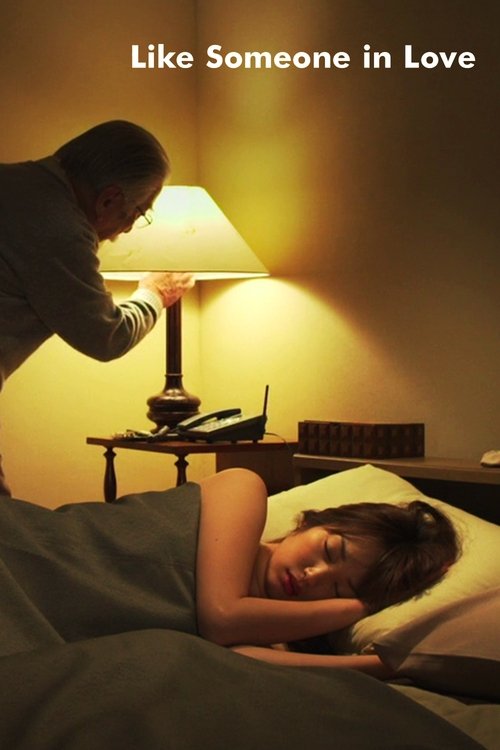
Like Someone in Love
2012 · Abbas Kiarostami
For a slow, thoughtful evening when you want a film that trusts you to lean in — something to turn over in your head for days rather than a story that hands you answers. Definitely a challenge pick, not a comfort watch.
What it's about
Over twenty-four hours in Tokyo, a sociology student who moonlights as an escort is sent across the city to the apartment of an elderly retired professor. He has cooked dinner and seems to want conversation more than anything else; she just wants to sleep. By morning their relationship has drifted into a strange new shape, as her jealous boyfriend mistakes the old man for her grandfather — and the old man doesn't correct him.
The experience
Quiet, patient, and deceptively gentle — long stretches of small talk and car rides that slowly tighten around you. It works by withholding: you keep waiting for the situation to be explained or resolved, and the tension of not knowing becomes the whole experience. The last minutes land like a slap.
Performances
Tadashi Okuno, a lifelong bit player given a lead role in his eighties, is extraordinary as the professor — courtly, wistful, and quietly evasive — and Rin Takanashi gives the exhausted young woman a tenderness that sneaks up on you.
The craft
Kiarostami shoots Tokyo largely through car windows and apartment glass, layering neon reflections over faces so the city seems to float across the characters. Conversations play out in long, unbroken takes with meticulous off-screen sound doing half the storytelling — a film that rewards good speakers and full attention more than a big screen.
Why it matters
Kiarostami's final completed fiction feature and his last made outside Iran, it proved a master of Iranian cinema could transplant his method whole into another language and culture, and its abrupt ending remains one of the most argued-over of its decade.
Snapshot
Twenty-four hours in Tokyo. Akiko, a sociology student who is pressured into escort work by the bar owner who manages her, is dispatched across the city to the apartment of Takashi Watanabe, an elderly retired academic and translator. He has cooked; he wants conversation, or company, or something he cannot name. She wants sleep, and to avoid the grandmother waiting for her at a train station she never gets out of the taxi to meet. The next morning he drives her to an exam, where her jealous fiancé Noriaki mistakes him for her grandfather — and Watanabe, without quite deciding to, accepts the part. The film then follows the fiction downhill until it detonates, off-screen and unresolved, in a final shot that ends the picture mid-gesture.
It was Abbas Kiarostami's second and last narrative feature made outside Iran, his only film in Japanese, and the last fiction feature he completed before his death in 2016. Premiered in competition at Cannes in May 2012, it is a chamber piece about substitution: what happens when three people agree, tacitly, to be someone other than themselves.
Industry & production
The film is a European-Japanese art-cinema co-production, financed principally through the French company MK2 — Kiarostami's producer on Certified Copy (2010) — in partnership with the Tokyo distributor and production house Eurospace. That structure is the point: by 2012 Kiarostami's work had migrated almost entirely into the European festival-and-subsidy economy. He had not made a fiction feature inside Iran since Ten (2002), and the political conditions for Iranian independent cinema had hardened sharply after 2009, with Jafar Panahi's arrest and filmmaking ban of 2010 the emblematic case. Kiarostami never framed his departure as exile in the political register some critics wanted; he described it more as curiosity about whether his method could survive translation. The financing model — French money, Japanese crew, an Iranian director with no Japanese — made that experiment institutionally possible.
Reported accounts of the production describe a project long in gestation, with the shoot affected by the aftermath of the March 2011 Tōhoku earthquake and tsunami, which disrupted work across the Japanese industry. Kiarostami said in interviews that the germ of the film was an image he had carried since an earlier visit to Tokyo: a young woman glimpsed on the street in a wedding dress, a figure whose incongruity he never resolved and eventually built a film around. He shot on location in Tokyo with a small crew and worked through interpreters.
The film premiered in competition at the 65th Cannes Film Festival, where the Palme d'Or went to Michael Haneke's Amour; Kiarostami, who had won the Palme in 1997 for Taste of Cherry, left empty-handed. It played the New York Film Festival that autumn and was released in the United States by IFC Films' Sundance Selects label in early 2013. Its commercial life was that of a specialty release — respectable for a subtitled auteur film, marginal in absolute terms. Precise grosses are not worth reciting here; the film's economics were festival economics.
Technology
Like Someone in Love belongs to Kiarostami's long digital period. He had been among the first major auteurs to abandon celluloid as a matter of principle rather than economy: ABC Africa (2001) was shot on consumer DV, Ten (2002) on two small cameras clamped to a car dashboard with no operator present, Five (2003) and Shirin (2008) likewise on video. He argued that lightweight digital capture removed the crew from the room and returned the actor to something closer to privacy.
Tokyo at night rewards that technology specifically. Much of the film is low-light exterior work seen through moving glass — neon smeared across a windscreen, signage doubling in a taxi window over a passenger's face — the kind of image that film stock renders as noise and a modern sensor renders as depth. The precise camera package is not well documented in accessible English-language sources, and it would be inventing detail to name one. What matters formally is that the image is digitally originated, held for long durations, and frequently exposed for the reflection rather than the subject behind it.
Technique
Cinematography
Katsumi Yanagijima photographed the film — a significant choice, since Yanagijima is best known as Takeshi Kitano's long-term cinematographer (Sonatine, Hana-bi, Dolls, Zatoichi), a body of work built on frontal, static, almost heraldic compositions punctuated by sudden violence. That grammar suits Kiarostami exactly.
The organizing device is glass. The opening sequence is a fixed shot of a bar interior in which we hear Akiko arguing on the phone before we know which of the women on screen she is; the camera declines to find her. The taxi ride that follows is the film's set piece: Akiko listens to her grandmother's accumulating voicemails while the city slides across the window in reflection, and asks the driver to circle the station a second time so she can see, without being seen, the old woman waiting by a statue. The city is superimposed on her face by physics, not by optical printing. Later, an elderly neighbor speaks to Akiko through a window grille, having watched Watanabe's apartment for years — surveillance rendered as neighborliness. The film's last event is a stone through a window: the glass that has mediated every relationship is finally broken, and the film stops.
Framing is largely static and often obstructed. Kiarostami and Yanagijima favour compositions in which the ostensible subject is partly occluded — by a car pillar, a doorframe, a reflection — so that the viewer performs the work of locating the drama.
Editing
Kiarostami edited the film himself, as he did most of his work. The cutting is sparse and long-take-based; whole scenes proceed in one or two setups. The consequential decisions are elisions. Akiko's night with Watanabe is skipped entirely: we do not learn what happened, and the film treats the question as vulgar. The beating Akiko receives from Noriaki occurs off-screen between shots. The ending is the boldest cut of all — an abrupt severance rather than a resolution, consistent with Kiarostami's long-stated preference for films that hand the last act to the audience. Critics divided sharply on whether this reads as rigor or as evasion; the argument has never been settled and probably cannot be.
Mise-en-scène / staging
Three spaces carry the film: a bar, an apartment, and a car. The car is Kiarostami's native architecture — the mobile confessional of Life and Nothing More, Taste of Cherry, The Wind Will Carry Us, Ten, Certified Copy — here transposed into a Tokyo of taxis, a compact sedan and a mechanic's garage. Two strangers facing forward rather than each other, speaking sideways, is the film's fundamental blocking.
Watanabe's apartment is dense with the residue of a scholarly life: books, a laid table, a record player, a framed picture of a young woman with a parrot that Akiko notices resembles her. The painting is the film's thesis in miniature — a portrait mistaken for a person, a resemblance doing the work of an identity, exactly as Watanabe will be mistaken for a grandfather and accept the role.
Sound
There is no score. Music is diegetic and scarce, and its central instance is the title: the 1944 Van Heusen–Burke standard "Like Someone in Love," played on a record in Watanabe's apartment — a song about the symptoms of love mistaken for the thing itself, which is precisely the film's subject.
Otherwise the soundtrack is location ambience and, above all, the telephone. Voicemail, ringtone, interrogation-by-mobile: Noriaki polices Akiko by phone, the grandmother reaches her only by recording, the bar owner dispatches her by call. Almost every relationship in the film is conducted through a device that transmits voice while withholding presence — a sonic rhyme for all that glass. Detailed credits for the sound team are thin in accessible sources, and I will not guess at them.
Performance
Casting is the film's most audacious gesture. Tadashi Okuno, who plays Watanabe, was by widespread report a career background player in Japanese film and television across many decades who had never carried a leading role; Kiarostami built the picture on a face with no star history attached to it. Rin Takanashi, then known chiefly from Japanese television, plays Akiko with a flat, exhausted opacity that resists both pity and eroticism. Ryo Kase — a familiar presence in international productions, from Letters from Iwo Jima to, later, Hong Sang-soo's Hill of Freedom and Scorsese's Silence — gives Noriaki a genuinely frightening ordinariness, the aggression of a man who believes he is being reasonable. Denden, memorable as the predatory tropical-fish dealer in Sion Sono's Cold Fish (2010), plays the bar owner with unnerving avuncular calm.
Kiarostami directed all of this without speaking Japanese, working through interpreters and attending to rhythm, gesture and hesitation rather than semantics — an extension of his lifelong practice of withholding full scripts from performers and shooting toward behavior rather than line readings.
Narrative & dramatic mode
The film is structurally a triangle that never closes. Each pairing — Akiko and Watanabe, Watanabe and Noriaki, Akiko and Noriaki — is built on a misapprehension the parties find it easier to sustain than to correct. The dramatic engine is not desire but impersonation drift: a small social lie (let the boy think you're her grandfather) accrues obligations until it becomes load-bearing, and then collapses.
Exposition is withheld as a matter of method. We never learn what Watanabe wanted, whether anything happened, what became of Akiko's grandmother, or what the stone means. The mode is closer to a Chekhovian short story or a Rohmer moral tale than to conventional screenplay architecture: incident is minor, stakes are entirely interior, and the ending is a cut rather than a conclusion. The unresolved close makes the preceding film retroactively unstable — the standard effect Kiarostami had been pursuing since Close-Up (1990) and Taste of Cherry.
Genre & cycle
Nominally a drama; functionally an anti-melodrama, built from the materials of the sex-work film and the May–December romance while refusing the payoffs of either. There is no seduction scene, no redemption, no exposure of a hypocrite.
Its true cycle is the late-career expatriate diptych with Certified Copy — two films about performed relationships made by a director working in languages and countries not his own — and, more broadly, the wave of festival auteurs making films abroad in the 2000s and 2010s. The essential comparison is Hou Hsiao-hsien's Café Lumière (2003), another Tokyo film by a non-Japanese master working under Ozu's shadow. Against Sofia Coppola's Lost in Translation (2003), Kiarostami's film is almost a rebuke: no jokes about Japanese strangeness, no outsider's bewilderment, the tourist's position simply refused.
Authorship & method
Kiarostami wrote, directed and edited. There is no composer, and that absence is authorial: he regarded non-diegetic music as a way of instructing the audience how to feel, and had largely eliminated it from his work.
The key collaborator is cinematographer Katsumi Yanagijima, whose Kitano-forged flair for the static frontal frame supplies the film's severity. The producing partnership with MK2 provided continuity from Certified Copy and the institutional means to work abroad. The performers, especially Okuno, function as collaborators in the Bressonian sense — models whose lack of technique the director treats as an asset.
The method itself is the through-line of Kiarostami's whole career: minimal crew, non-professional or unfamiliar faces, scripts withheld, long takes, refusal to show violence or death, an insistence that the film be finished by the spectator. He had described his ideal as a "half-made" cinema, incomplete by design. Working in Japanese removed his last remaining control — the words — and arguably clarified the method rather than damaging it.
Movement / national cinema
Kiarostami is the central figure of the Iranian New Wave's second phase, the internationally visible generation that ran from Where Is the Friend's House? (1987) through Close-Up, the Koker films, and Taste of Cherry, and that shaped how world cinema understood Iran for two decades. Like Someone in Love stands almost entirely outside that context — and its critics said so, some arguing that the Iranian specificity was exactly what gave the ellipticism its stakes.
Within Japanese cinema the film is a visitor with unusually good manners. Ozu comparisons were made by nearly every reviewer and are not idle: Kiarostami had already made Five Dedicated to Ozu (2003), five static long takes offered as homage. But the film's actual thematic ancestry runs closer to Mizoguchi's Street of Shame (1956) and Naruse's When a Woman Ascends the Stairs (1960) — the mizu-shōbai films about women whose labor is intimacy, and about the ledger such work keeps.
Era / period
Contemporary Tokyo, circa 2011–12: a post-bubble city of student debt, precarious work and total telephonic reachability, filmed shortly after the Tōhoku disaster without ever mentioning it. The film's most contemporary element is its infrastructure of surveillance — Noriaki's control of Akiko is exercised almost entirely through her handset, and the grandmother's love arrives as voicemail. It is one of the earlier art films to treat the mobile phone not as a prop but as the medium in which relationships now fail.
For Kiarostami it marks the terminus of a late period defined by mobility and abstraction. He died in Paris on 4 July 2016, leaving a project in China unrealised; the experimental 24 Frames (2017) was completed posthumously. Like Someone in Love is therefore his last completed narrative feature, and its unfinished ending has acquired a retrospective poignancy the film never asked for.
Themes
Substitution. Every character stands in for someone else: Watanabe for a grandfather, Akiko for the girl in the painting and for whatever Watanabe has lost, Noriaki's fiancée for a woman who does not exist. The film argues that identity is largely a matter of what others need us to be.
Knowledge and its refusal. Watanabe is a scholar and translator; Akiko is a sociology student who cannot attend her own exam. Both are professionally concerned with understanding, and neither understands anything about the other. The synopsis's formulation — she knows nothing about him, he thinks he knows her — is the film's precise thesis.
Mediation. Glass, phones, mirrors, records, reproductions. Intimacy is always transmitted through something, and the film's climactic violence consists of a medium being broken.
Care and its coercion. Watanabe's kindness is real and also purchased; Noriaki's love is real and also violent; the grandmother's devotion is real and also a debt. The film declines to sort them.
Generational obligation, finally, in a Japanese context where filial duty is culturally explicit — the abandoned grandmother by the station is the film's moral wound, and it never heals because Akiko never gets out of the car.
Reception, canon & influence
Critical reception at Cannes and after was respectful and genuinely split. Admirers — including a substantial cohort of English-language critics who placed it on year-end lists — read the film as a distillation: Kiarostami reduced to pure structure, with the taxi sequence singled out almost universally as among the finest things he ever shot. Detractors found it thin, an exercise in withholding by a director whose late work had become a set of moves, and the ending drew the sharpest fire, dividing the Cannes press between those who saw a rigorous refusal of closure and those who saw a director walking away from a problem he had created. It won no major prize at Cannes and did not achieve the immediate canonical position of Close-Up or Taste of Cherry.
Backward. The lineage is legible. Rossellini — whose Voyage to Italy was the acknowledged model for Certified Copy — supplies the idea that a relationship can be reconstituted by a misunderstanding. Bresson supplies the non-professional "model," the flattened performance and the refusal of psychology. Ozu supplies Tokyo, the elderly man and the frontal domestic frame, via Kiarostami's own explicit 2003 dedication. Mizoguchi and Naruse supply the social substrate. And Kiarostami's Persian literary inheritance — the elliptical quatrain, the poetry of Forough Farrokhzad, whose line gave The Wind Will Carry Us its title — supplies the conviction that the unsaid carries more than the said.
Forward. Its influence is real but diffuse, and it would be dishonest to claim a school. The clearest resonance is with the international art cinema of displaced authorship that followed — Hong Sang-soo's Hill of Freedom (2014), which cast Ryo Kase as a foreigner adrift in a language he half-speaks, sits in visible conversation with it. More broadly, the late Kiarostami mode of unresolved endings, glass-mediated compositions and performed relationships has become part of the shared vocabulary of contemporary festival filmmaking, from Ryusuke Hamaguchi's dialogue-driven car interiors to a generation of slow-cinema directors for whom withholding is the default grammar. Hamaguchi's Drive My Car (2021) in particular takes up the automobile-as-confessional and the performance-that-becomes-real, though he has cited a wide range of sources and any direct line should be described as convergence rather than debt.
Its most durable claim on the canon may be circumstantial: as the last narrative film by one of cinema's essential modernists, it ends mid-sentence, which is either the perfect close to that career or an accident that looks like one. Kiarostami, who spent thirty years insisting that the audience finish the film, would probably have been content with the ambiguity.
A Deleuzian reading
A taxi goes around the same traffic circle twice.
The full Deleuzian reading of Like Someone in Love →
Reception
Divisive at Cannes 2012 — plenty of critics left baffled, even annoyed, by that ending — but after Kiarostami's death in 2016 it was reappraised as his final narrative feature, and the enigma started reading like a fitting last word.
How Like Someone in Love was received, from release to now →
How to watch Like Someone in Love: what to notice on a first viewing
- Watch the city reflected across Akiko's face in the taxi. Katsumi Yanagijima lets neon and passing buildings slide across the glass and settle directly onto her face, city and person overlapping in the same shot. You cannot tell where the reflection ends and the woman herself begins.
- Listen for how many relationships happen only by phone. A grandmother reaches Akiko only through voicemail, a fiance interrogates her by call, a boss dispatches her by phone, voices arriving with no one actually present. Nearly every bond in the film is carried by a device that transmits a voice while withholding a person.
- Notice two people in a car facing forward, not each other. Kiarostami's characters sit side by side in taxis and sedans, speaking sideways rather than face to face, the car becoming the film's basic confessional space. Looking straight ahead together is how these strangers get closest to honest.
- Notice the framed photo of a young woman on his wall. In Watanabe's apartment hangs a picture of a woman with a parrot that Akiko notices looks like her, an old resemblance quietly placed among his things. A likeness on a wall is already doing the work an actual relationship would normally have to do.
- Watch how often something blocks your view of who's speaking. Compositions keep a doorframe, a car pillar, or a reflection between you and whoever is talking, so you have to work to find the drama in the frame. The obstruction makes you do the looking yourself instead of handing you the scene.
The whole guide to watching Like Someone in Love, with the keys for a rewatch →
Influences: the films it descends from and the films it influenced
- Voyage to Italy (1954) — Supplies the structural premise Kiarostami reworked in *Certified Copy* and again here — a couple's status is reconstituted by a stranger's misreading — with the car interior used as the two-shot chamber where the relationship is negotiated rather than dramatized.
- Tokyo Story (1953) — Source of the low, locked-off frontal domestic frame and of the elderly Tokyo man attended by a young woman not his blood; Kiarostami's explicit 2003 dedication (*Five*) makes the debt to Ozu's near-axial staging and refusal of conventional reaction coverage a declared one.
- L'Argent (1983) — The Bressonian 'model' — untrained performers delivering flattened, unpsychologized readings — combined with Bresson's terminal device of keeping the climactic violence entirely off-frame and cutting the film before its consequence can be absorbed.
- Street of Shame (1956) — Gives the film its social substrate: paid sex staged as wage labor brokered by telephone and by an intermediary who books the client, observed in sustained wide takes that decline to enter or moralize the transaction.
- When a Woman Ascends the Stairs (1960) — The hostess-economy template — a woman commuting by car between clients, patrons and family obligation, with the night city sliding past the window as the recurring image of her indebtedness, played without melodramatic escalation.
- Jeanne Dielman, 23 quai du Commerce, 1080 Bruxelles (1975) — The frontal, immobile domestic tableau in which a woman's sex work registers only as offscreen labor and schedule, scoreless throughout, and the precedent for ending on an abrupt unmetabolized rupture with nothing to cushion the cut.
- Three Colours: Red (1994) — Ancestor for the telephone as the actual dramatic channel — voices of people the film never shows — and for the unclassifiable charge between an aging solitary man and a young woman whose intimacy is built from overheard speech rather than contact.
- Close-Up (1990) — The originating experiment in mistaken identity as structure: a non-professional sustains a false role that others accept, and the director casts people to perform adjacent versions of themselves rather than characters.
- The Wind Will Carry Us (1999) — Systematizes withheld exposition and the telephone as medium — a protagonist whose errand is never stated, in constant phone contact with interlocutors the camera refuses to reveal, so that the offscreen carries the plot.
- Taste of Cherry (1997) — Establishes the car as confessional: driver and passenger in alternating frontal windshield framings, talking around the thing neither will name, and a film that terminates by rupturing its own fiction instead of resolving it.
- Ten (2002) — The dashboard-fixed static frontal camera that hands all staging to uninterrupted takes inside a moving vehicle, with the city admitted only as reflection on the glass and as ambient diegetic sound.
- Certified Copy (2010) — Immediate predecessor: shot abroad in languages the director does not command, with two people assuming a relationship they may never have had, sustained through long dialogue takes and glass-reflected two-shots in a car.
- Hill of Freedom (2014) — Casts Ryo Kase as a foreigner conducting his entire emotional life in a language he only half-speaks, built from static single-take conversational two-shots and a deliberately shuffled, gap-ridden narrative order.
- Drive My Car (2021) — Convergence rather than declared debt: takes up the automobile as confessional chamber and the rehearsal that becomes real, staging its most exposed exchanges as frontal in-car compositions between two people who confess precisely because they are not facing each other.
- Asako I & II (2018) — Extends the double-and-substitution figure — a woman confronted by an exact likeness of the man she loved — played in flat, affectless registers that leave the identity swap unadjudicated at the cut.
- Café Lumière (2003) — The parallel case of a non-Japanese auteur shooting Tokyo in an Ozu register on commission: static long takes, trains and glass surfaces, and a woman's private situation kept as withheld exposition rather than disclosed.
- Yi Yi (2000) — Sibling in treating window glass as a compositional layer — figures framed behind panes where the reflected city doubles them — so that urban surfaces perform the psychological work a close-up would otherwise do.
Similar films
- Certified Copy (2010) — influence & lineage
- The Wind Will Carry Us (1999) — influence & lineage
- Taste of Cherry (1997) — influence & lineage
- Drive My Car (2021) — influence & lineage
- Close-Up (1990) — influence & lineage
- Tokyo Story (1953) — influence & lineage
- Through the Olive Trees (1995) — shared sensibility
- Ikiru (1952) — shared sensibility