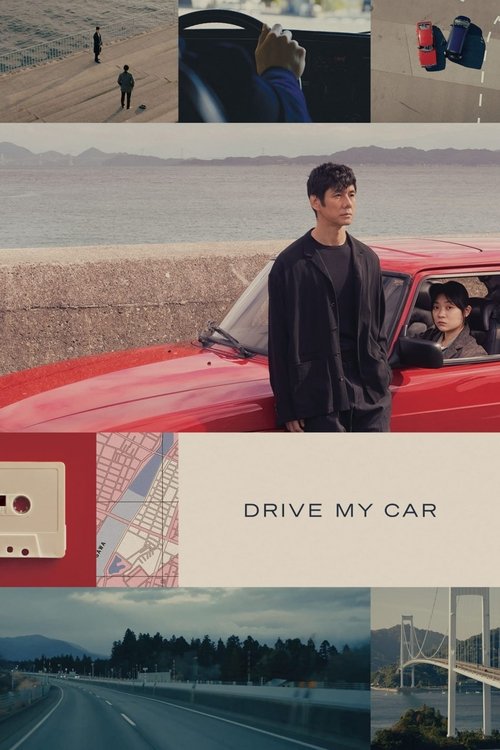
Drive My Car
2021 · Ryusuke Hamaguchi
Drive My Car's surprise Best Picture nomination made three-hour Japanese Chekhov adaptations a mainstream conversation topic; "the Hamaguchi pace" is now cinephile shorthand for durational patience as pleasure.
For a patient, contemplative evening when you want a film to sit with your own losses — the kind you carry around for days afterward. This is a challenge that pays off in tenderness, not a light watch.
What it's about
Two years after losing his wife, a stage director accepts a residency in Hiroshima to mount a multilingual production of Chekhov's Uncle Vanya. The festival insists a quiet young woman chauffeur him in his beloved old red Saab, and the drives — plus long rehearsals where actors speak past each other in different languages — slowly pry open what he's been avoiding. It's a story about grief, a marriage with secrets, and what it costs to say another person's words out loud.
The experience
Slow, hushed, and hypnotic — three hours that glide by like a night drive, with conversations that seem casual until they suddenly land like a punch to the chest. It doesn't jolt you; it accumulates, and the last stretch is quietly devastating.
Performances
Hidetoshi Nishijima plays the director with a stillness that makes every small crack in his composure enormous, and Toko Miura, as the driver, does wonders with silence — two people learning to talk by barely talking.
The craft
Hamaguchi builds the film out of rehearsal scenes, car interiors, and long two-person conversations, and somehow makes that riveting; even the placement of the opening credits is a quiet formal surprise. The road photography and the calm rhythm of the editing reward an uninterrupted sitting with no phone in reach.
Why it matters
It won the Academy Award for Best International Feature and broke into the Best Picture race — rare air for a non-English-language film — cementing Hamaguchi as a defining voice in contemporary Japanese cinema.
Snapshot
A three-hour elegy on grief, language, and the ethics of inhabiting another person's words, Drive My Car adapts Haruki Murakami's short story of the same title from the 2014 collection Men Without Women, expanding it into a formally rigorous, emotionally devastating drama. Stage actor and director Yusuke Kafuku, having lost his screenwriter wife Oto to a sudden cerebral hemorrhage, travels to Hiroshima to mount a radically multilingual production of Chekhov's Uncle Vanya, accompanied by a taciturn young woman named Misaki assigned as his driver. The film won the Academy Award for Best International Feature Film at the 94th Oscars, became only one of a handful of non-English-language films ever nominated for Best Picture, and confirmed Ryusuke Hamaguchi as the defining figure of contemporary Japanese art cinema. Its achievement lies in making Chekhovian duration and moral paralysis feel urgently cinematic rather than stagily literary.
Industry & production
Drive My Car was produced by C&I Entertainment with support from the Japan Art Fund and in association with BUG FILMS. The project grew directly from Hamaguchi's sustained engagement with Murakami's fiction: rather than adapting the title story alone, he and co-writer Takamasa Oe drew structural and thematic material from at least two other stories in Men Without Women — most notably "Scheherazade," whose motif of a woman weaving compulsive night-time narratives becomes Oto's defining habit — to construct a screenplay of substantially greater length and complexity than the source. The film runs 179 minutes, a duration Hamaguchi defended not as indulgence but as the minimum necessary for the viewer to experience time the way grief does.
Filming took place across multiple Japanese locations including Hiroshima, Tokyo, and Hokkaido, the last of which supplies the film's desolate epilogue landscape. The production followed Wheel of Fortune and Fantasy, Hamaguchi's anthology feature shot around the same period; both premiered at Berlin and Cannes respectively in 2021, an extraordinary dual showing that marked the year as his international breakthrough. Drive My Car's budget was modest by international art-film standards; precise figures have not been widely disclosed, and the film does not fit the profile of a major studio venture — it belongs to the tradition of producer-driven auteur filmmaking that sustains mid-scale Japanese cinema outside the major studio system.
Technology
The film was shot digitally, in the widescreen aspect ratio that allows the Saab 900's red interior to function as a contained, intimate frame-within-a-frame. While the specific digital camera package has not been foregrounded in production materials, the image has the characteristic qualities of high-resolution digital capture common to contemporary Japanese art productions — controlled grain structure, precision in low-light interiors, and a flatness in outdoor sequences that resists romantic beautification. Eiko Ishibashi's score exists partly as diegetic cassette tape recordings, blurring the distinction between soundtrack and story: the cassette Oto made of Uncle Vanya — on which she voices every character including those Kafuku himself will play — is reproduced through the car's tape deck with conspicuously analog warmth, a deliberate low-fidelity against the clarity of the digital image.
Technique
Cinematography
Hidetoshi Shinomiya, who had previously photographed Hamaguchi's Asako I & II (2018), shoots Drive My Car with a rigorous plainness that refuses to aestheticize sorrow. The camera rarely moves for expressive purposes; instead it holds on faces at unhurried medium-close range, or frames the Saab from outside as it moves through city or mountain road, the interior dimly visible through glass. This glass-and-car motif — Kafuku and Misaki often seen through windshields, their reflections doubling the characters — literalizes the film's recurring concern with oblique self-knowledge, with the difficulty of seeing oneself clearly. Shinomiya's palette is cool and overcast for most of the Hiroshima sequences; when warmth enters, it is conspicuous, almost suspicious.
Editing
Editor Azusa Yamazaki makes the film's most radical formal argument: the title card for Drive My Car does not appear until approximately forty minutes into the running time, after a prologue that in any conventional film would constitute a short feature in itself. This prologue — covering the full arc of Kafuku's marriage, Oto's erotic storytelling sessions, the discovery of her infidelity, and her death — is not labeled or separated; it simply runs. Audiences unaware of this strategy often experience genuine disorientation when the title finally appears. The effect is less a trick than a philosophical statement: grief cannot be skipped past, and the film requires you to have lived alongside Oto before it can ask you to mourn her. Elsewhere Yamazaki's cuts are unobtrusive, organized by the rhythms of performance and conversation rather than by conventional dramatic beats.
Mise-en-scène / staging
The multilingual Uncle Vanya production within the film is the conceptual centerpiece. Hamaguchi casts Kafuku's company with actors performing in Korean, Mandarin, Japanese, and Korean Sign Language — the last embodied by an actress (Park Yurim) who is Deaf and signs throughout, her performance neither subtitled onscreen nor explained, presented as legitimate theatrical language on equal terms. The choices are not merely cosmetic diversity: they dramatize Chekhov's theme of people unable to reach one another, literalising it across language barriers. The staging sequences are filmed with a calm observational authority, the camera treating the rehearsal room as a found space rather than a constructed one.
The car itself is the film's other principal stage. The red Saab 900 functions as a mobile confessional: isolated from the world, moving but not arriving, its seats arranged so that driver and passenger face forward rather than each other — a spatial configuration that Hamaguchi exploits to enable a form of sideways intimacy, confessions delivered to the windshield rather than to a face.
Sound
The sound design is structured around the cassette recordings Oto made — her voice performing all roles in Vanya, including Sonya, so that Kafuku rehearses his own lines against the ghost of his wife voicing every other character. This is not underscored or emotionally signaled; it is presented as a practical working method that has tipped into something more compulsive and painful. The tape hiss and warmth of analog playback contrast with the silence of Misaki's driving. Ishibashi's score, mostly strings and sparse keyboard, enters late and sparingly; its restraint means that when it rises, the emotional impact is considerable.
Performance
Hidetoshi Nishijima as Kafuku gives one of the great performances of recent Japanese cinema in a mode that resists legibility. Kafuku is a man who has trained himself not to react — he closes his eyes for a long beat before speaking, he conducts rehearsals with preternatural calm — and Nishijima inhabits this controlled surface while permitting grief to leak through it at intervals that feel genuinely unguarded. Toko Miura as Misaki is equally meticulous in her stillness; the two actors must establish intimacy without conventional markers of warmth, and they succeed through accumulation, through the slow accrual of shared hours in a car.
Hamaguchi's documented rehearsal method — requiring actors to read lines in a deliberately affectless, neutral register before adding emotional inflection — produces a particular quality of delivery: words are heard as words before they are felt as feeling, and the audience registers both the text and the character's relation to it simultaneously. This technique, developed most elaborately in the 317-minute Happy Hour (2015), was refined for the professional cast here, producing performances that feel inhabited rather than demonstrated.
Narrative & dramatic mode
Drive My Car operates in what might be called the confessional pastoral: characters move from city to a provisional, temporary space — the festival hotel, the rehearsal room, the car — and there excavate buried truths through extended conversation. The dramatic mode owes more to the late Chekhov of Uncle Vanya and Three Sisters than to conventional film narrative; problems are not solved but arrived at, circled, partly articulated. The film's climax is not an action but a speech: Misaki's account of her own trauma, delivered in the barren snowscape of Hokkaido, which in turn illuminates the climactic speech Sonya delivers at the end of the embedded Vanya production. Hamaguchi sets these two confessions in dialogue, one fictional, one personal, suggesting that drama — at its best — gives language to what direct conversation cannot.
Genre & cycle
The film sits at the intersection of several formations: the Japanese literary adaptation (Hamaguchi is part of a tradition that includes adaptations of Mishima, Oe, and Ogawa); the Chekhovian slow cinema practiced internationally by filmmakers like Carlos Reygadas, Béla Tarr, and Kelly Reichardt; and a specifically post-2000 cycle of Japanese films engaging with grief, silence, and survivor guilt (Hirokazu Kore-eda's work is the obvious reference, though tonally distinct). It is also legible within a global art-cinema conversation about performance and meta-theatrical doubling — films in which actors performing plays become conduits for meaning that exceeds the drama — a lineage that includes films by Olivier Assayas and Lars von Trier among others.
Authorship & method
Ryusuke Hamaguchi (b. 1978) studied film at Tokyo University of the Arts (Tokyo Geidai) under Kiyoshi Kurosawa, and his graduate research centered on the work of Hong Sang-soo — an influence legible in his interest in conversation as a primary cinematic event, in repetition as structure, and in the gap between what characters say and what they mean. His broader formative influences include John Cassavetes (the use of extended rehearsal and semi-improvisational preparation), Eric Rohmer (the moral comedy of talk, the literary adaptation), and Mikio Naruse (the observation of emotional constraint as a social condition specific to Japanese domestic life).
Co-writer Takamasa Oe has collaborated with Hamaguchi on multiple projects; the partnership produces screenplays of unusual density, structured around dialogue that bears re-reading and re-hearing. Hidetoshi Shinomiya (cinematographer) and Azusa Yamazaki (editor) are key recurring collaborators who have shaped the visual and temporal signature of Hamaguchi's mature work. Eiko Ishibashi, a musician and composer outside the mainstream film industry, brings a sensibility rooted in experimental rock and free improvisation; her score does not comment on the action so much as it extends the film's emotional atmosphere.
Movement / national cinema
Drive My Car arrives at a moment when Japanese art cinema has reasserted itself on the international festival circuit after a period in which Korean and Chinese cinemas had dominated critical attention. The film is continuous with a strain of Japanese filmmaking — associated with Kore-eda, Kawase Naomi, and Ogigami Naoko — that proceeds by accumulation and understatement, that distrusts melodrama, and that treats family and domestic space as the primary arena of moral life. It departs from this strain in its density of literary reference and its explicit engagement with theatrical form; the Chekhov is not merely a backdrop but a structural argument, and the film reads as a work in which cinematic thinking and theatrical thinking are inseparable. In this respect it connects Hamaguchi to a tradition of Japanese directors with deep stage backgrounds, though Hamaguchi himself comes primarily from cinema and critical theory.
Era / period
The film belongs to the post-3/11 moment in Japanese cultural life — though it does not address the 2011 earthquake and tsunami directly, the critical language that has grown up around it invokes a climate of unprocessed loss and the inadequacy of existing emotional vocabularies. More immediately it reflects the period of its production: the Hiroshima setting carries its historical weight quietly, as geography rather than symbol; the festival world of international co-productions and multicultural casting reflects an early-2020s art-cinema milieu that is consciously cosmopolitan.
Themes
The film's central inquiry is into the ethics and costs of language: Oto wrote stories and screenplays, refining raw experience into narrative; Kafuku inhabits written roles, speaking other people's words as a profession; Chekhov's Vanya speaks words no one wants to hear. At issue throughout is whether language can genuinely transmit interiority, or whether all speech is performance, all intimacy provisional. The car as confessional — a space without eye contact, with motion as its rhythm — suggests that some truths can only be told in transit, in a mode of not-quite-arrival.
Grief is the film's emotional substrate, but Hamaguchi is specifically interested in withheld grief, in the damage done by knowledge that arrives too late for the known to be confronted. Kafuku knew of his wife's infidelity but chose not to speak; now she is dead and the conversation cannot happen. Uncle Vanya stages the same structure at every level: characters who did not act when they could have, who face the remainder of their lives with the knowledge that the decisive moment has passed. Hamaguchi does not offer consolation, but he does suggest — through Sonya's final speech, through Misaki's eventual thaw — that language, however inadequate, is the only instrument available.
Reception, canon & influence
Drive My Car won the Best Screenplay award (Prix du scénario) at the 2021 Cannes Film Festival, where it competed in the main selection — a recognition that foregrounded the screenplay's structural ambition rather than merely its literary source. At the 94th Academy Awards (2022) it won Best International Feature Film and received nominations for Best Picture, Best Director, and Best Adapted Screenplay. The Best Picture nomination was widely noted as historically exceptional for a Japanese-language film; the film's commercial distribution in North America through Janus Films and streaming through MUBI gave it unusual visibility in Anglophone markets for a three-hour Japanese drama.
Influences on the film (backward): The Chekhovian inheritance is the most visible: not only the play-within-film, but the film's structural and moral assumptions — the sense that drama consists in what is not said, that time accumulates into revelation — are deeply Chekhovian. Hamaguchi's debt to Hong Sang-soo is traceable in the use of digressive conversation as the site of incident. Cassavetes's improvisational preparation and Rohmer's morally precise treatment of talk are documented influences. Within Japanese cinema, Naruse's films of emotional constraint — particularly Floating Clouds (1955) and When a Woman Ascends the Stairs (1960) — model the kind of suffering that manifests as perfect composure. Lee Chang-dong, whose Poetry (2010) similarly uses artistic practice as a vehicle for grief, is a proximate contemporary reference; Hamaguchi has spoken of the Korean new wave as formative.
Legacy (forward): The film arrived at a moment when "slow cinema" was being reassessed — accused by some critics of European festivalisation, of an aesthetic of deliberateness that had hardened into formula. Drive My Car met that critique not by speeding up but by making its duration feel necessary and its slow movement feel charged. Its influence on subsequent festival filmmaking is already apparent in a heightened interest in embedded theatrical text, in the car as intimate space, and in multilingual casting as a formal rather than merely political gesture. Hamaguchi's subsequent international profile has ensured sustained critical attention; the film is already a fixture on end-of-decade lists and in syllabus discussions of twenty-first-century world cinema. Whether it will prove as durable as the Chekhov it honors is the kind of question only time — the film's own most patient subject — can answer.
A Deleuzian reading
A man drives before dawn.
The full Deleuzian reading of Drive My Car →
Reception
It won Best Screenplay at Cannes in 2021, then just kept snowballing — sweeping the big US critics' prizes and becoming the first Japanese film ever nominated for Best Picture at the Oscars. Five years on it hasn't cooled off; it went almost straight from festival darling to consensus modern classic.
How Drive My Car was received, from release to now →
Influences: the films it descends from and the films it influenced
- Ten (2002) — The dashboard-mounted static camera recording unbroken conversations between driver and passengers established the formal template for the car-as-confessional: a windshield-framed space where sustained intimacy is achieved precisely because neither party has to maintain eye contact.
- Taste of Cherry (1997) — The windshield as compositional frame and the digressive philosophical conversation conducted through it — a man driving through arid hills whose passengers become reluctant confessors — is the direct formal ancestor of Misaki's car as a space where disclosure becomes possible only through motion.
- Right Now, Wrong Then (2015) — Structural repetition that reveals character through minute variation in what is said and omitted; digressive meal-table conversation as the primary site of dramatic incident — the Hong inheritance Hamaguchi absorbed through graduate-level study and that structures his characters' circling approaches to truth.
- My Night at Maud's (1969) — Extended moral-philosophical conversation in intimate enclosed spaces treated as the entire dramatic event; the intellectualised grammar of self-justification through spoken exchange that Hamaguchi inherits and transposes into Chekhovian register.
- When a Woman Ascends the Stairs (1960) — The specifically Japanese grammar of suffering expressed as perfect professional composure — interior devastation manifested through the performance of normalcy — that Hamaguchi cites as the behavioral and emotional model for characters whose grief never breaks the surface.
- Poetry (2010) — Artistic practice — here a poetry class — used as the vehicle through which a protagonist who cannot name her grief directly is forced toward language; the static-observational camera that watches a person learn to speak what they have been suppressing.
- Opening Night (1977) — The rehearsal process as a site where the boundary between actor and role dissolves; Gena Rowlands working through personal trauma via her stage character models the core mechanism of Hamaguchi's affectless-rehearsal method and its consequences for both Kafuku and Yusuke.
- Scenes from a Marriage (1973) — Extended confessional dialogue between two people across a series of intimate spaces treated as the complete dramatic event; duration held as formal necessity for the slow excavation of everything a couple has withheld from each other and themselves.
- The Sweet Hereafter (1997) — Literary adaptation (Russell Banks novel) structured around fractured temporality; an embedded poem — the Pied Piper, read aloud as counterpoint — functions structurally as Drive My Car's Uncle Vanya does: a borrowed text that reframes a community's unacknowledged grief as moral allegory.
- Tokyo Sonata (2008) — Hamaguchi inherits Tokyo Sonata's complete formal vocabulary: anamorphic widescreen with figures held in observational middle-distance, the systematic withheld close-up deployed as a device for controlled emotional release, masculine dissociation rendered through behavioral rather than verbal expression, and stillness-under-pressure as the primary performance register.
- In the Mood for Love (2000) — Hamaguchi structures the film around conversations that orbit a withheld emotional truth — characters who cannot say what they most need to say, with dialogue functioning as displacement rather than disclosure — extending ITMFL's lyric-suppression narrative strategy into Japanese literary cinema across a duration that accumulates the weight of what remains unspoken.
- After the Storm (2016) — Car interiors as self-contained pressure chambers for slow-disclosure dialogue, ambient texture sound design, and extended scene duration in a Japanese register that inherits and extends Kore-eda's formal template — the film that most visibly carries the family-cycle craft language into canonical international recognition.
- Past Lives (2023) — The night-drive confessional scene — Nora and Arthur unable to look at each other — directly cites Hamaguchi's car-as-disclosure device; multilingual dialogue (Korean/English) deployed as a formal marker of emotional untranslatability rather than mere biographical realism.
- All of Us Strangers (2023) — Grief addressed through intimate confessional conversation with the absent/dead inside enclosed domestic spaces; the affectless-precise acting register in which what is withheld is more dramatic than what is spoken; duration held past the point of social comfort.
- Evil Does Not Exist (2023) — The Eiko Ishibashi collaboration extended into a new context — the forest-as-confessional pastoral that develops the car-confessional logic outward, with Shinomiya's static-observational camera turned toward landscape and the analog score allowed to foreground silence rather than fill it.
- Wheel of Fortune and Fantasy (2021) — Made concurrently with the same craft DNA: the affectless rehearsal register, an erotic passage read aloud between near-strangers as the structural analog to the car-confessional, and Azusa Yamazaki's editing rhythm that holds on a face one beat past comfort.
- Uncle Boonmee Who Can Recall His Past Lives (2010) — Slow-cinema duration deployed as an ethical stance toward grief; the dead addressed directly within the same physical space as the living; an embedded narrative (the princess sequence) interrupting the realist frame without rupturing it — the same structural logic as the Chekhov rehearsals inside the fiction.
- What Time Is It There? (2001) — Affectless, minimally reactive performance as the formal register for grief; a dead father haunting the living through repetition of quotidian routines; static long-takes that observe rather than dramatize — the Taiwanese branch of the slow-cinema grammar Hamaguchi inhabits.
- Monster (2023) — Hamaguchi's practice of using extended ambient sound design — traffic, wind, the acoustic environment of enclosed space — in place of underscore during scenes of maximum emotional pressure is a direct sibling to Monster's environmental ambience method, both operating within the Ozu-derived tradition of affective restraint through acoustic texture.
- The Worst Person in the World (2021) — Hamaguchi's patient, chaptered adaptation of prose fiction—grief and desire unspooled through long dialogue and a novelistic sense of interior time—parallels the same year's literary-cinema register.
- Perfect Days (2023) — A contemporary Japanese contemplative drama built around a diegetic cassette tape of a dead voice — the analogue-cassette-as-emotional-object device that Perfect Days makes central to Hirayama's commute.
- Rental Family (2025) — Uses rehearsal and multilingual performance as the conduit to authentic grief, foregrounding the actor's craft and language barrier as emotional instruments the same way.
- The Taste of Things (2023) — Contemporary slow-cinema sibling built on durational takes and deliberately understated, restrained performance, letting process and routine — rather than plot incident — accumulate emotional weight.
- Touch (2024) — Layers multilingual performance and sound design so grief is mediated across languages, in a slow, faithful literary adaptation — kin to Touch's trilingual design and author-co-adapted fidelity.
Similar films
- Taste of Cherry (1997) — influence & lineage · often watched together
- Past Lives (2023) — influence & lineage · same viewing thread
- Burning (2018) — same viewing thread
- What Time Is It There? (2001) — influence & lineage · often watched together
- Uncle Boonmee Who Can Recall His Past Lives (2010) — influence & lineage · often watched together
- Tokyo Story (1953) — often watched together
- Eureka (2001) — often watched together
- After Life (1999) — often watched together
All the films related to Drive My Car →
Watch it with: curated runs of related films
- The Ache of Almost — Watch these together for the way each circles a love that time, distance, or duty keeps just out of reach — long looks, feelings left unsent, and the life that gets lived instead.