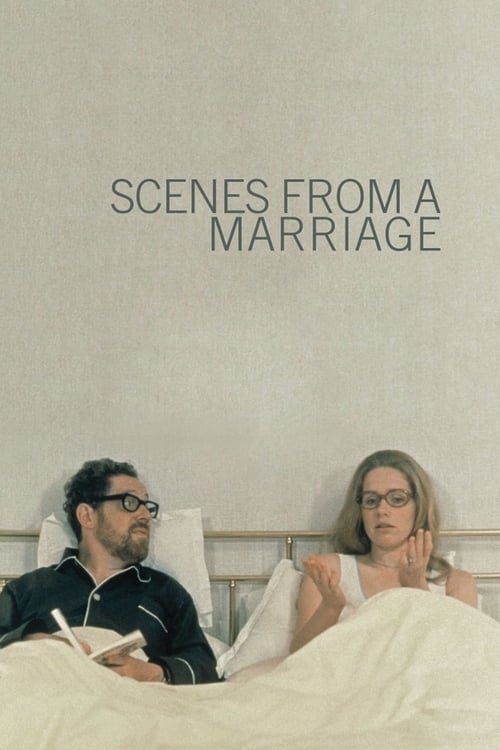
Scenes from a Marriage
1974 · Ingmar Bergman
For when you want a film to chew on for days — ideally with someone to talk it over with afterward. This is a challenge, not a comfort; don't reach for it on a fragile night, reach for it when you want the truth.
What it's about
Johan and Marianne — he's an academic, she's a divorce lawyer — look like the model couple, comfortable and settled, the kind friends point to. Then Johan admits he's been having an affair, and the film follows the two of them across years of separation, divorce, other partners, and the strange, stubborn bond that keeps pulling them back into the same room. It's a whole marriage — and its long afterlife — told almost entirely through conversations between two people.
The experience
Intense, intimate, and almost unbearably honest — long scenes of two faces in close-up saying the things couples usually never say out loud. It's not fast, but it's gripping the way a real argument is gripping, and it will make you think hard about every relationship you've ever been in.
Performances
Liv Ullmann and Erling Josephson carry the entire film between them, and both are extraordinary — Ullmann especially, whose face registers shifts of hurt, anger, and tenderness the script never has to spell out.
The craft
Bergman shot it lean — 16mm, modest interiors, a tiny crew — and turned those limits into the whole point: the camera lives inches from the actors' faces, so nothing can hide. The writing is the star; scene after scene plays like a duel where the weapons are sentences.
Why it matters
Made for Swedish television and then cut into a feature, it reportedly sent divorce rates and couples-counseling conversations climbing across Scandinavia, and it became the template for nearly every serious two-hander about a relationship made since.
Snapshot
A feature-length condensation of Bergman's six-part Swedish Television (SVT) miniseries Scener ur ett äktenskap (broadcast April–June 1973), Scenes from a Marriage follows Johan, an academic, and Marianne, a family lawyer, across roughly a decade of marriage, separation, divorce, and entangled aftermath. The theatrical cut (approximately 167 minutes) excises roughly half the original television material, preserving the emotional architecture while sharpening the dramatic compression. Shot in 16mm on modest interiors with a skeleton crew, the film operates almost entirely in close-up, reducing bourgeois domestic life to a series of confrontations between two faces. Few films in the sound era have charted the interior weather of a long relationship with comparable honesty or staying power.
Industry & production
Bergman made Scenes from a Marriage under the auspices of his production company Cinematograph in partnership with SVT. The commission was explicitly for television — a medium Bergman had begun taking seriously as a venue for intimate, dialogue-driven work after the relative commercial difficulties of his late-1960s art films. The budget was modest by any standard: a small permanent crew, a handful of locations (largely Bergman's own residences and familiar Stockholm interiors), and a compressed shooting schedule spread across 1972–1973.
The decision to originate in 16mm rather than 35mm was partly economic and partly aesthetic — the format permitted handheld intimacy, faster setups, and a grain that suited the confessional register Bergman was after. For the international theatrical release, the 16mm negative was blown up to 35mm, a process that intensified the grain and gave the image its slightly raw, documentary texture.
The project was semi-autobiographical in ways Bergman acknowledged obliquely over the years. His decade-long relationship with Liv Ullmann — the couple had a daughter, Linn Ullmann, born in 1966 — provided emotional material, though Bergman resisted straightforward identification. Ullmann herself has discussed the uncanny experience of embodying a character whose anguish drew on her own history with the director.
The Swedish broadcast became an immediate cultural event. The six episodes — each bearing a sardonic chapter title, from "Innocence and Panic" through "In the Middle of the Night in a Dark House Somewhere in the World" — prompted a reported surge in marriage counseling referrals and sparked national debate over divorce law and gender roles in Sweden. The precise causal relationship between the broadcast and shifts in Swedish divorce statistics has been greatly embellished in popular accounts and should be treated as vivid cultural mythology rather than documented fact.
Technology
The 16mm origination was central to what Scenes from a Marriage looked and felt like. Cinematographer Sven Nykvist used fast, available-light setups that would have been cumbersome in 35mm, and the smaller camera allowed an unobtrusiveness appropriate to scenes of intimate collapse. The blow-up to 35mm for theatrical distribution was a standard procedure in European prestige television of the period, though the resulting grain was coarser than Nykvist's customary 35mm work with Bergman.
There is no original underscore. Bergman stripped away music almost entirely, preferring ambient room sound and silence. The rare intrusions of music — a few bars of Bach at specific junctures — arrive with the force of editorial comment precisely because the surrounding silence is so sustained. The sound design, such as it is, is anti-design: cutlery, breathing, the creak of furniture, the particular acoustic deadness of Swedish interiors in winter.
Technique
Cinematography
Nykvist's work here extends the approach he had developed with Bergman through the chamber films of the late 1960s and the recently completed Cries and Whispers (for which he won the Academy Award for Best Cinematography in 1974). The camera in Scenes from a Marriage is almost never decorative. Nykvist holds on faces past the conventional cutting point, sometimes staying in close-up for minutes at a time as actors work through extended monologues or unresolved arguments. The depth of field is deliberately shallow, throwing backgrounds into soft abstraction so that nothing competes with the human face.
Lighting is naturalistic — windows, practicals, the occasional reflector — and erases the glamorizing function that studio lighting traditionally performs. The effect is to make actors look as they look, neither idealized nor caricatured: lines under eyes, flushed skin, the physical evidence of emotional states. This was a deliberate removal of the apparatus of beauty from the female face in particular, an act with feminist resonance in the context of Ullmann's performance.
Editing
The television version is structured by its episode titles and contains substantially more breathing room between confrontations. For the theatrical cut, Bergman condensed each of the six episodes while retaining their emotional logic, producing a rhythm of escalation and exhausted aftermath. Scenes tend to be long and unbroken; cuts are functional rather than expressive. The editing creates no visual rhetoric independent of the performances — it simply holds, then moves when it must.
Mise-en-scène / staging
The settings are deliberately undifferentiated: apartments, a country house, a lawyer's office, a hotel room. Bergman uses space as a map of power — who occupies the center, who retreats to a doorframe, who cannot stop moving while the other sits still. The film repeatedly stages the same fundamental geometry: two people, a table or bed between them, confined by walls that prevent flight. Furniture is thick with implication; the kitchen in particular becomes the arena for some of the film's most violent exchanges.
The staging exploits television-derived frontality. Characters frequently address the camera directly in early scenes, breaking the fourth wall in ways that position the audience as a third party in the marriage — observers who cannot intervene. This device dissolves as the film deepens, and the couple's indifference to being watched gives way to scenes of genuine exposure.
Sound
Dialogue is recorded with conspicuous directness — close-miked, present, without the flattering reverb that film mixing sometimes applies to interior speech. The actors' voices carry physical qualities: strain, alcohol, the slight thickening of someone who has been crying. This sonic nearness is inseparable from the film's ethical proposition that we are close enough to these people to hear what they cannot say to each other.
Performance
Liv Ullmann and Erland Josephson are among the most extensively prepared performers in Bergman's repertory company. Both had worked with the director across multiple films; Josephson had appeared in Wild Strawberries (1957), Hour of the Wolf (1968), and The Passion of Anna (1969). Ullmann had been central to Bergman's work since Persona (1966). Scenes from a Marriage pushes both actors into prolonged exposure at a scale television's episode structure permitted but theatrical filmmaking rarely does — the relationship accumulates in real time, and the viewer tracks minute behavioral shifts across the six-episode arc in ways that a single theatrical sitting cannot fully replicate.
Bergman's rehearsal methods involved extensive conversation about the characters' histories rather than drilling of lines; actors were expected to inhabit positions rather than execute blocking. The result is performance that reads as discovered, especially in the later episodes, where both actors modulate toward a damaged familiarity that cannot credibly be acted from outside.
Narrative & dramatic mode
The film proceeds in discrete scenes that function as case studies rather than a continuous narrative. Each episode isolates a mode of relational failure — denial, revelation, grief, rage, negotiation, recurrence — and exhausts it before advancing. The structure is Strindbergian in its commitment to attrition: no scene ends with resolution; the characters simply reach a point of exhaustion and resume later.
The mode is chamberwork. Exposition is minimal and largely delivered through argument — the audience learns what has happened from what the characters accuse each other of. The ellipses between scenes grow longer as the film progresses, moving from weeks to months to years, so that the final episode finds the characters aged, entangled in new lives, still unable to refuse each other entirely.
Marianne's arc is the more explicitly developmental: she moves from a woman who defines herself through Johan's definitions to someone capable of articulating her own terms. Johan's trajectory is more ambivalent — he gains a mistress, loses a wife, acquires a measure of self-knowledge he appears not to want. Bergman does not distribute blame evenly, but neither does he construct a simple victim-and-perpetrator schema.
Genre & cycle
Scenes from a Marriage belongs to the European art-film tradition of bourgeois-marriage examination: a cycle that includes Antonioni's La Notte (1961) and L'Eclisse (1962), John Cassavetes' Faces (1968), and extends back to the stage drama of Strindberg and Ibsen. It is simultaneously a founding text of the prestige television drama — the long-form, psychologically dense, auteur-driven series — that would become a defining format of the late 20th and early 21st centuries.
The film's genre instability is deliberate. It operates within melodrama's emotional register while refusing melodrama's resolution machinery; it employs documentary techniques (direct address, available light, unglamorous duration) while staging clearly scripted, precisely shaped confrontations. The mixture creates a sustained uncertainty about the ontological status of what is being witnessed.
Authorship & method
Ingmar Bergman wrote, directed, and oversaw the editing. The script was composed in intense, rapid sessions — Bergman has described the writing of Scenes from a Marriage as unusually compelled, emerging from personal material under pressure. His method by this period was highly controlled: scripts were detailed, actors worked closely with him before shooting to inhabit characters, and improvisation on set was structural rather than linguistic (positions could shift; lines could not).
Sven Nykvist (director of photography) had been Bergman's primary visual collaborator since Winter Light (1963). His contribution to Scenes from a Marriage was consistent with the philosophy they had developed together: remove decoration, put everything in the face, trust the actor. Nykvist's particular achievement here was sustaining visual intensity across an extended run without recourse to compositional variety as a substitute for dramatic content.
No original music was composed for the film; the absence of a composer is itself a creative decision integral to the work.
Movement / national cinema
Scenes from a Marriage is a product of Swedish cinema's postwar international prestige and of Swedish television's unusually generous relationship with authorial filmmaking in the 1970s. SVT had commissioned ambitious work from Bergman before — The Rite (1969) was made for television — and the collaboration reflects a specifically Scandinavian public-broadcasting model in which high-cultural ambition was considered within the medium's mandate.
Swedish cinema by the mid-1970s occupied an anomalous position: internationally celebrated through Bergman but domestically complicated by the question of whether art cinema could be commercially viable. Scenes from a Marriage sidestepped this problem by originating on public television, then traveling internationally as prestige export. It is, in some sense, the last great statement of classical Bergman — the chamber film pushed to its maximum formal development — before the director's retreat to Fårö and eventual theatrical retirement.
Era / period
The film was made and broadcast at a specific moment: 1973, the year after Sweden introduced unilateral no-fault divorce legislation and in the midst of second-wave feminism's impact on Scandinavian social institutions. Bergman did not make a political film, but he made a film whose subject — the legal, emotional, and erotic bonds of marriage and their unraveling — was saturated with the era's political content. Marianne's development as a character tracks, without programmatic intent, the period's feminist critique of women's self-abnegation within marriage.
The television episodic format was also historically specific: audiences in 1973 had not experienced the long-form prestige serial that would become ubiquitous by the 21st century. Watching Scenes from a Marriage across six weeks in Sweden was a different event than watching the theatrical cut in a cinema — a sustained cohabitation with these characters whose temporal experience echoed the rhythms of real relationship.
Themes
The film's central inquiry is into the gap between the public institution of marriage and the private experience of partnership — and the further gap between what partners say to each other and what they mean. Bergman is attentive to the way that bourgeois professional identity (Johan's academic role, Marianne's legal practice) functions as an evasion of emotional reckoning, and to the specific forms of dishonesty that mutual comfort generates over years.
Love and need are carefully distinguished. Johan and Marianne continue to need each other after they have stopped loving each other in the conventional sense; the film's final scenes suggest that this need, which is neither romantic nor entirely reducible to habit, may be the most durable form of human bond. Whether this is consoling or devastating is left genuinely open.
Female interiority and self-authorship occupy considerable space. Marianne's transformation is the film's most fully rendered development — from a woman who cannot articulate her own desires to someone capable of naming her experience in her own language. Her profession (family law, divorce proceedings) provides an irony the script does not belabor.
The unreliability of self-knowledge runs through Johan's characterization. He is more articulate than Marianne at the outset and less honest with himself; his intelligence is deployed as defense against introspection. This reversal — the apparently inarticulate person developing genuine self-awareness while the apparently sophisticated one remains essentially evasive — is one of the film's most precise psychological observations.
Reception, canon & influence
Critical reception was immediate and substantial. The international theatrical release in 1974 positioned the film as major Bergman — perhaps the most accessible and emotionally direct work he had produced. Critics who had found the late-1960s films hermetially symbolic responded to the frank realism of the chamber format. The film received an Academy Award nomination for Best Foreign Language Film (representing Sweden) for the 1974 theatrical release year.
Influences on the film (backward): August Strindberg's chamber plays — particularly The Dance of Death (1900) and Miss Julie (1888) — provide the dramaturgy of attrition and mutual destruction. Ibsen's sustained examination of bourgeois marriage and women's inner life (A Doll's House, Hedda Gabler) is an equally visible precursor. Within cinema, Antonioni's early-1960s trilogy explored bourgeois affective alienation with a similarly unsparing attention. Cassavetes' Faces (1968), made with an overlapping semi-documentary aesthetic, was known to Bergman. Within his own filmography, the chamber films — particularly Persona (1966), with its two-character dissolution of identity, and The Passion of Anna (1969), with its examination of violence within intimacy — are direct predecessors.
Legacy and forward influence: The film's most immediate legacy was on subsequent television drama. Its demonstration that the intimate psychological serial could be a vehicle for art-cinema ambition provided a template that has been drawn on, consciously or not, by prestige television from the 1990s onward.
More specifically traceable is the line to Richard Linklater's Before trilogy (1995–2013), which uses extended dialogue sequences and the long temporal arc of a relationship to explore compatible themes with a different tonal register; and to Noah Baumbach's Marriage Story (2019), which engages Scenes from a Marriage directly in its subject matter, structure, and emotional pitch.
The film was remade as an HBO miniseries in 2021, directed by Hagai Levi and starring Oscar Isaac and Jessica Chastain, transposing the material to contemporary American academic milieu. The remake testifies to the durability and adaptability of Bergman's dramatic architecture rather than to any obsolescence in the original.
Within the international canon, Scenes from a Marriage has been placed near the summit of films about romantic relationships — a presence in retrospective lists of the greatest films of the 1970s and of television drama. Its specific accomplishment — the fusion of documentary visual restraint with precisely scripted dramatic escalation, sustained across a duration that has no equivalent in theatrical cinema — remains largely unmatchable, not because later filmmakers have not attempted it but because the conditions that produced it (a national public broadcaster willing to fund a major auteur's most personal project; a repertory company of trained, trusted actors; a director willing to transmit genuine exposure as dramatic material) are essentially unrepeatable.
A Deleuzian reading
Start with the kitchen.
The full Deleuzian reading of Scenes from a Marriage →
Reception
A national event in Sweden first — the 1973 TV broadcasts emptied the streets — then a critical hit abroad in its condensed 1974 theatrical cut. Today it's fully canonized as the template for every serious 'divorce drama' since, its stock only rising as Marriage Story and the HBO remake sent viewers back to the source.
How Scenes from a Marriage was received, from release to now →
Influences: the films it descends from and the films it influenced
- Winter Light (1963) — Nykvist and Bergman first commit here to available daylight, unflattered close-up, and absolute silence beneath performance — the visual-sonic philosophy they carry unchanged into Scenes, with Björnstrand's ravaged face shot without fill as the inaugural proof that the actor's face alone can hold duration.
- Persona (1966) — Bergman and Nykvist develop the two-face chamber grammar here — lens held within inches of Ullmann and Andersson, confined interior stripped of establishing geography, score absent — the direct visual prototype for the Josephson-Ullmann dynamic of Scenes, including the dissolution of the boundary between two people in sustained proximity.
- The Passion of Anna (1969) — Bergman first uses direct-address episodes in which actors speak in their own voices about the characters they inhabit — the reflexive case-study device he carries into Scenes — while also establishing Josephson and Ullmann as the couple sustaining intimate violence under confined repertory-ensemble observation.
- Faces (1968) — Cassavetes shoots on 16mm with close-miked overlapping dialogue and no multiple-angle coverage, using the grainy blown-up image as aesthetic fact rather than technical liability — the same 16mm-to-35mm strategy, close-miking, and unresolved episodic structure of bourgeois marital erosion that Bergman directly adopts.
- La Notte (1961) — Antonioni's sustained long takes diagnose the couple's intimacy deficit through duration in shallow-focus confinement without score — the long-take, near-absent-score model Bergman deploys in his most extended confrontation sequences, where cutting away from discomfort is refused as a formal discipline.
- Who's Afraid of Virginia Woolf? (1966) — Haskell Wexler's close-miked, available-light cinematography established that verbally devastating theatrical dialogue could be rendered through documentary-adjacent visual texture — minimal cutting, single locations, score withheld beneath the words — the discipline Bergman applies when condensing his six-hour television serial into a theatrical feature.
- Cries and Whispers (1972) — Made immediately before Scenes with the identical Nykvist close-up grammar and the same repertory ensemble (Ullmann, Andersson, Sylwan), but Bergman deploys Chopin on the score and a deep-red palette — the contrasting simultaneous work that reveals, by deliberate divergence, what Scenes strips away to achieve its documentary severity.
- A Lesson in Love (1954) — The terminus of the marital investigation A Lesson in Love initiates: the same formal interest in marriage as psychological warfare and sustained self-deception, now conducted in extreme close-up in real time rather than through comic flashback, discarding the medium two-shot's ironic distance for frontal confrontation.
- The Touch (1971) — The perfected version of The Touch's project — marital anatomy built from discrete, dialogue-driven scenes shot in close-up by Nykvist; The Touch reads as its rough draft.
- Husbands and Wives (1992) — Allen shoots handheld on 16mm with crash zooms and direct-address interview sequences that explicitly borrow from Cassavetes and from Bergman's Passion of Anna device, episodically structuring two dissolving bourgeois marriages through close-miked confined-interior performance with near-absent score — the most direct formal homage to Scenes in American cinema before Baumbach.
- Before Sunset (2004) — Linklater extends Bergman's long-take dialogue logic into continuous shallow-focus tracking shots that hold the lens at face-distance on two people walking, with no score beneath the conversation, using the nine-year temporal ellipsis since Before Sunrise as a structural mirror of Bergman's episode-to-episode time jumps.
- Before Midnight (2013) — The trilogy's third film transposes Bergman's confined-interior confrontation structure almost directly — a sustained two-person argument in a hotel room, long takes, shallow-focus close-up framing, close-miked dialogue, near-absent score — the fight's episodic structure of escalation, withdrawal, and re-escalation constituting a Bergman chamber movement transposed to the Peloponnese.
- Blue Valentine (2010) — Andrij Parekh's 16mm available-light stock for the courtship sequences and HD video for the marriage-in-collapse makes the temporal ellipsis legible in image texture itself; the confined motel-room confrontations inherit Bergman's long-take, close-miked, score-absent grammar for sustained marital breakdown in small interiors.
- A Separation (2011) — Farhadi's episodic case-study structure — discrete chapters of marriage dissolution observed through behavioral close-up, near-absent score, and withheld moral adjudication — is the closest formal descendant of Bergman's procedural drama, and Mahmoud Kalari's shallow-focus available-light cinematography echoes the Nykvist visual grammar without citation.
- 45 Years (2015) — Lol Crawley shoots in available light with sustained close-ups on Charlotte Rampling's face, the drama communicated through what she does not say across long takes in domestic confinement with near-absent score — the camera behaving precisely as Nykvist's philosophy demands: eliminate decoration, put everything in the face, trust the actor to carry the duration.
- Marriage Story (2019) — Baumbach adopts Scenes' episodic case-study structure with temporal ellipsis between chapters, and the central confrontation sequence — one room, sustained close-ups, close-miked dialogue, score absent throughout — directly channels Bergman's theatrical condensation of marital dissolution, with Robbie Ryan's available-light cinematography sustaining the visual restraint.
- Sentimental Value (2025) — Pioneered the talk-driven, intimately staged interior chamber drama parsing a relationship across time in long dialogue scenes — the novelistic-realist mode Trier and Vogt write in.
- The Celebration (1998) — Shot on 16mm for Swedish television then re-cut and released theatrically, establishing the model for the small-format domestic drama that trades cinematic scale for performance proximity; Vinterberg inherits both the blow-up format strategy and the sustained family-confession dramatic structure.
- Fanny and Alexander (1982) — Bergman's first systematic use of dual-version architecture—a six-part television serial simultaneously edited into a theatrical feature, each version constituting a differently weighted artifact with its own pacing logic—establishes the production model F&A inherits and extends on a larger scale.
- Autumn Sonata (1978) — The immediate structural prototype for Autumn Sonata's two-hander grammar: two people confined to intimate domestic spaces across episodic confrontation scenes, Nykvist's sustained close-up calibrated to the actors' emotional rhythms rather than to continuity cutting, the domestic interior as the exclusive arena of revelation.
- From the Life of the Marionettes (1980) — Chapter-titled partition of a bourgeois marriage's dissolution, with Nykvist's frontally composed close-up vocabulary and full-duration scene cuts establishing the structural template Marionettes inherits and redirects into criminal case-study form.
- A Woman Under the Influence (1974) — Released the same year, Cassavetes' available-light, close-miked 16mm long-take examination of a marriage under psychological disintegration — no score beneath Rowlands' performance, no multiple angles to soften the confrontations — occupies identical craft coordinates developed independently along the Cassavetes rather than Bergman lineage.
- Journey to Italy (1954) — Sustains the unsparing, dedramatized dissection of a couple through long takes of genuine performance friction, extending the documentary-of-a-marriage approach Journey pioneered with its real-life Rossellini–Bergman tension.
- Closer (2004) — The sustained held-on-faces two-shot during dialogue duels, refusing coverage so the camera becomes a clinical instrument exposing a relationship dissolving in real time.
- The Mother and the Whore (1973) — Released the same year, it independently arrives at chamber-confinement talk-cinema: relationships anatomized through sustained two-person dialogue takes in enclosed rooms, dialogue carrying all dramatic weight with the score nearly absent.
Similar films
- Persona (1966) — influence & lineage
- Cries and Whispers (1972) — influence & lineage
- Marriage Story (2019) — influence & lineage
- Winter Light (1963) — influence & lineage
- Faces (1968) — influence & lineage
- A Separation (2011) — influence & lineage
- Face to Face (1976) — shared sensibility
- A Lesson in Love (1954) — shared sensibility
All the films related to Scenes from a Marriage →