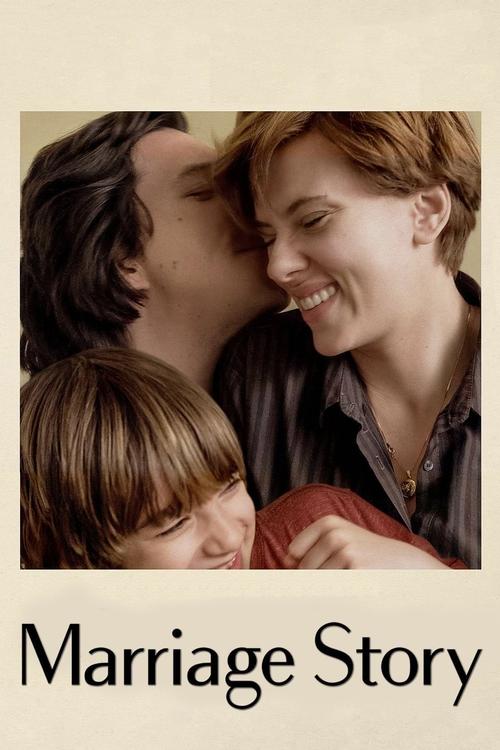
Marriage Story
2019 · Noah Baumbach
For when you want to feel something real and don't mind getting wrecked a little — a film for a serious night in, ideally when you're ready to talk about it afterward. If you've ever loved someone through an ending, it will find you.
What it's about
Charlie is a rising New York theater director; Nicole is the actress at the center of his company and his life. When she moves back to Los Angeles and the marriage comes apart, what begins as an amicable split gets fed into the machinery of lawyers, custody schedules, and two coasts — and two people who genuinely knew and loved each other are pushed to say things they can't take back.
The experience
Funny, raw, and precisely observed — it moves between warm domestic comedy and arguments so real they're hard to watch. It's the rare divorce film that holds sympathy for both people at once, which is exactly what makes it hurt.
Performances
Adam Driver and Scarlett Johansson both do career-best work — each gets long, unbroken scenes that swing from tenderness to fury — and Laura Dern won an Oscar as a divorce lawyer whose friendly warmth conceals a killer instinct.
The craft
Noah Baumbach's screenplay is the star: monologues, overlapping fights, and courtroom procedure written with a playwright's ear and a survivor's honesty. The direction stays close and unfussy, trusting faces and language, with a Randy Newman score that keeps a thread of tenderness running under the wreckage.
Why it matters
One of Netflix's defining prestige releases, it earned six Academy Award nominations, became the most widely embraced film of Baumbach's career, and instantly entered the canon of great American divorce dramas.
Snapshot
Marriage Story is Noah Baumbach's chamber drama about the dissolution of a marriage between Charlie Barber (Adam Driver), a rising New York theater director, and Nicole (Scarlett Johansson), an actress who returns to Los Angeles and to screen work as their union unwinds. Structurally it is a divorce procedural braided with a love story told in reverse: it opens with each spouse's affectionate catalog of the other, then spends its remaining runtime demonstrating how affection is metabolized by lawyers, geography, and the machinery of custody. Produced by David Heyman's Heyday Films for Netflix and released in 2019, it became one of the streamer's flagship awards vehicles, earning six Academy Award nominations and a Best Supporting Actress win for Laura Dern. It stands as Baumbach's most widely embraced film and a defining example of the late-2010s "prestige streaming" drama.
Industry & production
The film sits at a pivotal moment in Netflix's push toward theatrical-grade auteur cinema, the same 2018–2019 cycle that produced Alfonso Cuarón's Roma and Martin Scorsese's The Irishman. Baumbach, a director long associated with independent financing and specialty distributors, moved to Netflix for a project whose intimacy would ordinarily have made it a modestly budgeted indie; the streamer's model allowed a mid-budget adult drama to be made without the box-office anxiety that had increasingly squeezed such films out of theatrical production. The picture received a limited theatrical release ahead of streaming to qualify for awards and preserve some theatrical presence, but Netflix does not report conventional box-office figures, so the film's commercial performance is not documented in the ordinary sense — a genuine gap in the public record rather than an omission here.
Production was anchored by longtime and new collaborators alike. Baumbach wrote the screenplay himself, drawing on extensive conversations with divorce lawyers, mediators, and people who had been through the process, as well as on his own experience of divorce — a lineage that connects directly back to his 2005 breakthrough The Squid and the Whale. The film premiered on the fall-festival circuit in 2019, including a berth at the Venice Film Festival, before rolling out through Telluride, Toronto, and the New York Film Festival, the standard prestige path for a Netflix awards contender that year.
Technology
Marriage Story was shot photochemically on 35mm film by cinematographer Robbie Ryan, consistent with Ryan's well-established preference for celluloid across his work with Andrea Arnold and Yorgos Lanthimos. The choice is not incidental: the grain and gentle roll-off of film stock lend the domestic interiors a warmth and tactility that suit a story about the erosion of intimate spaces. In a period when even prestige productions had largely migrated to high-resolution digital capture, the film's commitment to a traditional photochemical pipeline aligns it with a strand of 2010s American cinema — Paul Thomas Anderson, the Safdie brothers, Baumbach himself — that treated film as an aesthetic and expressive commitment rather than a nostalgic affectation. Distribution, by contrast, was fully of its moment: the film was engineered for streaming delivery to a global home-viewing audience, a duality (celluloid capture, streamed presentation) that captures the industrial contradictions of its era.
Technique
Cinematography
Robbie Ryan's photography organizes the film around a bicoastal contrast. New York, associated with Charlie's theater world and the couple's shared past, tends toward cooler, more contained framings; Los Angeles, where Nicole reconstitutes her independence, is rendered in warmer, sunnier light. Ryan favors a classical, unfussy grammar — clean medium shots, patient two-shots, and sustained takes that let performance carry scenes rather than cutting to manufacture tension. The camera frequently isolates each spouse in single framing during moments of legal or emotional separation, then reunites them in shared frames when the underlying love resurfaces. The film's most discussed sequence, a shattering argument in Charlie's spare Los Angeles apartment, is staged and shot to let the actors move through the space while the camera tracks and reframes, so that the blocking itself charts the collapse from restraint into rage and back into grief.
Editing
Jennifer Lame, a frequent Baumbach editor whose work with him includes Frances Ha, While We're Young, Mistress America, and The Meyerowitz Stories, cuts the film with a rhythm attentive to speech and pause. Baumbach's dialogue is dense and overlapping, and the editing preserves the awkward beats, interruptions, and trailing silences that give the performances their lived-in quality. The opening montage — the paired voiceover "what I love about" letters set against images of ordinary family life — is a bravura editorial passage that establishes the couple's tenderness economically before the narrative dismantles it. Elsewhere Lame resists the temptation to over-cut confrontations, holding on long takes so that the audience must sit inside discomfort rather than being released from it.
Mise-en-scène / staging
The film is, in the most literal sense, theatrical: its protagonist is a stage director, and Baumbach stages domestic and legal scenes with a playwright's attention to entrances, exits, and the choreography of bodies in rooms. Lawyers' offices, mediation rooms, and cramped sublets become stages on which the spouses perform revised versions of themselves. The production design contrasts Charlie's under-furnished, provisional LA apartment with the warmer, more established homes associated with Nicole's family, using space to externalize who is losing footing and who is regaining it. Recurring motifs — doorways, thresholds, the shuttling of their son Henry (Azhy Robertson) between residences — reinforce the theme of a shared life being partitioned.
Sound
Randy Newman's orchestral score is central to the film's tone, supplying separate musical themes associated with Charlie and Nicole that let the music articulate an emotional continuity the characters can no longer voice to each other. Newman's writing is lush and old-fashioned in the best sense, evoking a classical Hollywood register that grants the couple's private drama an almost novelistic scale. The film also foregrounds diegetic performance, most famously Charlie's late rendition of "Being Alive" from Stephen Sondheim's Company and the earlier, lighter performance of "You Could Drive a Person Crazy" from the same musical by Nicole and her family — a paired use of Sondheim that maps the show's ambivalence about coupledom onto the film's own.
Performance
Performance is the film's engine. Adam Driver and Scarlett Johansson each deliver work built on the accumulation of small behavioral detail — the way spouses know and can wound each other — culminating in the apartment argument that both actors play across a wide dynamic range without tipping into melodrama. Laura Dern, as Nicole's formidable attorney Nora Fanshaw, gives a sharply calibrated comic-dramatic performance that anatomizes the divorce industry's blend of empathy and gamesmanship; the role won her the Academy Award for Best Supporting Actress. The supporting ensemble — Alan Alda and Ray Liotta as opposing lawyers, Julie Hagerty and Merritt Wever as Nicole's mother and sister, Azhy Robertson as Henry — is used with precision, each figure sharpening the machinery grinding the marriage down.
Narrative & dramatic mode
The film's dramatic mode is domestic realism inflected with tragicomedy. It withholds villains: neither spouse is framed as the party at fault, and the screenplay is scrupulous about granting each a coherent grievance and a genuine claim on the audience's sympathy. Structurally it inverts the romance: it begins at the point of decision to separate and traces the widening consequences, so that the love the opening montage asserts is felt as loss throughout. Baumbach modulates between mordant comedy — the absurdist rituals of custody evaluation, the theatrics of adversarial law — and sustained emotional devastation, refusing to let either register fully displace the other. The result is a study of process: how an amicable intention is bureaucratized into war, and how people say unforgivable things and continue to love each other anyway.
Genre & cycle
Marriage Story belongs to the American divorce drama, a lineage most immediately invoking Robert Benton's Kramer vs. Kramer (1979) and, further back, the marital dramas of classical Hollywood. It also participates in the broader tradition of the domestic art-film, and within Baumbach's own filmography it forms a clear cycle with The Squid and the Whale (2005) — both films examine the wreckage of a marriage through the lens of a family's cultural and artistic milieu, though Marriage Story views it from the spouses' vantage rather than the children's. In genre terms it is a drama that borrows the tempo and observational comedy of the American independent film while reaching for the emotional amplitude of a studio-era weepie.
Authorship & method
The film is unmistakably Baumbach's — verbally dense, attuned to the vanities and self-justifications of creative-class New Yorkers, and structured around the failure of articulate people to communicate. His method here foregrounded research: rather than a purely confessional account, the screenplay synthesizes many people's experiences of divorce, and Baumbach has been open that his own divorce informed but did not dictate the material. His key collaborators shape the result decisively. Cinematographer Robbie Ryan, new to Baumbach's world, brought a celluloid classicism distinct from the black-and-white and lighter palettes of Baumbach's earlier work with Sam Levy. Editor Jennifer Lame, by contrast, represents deep continuity, her rhythmic sensibility having helped define Baumbach's house style across the 2010s. Composer Randy Newman had scored Baumbach's The Meyerowitz Stories (2017) immediately prior, and their partnership here gives the film its unexpectedly grand emotional architecture. The collaboration of a research-driven, dialogue-first writer-director with these particular craftspeople is what lifts an intimate story to something operatic.
Movement / national cinema
The film is a product of American independent cinema's absorption into the streaming era. Baumbach emerged from the mumblecore-adjacent and post-indie milieu of 2000s New York filmmaking and is often grouped with contemporaries such as Wes Anderson (a frequent collaborator) and Greta Gerwig (his creative and personal partner). Marriage Story represents the point at which that independent sensibility became a prestige commodity underwritten by a global streaming platform — an "indie" in aesthetic lineage but a major studio-scale production in reach. It is squarely a work of American national cinema, preoccupied with the country's bicoastal cultural geography and the specific institutions — the American adversarial legal system chief among them — that structure its drama.
Era / period
Made and set in the late 2010s, the film captures a particular moment in American cultural life: the professional creative class, the specific economics of theater versus television and film work, and the still-fresh disruption of streaming that its own production embodies. Its concerns — the negotiation of two careers across two coasts, the gendered asymmetries of whose ambitions are deferred — are legible as period-specific even as they aim at the timeless. As an artifact, it belongs to the brief window in which streaming platforms actively courted auteurs with awards ambitions, before the strategy's economics were reassessed in the following years.
Themes
At its center is the gap between love and compatibility — the recognition that two people can continue to love each other and still be unable to remain married. The film examines gender and ambition, particularly the ways Nicole's artistic identity was subordinated to Charlie's during the marriage, and how her divorce becomes an act of self-reclamation that Charlie experiences as betrayal. It is deeply concerned with institutions: the divorce-industrial complex of lawyers and evaluators that transforms private grief into strategic warfare, escalating hostilities the spouses never intended. It reflects on performance and self-presentation — fitting for a film about theater people — and on parenthood, with young Henry as the stake and the casualty. Above all it is about communication and its failure, the tragedy of articulate people rendered inarticulate at the moment it matters most.
Reception, canon & influence
Critically, Marriage Story was among the most acclaimed American films of 2019, widely praised for its screenplay, its performances, and its refusal to assign blame. It earned six Academy Award nominations — including Best Picture, Best Actor, Best Actress, Best Original Screenplay, and Best Original Score — with Laura Dern winning Best Supporting Actress, and it featured prominently across the season's critics' awards and guild honors. The apartment argument scene became an immediate reference point in film culture and, in a marker of its saturation, a widely circulated internet meme — a double-edged sign of how deeply the film penetrated popular consciousness.
Its backward-facing influences are explicit and often noted by critics: Ingmar Bergman's Scenes from a Marriage (1973) is the towering precedent for the anatomized dissolution of a couple, and Kramer vs. Kramer (1979) is the American touchstone for the custody drama. Within Baumbach's own work, The Squid and the Whale is the essential antecedent. Its forward influence is best understood as consolidating the viability of the mid-budget adult drama on streaming platforms and reaffirming the appeal of the dialogue-driven, performance-centered divorce film for a new generation of filmmakers and audiences; it also marked a career high point that reframed Baumbach as a maker of large-scale emotional cinema, a trajectory that would carry into his subsequent, more expansive projects. As the film is still recent, claims about its long-term canonical standing should be made cautiously — but its immediate reception and its rapid entry into the common vocabulary of film culture suggest a work already treated as a modern reference for the marriage drama.
A Deleuzian reading
The film opens with two love letters that never get delivered.
The full Deleuzian reading of Marriage Story →
Reception
A Venice premiere and instant awards darling in 2019 — six Oscar nominations, part of that stacked Parasite/Irishman year — it's since settled into a curious double life: still respected as a gut-punch drama, but now equally famous as meme fodder from its centerpiece argument scene.
How Marriage Story was received, from release to now →
Influences: the films it descends from and the films it influenced
- Scenes from a Marriage (1973) — The template of anatomizing a marriage's dissolution through discrete, scene-by-scene chamber confrontations held in long takes on the actors' faces — Baumbach explicitly patterns the mediation and lawyer scenes on Bergman's clinical two-handers.
- Kramer vs. Kramer (1979) — The American custody-drama procedure: dramatizing divorce through dueling lawyers, depositions and a child in the middle, where the legal machine forces articulate parents to perform their worst selves in court.
- The Squid and the Whale (2005) — Baumbach's own autobiographical divorce film that established his verbally dense, creative-class New York register and the children-as-witnesses observation he refines here.
- Annie Hall (1977) — The bicoastal NY-vs-LA cultural contrast and the comedy of articulate creatives failing to connect, plus the opening direct-address inventory of a relationship that Marriage Story converts into its 'what I love about' voiceover montage.
- Faces (1968) — The long-take, performance-first domestic rupture in which the camera simply holds on actors through an escalating home argument — the formal ancestor of the celebrated apartment-argument scene.
- Shoot the Moon (1982) — A divorce drama built around explosive apartment confrontations and the mundane logistics of splitting a household, prefiguring Marriage Story's blend of rage and administrative detail.
- Interiors (1978) — The American transposition of Bergman's chamber-drama gravity onto an upper-middle-class family — precedent for grafting operatic seriousness onto observed domestic realism.
- Two for the Road (1967) — The nonlinear anatomy of a marriage that cross-cuts its tender beginning against its bitter end, ancestor to Marriage Story's reverse-love-story framing that opens on affection already past tense.
- Autumn Sonata (1978) — Baumbach's central confrontation scene — two people in a bare apartment, sustained takes, performance rhythm overriding continuity cuts, a scene structured like a musical movement building through development to unavoidable breakdown — is a precise transposition of Autumn Sonata's two-hander chamber grammar into contemporary American divorce drama.
- A Woman Under the Influence (1974) — Frames its dissolution around extended single-take actor showcases and a diptych his/her structure, openly indebted to the Cassavetes-Rowlands performance-centered marriage drama.
- The Touch (1971) — Explicitly modeled on Scenes from a Marriage, anatomizing a divorce scene by scene through long two-hander confrontations shot tight on faces.
- The Mother and the Whore (1973) — The film's dramatic peaks are sustained, near-uninterrupted dialogue confrontations in confined rooms where the writing's precision must read as raw spontaneity — the controlled-scripting-producing-looseness paradox that defines Eustache's method.
- White Noise (2022) — The larger-scale, more expansive project Marriage Story's success enabled, extending Baumbach's move from intimate indie toward operatic emotional cinema.
- Malcolm & Marie (2021) — A single-location two-hander staging a couple's night-long argument as a virtuoso actors' showcase shot on celluloid, extending the apartment-argument set-piece into an entire feature.
- Jay Kelly (2025) — The device of a character's carefully prepared self-presentation — the read-aloud letter, the rehearsed apology — collapsing in front of the person it was written for, which is the exact mechanism of Jay's staged reconciliations.
- The Meyerowitz Stories (2017) — The immediately preceding Baumbach film scored by Randy Newman, where the composer's warm, symphonic sensibility first gave Baumbach's dialogue-driven material an unexpectedly grand emotional architecture.
- Frances Ha (2012) — The film that established editor Jennifer Lame's speech-attentive cutting rhythm — trimming to the cadence of overlapping dialogue — that defines Baumbach's house style carried into Marriage Story.
- Blue Valentine (2010) — Intercuts a couple's tender origin against its collapse — the love-story-in-reverse structure — using raw, improvisation-forward performance to make dissolution feel documented rather than written.
- The Worst Person in the World (2021) — A chaptered anatomy of a modern relationship's arc, using voiceover and discrete titled episodes to dissect love-versus-compatibility in the same performance-centered register.
- Revolutionary Road (2008) — A marital-collapse drama constructed around theatrically blocked apartment argument set-pieces, where staging and blocking do the dramatic work of exposing a couple's incompatibility.
- A Separation (2011) — Builds its divorce drama around the mediation-and-legal apparatus grinding a separating couple, opening on the direct-to-camera two-shot before the judge — the bureaucratic machinery Marriage Story dramatizes through lawyers and evaluators.
- Anatomy of a Fall (2023) — The dissolution of a marriage channeled through institutional legal machinery; extended performance sequences in which characters simultaneously address legal audiences and perform genuine emotional revelation — the legal process as a device converting intimate knowledge into adversarial evidence.
- Who's Afraid of Virginia Woolf? (1966) — Descendant extending the two-hander marital-combat scene as set piece — long, escalating-tempo verbal duels staged in confined domestic interiors with deglamorized star performances foregrounded over visual spectacle.
- Manchester by the Sea (2016) — Also edited by Jennifer Lame and likewise pivoting on a devastating two-hander confrontation set-piece between estranged partners, echoing the Affleck–Williams street scene.
- Closer (2004) — Builds its centerpiece around an extended dialogue-driven marital-combat scene, theatrically staged and sustained, where language inflicts the damage—the Nichols/Albee set-piece tradition.
- Little Women (2019) — A sibling from the same Baumbach-Gerwig household using overlapping, naturalistically colliding domestic dialogue to stage the fine print of love and money.
- We Live in Time (2024) — Sibling in actor-centric two-hander construction, staging the anatomy of a relationship through sustained performance and everyday domestic behavior rather than plot mechanics — the Pugh/Garfield chemistry model of drama.
Similar films
- The Squid and the Whale (2005) — influence & lineage
- Kramer vs. Kramer (1979) — influence & lineage
- A Separation (2011) — influence & lineage
- Annie Hall (1977) — influence & lineage
- The Worst Person in the World (2021) — influence & lineage
- White Noise (2022) — influence & lineage
- tick, tick... BOOM! (2021) — often watched together
- Synecdoche, New York (2008) — shared sensibility