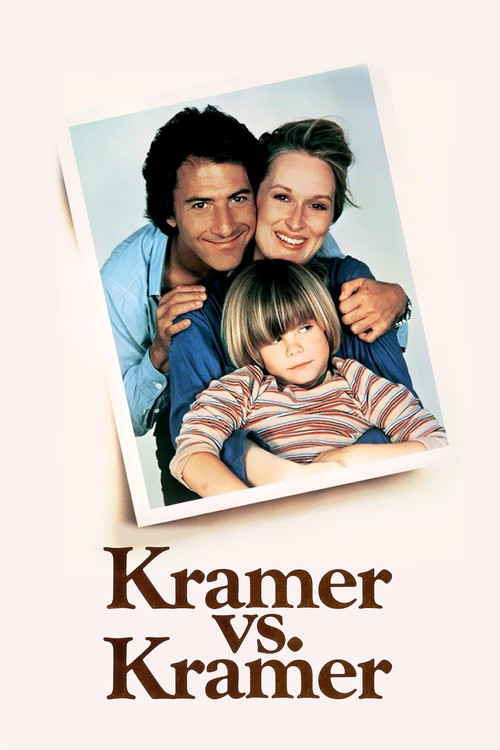
Kramer vs. Kramer
1979 · Robert Benton
When you want a serious, grown-up drama that earns its tears — not comfort viewing, but deeply humane. Reach for it when you're ready to think hard about marriage, work, and what parents owe their kids.
What it's about
Ted Kramer is a Manhattan ad man whose career always came first — until the night his wife Joanna walks out, leaving him alone with their young son Billy. What starts as a crash course in French toast, school runs, and single parenthood becomes something deeper, and then Joanna returns, setting off a custody fight in which two decent people are made to tear each other apart in court.
The experience
Intimate and quietly devastating — it plays out in kitchens, waiting rooms, and courtrooms rather than big set pieces, and the tension is all emotional. You'll feel for everyone at once, which is exactly what makes it hurt.
Performances
Dustin Hoffman and Meryl Streep both won Oscars for this, and you can see why: Hoffman makes Ted's transformation from absentee to devoted father feel gradual and real, while Streep takes a role that could have been the villain and makes her wrenching and sympathetic in limited screen time. Young Justin Henry is remarkably unactorly as Billy.
The craft
Robert Benton's writing and direction find the drama in tiny domestic gestures — a breakfast botched, then a breakfast perfected — so that by the time the courtroom scenes arrive, every legal question lands as a personal wound. It's a masterclass in the small-scale, performance-driven American drama.
Why it matters
It swept the major Academy Awards, was the box-office event of its year, and crystallized a national conversation about divorce, fatherhood, and working mothers at the end of the 1970s — the template for the prestige domestic drama ever since.
Snapshot
Kramer vs. Kramer is the rare prestige drama that arrived as both a critical triumph and the commercial event of its year, sweeping the major Academy Awards and crystallizing a national conversation about marriage, work, and the custody of children. Adapted by Robert Benton from Avery Corman's 1977 novel, it follows a Manhattan advertising man, Ted Kramer (Dustin Hoffman), whose wife Joanna (Meryl Streep) abruptly leaves, forcing him to learn the daily labor of raising their young son Billy (Justin Henry) — only to face her return and a bruising legal fight for the boy. Made on an intimate domestic scale, the film translated the social upheavals of 1970s divorce culture into a chamber drama of small gestures: a botched French-toast breakfast, a hospital waiting room, a courtroom where two decent people are reduced to adversaries. Its restraint, its performances, and its refusal to assign clean villainy made it a defining American picture of the decade's close.
Industry & production
The film was produced by Stanley R. Jaffe for Columbia Pictures, with Richard C. Fischoff as associate producer, and shot largely on location in New York City. It belongs to a late-1970s Hollywood moment in which the studios, chastened by the collapse of the roadshow era and energized by the success of director-driven dramas, were willing to back adult, dialogue-centered material with serious stars. Jaffe and Benton built the project around Dustin Hoffman, then at the height of his post-Graduate, post-Midnight Cowboy standing, though Hoffman — himself in the midst of a difficult divorce — was initially reluctant and became deeply, sometimes contentiously, involved in shaping the material. The casting of the female lead was unsettled until Meryl Streep, in only her third or fourth feature year, pushed for and won the role of Joanna, arguing the part as written risked caricaturing the departing wife.
The production is famous in industry lore for the intensity Hoffman brought to the set and for Benton's willingness to absorb his collaborators' contributions into the script. Streep is widely credited with rewriting her own courtroom testimony to give Joanna interiority and dignity; the legend that Hoffman occasionally provoked his co-stars to sharpen reactions is part of the film's contested making-of record, and is best treated as well-attested anecdote rather than settled fact. What is clear is that Benton ran an unusually open, performer-centered set for a studio picture of its budget class.
Commercially, the film was a major success — it was the top-grossing release of 1979 in North America — and it converted that success into awards dominance, winning the Academy Awards for Best Picture, Best Director, Best Actor, Best Supporting Actress, and Best Adapted Screenplay, with additional nominations including Justin Henry, then eight years old and the youngest competitive acting nominee in Academy history. Precise grosses vary across sources; I leave specific dollar figures uncited rather than risk false precision.
Technology
Kramer vs. Kramer is not a technological showcase, and its artistry lies in restraint rather than apparatus. It was shot photochemically on 35mm in a standard widescreen frame, using available and naturalistic lighting wherever possible — an approach more associated with European art cinema than with Hollywood gloss. The significant "technology" of the film is thus a philosophy of light and lens: cinematographer Néstor Almendros, trained in the low-key, source-motivated style he had refined for the French New Wave, favored soft, directional, often window-driven illumination and a muted palette that let New York apartments read as lived-in rather than designed. There are no optical spectacle effects, no elaborate camera rigs of note; the picture's technical ambition is the discipline to make the camera and the cutting disappear so that performance and behavior carry the drama.
Technique
Cinematography
Almendros — Truffaut's and Rohmer's cinematographer, and an Oscar winner the prior year for Days of Heaven — gives the film a humane, observational look built on natural light and unfussy framing. Interiors are lit as if by their practical sources; the Kramer apartment feels softly underlit, warm and a little worn, while the legal and professional spaces read cooler and harder. Almendros tends to hold the camera at the children's and characters' eye level, using medium shots and patient two-shots that keep parent and child in the same frame, so that the visual grammar itself argues for connection. He reserves the close-up for moments of genuine rupture, which gives those images unusual weight. The cinematography earned an Academy Award nomination; its influence runs less through any single bravura image than through its demonstration that a major studio drama could be photographed with art-house naturalism.
Editing
Gerald B. (Jerry) Greenberg, who had cut The French Connection and would go on to Apocalypse Now, edits for behavioral truth rather than momentum. The film's most discussed cutting strategy is its use of repetition and rhyme: the breakfast sequences that bookend Ted's arc — clumsy and chaotic early, fluent and companionable late — depend on the editor's patience in letting a small domestic routine play long enough to register as character growth. Greenberg favors holding on reactions, allowing pauses to breathe, and trusting the actors; the cutting in the courtroom scenes is similarly disciplined, intercutting testimony with listening faces so that judgment seems to gather in the room rather than be delivered by the film. The work earned an Oscar nomination for editing.
Mise-en-scène / staging
The film's staging is domestic realism in the truest sense: the drama is blocked around kitchens, hallways, bedtime, the walk to school, the playground. Benton repeatedly stages action so that adult conflict is observed, or nearly observed, by Billy, keeping the child's vulnerability physically present in the frame. The apartment is a real, constraining space — doors, corridors, the kitchen table — and the recurrence of these locations builds an emotional cartography of the family's daily life. Props carry meaning through repetition: the French toast, a drawing, an ice-cream-for-dinner standoff, a fall from a playground jungle gym that triggers a panicked dash to the hospital. Nothing is decorative; the production design (art direction by Paul Sylbert) serves the impression of unremarkable middle-class life rendered with great specificity.
Sound
The soundtrack is notable for what it withholds. The film uses no conventional original orchestral score; instead it draws on pre-existing classical music — works associated with Henry Purcell and Antonio Vivaldi — in spare, almost chamber-like arrangements, with John Kander credited for the film's music adaptation. The effect is to elevate ordinary domestic moments with a poised, baroque clarity rather than to manipulate emotion with swelling underscore. Otherwise the sound design is naturalistic and dialogue-forward: the ambient texture of New York streets and apartments, overlapping family talk, and crucially the silences in which arguments land. This austerity is part of the film's overall ethic of restraint.
Performance
Performance is the film's true medium. Hoffman's Ted is a study in a man's slow, unglamorous education in care — the work is internal, accumulative, built from irritation, exhaustion, and dawning tenderness rather than big speeches, and it won him the Academy Award for Best Actor. Streep's Joanna, on limited screen time, is the film's most quietly radical achievement: she insisted the character not be a villain, and her courtroom testimony — material she is credited with reshaping — gives the abandoning mother a wounded coherence that complicates the entire narrative, earning the Oscar for Best Supporting Actress. Justin Henry, untrained and very young, delivers a startlingly unaffected child performance that the film's intimacy depends upon. Jane Alexander, as the neighbor and friend Margaret who testifies, anchors the supporting cast and was herself Oscar-nominated. The ensemble's naturalism — fostered by Benton's open set — is the film's signature.
Narrative & dramatic mode
The film operates in the mode of domestic realism and the "problem drama," organizing itself around a clean two-act reversal: first the abandonment and Ted's transformation into a competent, loving single father; then Joanna's return and the custody trial that threatens to undo it. Its dramaturgy is deliberately undramatic in the conventional sense — the stakes are a small boy's daily wellbeing, and the climaxes are a hospital sprint and a court ruling rather than violence or spectacle. Crucially, the screenplay refuses a clear antagonist: the law itself, and the social assumptions encoded in it, become the obstacle, so that the audience is asked to mourn a contest in which no one can win cleanly. The ending — Joanna's decision at the threshold — withholds easy catharsis and leaves the emotional resolution to a gesture rather than a verdict.
Genre & cycle
Kramer vs. Kramer sits at the center of a late-1970s cycle of American films about marriage, divorce, and the renegotiation of gender roles — a cluster that includes An Unmarried Woman (1978), Starting Over (1979), and, in adjacent registers, Ordinary People (1980). These films took the social fact of rising divorce rates and the cultural pressure of second-wave feminism as their subject, translating public debate into intimate domestic drama. Within that cycle, Kramer is distinctive for centering the father's experience of single parenting, a then-novel inversion that both reflected shifting attitudes toward the "tender years" presumption in custody law and, in some feminist critiques, risked privileging the man's redemption over the woman's autonomy. As a "prestige adult drama," it also exemplifies the kind of mid-budget, star-driven, awards-oriented picture that the studios still routinely financed before the blockbuster economy narrowed that space.
Authorship & method
Robert Benton is the film's controlling sensibility, and his background illuminates its method. A co-writer of Bonnie and Clyde (1967), Benton came out of a generation steeped in the European art film, and his directorial instinct here is toward observation, ambiguity, and trust in actors over authorial flourish. He wrote the adapted screenplay himself and won Academy Awards for both writing and direction, but his characteristic move was self-effacing: incorporating Hoffman's and Streep's contributions, letting the script evolve toward the performers' truth. The collaboration with Almendros imported a European naturalism of light; the editing of Gerald B. Greenberg supplied behavioral patience; the unconventional musical choices, adapted by John Kander, supplied poise without sentiment. The result is an auteurism of restraint — a film whose "style" is the discipline to subordinate every craft department to performance and to the moral seriousness of the material.
Movement / national cinema
Though wholly an American studio production, the film is a fascinating conduit for European influence into Hollywood. Almendros's presence ties it directly to the French New Wave and its naturalistic aesthetics, while Benton's New Hollywood lineage connects it to the American auteurist wave that the New Wave helped inspire. Kramer can thus be read as a late, mainstream synthesis of New Hollywood's social seriousness with art-cinema craft, arriving just as that movement's commercial latitude was contracting. It is national cinema as domestic anthropology: a portrait of a specific urban American milieu — professional Manhattan at the end of the 1970s — rendered with a precision that gives it documentary value about its moment.
Era / period
Released in December 1979, the film is inseparable from its instant: the high-water mark of second-wave feminism, the public salience of the Equal Rights Amendment debate, soaring divorce rates, and an evolving legal landscape in which the automatic maternal presumption in custody was beginning to erode. It captures a transitional anxiety about what families were becoming, and about whether fatherhood could be redefined as hands-on care. As a period artifact it also marks a hinge in Hollywood history — the last full year before The Empire Strikes Back and the maturing blockbuster era reshaped what a "major film" looked like — making Kramer's dominance of the 1979 box office and awards season feel, in retrospect, like a high point for the mid-budget human drama.
Themes
At its core the film concerns the labor and meaning of parenthood — specifically the unglamorous, repetitive work of care, which it dignifies as a site of moral growth. It interrogates the costs of a career-first masculinity and stages a man's belated discovery that presence, not provision, is the substance of love. It examines marriage and its dissolution without melodrama, insisting on the legitimacy of a woman's need for selfhood even as it centers the father's transformation — a tension feminist critics have probed ever since. It indicts an adversarial legal system that forces complex human relationships into win-lose contests, and it meditates on the gap between social roles and lived emotional truth. Above all it is about how ordinary domestic ritual — breakfast, bedtime, the walk to school — becomes the medium through which people learn to love.
Reception, canon & influence
Backward (influences on the film): The picture draws on Avery Corman's source novel and on the long tradition of American social-problem drama, but its decisive aesthetic inheritance is European — Almendros's New Wave naturalism and Benton's New Hollywood debt to the art film. The contemporaneous cycle of divorce dramas (An Unmarried Woman, Starting Over) supplied a cultural and generic context that the film both joined and refined.
Reception: Critically, the film was widely praised on release for its sensitivity, its performances, and its refusal of villainy, and it converted that esteem into a near-total sweep of the major Academy Awards — Picture, Director, Actor, Supporting Actress, and Adapted Screenplay — with further nominations for cinematography, editing, and the supporting work of Justin Henry and Jane Alexander. It was simultaneously the year's commercial leader, a convergence of prestige and popularity that is now uncommon.
Forward (legacy): Kramer vs. Kramer became a cultural touchstone for the single-father narrative and a frequent reference point in discussions of custody, parenting, and gender on screen; its very title entered shorthand for a bitter custody fight. It helped consolidate Meryl Streep's emergence as the defining American actor of her generation and reinforced the viability of restrained, performance-driven domestic drama as Oscar-caliber filmmaking, a template visible in Ordinary People the following year and in much subsequent prestige cinema. Its critical reputation has since been complicated — later feminist scholarship has questioned its sympathies and its treatment of Joanna — and that ongoing argument is itself a measure of the film's durability: it remains a work that audiences and scholars return to in order to think through how movies imagine family, gender, and care.
A Deleuzian reading
Start with the French toast.
The full Deleuzian reading of Kramer vs. Kramer →
Reception
The biggest hit of 1979 and a five-Oscar sweep, it's now remembered less as a champion than as the film that beat Apocalypse Now — though its reputation quietly recovered once Marriage Story sent everyone back to it.
How Kramer vs. Kramer was received, from release to now →
Influences: the films it descends from and the films it influenced
- The 400 Blows (1959) — Establishes the untrained-child performance and child's-eye witnessing of adult failure that Benton borrows for Justin Henry's Billy, whose unschooled reactions are blocked at his own eye level.
- Bicycle Thieves (1948) — The neorealist template of a father and small son moving through ordinary spaces in available light, the child silently registering a parent's crisis, underlies Kramer's domestic-realist staging.
- Faces (1968) — Pioneers the dialogue-forward naturalism and long reaction-holds on faces mid-conversation that let behavior accrete rather than plot advance — exactly Benton's discipline of subordinating craft to performance.
- A Woman Under the Influence (1974) — Models the internalized-accretion performance inside a collapsing household, the camera waiting on the actor's unraveling without score or authorial flourish.
- Scenes from a Marriage (1973) — Dramatizes marital dissolution almost entirely through reserved close-ups and eye-level two-shots of talk, refusing villainy and melodrama — the dialogue-forward, no-antagonist grammar Kramer adopts.
- My Night at Maud's (1969) — Néstor Almendros's available-light, eye-level coverage of people simply talking is the collaborator method Almendros then imports wholesale into Kramer's apartment interiors.
- Bonnie and Clyde (1967) — Benton co-wrote it; its French New Wave-derived tonal shifts and refusal of clean moral judgment are the New Hollywood screenwriting instincts he later turns inward to domestic observation.
- Ordinary People (1980) — Directly extends Kramer's template of restrained, performance-driven domestic grief with sparse classical-music cues and no melodramatic score, sweeping the same Oscars one year later.
- Shoot the Moon (1982) — Carries forward the no-villain divorce drama observed partly through the children's witnessing eyes, with reaction-holds on a fracturing family at the dinner table.
- Terms of Endearment (1983) — Consolidates Kramer's prestige formula of intimate eye-level two-shots and accreted performance over years of domestic life as Oscar-caliber filmmaking.
- The Squid and the Whale (2005) — Refracts a divorce through child-witness blocking and a refused-antagonist structure where both parents are partly culpable, descending directly from Kramer's even-handed custody framing.
- Marriage Story (2019) — Extends the no-villain custody drama built on actor-driven, dialogue-forward naturalism and the procedural realism of lawyers and hearings that Kramer pioneered as serious drama.
- A Separation (2011) — Builds an entire film on the refused-antagonist custody dispute and dialogue-forward naturalism, withholding judgment so the audience adjudicates competing parental truths as Kramer does.
- Boyhood (2014) — Pushes the untrained-child performance and naturalist domestic observation to its limit, letting a real child's growth accrete on camera amid a separated family.
- Manchester by the Sea (2016) — Sustains the internalized-accretion performance and reaction-holds on grief, refusing catharsis or score, in the lineage of restrained guardianship drama Kramer established.
- Kolya (1996) — A man with no aptitude for childcare learning tenderness through repeated domestic routine, played in underplayed naturalistic register rather than melodrama — Zdeněk Svěrák's mode exactly.
- Rain Man (1988) — Supplies the humanist-issue-drama template — Hoffman in restrained, domestic, performance-driven mode — that proves a quiet character study can anchor a Best Picture campaign.
- Gett: The Trial of Viviane Amsalem (2014) — Turns family life into a courtroom procedural where advocates litigate intimacy and a spouse is cross-examined about their private conduct — the de-facto-advocacy structure Gett reworks.
- The Pursuit of Happyness (2006) — The intimate single-father domestic melodrama built on a movie star delivering a restrained naturalistic performance opposite a small child.
- Days of Heaven (1978) — Almendros's natural-light cinematography immediately prior — window light, no fill, time-of-day realism — is the same photographic naturalism he carries straight into Kramer the following year.
- An Unmarried Woman (1978) — The contemporaneous divorce problem-drama that also refuses a villain and trusts an actor (Clayburgh) to carry the rupture through behavioral detail rather than confrontation.
Similar films
- Marriage Story (2019) — influence & lineage
- A Separation (2011) — influence & lineage
- The Squid and the Whale (2005) — influence & lineage
- Ordinary People (1980) — influence & lineage
- The Graduate (1967) — shared sensibility
- The Bridges of Madison County (1995) — shared sensibility
- sex, lies, and videotape (1989) — shared sensibility
- American Beauty (1999) — shared sensibility
All the films related to Kramer vs. Kramer →
Watch it with: curated runs of related films
- Families Made and Unmade — A run of intimate domestic portraits — watch these together and feel marriages dissolve, mothers improvise, and love keep redrawing the shape of a family across sixty years.