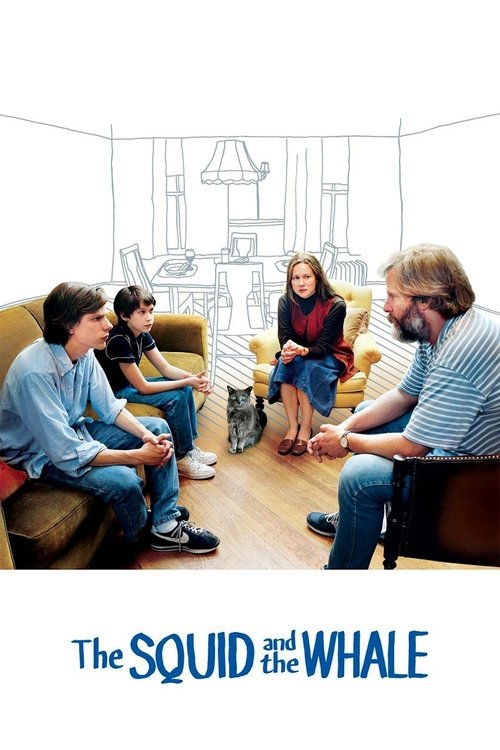
The Squid and the Whale
2005 · Noah Baumbach
For when you want something smart and biting that still hits you in the chest — comfort food for anyone who grew up around difficult, articulate adults. It's a quick watch that lingers way longer than its runtime.
What it's about
Brooklyn, the mid-1980s: a literary marriage comes apart, and the two sons get caught in the wreckage. The father is a novelist whose career is fading, the mother a writer whose star is rising, and as they split the week into joint custody, teenage Walt sides fiercely with his dad while his younger brother Frank quietly starts to unravel. It's a divorce story told from inside the kids' confusion, drawn from director Noah Baumbach's own childhood.
The experience
Sharp and fast and frequently very funny in a way that makes you wince, because every laugh is at the expense of someone's pretensions or someone's pain. At barely over 80 minutes it moves like a short story — you come out bruised and a little tender toward everyone in it.
Performances
Jeff Daniels is remarkable as Bernard — pompous, wounded, and infuriating, a man quoting his own reviews as his life collapses — and a young Jesse Eisenberg is painfully believable as the son parroting his father's opinions. Laura Linney brings warmth and guilt in equal measure.
The craft
Shot on grainy Super 16mm in about three weeks, and the rough, handheld texture suits the material perfectly — it feels like a memory rather than a production. Baumbach's script is the engine: dialogue so precisely observed it doubles as character assassination, trimmed to a lean, ruthless 81 minutes.
Why it matters
This is the film that established Baumbach as a major American voice and set the template for a generation of prickly, literate family comedies. It also announced Jesse Eisenberg to the world.
Snapshot
The Squid and the Whale is Noah Baumbach's fourth feature and the film that retroactively defined him as a major American voice: a compact, autobiographical chronicle of a literary family's disintegration in mid-1980s Park Slope, Brooklyn. Drawn from Baumbach's own childhood as the son of novelist and critic Jonathan Baumbach and critic Georgia Brown, it follows the Berkman family — declining novelist Bernard (Jeff Daniels), ascending writer Joan (Laura Linney), and their two sons, the father-worshipping teenager Walt (Jesse Eisenberg) and the younger, secretly unraveling Frank (Owen Kline) — through the months of their parents' separation and joint-custody negotiations. Running a lean 81 minutes and shot on Super 16mm in roughly three weeks on a modest budget (widely reported at around $1.5 million), the film converts intimate humiliation into rueful comedy. It premiered at the 2005 Sundance Film Festival, where it won the Directing and Waldo Salt Screenwriting awards, and earned Baumbach an Academy Award nomination for Best Original Screenplay. Its title, taken from a diorama at the American Museum of Natural History, names the film's governing image of two adversaries locked in combat — and the childhood terror that adult understanding must eventually overwrite.
Industry & production
The film sits squarely in the mid-2000s American independent ecosystem, where Sundance functioned as both incubator and launch pad and where specialty distributors competed for the festival's discoveries. It was produced under the banner of Samuel Goldwyn Films and Sony Pictures Classics, with Wes Anderson among its producers — a partnership rooted in Baumbach's co-writing of Anderson's The Life Aquatic with Steve Zissou (2004). That collaboration is materially visible in the production: Anderson's regular cinematographer, Robert D. Yeoman, shot the film, lending it craft credentials beyond its budget.
The economics were defining rather than incidental. The compressed schedule (reported at roughly 23 days), the Super 16 format, and the use of real Brooklyn locations rather than constructed sets were dictated by money and in turn shaped the aesthetic — handheld coverage, available-light interiors, and a documentary closeness that reads as style but began as necessity. Baumbach had come off the commercial disappointment of Mr. Jealousy (1997) and the troubled, barely released Highball (1997), a period that effectively stalled his career; The Squid and the Whale was a deliberate reset toward smaller, more personal work. Its critical reception and awards traction made it a model of the era's low-budget, high-prestige independent film, and it is frequently cited as the project that made Baumbach "bankable" as an auteur.
Technology
The decisive technological choice is the Super 16mm format. In an era when independent filmmaking was beginning its migration toward digital video, Baumbach and Yeoman chose film stock specifically for its grain and texture, seeking the look of the 1970s and early-'80s American cinema the story inhabits. The result is a deliberately degraded, warm, slightly soft image — a period feel achieved through the capture medium itself rather than through post-production color manipulation. The 16mm gauge also enabled the loose, mobile, often handheld shooting the budget and schedule required; the lighter camera package supported quick setups and improvisatory framing in cramped real interiors. In this sense the film's "technology" is conservative and retrospective: it uses an older capture format to evoke an older cinema, aligning means and meaning.
Technique
Cinematography
Yeoman's photography is the film's most discussed craft element. Working handheld for much of the picture, he favors close framings, naturalistic and often low light, and a restless, observational camera that stays near the actors' faces. The grain of the Super 16 is foregrounded rather than smoothed away, and the palette tends toward muted browns, autumnal interiors, and the lived-in clutter of bookish domestic spaces. The look consciously evokes 1970s American film and the textures of memory — this is a recollected childhood, and the imagery carries the slightly faded quality of something remembered rather than recorded live. Yeoman's restraint is notable given his more composed, symmetrical work for Wes Anderson; here the same cinematographer produces something rougher and more vérité.
Editing
Edited by Tim Streeto, the film is tightly compressed — its brevity is itself an editorial statement, refusing to linger or sentimentalize. Scenes are clipped to their essential friction; transitions are often abrupt, dropping the viewer into a new confrontation without establishing comfort. The cutting supports the comic timing, letting a cruel or self-deluding line land and then moving on before the audience can settle. The rhythm mirrors the children's experience of divorce as a series of disorienting jumps between two households and two parental versions of reality.
Mise-en-scène / staging
Production design does enormous narrative work. The Berkman home is dense with books, and the film treats bookshelves, manuscripts, and cultural artifacts as the family's true language — taste is currency, and the décor encodes status. When Bernard moves to a shabbier house "on the other side of the park," the spatial geography of gentrified Brooklyn becomes a map of his decline. Costuming and period props (the era's clothing, the specific cultural references) establish 1986 without museum-piece fussiness. Staging frequently isolates characters within frames or sets them in tense two-shots across kitchen tables and doorways, the architecture of a divided household.
Sound
The soundtrack mixes an original score by Dean Wareham and Britta Phillips with carefully chosen period needle-drops. The most narratively loaded music cue is Pink Floyd's "Hey You," which Walt performs at a school talent show and passes off as his own composition — a plagiarism that becomes the film's central metaphor for inherited, unearned identity. Other source music (including tracks by Loudon Wainwright III and Lou Reed) situates the period and the family's cultural milieu. Dialogue is the dominant sonic texture: the film is talky in the literary-family idiom, and its comedy lives in vocabulary, in the way characters deploy words like "philistine" and "Kafkaesque" as weapons.
Performance
Performance is where the film's reputation was made. Jeff Daniels gives a career-redefining turn as Bernard — pompous, wounded, casually cruel, and pitiable, a man whose intellectual vanity has curdled into bitterness as his literary star fades. Laura Linney's Joan is more guarded and ambiguous, a woman finding her own voice and freedom amid the wreckage, neither villain nor saint. Jesse Eisenberg, in an early lead, plays Walt's parroting of his father's opinions with painful precision, charting a slow, partial awakening. Owen Kline, in his sole major screen role as Frank, delivers the film's most disturbing and least mannered work — a child acting out his confusion through alcohol and sexual provocation. The ensemble's naturalism, abetted by the handheld camera, gives the picture its documentary sting.
Narrative & dramatic mode
The film operates in the mode of autobiographical tragicomedy. Its dramatic engine is not plot but accumulating revelation: a series of small, often excruciating scenes in which each family member's self-deception is exposed. Baumbach refuses melodrama's catharsis and the redemptive arc of conventional divorce drama; instead the structure is episodic and observational, organized around the rhythms of custody, school, and the boys' attempts to model themselves on a parent. The point of view is fundamentally the children's — particularly Walt's — and the film's emotional logic is that of a son slowly perceiving his father clearly for the first time. The climactic movement is internal: Walt's flight to the museum diorama is an act of recovered memory, not external resolution. The tone holds comedy and cruelty in unstable suspension, asking the audience to laugh at people it also pities.
Genre & cycle
Generically the film is a domestic comedy-drama and a coming-of-age story, but its more precise lineage is the literate American indie of the 1990s and 2000s — the talky, character-driven, milieu-specific film exemplified by Whit Stillman and the autobiographical strain of Woody Allen. It also belongs to the long cycle of divorce films in American cinema, offering a deliberately anti-sentimental counter to the empathetic seriousness of Kramer vs. Kramer (1979) and Ordinary People (1980). Within Baumbach's own filmography it inaugurates a recurring cycle of studies in arrested or wounded intellectuals and dysfunctional family systems that continues through Margot at the Wedding, Greenberg, While We're Young, and Marriage Story.
Authorship & method
This is the foundational text of Baumbach's authorship. As writer-director he worked from his own family history, fictionalizing his parents' separation and his own adolescent confusions, and the film's authority derives from that proximity — its specificity about literary-class Brooklyn could not be invented. His method here, refined over later films, treats the family as a system of competing self-narratives, dialogue as the medium of power, and comedy as the honest register for pain.
The key collaborators reinforce the achievement. Cinematographer Robert D. Yeoman supplied the period-evoking Super 16 look. Editor Tim Streeto, who would continue working with Baumbach, shaped the film's brisk, unsentimental rhythm. The musical team of Dean Wareham and Britta Phillips (of the bands Luna and Dean & Britta) provided a spare original score that sits unobtrusively beneath the period source cues. Producer Wes Anderson lent both practical support and, through the shared Yeoman collaboration, a craft sensibility — though Baumbach's rougher, more confrontational tone is distinct from Anderson's stylization. The ensemble cast, led by Daniels and Linney, completes the authorship: this is a director's film realized through performance.
Movement / national cinema
The film is a product of American independent cinema in its post-Sundance, specialty-distributor phase, but its aesthetic affiliations are transatlantic. Baumbach has repeatedly cited the European art cinema of his cinephile upbringing — the French New Wave and especially the conversational, morally observant films of Éric Rohmer — and The Squid and the Whale translates that sensibility into a New York register. It is, in effect, an American art film made in dialogue with French models, situated within the bookish, self-aware Brooklyn intelligentsia it depicts. Its national-cinema identity is therefore double: unmistakably a New York film about a particular American literary class, and a self-conscious heir to European traditions of intimate, talk-driven drama.
Era / period
The film is meticulously a period piece set in 1986, and the period is thematically essential rather than nostalgic decoration. The mid-1980s setting locates the story in a specific cultural moment — pre-internet, when literary reputation still carried tangible social weight and a novelist could be a local celebrity. Bernard's decline is partly the decline of that world's certainties. The Brooklyn of the film, before its later waves of gentrification fully transformed it, is itself a period subject. As a production of 2005, the film also belongs to a moment when American independent cinema briefly commanded outsized critical prestige, and when autobiographical, low-budget filmmaking could reach a national art-house audience.
Reception, canon & influence
Critically, the film was widely acclaimed on release and remains among the most esteemed American independent films of its decade. Reviewers singled out the screenplay's unsparing honesty and the performances, particularly Daniels's, which was frequently described as a revelation and a high point of his career. Beyond its Sundance directing and screenwriting awards, the film earned Baumbach an Academy Award nomination for Best Original Screenplay and won the Independent Spirit Award for Best Feature, cementing its standing.
Its influences run backward to Rohmer and the French New Wave, to the autobiographical and New York–centric comedy of Woody Allen, and to the literate American indie of Whit Stillman, as well as to the empathetic divorce dramas it both echoes and rebukes. Looking forward, it shaped Baumbach's own subsequent career and helped establish a template for the acerbic, intellectual family comedy-drama in American independent film. It launched Jesse Eisenberg toward leading roles and gave Jeff Daniels a defining late-career dramatic part. More broadly, its blend of naturalistic performance, handheld intimacy, and verbally precise cruelty influenced a generation of American indie filmmakers working in the domestic-realist mode, and it is now routinely included in surveys and best-of-decade lists as a touchstone of 2000s independent cinema. Where the film's longer-term canonical status is concerned, it is best described as secure but still consolidating — a critically beloved work whose influence is most legible within Baumbach's continuing body of films.
A Deleuzian reading
Walt stands on a school stage and sings Pink Floyd's "Hey You" as though he wrote it.
The full Deleuzian reading of The Squid and the Whale →
Reception
An instant Sundance darling in 2005 (it won both directing and screenwriting prizes there) and an Oscar nominee for its screenplay, it's only grown in stature since — now read as the Rosetta Stone for everything Baumbach did after, especially Marriage Story.
How The Squid and the Whale was received, from release to now →
Influences: the films it descends from and the films it influenced
- My Dinner with Andre (1981) — Establishes the verbally-driven American art film where talk itself is the action and the camera serves dialogue, the mode Baumbach adopts by letting precise speech rather than plot carry the drama.
- Annie Hall (1977) — Pioneers the autobiographical New York intellectual comedy that mines the filmmaker's own romantic and family failures for rueful humor, the template Baumbach reworks into divorce-from-a-child's-view.
- Manhattan (1979) — Models the literate-Manhattan milieu of writers and academics whose cultural posturing and adultery are rendered with affectionate cruelty, the same status-through-taste texture Baumbach maps onto literary Brooklyn.
- La Collectionneuse (1967) — Builds character entirely from how people talk about books, taste and seduction, the Rohmerian conviction—directly cited as an influence—that self-justifying speech reveals moral character, which structures the Berkmans' competing self-narratives.
- Metropolitan (1990) — Establishes the literate American indie of young people performing erudition (name-dropping authors they haven't read), the exact intellectual-class affectation Walt parrots from his father.
- Shoot the Piano Player (1960) — French New Wave handheld immediacy and abrupt tonal shifts between comedy and pain, the loose, available-light shooting grammar Baumbach and Yeoman adopt on Super 16.
- Husbands and Wives (1992) — Deploys jittery handheld camera and jump-cut editing to dramatize a marriage dissolving, the restless verité intimacy Baumbach extends into compressed, unsentimental domestic crisis.
- Kramer vs. Kramer (1979) — The empathetic mainstream divorce drama centered on custody and a child's loyalty that Squid both echoes and rebukes, replacing sentiment with the children's weaponized partisanship.
- Kicking and Screaming (1995) — Baumbach's own debut establishes his dialogue-as-power method—post-collegiate intellectuals talking past each other—the verbal style he matures into autobiographical specificity here.
- The Royal Tenenbaums (2001) — Co-written by Baumbach, it shares the dysfunctional-family-of-prodigies-and-a-narcissistic-patriarch system and decor-as-status mise-en-scène, the collaboration that fed directly into Squid's family-as-competing-narratives structure.
- Election (1999) — Extends the strain of unsentimental, morally complex American comedy that Election legitimized — characters mapped by the gap between self-image and conduct, observed without a sympathetic anchor.
- Igby Goes Down (2002) — Extends the autobiographical-satire method — weaponizing one's own literate dysfunctional family — with handheld 16mm intimacy and an autumnal palette directing the ensemble to a unified tone of rueful despair.
- Margot at the Wedding (2007) — Extends Squid's method—handheld available-light intimacy, verbally precise cruelty within a literary family—into an even more abrasive study of an articulate, wounding mother.
- The Savages (2007) — Carries forward the acerbic intellectual-family tragicomedy of literate siblings managing a difficult parent, with comedy as the honest register for pain in the domestic-realist key Squid templated.
- Greenberg (2010) — Develops the naturalistic ensemble and uncomfortable-character study further, with needle-drop scoring and dialogue that exposes a self-justifying narcissist, deepening Squid's authorial signature.
- Frances Ha (2012) — Distills the handheld available-light intimacy, compressed runtime and abrupt transitions into a black-and-white New York character study, the formal economy first achieved on Squid's Super 16.
- The Meyerowitz Stories (2017) — Returns directly to Squid's subject—adult children and a self-mythologizing artist-father competing for legitimacy—using the same dialogue-as-power and abrupt-cut comedic timing.
- Marriage Story (2019) — The mature culmination of Squid's divorce-from-the-inside project, again autobiographically rooted, trading handheld roughness for composed precision but retaining the children-caught-between-parents core.
- The Squid and the Whale of indie verbal cruelty—Tiny Furniture (2010) — Inherits the autobiographical, talky, naturalistic-ensemble mode of mining one's own privileged intellectual family for tragicomedy, extending Squid's template to a younger generation of American indie.
- Lady Bird (2017) — Baumbach's semi-autobiographical family drama pioneers the overlapping, wounding parent-child dialogue and finely calibrated cruelty that is Gerwig's collaborator's core method.
- A Real Pain (2024) — Supplies the verbally precise, behavioral-realist mode of family friction — and is literally where Baumbach cast Eisenberg, forging the neurotic self-conscious screen persona he later writes and directs for himself.
- Captain Fantastic (2016) — Father as syllabus: the technique of letting a child parrot a parent's cultural verdicts verbatim so the recitation indicts the adult — precisely how Ross stages the kids' Bill of Rights and book-report catechisms.
- American Fiction (2023) — Dramatizes a novelist's vanity entirely through family dinner-table blocking and overlapping dialogue in warm practical interiors, never through his prose — the method Jefferson uses to keep the Ellison household scenes doing the film's real emotional work.
- White Noise (2022) — Establishes Baumbach's signature treatment of the family as an acoustic problem: four people talking past each other in one room, affection expressed as interruption — the one authorial technique that survives intact into a film otherwise made with an entirely new crew.
- Rushmore (1998) — Shares producer Wes Anderson and cinematographer Robert Yeoman, and the precocious-boy-imitating-adults archetype, though Baumbach strips Anderson's symmetrical stylization for rougher handheld confrontation.
- You Can Count on Me (2000) — The naturalistic dialogue-driven family indie built on lived-in sibling/parent friction and Laura Linney's restrained performance register, the same domestic-realist mode and lead actor.
- The Holdovers (2023) — 1970s-80s academic period recreation on grainy 16mm-feel stock, populated by self-important literary men — the same textured-nostalgia-plus-bitter-intellect combination.
- Sideways (2004) — Extends the literate, acid-but-humane naturalism of male ego and creative failure, handheld and unglamorous, in the same specialty-division comedy-drama register.
Similar films
- Marriage Story (2019) — influence & lineage
- Kicking and Screaming (1995) — influence & lineage
- The Royal Tenenbaums (2001) — influence & lineage
- Kramer vs. Kramer (1979) — influence & lineage
- Rushmore (1998) — influence & lineage
- White Noise (2022) — shared sensibility
- The Fabelmans (2022) — shared sensibility
- Synecdoche, New York (2008) — shared sensibility