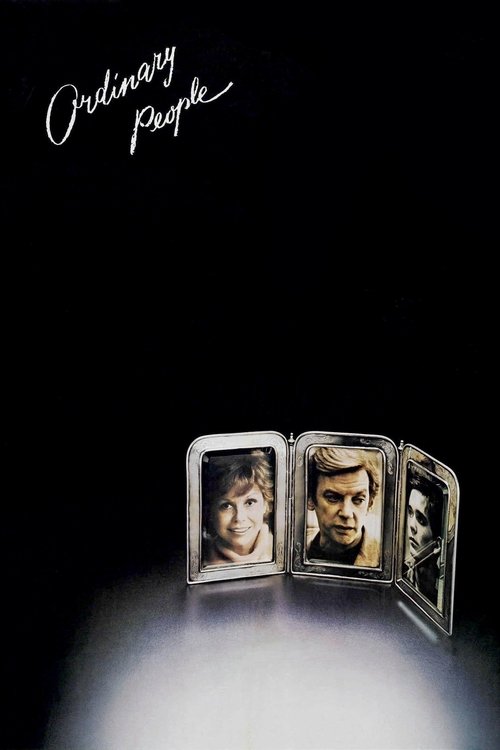
Ordinary People
1980 · Robert Redford
For when you need a good cry, or when you're ready to sit with grief and actually feel it — especially if family silence is something you know from the inside. Emotionally demanding, but it holds your hand through the dark.
What it's about
An affluent family in suburban Chicago is coming apart in perfect silence. The elder son died in a sailing accident; the younger, Conrad, survived, attempted suicide, and has come home from the hospital to a mother who can't forgive him for living and a father straining to hold everyone together. The drama plays out in a psychiatrist's office and across breakfast tables — small rooms where everything unsaid finally has to be said.
The experience
Quiet, precise, and emotionally devastating in slow motion — it builds not through events but through conversations that keep almost happening. Expect to cry, and expect a couple of therapy scenes to land like body blows.
Performances
Timothy Hutton is astonishing as Conrad, all raw nerves and guarded flinches, and Mary Tyler Moore plays devastatingly against her sunny image as a mother frozen behind immaculate control. Donald Sutherland's gentle, bewildered father and Judd Hirsch's warm, needling psychiatrist round out one of the great ensemble quartets.
The craft
Robert Redford's debut as a director is a masterclass in restraint: composed, wintry suburban frames where the tidiness of the house becomes the problem. The script trusts silences and half-finished sentences, and the spare use of Pachelbel's Canon gives the film its aching, elegiac undertow.
Why it matters
It swept the top Academy Awards including Best Picture and launched Redford's directing career, and it set the template for serious American films about therapy, grief, and the unraveling of the picture-perfect family.
Snapshot
Ordinary People is the story of an affluent suburban family fracturing quietly under the weight of an unspoken grief. The Jarretts of Lake Forest, Illinois, have lost their elder son, Buck, in a sailing accident; the younger son, Conrad (Timothy Hutton), survived, attempted suicide, and has returned from a psychiatric hospital to a house that cannot speak of any of it. Calvin (Donald Sutherland), the father, strains to keep the family intact; Beth (Mary Tyler Moore), the mother, retreats into immaculate control, unable to forgive the wrong son for living. The film's drama is therapeutic rather than incident-driven: its decisive scenes occur in a psychiatrist's office and across a breakfast table. Adapted from Judith Guest's 1976 novel, it was Robert Redford's debut as a director and became one of the most decorated American dramas of its era, winning the Academy Award for Best Picture. It is also a film perpetually relitigated — remembered as much for what it defeated (Martin Scorsese's Raging Bull) as for what it achieved, a fault line in arguments about American taste at the turn of the 1980s.
Industry & production
The film was produced by Ronald L. Schwary for Paramount Pictures, arriving in the autumn of 1980. Its origin lay in Judith Guest's first novel, a critical and commercial success that Paramount and Redford pursued as a vehicle for Redford's transition behind the camera. By 1980 Redford was among the most bankable American stars; that he chose to make his directing debut on an interior chamber drama, taking no acting role in it, signaled a deliberate bid for authorship over stardom. The screenplay was entrusted to Alvin Sargent, a veteran adapter of literary material (Paper Moon, Julia) whose discipline in compression suited a novel built largely from interiority.
Casting was the production's most consequential gamble. Mary Tyler Moore, indelibly associated with warm, sympathetic television comedy, was cast sharply against type as the frozen, withholding Beth. Donald Sutherland took the less flashy role of the father. For Conrad, Redford cast Timothy Hutton, the son of actor Jim Hutton, in his feature debut. Judd Hirsch — himself a television figure, from Taxi — played the psychiatrist Dr. Berger, and Elizabeth McGovern made her screen debut as Conrad's classmate Jeannine. The production shot on location on Chicago's North Shore, using the manicured affluence of Lake Forest as a character in itself. The picture proved a substantial commercial success and swept the major Academy categories, winning Best Picture, Best Director for Redford, Best Adapted Screenplay for Sargent, and Best Supporting Actor for Hutton (campaigned in the supporting category despite a lead-sized role). Moore and Hirsch were nominated; Moore's loss is among the more cited near-misses of the period.
Technology
Ordinary People is, technologically, a conservative film, and deliberately so. It was photographed on 35mm color stock using conventional anamorphic-era studio craft, with no recourse to the showy optical or camera-movement innovations then circulating in American cinema. Where contemporaries chased the Steadicam's gliding mobility (popularized only a few years earlier) or the saturated, high-contrast palettes of the New Hollywood's last flowering, Redford and cinematographer John Bailey pursued restraint: available-feeling light, naturalistic interiors, a muted New England-by-way-of-Midwest autumnal palette. The technological "advance," such as it is, lies in the suppression of technique — a polished invisibility meant to keep attention on faces and silences. The film belongs to a transitional moment when the textural grit of 1970s American filmmaking was giving way to a smoother, more classical surface, and its tools are marshaled toward that smoothness rather than against it.
Technique
Cinematography
John Bailey, near the start of a distinguished career, shot the film, and his work is a study in calibrated coolness. The Jarrett house is rendered in clean, balanced compositions — symmetrical, tasteful, almost suffocatingly ordered — so that the visual environment embodies Beth's need for control. Light is soft and natural; the palette favors autumnal browns, golds, and the chilled blues of a Midwestern fall, with the emotional temperature dropping as the family's crisis deepens. Bailey and Redford favor a relatively static, observational camera that holds on actors' faces, letting performance rather than movement carry meaning. The visual scheme withholds expressionist flourish precisely so that the rare disruptions — a face caught off-guard, a composition broken by an outburst — register as genuine rupture. It is photography organized around containment and its failure.
Editing
The film was cut by Jeff Kanew. The editing's signal device is the controlled use of fragmentary flashback: Conrad's traumatic memory of the sailing accident and his hospitalization surface in brief, intrusive shards rather than sustained sequences, mimicking the involuntary return of trauma. These flashes are withheld and rationed, with the fullest revelation reserved for the film's climax, so that the audience reconstructs the catastrophe at roughly the pace Conrad himself can bear to. Otherwise the cutting is patient and classical, built to give scenes — especially the therapy sessions — room to breathe and to let silence accumulate weight. The rhythm is dictated by performance and by the logic of suppression: cuts often land a beat later than a more conventional film would allow, holding on discomfort.
Mise-en-scène / staging
Staging is where the film's themes are most legibly inscribed. The Jarrett home is a set-dressed argument: spotless, coordinated, full of objects that signify success and conceal grief. Beth's domain is order — the perfectly set table, the controlled exterior — and Redford repeatedly stages her in relation to surfaces she is managing. The recurring breakfast-table scenes function as a theater of avoidance, with the French toast Conrad cannot eat becoming an emblem of nurture that has curdled into performance. Blocking emphasizes distance: family members are framed apart, divided by furniture and thresholds, rarely sharing intimate two-shots until the film forces a reckoning. Against this domestic frigidity, Berger's cluttered, informal office is staged as its opposite — disordered, human, safe — making the consulting room the only space in the film where truth can be spoken.
Sound
The film's most famous sonic decision is its use of Johann Pachelbel's Canon in D as a recurring musical motif, an existing baroque work rather than an original theme, adapted into the score overseen by Marvin Hamlisch. The Canon's serene, cyclical structure lends the film an air of poised civility that ironizes the turmoil beneath — beauty as a kind of denial, fitting for a family that prizes appearances. Beyond the music, the sound design leans on quiet: the film is attentive to the texture of silence, to the awkward pauses and half-finished sentences in which the Jarretts conduct their evasions. Dialogue is staged for what it withholds, and the absence of underscoring across long stretches makes the eventual returns of the music, and the eventual emotional eruptions, more pointed.
Performance
Performance is the film's true medium. Mary Tyler Moore's Beth is the production's enduring achievement — a portrait of grief expressed entirely as control, a woman whose warmth has frozen into brittle composure, played without bids for sympathy. The casting against her beloved comic persona deepens the unsettling effect. Donald Sutherland gives a generous, recessive performance as a decent man slowly realizing his marriage and his understanding of his wife are collapsing. Timothy Hutton, in his debut, carries the film's raw nerve, charting Conrad's movement from clenched terror toward the possibility of feeling; his climactic breakthrough scene in Berger's office is the film's emotional fulcrum. Judd Hirsch plays Berger as warm, probing, and unsentimental, a counterweight of human messiness. The ensemble is tuned to naturalism — small gestures, withheld reactions — which is precisely what the material's containment requires.
Narrative & dramatic mode
Ordinary People operates in the mode of the domestic psychological drama, and more specifically the "therapeutic" narrative: its arc is the work of mourning and the recovery of buried feeling, externalized through psychotherapy. The structure is one of gradual revelation rather than plot mechanics — the audience pieces together the accident, the suicide attempt, and the family's history of preference and resentment through accreted scenes and rationed flashbacks. Conflict is largely internal and relational, dramatized in conversation, and the film's "events" are emotional thresholds crossed: a first honest exchange, a refused embrace, a parent's departure. It privileges interiority and ambivalence over resolution; its ending offers reconciliation between father and son but no tidy redemption for the family as a whole, with Beth's inability to change left unhealed. This is realism of the chamber-drama kind, indebted to literary fiction and to the theatrical tradition of the family confrontation.
Genre & cycle
The film sits within the American domestic melodrama, updated for a post-1970s sensibility attuned to psychology and suburban malaise. It belongs to a cluster of late-1970s and early-1980s pictures dramatizing the fracture of the middle-class family — most obviously Kramer vs. Kramer (1979), with which it shares an Oscar-winning interest in fathers, families, and the wounds of dissolution. Together these films mark a moment when Hollywood's prestige register shifted from the male-genre energies of the New Hollywood toward intimate dramas of domestic crisis and emotional literacy. Ordinary People also participates in a longer American tradition of unmasking suburban affluence as a site of repression and hidden damage, a lineage that runs back through Douglas Sirk's melodramas and forward toward later anatomies of the manicured suburb.
Authorship & method
As a directorial debut, the film is notable for Redford's effacement of himself. Having built his stardom on charisma, he directs in a register of restraint — trusting actors, holding the camera still, organizing the whole film around the discipline of withholding. His method here is essentially an actor's-director method: careful casting (including the counterintuitive choices of Moore and Hutton), close attention to performance, and a refusal of stylistic display that keeps the focus on emotional truth. His key collaborators each serve that program. Alvin Sargent's screenplay performs the crucial labor of converting Guest's interior novel into externalized scenes of speech and silence, finding the therapy sessions and family meals that can carry inner states. John Bailey's cinematography supplies the cool, ordered surface; Jeff Kanew's editing controls the rationing of revelation; and the adaptation of Pachelbel's Canon under Marvin Hamlisch supplies the ironic serenity that binds the whole. The authorial signature is collective and self-suppressing — a film about emotional honesty made through formal modesty.
Movement / national cinema
The film is a product of mainstream American studio filmmaking at a hinge point. It does not belong to the auteurist New Hollywood of the preceding decade so much as to the prestige-drama mode that succeeded it: literate, character-centered, awards-oriented pictures made within the studio system for an adult audience. Its sensibility is thoroughly American and specifically that of the affluent Northern suburb, and it can be read as part of a national cinema increasingly preoccupied, at the dawn of the Reagan era, with the private discontents beneath middle-class prosperity. Where European art cinema had long mined familial repression, Ordinary People domesticates that inquiry into a recognizably American idiom of self-improvement and therapy.
Era / period
Released in 1980, the film stands precisely on the threshold between the New Hollywood and the studio era that followed. The 1970s' appetite for moral ambiguity and stylistic risk is present in its refusal of easy uplift, but its polished surface and emotional accessibility point toward the 1980s. Its preoccupations — therapy, emotional articulacy, the wounds of the prosperous family — are very much of their cultural moment, when psychotherapeutic language was entering the American mainstream. The contemporaneous canonization of Ordinary People over Raging Bull has come to symbolize this transition for later critics: a vote, as the argument goes, for tasteful sincerity over visceral formal audacity, and thus a marker of where official American taste stood as one decade gave way to the next.
Themes
At its center is grief and the catastrophe of its suppression — a family that has lost a son and lost, too, the capacity to mourn him aloud. From this flow the film's interlocking concerns: guilt, especially the survivor's guilt that drives Conrad's self-destruction; the corrosive effects of emotional repression and the cult of appearances; and the question of whether love can survive without the willingness to be vulnerable. Beth embodies the theme of control as a defense against feeling, and the film's quiet tragedy is its refusal to redeem her — some people, it suggests, cannot bend. Against that, it dramatizes the value and the difficulty of emotional honesty, locating healing not in the family's affluent self-sufficiency but in the messy, humane intervention of therapy. Class hovers throughout: the immaculate surfaces of privilege are shown as both shelter and prison, the very perfection that makes grief unspeakable.
Reception, canon & influence
Ordinary People was broadly acclaimed on release and validated decisively by the Academy, taking Best Picture, Director, Adapted Screenplay, and Supporting Actor. Praise centered on the performances — Moore's in particular — and on Redford's unexpected assurance as a director of actors. Its reputation has since become double-edged. The film remains admired as an intelligent, finely acted family drama and a model of restrained adaptation; but its Best Picture victory over Raging Bull (and over The Elephant Man) has made it a recurring exhibit in revisionist arguments that the Academy rewards tasteful accessibility over formal greatness. That debate has, somewhat unfairly, come to overshadow the film on its own terms, casting it as the era's "safe" choice.
Looking backward, the film draws on the American tradition of the suburban-family melodrama and on the literary realism of Guest's novel; its immediate kin is Kramer vs. Kramer, and behind both lies a long lineage of dramas exposing the repression beneath middle-class comfort. Looking forward, it helped consolidate the early-1980s prestige template of the intimate, performance-driven adult drama, and it demonstrated that a major star could credibly reinvent himself as a serious director — a path Redford continued to pursue. Its therapeutic structure and its anatomy of the emotionally frozen affluent family anticipate later screen treatments of suburban damage. The film also launched careers, most visibly Timothy Hutton's and Elizabeth McGovern's, and cemented John Bailey as a leading cinematographer. If its place in the canon remains contested, its craft and its central performances continue to reward attention, and its standing as a touchstone in the perennial argument over American cinematic taste is, paradoxically, its most durable form of influence.
A Deleuzian reading
Conrad makes French toast for his mother.
The full Deleuzian reading of Ordinary People →
Reception
Swept the 1981 Oscars — Best Picture, Director, the works — then spent decades as the punchline 'the movie that beat Raging Bull.' Recent years have brought a genuine reappraisal, with critics and Letterboxd users arguing it was never the villain, just the collateral damage of Scorsese discourse.
How Ordinary People was received, from release to now →
Influences: the films it descends from and the films it influenced
- East of Eden (1955) — Kazan's actor's-director method of coaxing raw, unguarded vulnerability from a young, near-untrained lead inside a repressive father-son household is the template for Redford's intimate handling of Hutton.
- Splendor in the Grass (1961) — Uses psychiatric breakdown and institutional treatment of repressed affluent youth as the dramatic engine that surfaces buried feeling — the therapeutic structure Ordinary People externalizes through its sessions.
- Long Day's Journey Into Night (1962) — A living-room chamber drama carried entirely by performance and the gradual unsealing of a death the family will not name, modeling the rationed-revelation withholding strategy.
- Scenes from a Marriage (1973) — Static, near-clinical observation of bourgeois partners articulating interior states aloud in dialogue establishes the therapy-room aesthetic of a held, undistracting camera trained on talk.
- Autumn Sonata (1978) — Builds its drama on a child's reckoning with a withholding, emotionally frozen mother in an autumnal palette — the precise affective architecture of the Moore character's coldness.
- Interiors (1978) — Imports Bergman's method to anatomize a frozen affluent American family through cool, ordered framing, static blocking and near-silence — the same self-suppressing formal modesty Redford adopts.
- Kramer vs. Kramer (1979) — Immediate kin: the prestige, performance-driven domestic drama that externalizes interior crisis through ordinary scenes — meals, errands, a child at the emotional center — rather than stylistic display.
- Equus (1977) — Builds its entire dramaturgy on Equus's therapeutic engine — escalating analyst-patient sessions that excavate a guarded trauma — treating the confessional breakthrough itself as the film's climax.
- The Big Chill (1983) — Bailey's naturalistic, cool-surfaced cinematography again frames an affluent group metabolizing a sudden death, extending his Ordinary People register into ensemble grief.
- A River Runs Through It (1992) — Redford continues his own signature — restrained direction, autumnal palette, and a withholding, inexpressive father whose love is legible only through discipline and absence.
- The Ice Storm (1997) — Extends the autumnal palette and static, observational framing of affluent suburban paralysis, locating repression in the cold geometry of domestic space exactly as Bailey's surfaces do.
- American Beauty (1999) — Inherits the anatomy of damage beneath an affluent suburban surface, organizing the film around the repression and emotional frostiness of the upper-middle-class household.
- In the Bedroom (2001) — Rations the revelation of parental grief through silence design, blocking distance and avoided dinner-table contact — the New England restraint and withholding directly descended from Redford's method.
- Rabbit Hole (2010) — A therapeutic-drama of a couple after a child's accidental death, using group/therapy scaffolding to externalize grief that the spouses suppress at home.
- Manchester by the Sea (2016) — Uses fragmentary flashback to ration a withheld traumatic death and stages grief as emotional inarticulacy rather than catharsis — the gradual-revelation editing logic of Ordinary People pushed further.
- Warrior (2011) — The structural architecture of family grief encoded as behavioral displacement and emotional withdrawal — forcing itself into open confrontation only through a long-deferred revelation — is the dramatic template O'Connor inherits for the Hardy–Nolte dynamic, where the incapacity for honest speech is both symptom and subject.
- Magnolia (1999) — Its earnest American melodrama of guilt and unhealed father/parent–child wounds, played in long therapy-room two-handers, supplies the emotional register Magnolia amplifies in the Mackey–Earl and Stanley–Jimmy strands.
- Hereditary (2018) — Supplies the American domestic-grief-drama scaffolding — a mother who cannot love her surviving child, the lacerating dinner-table recrimination — that Aster adopts at art-drama seriousness before detonating it.
- Good Will Hunting (1997) — Builds its drama from repeated psychiatrist-patient sessions that escalate toward a single guilt-releasing breakthrough — the direct structural model for Will's therapy arc and the 'it's not your fault' catharsis.
- Happiness (1998) — Establishes the euphemistic therapy-and-self-help register of dialogue about repressed suburban families that Solondz writes straight and weaponizes for irony.
- American Gigolo (1980) — John Bailey's cinematography here supplies the same cool, ordered, controlled surfaces — composed light over emotional refrigeration — that he brings to Ordinary People the same year.
- Terms of Endearment (1983) — Consolidates the same early-1980s prestige template of the intimate, performance-led adult domestic melodrama built around mother-child friction and grief.
Similar films
- In the Bedroom (2001) — influence & lineage
- Long Day's Journey Into Night (1962) — influence & lineage
- The Big Chill (1983) — influence & lineage
- Interiors (1978) — influence & lineage
- Manchester by the Sea (2016) — influence & lineage · same viewing thread
- A Separation (2011) — same viewing thread
- Amour (2012) — same viewing thread
- Ghostlight (2024) — shared sensibility
All the films related to Ordinary People →
Watch it with: curated runs of related films
- When the Family Comes Undone — Watch these when you want intimate, one-household dramas where love and grief are the same thing — a parent fading, a marriage on trial, a child at the center of the wreckage.