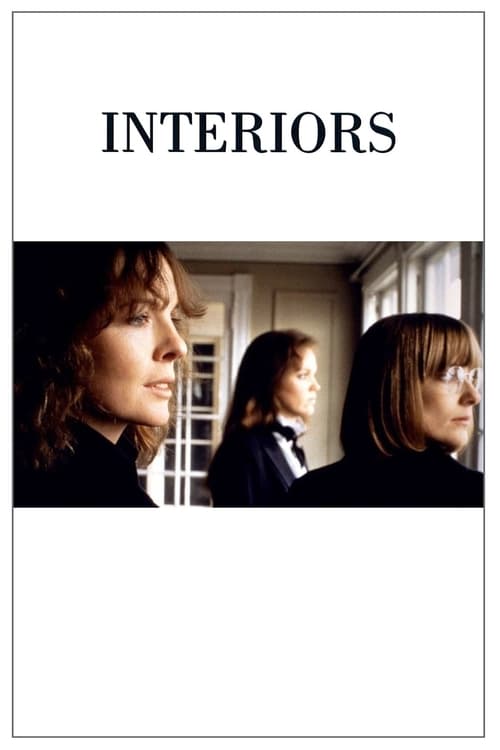
Interiors
1978 · Woody Allen
For when you want a serious, adult drama to chew on — one about mothers, daughters, and the damage perfectionism does — and you're up for a challenge rather than comfort. Not the film for a light evening; very much the film for a reflective one.
What it's about
After decades of marriage, Arthur abruptly leaves Eve, an interior designer whose exacting, controlling taste has shaped — and suffocated — their family. The desertion cracks open the lives of their three grown daughters: Renata, a successful writer; Joey, paralyzed by indecision about what to do with her life; and Flyn, an actress. As their fragile mother unravels, the sisters' jealousies and resentments surface, and Arthur's arrival with a warm new companion forces everything to a head.
The experience
Severe, hushed, and deliberately airless — a slow-burning chamber drama where the tension lives in what this family cannot say to each other. It's demanding and emotionally cold by design, and it sits with you afterward like a difficult conversation you didn't finish.
Performances
Geraldine Page is devastating as Eve, all brittle control over a collapsing center, and Maureen Stapleton blows through the film's chill like an open window.
The craft
Woody Allen's first pure drama, made in open homage to European art cinema: muted beach-house palettes, precise compositions, long silences, and no score to soften anything. Gordon Willis's austere cinematography turns rooms and interiors into a portrait of the woman who arranged them.
Why it matters
One of the most debated pivots in American filmmaking — the reigning comedy director going fully somber a year after Annie Hall — it earned multiple Oscar nominations and proved Allen would spend his career alternating between laughter and gravity.
Snapshot
Interiors is Woody Allen's first drama without comedy — a severe, hushed chamber piece about an upper-middle-class New York family cracking along the fault lines its matriarch spent a lifetime lacquering over. Released in August 1978, roughly a year and a half after Annie Hall had made Allen the most celebrated American comic filmmaker of his moment, the film was a deliberate and much-remarked act of self-reinvention: a bid to be taken seriously as a maker of European-style art cinema, conducted in open homage to Ingmar Bergman. Eve, an interior designer of formidable, controlling taste, is left by her husband Arthur after decades of marriage; the desertion exposes the paralyzed inner lives of their three grown daughters — the writer Renata, the perpetually blocked Joey, the actress Flyn — and, when Arthur brings home a warm, vulgar, life-loving new partner named Pearl, precipitates tragedy. The film earned five Academy Award nominations and remains one of the pivotal, most contested works in Allen's filmography: to admirers a rigorous formal exercise in restraint, to detractors an airless imitation. It is, in either reading, an unusually pure document of an American comedian willing his own transformation into a tragedian.
Industry & production
Interiors was produced within the singular arrangement Allen enjoyed with United Artists and his longtime management-production partners Jack Rollins and Charles H. Joffe, who had shepherded his films since the 1960s. That deal granted Allen extraordinary creative autonomy — final cut, freedom of subject — in exchange for working on modest budgets, an autonomy few American directors of the era commanded. It is precisely that latitude that made a film like Interiors possible: a commercially unpromising, laugh-free drama greenlit on the strength of the goodwill and profit generated by Annie Hall, which had just won the Academy Award for Best Picture (for 1977).
The production kept the tight, loyal New York craft ensemble Allen was assembling into a repertory company. Robert Greenhut, who would become Allen's producing mainstay for two decades, worked on the film; the shoot was based in and around New York, with the family's coastal house — a crucial location — anchoring the drama's key movements. The film was shot economically and quickly by the standards of the material's apparent prestige. I don't have reliable budget or box-office figures to cite and won't invent them; the safe historical generalization is that Interiors was a small-budget picture that performed modestly, well below the comedies, and was received as a "difficult" release rather than a hit.
Technology
Technologically Interiors is conventional for a late-1970s American feature: 35mm photography, spherical (non-anamorphic) lensing, conventional optical and photochemical finishing. Its interest lies not in apparatus but in the disciplined suppression of it. The most conspicuous technical decision is a negative one — the complete absence of a musical score. There is no non-diegetic music anywhere in the film, an austerity that throws the burden of atmosphere entirely onto image, performance, and the ambient sound of interiors and the sea. The palette, too, functions almost as a technological signature: cinematographer Gordon Willis and the production team pushed color film toward a nearly monochrome register of grays, beiges, off-whites, and muted earth tones, using the medium's capacity for saturation as a resource to be withheld rather than exploited. The "technology" of the film is thus best understood as an aesthetics of subtraction.
Technique
Cinematography
The photography is by Gordon Willis, the cinematographer nicknamed "the Prince of Darkness" for the underexposed, top-lit work he had done on The Godfather films. Interiors was his second collaboration with Allen, after Annie Hall, inaugurating a partnership that would run through Manhattan, Stardust Memories, and beyond. Here Willis works in a key of restrained natural light, wide window-lit rooms, and cool desaturation. Compositions are frequently static and frontal, with characters arranged against pale walls and empty space; the framing isolates figures within the very rooms Eve has so carefully designed, making the décor a visible instrument of confinement. The film is famous for a controlled, muted color scheme against which a single deliberate intrusion registers — Pearl's arrival in vivid red — so that costume and palette carry thematic weight the dialogue leaves implicit. Willis's willingness to let faces fall into shadow, to hold the camera still, and to compose through doorways and mirrored surfaces gives the film its Bergmanesque gravity.
Editing
The film was edited by Ralph Rosenblum, whose partnership with Allen reached back to Take the Money and Run and encompassed Bananas, Sleeper, Love and Death, and Annie Hall — Rosenblum being widely credited with helping shape the loose, associative comic rhythms of those films (and, famously, with salvaging Annie Hall in the cutting room). Interiors was, notably, effectively the end of that collaboration; from Manhattan onward Allen's editor would be Susan E. Morse. The cutting in Interiors is correspondingly un-comic: long takes, patient holds, few cuts within scenes, an editorial rhythm built to let discomfort accumulate rather than to release it. Where the comedies cut for the timing of a joke, Interiors cuts for the timing of silence.
Mise-en-scène / staging
Mise-en-scène is arguably the film's true subject, given that its central character composes rooms for a living. Production designer Mel Bourne built interiors of studied, sterile good taste — spare, pale, meticulously ordered — that literalize Eve's aestheticized emotional repression: her family lives inside her control. Staging tends toward stillness and careful spatial separation, with characters positioned to register estrangement through blocking, turned backs, and the distances between bodies in a room. The coastal house, the beach, and the gray sea provide the recurrent counter-space to the manicured interiors, and the film's climactic movement carries the drama out of the designed room and into the indifferent natural world. The controlling metaphor — interiors as both domestic spaces and psychological ones — is executed through design and staging rather than stated.
Sound
The soundtrack is defined by the absence of music and the presence of ambient quiet: the sound of the ocean, of footsteps on wood, of rooms in which no one is speaking. This scoreless design amplifies dialogue and, crucially, silence, forcing the audience to sit inside the family's inarticulate tension without the emotional cueing a score would supply. The sea recurs as the dominant sonic motif, a natural undertone against the manufactured hush of the interiors.
Performance
Performance is where the film's ambitions are most fully realized. Geraldine Page plays Eve as a woman whose exquisite composure is a form of illness, her rigidity barely containing panic and despair. E.G. Marshall gives Arthur a weary, guarded decency. As the daughters, Diane Keaton — cast startlingly against the comic warmth of Annie Hall — plays Renata's brittle intellectual anguish; Mary Beth Hurt is the aching, self-doubting Joey, the moral center who cannot act; and Kristin Griffith is Flyn. The decisive contrast is supplied by Maureen Stapleton as Pearl, whose earthy vitality and appetite for life — she is warm, loud, sensual, unashamed — breaks into the family's frozen world like weather. Sam Waterston and Richard Jordan fill out the men attached to the daughters. The acting register is theatrical in the best sense: sustained, verbal, interior, dependent on the actors' capacity to hold emotion in stillness.
Narrative & dramatic mode
The dramatic mode is domestic tragedy in a deliberately theatrical key — closer to Chekhov, Strindberg, or O'Neill than to the American comedy Allen had mastered. The structure is that of a family drama triggered by a rupture (Arthur's departure) and resolved by a catastrophe (bound up with Eve's fate and Pearl's intrusion). The film's method is one of exposure rather than plot: the desertion functions less as an engine of incident than as a solvent that dissolves the family's protective surfaces, laying bare jealousy, insecurity, blocked ambition, and the inability to speak. Dialogue is literary, self-analytic, sometimes consciously "written," and the film trusts talk and silence to do the work that a genre picture would assign to action. Its rhythm is deliberately undramatic in the conventional sense — accretive, patient, withholding catharsis.
Genre & cycle
Generically the film is a serious familial melodrama or art-house chamber drama, and its significance within Allen's career is precisely that it stands outside the comic cycle that defined him. It belongs to a transatlantic lineage of European modernist art cinema rather than to any Hollywood genre cycle, and it inaugurated a strand in Allen's own output — the recurring return to Bergmanesque or Chekhovian serious drama — that would resurface in later films such as September and Another Woman. Within the broader landscape of 1970s American cinema, it can be read alongside the decade's other unsparing marital and familial dramas, but its stylistic allegiance is emphatically European.
Authorship & method
Interiors is a signal authorial statement: Allen writing and directing, for the first time, entirely without appearing on screen and entirely without comedy. The method is one of self-effacement paradoxically in the service of self-assertion — the removal of the "Woody Allen" comic persona in order to claim a different artistic identity. The collaborators are essential to that method and largely drawn from his emerging stock company: Gordon Willis's photography supplies the visual gravity; Mel Bourne's production design supplies the controlling metaphor; Ralph Rosenblum's editing (in its final Allen outing) supplies the patient rhythm; the scoreless sound design supplies the austerity. The most important single influence on Allen's authorship here is external: Ingmar Bergman, whose chamber dramas of familial and spiritual crisis — the interrogation of faith, mortality, and the failures of love among a handful of characters in enclosed spaces — provide the film's evident model. Allen's authorship in Interiors is thus best described as a disciplined, sometimes reverent act of stylistic apprenticeship to a master he openly admired.
Movement / national cinema
Though an American film made in New York with American actors, Interiors is stylistically an act of allegiance to European art cinema, specifically the Scandinavian modernism of Bergman. It sits, in that sense, athwart national categories: a product of the New Hollywood's auteur freedoms deployed to imitate a foreign tradition. It is a landmark of the 1970s American cinema's willingness — enabled by the auteur latitude of the period — to attempt austere, non-commercial, personal art films, but its "movement" is less a national school than one director's private importation of a European sensibility onto American ground.
Era / period
The film is a creature of the late New Hollywood, that brief window in which studios ceded unusual control to directors and financed idiosyncratic personal projects. Its very existence depends on the moment: it was made in the immediate afterglow of Annie Hall's Best Picture win, when Allen's commercial and critical capital was at a peak and United Artists was prepared to indulge a radical departure. The period detail is spare and contemporary — an affluent, cultured, secular New York milieu of writers, designers, and actors — and the film reads as a considered response to the anxieties of that class at the end of the 1970s: aging, mortality, the exhaustion of a certain aestheticized WASP gentility, and the failures of a lifetime of good taste to produce happiness.
Themes
The governing theme is announced by the title's double meaning: interiors as designed rooms and as psychological depths, the two collapsed into one. The film anatomizes emotional repression — the way exquisite control, aesthetic order, and cultivated restraint become instruments of sterility and death. It sets art against life: Eve's perfectionism and her daughters' creative anxieties are contrasted, pointedly, with Pearl's uncultured vitality, generosity, and appetite. The film is preoccupied with mortality and despair, with the fear of death and the wish for it, and with the way parents transmit paralysis to children. Sibling rivalry, blocked ambition, the inarticulacy of people who cannot say what they feel, and the moral question of whether a life devoted to beauty can also be a life devoted to love — all run through it. Underlying everything is a meditation on whether cold perfection is a form of living death and whether the "vulgar" warmth it despises might in fact be life itself.
Reception, canon & influence
Critical reception was sharply divided and remains so. Interiors drew serious respect for its ambition, its performances, and Willis's photography, and it was recognized institutionally with five Academy Award nominations — including Best Director and Best Original Screenplay for Allen, Best Actress for Geraldine Page, Best Supporting Actress for Maureen Stapleton, and Best Art Direction — though it won none of them. At the same time it provoked a durable strain of criticism that found it a self-conscious, airless imitation of Bergman, admiring its discipline while doubting its life; the charge that Allen had borrowed a master's manner without a master's feeling has followed the film ever since. It is one of the most debated pictures in his corpus precisely because both readings are defensible.
The influences on the film are unusually legible: above all Ingmar Bergman's chamber dramas (the family's spiritual crisis, the enclosed spaces, the confrontation with death recall Cries and Whispers and its kin), together with the theatrical tradition of Chekhov, Strindberg, and O'Neill that stands behind Bergman as well. The influence of the film runs primarily through Allen's own career: it established that he would periodically abandon comedy for serious drama, a vein he returned to in September (1987) and, most successfully in many critics' estimation, Another Woman (1988) — the latter again shot by a great cinematographer in a Bergmanesque key. More broadly, Interiors stands as a case study in the comedian's pivot to tragedy, cited in later discussions of directors who seek to escape the genre that made them. Its longer legacy is thus double: a permanent, ambivalent fixture in Allen's canon, and an object lesson in the risks and rewards of stylistic homage.
A Deleuzian reading
A red vase in a gray room.
The full Deleuzian reading of Interiors →
Reception
Landing straight after Annie Hall's Best Picture win, Allen's sudden pivot to solemn drama split critics down the middle in 1978 — Pauline Kael savaged it while the Academy handed it five Oscar nominations, including Best Director. Decades on it's still the ranking-list wild card: some call it his most underrated film, others still can't get past the austerity.
How Interiors was received, from release to now →
Influences: the films it descends from and the films it influenced
- Cries and Whispers (1972) — The template for Interiors' enclosed dying-family chamber drama, down to the color-accent-red walls Allen answers with his single red vase against a desaturated gray-beige palette and the death-confrontation staged in still, sparsely furnished rooms.
- Winter Light (1963) — Source of the scoreless austerity and static frontal framing of spiritual crisis, where ambient sound and silence replace any musical cushion — the sonic model for Interiors' refusal of a score.
- Persona (1966) — The seaside chamber study of women's identities bleeding into one another, with its ambient-sea motif and stripped two-woman form that Interiors' beach-house crisis directly recalls.
- The Godfather (1972) — Where Gordon Willis established the underexposed, top-lit, desaturated photography and static compositional gravity that he carries directly into Interiors' muted interiors.
- Klute (1971) — Willis's shadow-heavy, muted-palette interior lighting and willingness to let faces fall into darkness — the cinematographer's grammar Allen hires him to apply to a family drama.
- Long Day's Journey Into Night (1962) — The O'Neill domestic-tragedy tradition of a family exposed through talk rather than plot in a few confined rooms — the theatrical exposure-over-plot structure Interiors inherits via Bergman.
- The Touch (1971) — Explicit transposition of Bergman's chamber method — muted palette, faces held in silence, family/marital rupture staged as still tableaux — to American art cinema.
- Face to Face (1976) — An overt transplant of Bergman's chamber-film method — muted-toned bourgeois interiors, dialogue-driven psychological laceration, and a woman's breakdown staged in near-theatrical restraint.
- Ordinary People (1980) — Extends Interiors' repressed upper-middle-class WASP family into a muted-palette study of grief staged as exposure-over-plot, arriving two years later with the same theatrical-restraint performances.
- September (1987) — Allen's fullest return to the Interiors mode: a scoreless single-house chamber drama blocked like a stage play, confining an ensemble to one set across an evening.
- Another Woman (1988) — Allen hires Bergman's own cinematographer Sven Nykvist to shoot a Bergmanesque study of a repressed woman — completing the apprenticeship Interiors began by importing the master's actual craftsman.
- Hannah and Her Sisters (1986) — Reworks the three-sisters domestic-ensemble architecture of Interiors, folding its serious family-portrait structure back into a comic register.
- Crimes and Misdemeanors (1989) — Continues the serious-drama vein Interiors opened in Allen's career, sustaining the scoreless, morally weighted dramatic mode alongside comedy.
- The Ice Storm (1997) — A desaturated, chilly, precisely composed portrait of a repressed WASP family whose emotional confinement is expressed through static framing and controlled mise-en-scène — Interiors' formal repression grammar applied to the suburbs.
- August: Osage County (2013) — A theatrically-staged family reckoning confined largely to one house, driven by exposure-over-plot confrontations and a matriarch played against type — the O'Neill/Interiors chamber-tragedy form in a later idiom.
- Manhattan (1979) — Allen's Bergman-inflected experiment in tonal gravity and Willis's muted, composed framing gave Allen the confidence to fuse moral seriousness with visual rigor that Manhattan then balances against comedy.
- Marriage Story (2019) — The American transposition of Bergman's chamber-drama gravity onto an upper-middle-class family — precedent for grafting operatic seriousness onto observed domestic realism.
- Tiny Furniture (2010) — Gordon Willis's treatment of a monochrome designed apartment as a composed gallery box, blocking figures against furniture and blank wall so the décor itself carries the family's status and chill — the direct model for the loft's white-cube framing.
- Autumn Sonata (1978) — Same-year mother-daughter reckoning built from extended two-hander confrontations inside one house, with theatrical restraint and a legend cast against type (Ingrid Bergman) — the exact register Allen chases with Geraldine Page and Maureen Stapleton.
- Three Women (1977) — A contemporaneous American art-house study of women's selves dissolving inside dreamlike domestic space, sharing Interiors' hushed, near-abstract mise-en-scène of feminine psychology.
- A Woman Under the Influence (1974) — A parallel American domestic-breakdown film that foregrounds raw, exposed theatrical performance within the home as the whole event — the same trust in acting over incident.
Similar films
- Autumn Sonata (1978) — influence & lineage · same viewing thread
- Persona (1966) — influence & lineage · same viewing thread
- Cries and Whispers (1972) — influence & lineage · same viewing thread
- Long Day's Journey Into Night (1962) — influence & lineage
- 3 Women (1977) — same viewing thread
- The Silence (1963) — same viewing thread
- Face to Face (1976) — same viewing thread
- Through a Glass Darkly (1961) — same viewing thread
All the films related to Interiors →
Watch it with: curated runs of related films
- The Fractured Self — A run of art films where identity, memory, and sanity refuse to stay solid — watch them near each other and the faces, silences, and doublings start to rhyme.