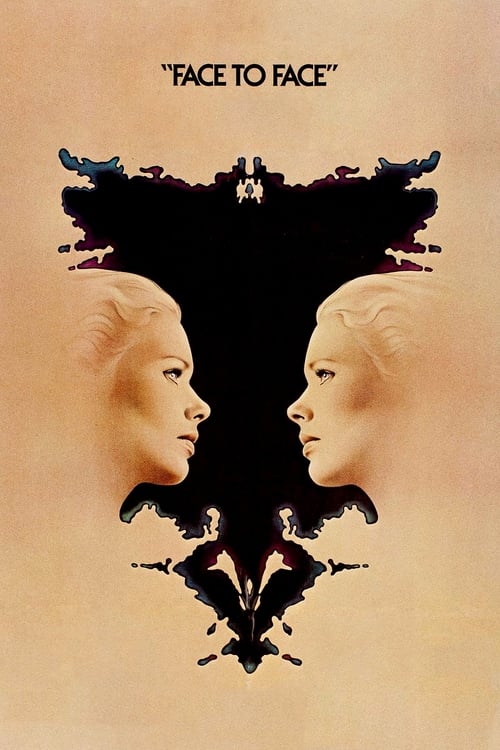
Face to Face
1976 · Ingmar Bergman
For when you want cinema at its most emotionally unguarded and are ready to be put through something — a demanding, cathartic watch, the opposite of comfort viewing.
What it's about
Dr. Jenny Isaksson is a successful psychiatrist holding everything together — patients, family, career — while staying alone in her grandparents' apartment during a summer apart from her husband. A dread she can't name starts rising through her days, old memories from that apartment begin pressing in, and the healer finds she cannot heal herself as her composure comes apart from the inside.
The experience
Harrowing and intensely close — long stretches live right on one woman's face as reality and hallucination blur, and the film goes to genuinely dark places about trauma and despair before reaching for something like grace. It is heavy, unnerving, and not easily shaken off.
Performances
Liv Ullmann gives one of the most ferocious performances of her career — a controlled professional whose disintegration she plays in unbroken close-up, moving from clinical calm to raw, childlike terror with almost unbearable directness.
The craft
Bergman strips the film down to faces, rooms, and dream logic, sliding from realism into hallucination without warning so you feel the ground move as Jenny does. Conceived for television and condensed for cinema, it's chamber filmmaking at full intensity — best watched close, in the dark, without distractions.
Why it matters
One of the peaks of Bergman's 1970s run of psychological close-up dramas, it earned Ullmann major international acclaim and stands among cinema's most unflinching portraits of mental collapse.
Snapshot
Face to Face (Ansikte mot ansikte) is Ingmar Bergman's clinical, harrowing account of a psychiatrist's nervous collapse — a film about a healer who cannot heal herself. Liv Ullmann plays Dr. Jenny Isaksson, a composed, professionally successful analyst temporarily lodged in her grandparents' apartment while her husband is abroad and her own home is being renovated. Over the course of the film that composure disintegrates: a suffocating dread rises through her days, a recurring apparition of a one-eyed woman in gray haunts her, and she attempts suicide with an overdose of sleeping pills, after which the film descends into an extended zone of dream, memory, and hallucinated confrontation with the dead and the buried. Conceived and shot as a four-part television miniseries for Swedish broadcast and simultaneously condensed into a roughly 135-minute theatrical feature, it belongs to the sequence of intimate psychological chamber works — Cries and Whispers (1972), Scenes from a Marriage (1973) — through which Bergman, working with cinematographer Sven Nykvist and Ullmann, anatomized women in extremis. It is among his most divisive films, admired for the ferocity of Ullmann's performance and doubted, including by Bergman himself, for the schematic literalism of its dream imagery.
Industry & production
Face to Face was produced through Bergman's own production framework in collaboration with Swedish television (Sveriges Radio / SR), the institutional home for much of his mid-1970s work; like Scenes from a Marriage before it, it was made in the dual format that had become his practice — a multi-part serial for domestic television and a shorter cut for cinemas and international release. The picture was made in 1975 and released in 1976. Its production sits on the fault line of a notorious biographical rupture: in January 1976 Bergman was detained by Swedish tax authorities on charges later dropped, an experience that precipitated a breakdown of his own and his self-imposed exile from Sweden, which shaped his subsequent West German–based films. Face to Face was thus one of the last works completed in Sweden before that departure, and its subject — a professional's psychic collapse — has often been read against the pressure of that period, though the film's conception predates the arrest.
For international distribution the film moved through channels associated with major American and Italian commercial partners of Bergman's late-1970s output; the precise contractual arrangements are not something I can characterize confidently from the established record, and I will not invent figures. Box-office performance was modest, as with most of Bergman's austere features, and the film's primary commercial life was as an art-house release buoyed by Ullmann's awards attention.
Technology
The film was shot on 35mm color stock, consistent with Bergman and Nykvist's mid-1970s move away from black-and-white into a controlled, desaturated naturalism. Its origin as television material meant it was made to read on the small screen as well as in cinemas: framing favors the close and the medium shot over expansive widescreen composition, and lighting is calibrated for legibility of the human face rather than pictorial spectacle. There is nothing technologically experimental in the apparatus here — no unusual lenses, process work, or optical trickery drives the film. Its "technology" is essentially the disciplined use of conventional color photography and interior lighting to render psychological states, with the dream sequences achieved through staging, color, and editing rather than through the optical or matte effects a more fantastical treatment might have used.
Technique
Cinematography
Sven Nykvist's photography is the film's decisive formal instrument. Working in the register he and Bergman had refined across their color collaborations, Nykvist lights faces with a soft, even, seemingly sourceless naturalism that leaves nothing to hide behind — the camera holds on Ullmann's features for long stretches as expression shifts by degrees. The palette in the waking scenes is muted and domestic; the recurring dream and breakdown material is marked by a heightened, more expressionistic use of color and shadow, so that the visual world curdles as Jenny's mind does. Nykvist's method throughout privileges the human face as landscape, a hallmark of his work with Bergman, and Face to Face is one of the most sustained tests of that principle: much of the film's meaning is carried in the microclimate of a single held countenance.
Editing
The film was edited by Siv Lundgren, Bergman's editor across this period of his career. The cutting is patient in the naturalistic passages — scenes are allowed to run, dialogue exchanges play in sustained shot/reverse-shot or in single takes that let performance accumulate. The structural challenge, and the site of the film's most debated choices, is the transition into and out of Jenny's post-overdose interior world, where editing must move between hospital reality and hallucination. Note that the theatrical feature is itself a product of editorial compression from the longer television version, so the received cinema Face to Face is a condensation; some of the criticism directed at its rhythm and its abrupt tonal shifts is arguably a function of that reduction from four broadcast parts to a single feature.
Mise-en-scène / staging
The film is built from confined, charged interiors: the grandparents' old-fashioned apartment with its dark furniture and the ominous red-toned wardrobe-space of Jenny's childhood memory, the clinical spaces of the hospital, the anonymous rooms of a party and a near-assault. Bergman stages the waking drama with theatrical economy — two or three figures in a room, the geometry of proximity and withdrawal doing the work. In the dream sequences the staging turns emblematic: the apparition of the one-eyed woman, the confrontations with figures from Jenny's past, the imagery of coffins and burning. This literal, tableau-like externalization of the unconscious is precisely what divides viewers — where the marital dialectics of Scenes from a Marriage stayed grounded, Face to Face risks concretizing psychic content into set-pieces.
Sound
The soundscape is dominated by voice — the film is verbally dense, built on confession, analysis, and self-examination — and by pointed silences around Jenny's dread. Regarding a musical score: Bergman's films of this era frequently forgo an original composed score in favor of sparing use of pre-existing music and ambient sound, and I do not have a firm, verifiable attribution of an original composer for Face to Face to offer; rather than invent one, I flag that the record as I can attest to it is thin on this point, and the film's aural identity rests primarily on speech, room tone, and silence.
Performance
Liv Ullmann's performance is the reason the film endures, and it is a tour de force of controlled disintegration: the early scenes of professional poise, the creeping wrongness, the extended nervous collapse and the raw, keening extremity of the breakdown and its aftermath. It earned her an Academy Award nomination for Best Actress and wide critical recognition as among the great screen depictions of psychic crisis. Erland Josephson plays Tomas Jacobi, the doctor she meets and who finds her after the overdose, bringing his characteristic warmth and gravity as a counterweight to Jenny's descent. Gunnar Björnstrand, a Bergman veteran, appears in a smaller role. The ensemble works in the intimate, exposed key the material demands.
Narrative & dramatic mode
The film's mode is psychological realism ruptured by expressionist interlude. Its first movement is a naturalistic study of a functioning woman whose interior is quietly failing; its second is a plunge into a subjective dream-space triggered by the suicide attempt, where the drama becomes an internal reckoning with childhood, guilt, the dead grandparents, and the sources of Jenny's arrested emotional life. Structurally it is a descent-and-partial-return: crisis, collapse, hallucinated confrontation, and a tentative, unresolved convalescence. The dramaturgy is essentially therapeutic in shape — the film enacts something like an analysis, forcing the analyst into the patient's chair — and its confidence in verbalized self-revelation is characteristically Bergmanian and characteristically theatrical.
Genre & cycle
Generically it is a psychological drama, more specifically the Bergmanian "chamber film" of interior crisis. It belongs to a clear authorial cycle: the run of 1970s works — Cries and Whispers, Scenes from a Marriage, and, shortly after, Autumn Sonata (1978) — centered on women, familial wounds, illness, and breakdown, all photographed by Nykvist and several starring Ullmann. Within the broader landscape it can be located in a lineage of the cinema-of-mental-illness, the filmed nervous breakdown, though Bergman's treatment is closer to modernist art cinema than to any clinical or melodramatic genre convention.
Authorship & method
Face to Face is a fully authored Bergman work — written and directed by him — and it is unusually personal even by his standards, the product of a filmmaker who repeatedly mined his own anxieties, and who would soon suffer a documented crisis of his own. His method here is the one refined over decades: intimate ensembles of trusted collaborators, long takes on the face, dialogue as the primary dramatic engine, and the pursuit of psychological truth through sustained, exposing performance. His central collaborators are the constants of his late career: cinematographer Sven Nykvist, whose lighting of the face is inseparable from the film's meaning; editor Siv Lundgren; and, above all, Liv Ullmann, his frequent lead and by this point his most important interpreter, alongside Erland Josephson. On the question of a credited composer I again note the record is thin and decline to assert one. Bergman himself, in later reflection, was notably critical of the film, and this authorial self-doubt is part of its reception history rather than a marketing gloss.
Movement / national cinema
The film is a product of Swedish art cinema at its most institutionally supported, made within the television-and-film ecosystem that funded Bergman's most personal projects. It stands in the modernist European art-cinema tradition of the 1960s–70s — the cinema of interiority, ambiguity, and authorial signature — of which Bergman was a defining figure internationally. It is also a case study in the porousness of the film/television boundary in Swedish production of the era: like Scenes from a Marriage, it was conceived for broadcast and reshaped for the world's cinemas, a hybrid that anticipated later prestige serial forms.
Era / period
Situated in the mid-1970s, Face to Face comes at the close of Bergman's Swedish period, on the threshold of his exile. It reflects a moment when the European auteur cinema of the previous decade was maturing into darker, more confessional registers, and when television had become a serious vessel for major cinematic authorship. The film's preoccupation with psychiatry, breakdown, and the interior life is of its period — the 1970s cultural fascination with the therapeutic and the psychoanalytic — even as its formal austerity resists the era's more fashionable stylistic experiments.
Themes
Its governing themes are mental collapse and the failure of professional competence to protect against private ruin; the return of repressed childhood trauma, figured in the grandparents' apartment and the terrifying wardrobe-memory; the proximity of death and the temptation of suicide; the difficulty of feeling, love, and genuine contact for a person armored in role and function. The apparition of the one-eyed woman condenses the film's dread — a figure of the death and disfigurement Jenny cannot look at directly. Running beneath is a characteristic Bergman inquiry into whether authentic human connection is possible, and whether the self that emerges from crisis can be rebuilt rather than merely restored to its former, hollow competence. The ending is deliberately unresolved, offering convalescence rather than cure.
Reception, canon & influence
Critical reception was sharply split and remains so. Ullmann's performance drew near-unanimous praise and became the film's enduring claim on attention, anchored by her Academy Award nomination for Best Actress and Bergman's nomination for Best Director — recognition that placed the film prominently in the year's awards conversation. Against this, a substantial line of criticism, including Bergman's own retrospective verdict, judged the film a lesser entry in the cycle: the dream imagery too literal, the externalization of the unconscious too schematic, the whole less integrated than the marital anatomy of Scenes from a Marriage or the concentrated force of Cries and Whispers. That divided estimate — a great central performance inside a flawed film — is the stable shape of its reputation.
Looking backward, the film draws on Bergman's own repertoire of influences: the confessional, spiritually searching drama he had pursued since the 1950s; a Strindbergian theatrical inheritance of psychological laceration; and the psychoanalytic culture that gave him the frame of analyst-as-patient. Looking forward, its most consequential legacy is bound up with Ullmann's portrayal, which stands as a reference point for screen depictions of breakdown, and with the ongoing collaboration between Bergman, Ullmann, and Nykvist that would culminate in Autumn Sonata. Its broader influence is more diffuse than that of Bergman's most canonical works; it is studied and revisited chiefly as a document of that partnership and of Bergman's Swedish endgame, rather than as a template widely imitated by later filmmakers. Where its imprint is clearest is in the license it and its sister films gave to serious cinema — and later prestige television — to treat psychological collapse with unhurried, unflinching attention to the human face.
A Deleuzian reading
A woman in gray is standing in the apartment.
The full Deleuzian reading of Face to Face →
Reception
In 1976 it was an event — Oscar nominations for Liv Ullmann and for Bergman's direction — but its stock fell fast, and today it's usually filed among his minor works, overshadowed by Persona and Cries and Whispers even by Bergman devotees.
How Face to Face was received, from release to now →
Influences: the films it descends from and the films it influenced
- The Passion of Joan of Arc (1928) — Establishes the sustained, near-scaleless facial close-up against neutral ground as the primary dramatic surface — the 'face as landscape' grammar Bergman and Nykvist inherit and rebuild here.
- Gertrud (1964) — Chamber-drama staging where dialogue and long-held silences on seated figures, not action, carry the psychological reckoning — the austere talking-cure interior Bergman refines.
- Through a Glass Darkly (1961) — Bergman's own template for a woman's descent into psychosis inside a closed cast, with hallucination erupting through realist surface — the schema Face to Face literalizes.
- The Silence (1963) — Nykvist's high-contrast lighting of the isolated female face in confined interiors, with sound design foregrounding silence as dramatic pressure.
- Persona (1966) — The Bergman–Ullmann–Nykvist method itself: prolonged takes on Ullmann's face registering interior collapse, with formal rupture (the image breaking down) standing in for psychic breakdown.
- Hour of the Wolf (1968) — Bergman's most explicit externalization of the unconscious as expressionist dream-tableau invading the frame — the device Face to Face extends (and critics faulted as too literal).
- Cries and Whispers (1972) — Nykvist's saturated interior palette and the chamber-film architecture of women enclosed with dying/dissolving selves, cut for concentrated emotional duration by the same late-career team.
- Scenes from a Marriage (1973) — The television-film hybrid form — a multi-part TV drama condensed for cinema by Siv Lundgren's editing — that Face to Face reuses as its production and structural model.
- Autumn Sonata (1978) — The direct culmination of the same Bergman–Ullmann–Nykvist partnership: a two-hander of buried childhood trauma dredged up in chamber interiors through unbroken close-ups on the confessing face.
- Interiors (1978) — An overt transplant of Bergman's chamber-film method — muted-toned bourgeois interiors, dialogue-driven psychological laceration, and a woman's breakdown staged in near-theatrical restraint.
- Another Woman (1988) — Shot by Nykvist himself, it applies his face-lighting to a woman's interior reckoning, with dream and memory tableaux surfacing repressed self-knowledge — Bergman's device carried by his own cinematographer.
- Safe (1995) — A clinically observed psychological collapse of a woman, built from patient, distanced attention to a deteriorating face and body rather than event — the unhurried anatomy-of-breakdown inheritance.
- Antichrist (2009) — Von Trier's explicitly Bergman-dedicated grief-and-breakdown chamber piece, using expressionist dream-tableaux and prolonged facial suffering as the externalized unconscious.
- Saraband (2003) — Bergman's TV-shot late coda reviving the digital-era chamber form with Ullmann and Josephson, sustaining confrontational close-up duets of confession as the terminal statement of the method.
- A Woman Under the Influence (1974) — Contemporary parallel in which a woman's mental collapse is built through an unflinching, exposing lead performance held in real time — Rowlands as the American counterpart to Ullmann's breakdown.
- Opening Night (1977) — Extends the actress-in-crisis study, staging a psychological unraveling where hallucinated figures intrude on a realist performer — kindred externalization of the unconscious through acting.
- 3 Women (1977) — A dream-sourced study of feminine identity dissolving, using surreal interior tableaux and close observation of the face to render psychic disintegration in the same year.
Similar films
- Persona (1966) — influence & lineage · same viewing thread
- Cries and Whispers (1972) — influence & lineage · same viewing thread
- Autumn Sonata (1978) — influence & lineage · same viewing thread
- Through a Glass Darkly (1961) — influence & lineage · same viewing thread
- The Silence (1963) — influence & lineage · same viewing thread
- Interiors (1978) — influence & lineage · same viewing thread
- Hour of the Wolf (1968) — influence & lineage
- The Passion of Joan of Arc (1928) — influence & lineage
All the films related to Face to Face →
Watch it with: curated runs of related films
- The Fractured Self — A run of art films where identity, memory, and sanity refuse to stay solid — watch them near each other and the faces, silences, and doublings start to rhyme.