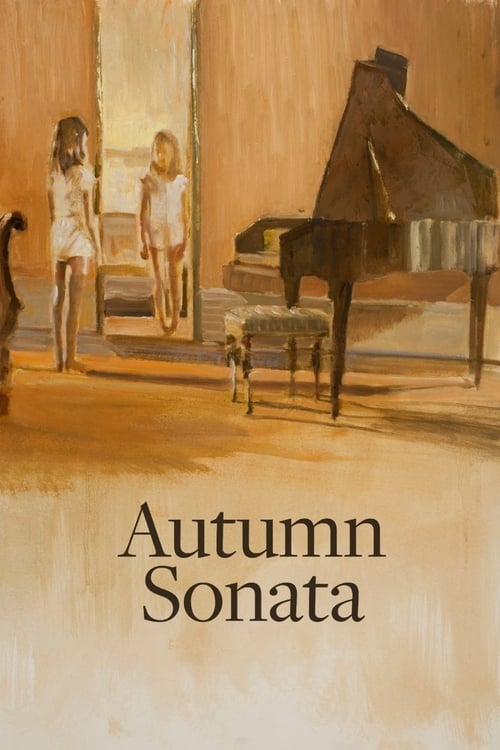
Autumn Sonata
1978 · Ingmar Bergman
For when you want to feel something all the way down — a film to reach for when you're ready to think hard about your own parents or children, not when you need cheering up. Challenge, not comfort, and worth it.
What it's about
A celebrated concert pianist visits the daughter she hasn't seen in seven years, arriving at the quiet parsonage where the daughter lives with her husband. What begins as a polite reunion turns, over one long night, into a full accounting of the childhood the mother's career left behind — every grievance, every longing, every wound reopened between two people who love each other and can't forgive each other.
The experience
Intimate to the point of being almost unbearable — slow, hushed, and then suddenly scalding, like watching a family argument you can't leave the room for. It's emotionally exhausting in the way only honest films are.
Performances
Ingrid Bergman, in one of her final and greatest roles, plays the mother with dazzling charm stretched over bottomless guilt, and Liv Ullmann matches her blow for blow as the daughter — two of the era's finest actresses locked in the same room.
The craft
A chamber piece built almost entirely from faces: long, unflinching close-ups in warm autumnal light, with a piano piece played twice — once by each woman — doing the work of an entire argument. The writing compresses a lifetime into a single night without ever feeling stagey.
Why it matters
The only time Ingmar Bergman directed Ingrid Bergman, made near the end of her life — a summit meeting that stands among the great films about mothers and daughters.
Snapshot
A chamber drama of annihilating intimacy, Autumn Sonata (Höstsonaten) stages the reckoning between a celebrated concert pianist and the adult daughter who grew up in her orbit and in her shadow. Written and directed by Ingmar Bergman, the film compresses a lifetime of grievance, longing, and mutual self-deception into a single fraught night, using the confrontational two-hander as both formal architecture and emotional weapon. It is remarkable for two reasons that the historical record confirms beyond dispute: it is the only film in which Ingmar Bergman directed Ingrid Bergman — no relation — and it was made while Ingrid Bergman was already living with the cancer that would kill her four years later. The two facts are not incidental; they give the film's themes of mortality, unfinished business, and the impossibility of reconciliation an undertow of biographical actuality that deepens without cheapening it.
Industry & production
By 1978, Ingmar Bergman had been living in voluntary exile from Sweden for two years, having fled in 1976 following a traumatic tax investigation by Swedish authorities that he regarded as a humiliation. He was based in Munich, working with the Residenztheater, and had channeled his rage and displacement into The Serpent's Egg (1977), a German-language thriller that critics received with puzzlement. Autumn Sonata marked a deliberate return to the intimate Scandinavian register that had defined his greatest work.
The film was produced through Personafilm GmbH, Bergman's own Munich-based production company, in co-production with the Swedish Film Institute and with international financing assistance from ITC Entertainment (the British company headed by Lew Grade). The international dimension reflected Bergman's exiled status: this was not a straightforwardly Swedish production. Principal photography took place in Norway, partly at locations in the vicinity of Hamar, chosen partly to accommodate both Bergmans' schedules and nationalities of the co-production. The production manager was Katinka Faragó, who had been a constant organizational presence in Bergman's films since the 1960s and whose efficiency made his compressed shooting schedules possible.
Ingrid Bergman's availability was far from assured. By the time filming was underway, she had already been treated for breast cancer and was not in full health. Her willingness to take on a role of this psychological and physical demand — the film requires her to collapse internally while maintaining a socially polished surface — speaks to her commitment and to the script's obvious draw. Ingmar Bergman had long wanted to work with her; the project finally became viable at a moment when it was almost too late.
Technology
Autumn Sonata was shot in 35mm. Cinematographer Sven Nykvist, Bergman's collaborative partner since the late 1950s, employed a predominantly interior visual grammar: the film's action unfolds almost entirely within the rooms of the Norwegian parsonage where Eva and her pastor husband Viktor live. The technology of glass and lens choice was oriented toward the face. Nykvist used lenses and lighting setups that allowed him to linger on skin in extreme close-up without clinical harshness — a warmth that makes the emotional violence of the dialogue land against flesh rather than abstraction. No unusual or experimental technology was deployed; the achievement here is the disciplined application of classical cinematographic means in service of psychological excavation.
Technique
Cinematography
Nykvist's approach to Autumn Sonata is best understood as the culmination of a method he and Bergman had refined over two decades: the privileging of the human face as the primary landscape. The camera holds in close-up long past the point where conventional coverage would cut away, forcing spectators to read microexpressions — the millisecond Charlotte's professional composure falters, the moment Eva's suppressed rage crosses into something closer to grief. The film is lit softly and without high-contrast drama; illumination in interior scenes suggests diffused window light or warm artificial sources, avoiding the chiaroscuro expressionism of earlier Bergman work. This naturalistic approach was consistent with Nykvist's mature aesthetic, earned through years of rejecting artifice. The few exterior shots — the pastoral Norwegian countryside glimpsed at the film's opening — function as ironic pastoral, a wide prospect against which the interior confinement becomes all the more suffocating.
Editing
Sylvia Ingemarsson, who served as Bergman's editor across much of his late period, cut the film with a fidelity to the scene's internal rhythm rather than to the conventions of classical continuity editing. Scenes are allowed to breathe, even to hold uncomfortable silences, before the cut arrives. The editing does not rescue the actors from exposure — it guarantees it. During the long night of confrontation, Ingemarsson's choices enforce the theatrical architecture of Bergman's script: each exchange between Charlotte and Eva builds like a movement within a sonata form (the title is not decorative), with returns and variations on earlier emotional themes rather than linear escalation.
Mise-en-scène / staging
Bergman stages the film's central confrontation in the bedroom where Charlotte sleeps, a domestic space that becomes charged with the transgressions of childhood and the humiliations of adulthood. The spatial arrangement of the two women — on the bed, apart, approaching and withdrawing — maps the emotional choreography of the drama. Helena, the younger daughter who is severely disabled by what the film characterizes as a degenerative neurological condition, occupies her own room, an almost spectral presence whose suffering functions as moral calibration for the audience: her condition, unlike Charlotte's emotional failures, was not willed. Bergman uses doors, mirrors, and thresholds as visible grammar — Charlotte framed in doorways she cannot quite bring herself to cross, Eva glimpsed in reflections that fragment her self-image. The staging is sparse rather than theatrical; no shot draws attention to its own design.
Sound
The film's sound architecture rests on two registers: speech and music. The dialogue is recorded with an intimacy that makes whispers as audible as shouted accusations. The musical dimension is not merely accompaniment but structural argument. Eva plays Chopin's Prelude No. 2 in A minor (Op. 28) for her mother; Charlotte listens with barely suppressed impatience and then plays the same piece herself — technically flawless, emotionally composed, utterly unlike Eva's tentative, vulnerable rendering. The scene is one of the most precisely observed in Bergman's cinema: it shows, without verbal explanation, exactly what Charlotte is and why she and Eva can never meet. Music becomes the language in which Charlotte is fluent and through which she cannot be reached. The silence that follows her playing is devastating.
Performance
Ingrid Bergman's Charlotte is a performance of controlled implosion. She maintains a surface of warmth, wit, and professional self-possession while the film gradually exposes the armature of self-deception beneath. That Charlotte is not simply a villain — that she too is frightened and diminished — is entirely a performance achievement, not a scripted instruction. Liv Ullmann's Eva is the necessary counterweight: where Charlotte smooths, Eva splinters; where Charlotte deflects, Eva insists. The two performers had not worked together before and the chemistry of their misalignment — two very different acting temperaments occupying the same frame — generates authentic friction rather than theatrical simulation. Lena Nyman as Helena works in a register of pure physical presence, her body and its limits communicating what language has been denied her.
Narrative & dramatic mode
The film operates in the mode of the chamber revelation drama: a closed domestic space, a small cast, an accumulation of confessions and counter-accusations across a compressed time-frame, and no redemption at the end — only the uncertain continuation of damaged lives. The narrative architecture is deceptively simple: Charlotte arrives at Eva's home after seven years; the sisters' reunion triggers in Eva an eruption of long-suppressed feeling; the night becomes a trial. What prevents the film from being schematic is Bergman's refusal to adjudicate. Charlotte's closing interior monologue, and the letter Eva writes and that Charlotte will perhaps never receive, suggest parallel loneliness rather than victory for either party. The film belongs to a tradition of drama — Strindbergian, Ibsenite — that uses the family home as the site where illusions are dismantled, but it inflects that tradition through a mid-century art-cinema vocabulary that complicates sympathy.
Genre & cycle
Autumn Sonata sits within the art-cinema chamber drama, a mode Bergman had helped define with the early-1960s trilogy (Through a Glass Darkly, Winter Light, The Silence) and continued through Persona (1966), Cries and Whispers (1972), and Scenes from a Marriage (1973). It belongs also to a cycle of films across world cinema in the 1970s that placed women's interior lives at the center: the work of Chantal Akerman, Margarethe von Trotta, Agnès Varda, and others who were, in parallel, constructing a female-centered art cinema. Bergman approaches this from a different angle — the male director examining female psychology with penetrating if not uncomplicated intimacy — but the film circulates among this international formation and is read in relation to it.
Authorship & method
Bergman wrote the original screenplay, as was his standard practice for his most personal work. The script is structured like a musical composition: thematic material introduced early returns in altered form, confessions spiral rather than progress, and the ending withholds resolution the way a coda withholds resolution. His direction on set was, by all accounts, the intensive and psychologically demanding process for which he was known — long preparatory discussions with actors, an environment of deliberate psychological intimacy, minimal interruption during takes.
Sven Nykvist, collaborating with Bergman for the sixteenth time, was by this point operating not merely as director of photography but as a visual co-author. Their shared grammar — the sustained close-up, the naturalistic interior light, the refusal of decorative framing — required no extensive discussion; it was a mature creative partnership. Katinka Faragó's production management ensured that a complex international co-production ran smoothly enough to allow Bergman his customary creative concentration. No composer was credited for an original score; the film's musical content derives entirely from performed classical repertoire, specifically Chopin, and from silence.
Movement / national cinema
Although produced outside Sweden and shot in Norway, Autumn Sonata belongs definitively to the Swedish art-cinema tradition that Bergman had spent three decades building. It is Scandinavian in its thematic preoccupations — emotional repression as cultural pathology, guilt as a condition rather than an event, landscape as spiritual index — even when those landscapes are Norwegian rather than Swedish. The Swedish Film Institute's involvement anchored it institutionally to Swedish cinema. The film stands as a late exemplar of the post-war European art cinema: a serious, formally rigorous, politically disengaged work oriented entirely toward psychological and existential investigation, produced outside the commercial mainstream while expecting and receiving serious critical attention in that mainstream's best venues.
Era / period
The late 1970s context shapes the film in ways the production history makes legible. Bergman was in exile, estranged from his home culture, working from German bases while looking back — literally, in this film — at Swedish-Norwegian domestic life. The late 1970s represented a period in which the first wave of second-wave feminist discourse had entered intellectual mainstream circulation, and the film's focus on a mother who chose career over family was legible to its contemporaries as engaging, if not straightforwardly endorsing, those debates. Charlotte is not punished for her ambition in any simple sense; she is shown to have paid costs, but so has Eva, and the film resists collapsing into either feminist polemic or conservative moralism. It is a film of its moment in its ambivalence.
Themes
The film's central theme is the inheritance of damage: how parents' unresolved emotional wounds — Charlotte's inability to be present, her flight into professional achievement, her substitution of technical mastery for human availability — propagate into children who can neither accept nor escape them. Closely related is the theme of self-deception and its costs: Charlotte has constructed an autobiography in which she is a victim of circumstance, a woman who could not have done otherwise; Eva's confrontation is an attempt to force her mother to see a different account. The film is also, at an oblique angle, about art and its relationship to emotional life — Charlotte's musical gifts are genuine, her playing extraordinary, and yet she has used music as a way of not-feeling rather than feeling more. Helena's disability functions thematically as a condition that cannot be aestheticized or rationalized away: she is what remains when the mechanisms of flight and self-deception are unavailable.
Death and its proximity inflect every exchange: Bergman knew that Ingrid Bergman was ill, and her physical presence in the frame carries that knowledge whether or not the screenplay makes it explicit. Charlotte's late-film recognition that she is old, that time has closed off possibilities, lands with the weight of an actuality rather than a dramatic contrivance.
Reception, canon & influence
Critical reception. The film premiered in the United States at the New York Film Festival in 1978 and received substantial critical attention. At the Academy Awards, it earned two nominations: Best Actress for Ingrid Bergman and Best Original Screenplay for Ingmar Bergman — Ingrid Bergman lost to Jane Fonda (Coming Home). Critical responses were broadly admiring of the performances, with some reservations, articulated by reviewers including Pauline Kael, about what they perceived as a schematic or melodramatic quality in the dramatic construction. The film has, over subsequent decades, secured a firm place in the Bergman canon, typically read alongside Persona and Cries and Whispers as one of his definitive examinations of female psychology and relational damage. Specific box-office figures from its original release are not part of the widely available record.
Influences on the film (backward). The drama of confrontation within a sealed domestic space descends from two Scandinavian theatrical lineages Bergman had absorbed throughout his career: Strindberg's chamber plays (The Father, Miss Julie, The Stronger) with their vision of the family as a site of mutual destruction, and Ibsen's domestic realism (Ghosts, The Lady from the Sea) with its preoccupation with women trapped between duty and desire. The film's specific two-woman intensity recalls Persona (1966), Bergman's own prior excavation of female identity in a closed environment. The use of sustained close-up in emotional confrontation had been Bergman and Nykvist's shared grammar since at least The Silence (1963). John Cassavetes' improvisational family dramas (Faces, 1968; A Woman Under the Influence, 1974) belong to the same lineage of chamber realism, though direct influence between Cassavetes and Bergman is a matter of parallel evolution rather than documented exchange.
Legacy and forward influence. The most immediate documented case of influence is the cluster of films made in the wake of Autumn Sonata's release that absorbed its two-hander confrontational structure and its privileging of female interiority. Woody Allen's Interiors (1978), released the same year, draws so explicitly on Bergman's aesthetic vocabulary — including the emotional distance of a mother from her children — that its relationship to Autumn Sonata is better understood as parallel Bergman influence than direct derivation from this film specifically. Over the longer term, the film became a reference point for filmmakers working in the key of intimate family drama: Mike Leigh's Secrets & Lies (1996) shares its commitment to the eruption of suppressed truth in a domestic space; Xavier Dolan has cited Bergman's influence on his repeated engagements with mother-son conflict; Lynne Ramsay's We Need to Talk About Kevin (2011) reworks the theme of maternal guilt and self-examination. In feminist film theory, Autumn Sonata has received substantial scholarly attention — including analysis of the film's ambiguous relationship to its female characters — as a key text in the examination of how a male director stages female consciousness. Its influence on that critical tradition is at least as significant as its influence on subsequent filmmakers. Autumn Sonata remains, as of this writing, among the handful of Bergman films considered essential by scholars, critics, and serious practitioners of the art, and its two central performances are routinely cited as among the finest ever committed to film.
A Deleuzian reading
Eva sits at the piano and plays Chopin's second Prelude.
The full Deleuzian reading of Autumn Sonata →
Reception
Warmly received in 1978 — Ingrid Bergman got an Oscar nomination — but some critics sniffed that it was Bergman on autopilot; decades on, it's settled comfortably into the 'late masterpiece' shelf, treasured as one of the great mother-daughter films.
How Autumn Sonata was received, from release to now →
Influences: the films it descends from and the films it influenced
- Persona (1966) — Nykvist's technique of the extreme close-up as the sole surface of psychological excavation — two faces dissolving into one another under naturalistic window light — is the direct grammatical prototype for every sustained close-up in Autumn Sonata's confrontation scenes; the two-woman sealed-space structure is inherited without alteration.
- The Silence (1963) — The film where Nykvist first sustained naturalistic interior light — unlit rooms, window-sourced illumination, no fill — in combination with extreme close-up within a claustrophobic enclosure; the specific lighting and framing grammar Autumn Sonata inherits is assembled here.
- Cries and Whispers (1972) — Establishes the bedroom as the chamber space where suppressed female damage surfaces, with Nykvist's candlelit naturalistic interior as the visual field; the structure of women enclosed together in a domestic space, unable to offer or receive comfort, is Autumn Sonata's direct architectural predecessor.
- Scenes from a Marriage (1973) — The immediate structural prototype for Autumn Sonata's two-hander grammar: two people confined to intimate domestic spaces across episodic confrontation scenes, Nykvist's sustained close-up calibrated to the actors' emotional rhythms rather than to continuity cutting, the domestic interior as the exclusive arena of revelation.
- Miss Julie (1951) — Swedish cinema's primary translation of Strindberg's threshold grammar — doorways and staircases as spatial power markers — into film language, giving Bergman the template for reading the domestic floor plan as a confrontation map; the two-person class and gender destruction Strindberg encoded as a spatial syntax is the theatrical lineage Autumn Sonata inherits.
- Faces (1968) — Cassavetes' use of long-lens close-up to capture domestic confrontation in real time — the face as the site where social performance breaks down mid-sentence — runs parallel to Nykvist's method and belongs to the same emerging grammar of chamber realism in which performance rhythm governs editing rather than the reverse.
- The Touch (1971) — Carries forward the Nykvist-lit chamber two-hander of wounding intimacy, where one sustained confrontation between two faces becomes the entire dramatic architecture.
- Face to Face (1976) — The direct culmination of the same Bergman–Ullmann–Nykvist partnership: a two-hander of buried childhood trauma dredged up in chamber interiors through unbroken close-ups on the confessing face.
- The Piano Teacher (2001) — Haneke deploys diegetic classical music — Schubert and Schumann performed on screen, not scored — as a dramatic pivot rather than accompaniment, and builds the film's architecture around Isabelle Huppert's controlled-implosion performance within a suffocating mother-daughter relationship of damage inheritance; the specific combination of concert-hall music, female repression, and domestic confrontation is Autumn Sonata transposed to Vienna.
- Secrets & Lies (1996) — Leigh inherits the structure of suppressed familial truth erupting in a domestic confrontation, calibrating scene rhythm to performance — sustained takes that give actors room to implode before the camera — rather than to plot mechanics; the film's climactic table scene is a direct application of Autumn Sonata's grammar of revelation-by-endurance.
- I Killed My Mother (2009) — Dolan's debut directly inherits Autumn Sonata's two-hander confrontation structure — sustained close-ups in domestic interiors calibrated to the moment of emotional breakdown, scene rhythm governed by the actors' faces — as his acknowledged template for staging the mother-child relationship as mutual wound.
- We Need to Talk About Kevin (2011) — Ramsay reworks Autumn Sonata's structure of maternal guilt and suppressed self-examination by fragmenting it across non-linear chamber scenes — the mother's accumulated damage revealed in sustained close-up rather than confessed in speech, the domestic interior rendered as a space the body cannot escape.
- Force Majeure (2014) — Östlund adopts the two-hander confrontation structure with precision: a single incident of revealed cowardice destabilizes a marriage across a series of sustained confrontation scenes in which the camera holds on faces until the social performance of the marriage collapses, the hotel room functioning as Autumn Sonata's domestic threshold.
- 45 Years (2015) — Haigh constructs a two-hander revelation drama where a single letter ruptures a marriage across seven days, with scene rhythm governed by Charlotte Rampling's controlled-implosion performance — each sustained interior scene held until her face completes what the script withholds — applying Autumn Sonata's grammar of the body as the site where suppressed damage finally registers.
- Mommy (2014) — Dolan's sustained extreme close-ups in mother-son confrontation — faces filling the frame in moments of rage, need, and collapse — and his use of diegetic music as an emotional pivot point directly apply Autumn Sonata's close-up and music grammar to the damaged parent-child dyad.
- Marriage Story (2019) — Baumbach's central confrontation scene — two people in a bare apartment, sustained takes, performance rhythm overriding continuity cuts, a scene structured like a musical movement building through development to unavoidable breakdown — is a precise transposition of Autumn Sonata's two-hander chamber grammar into contemporary American divorce drama.
- Dreams (2024) — Stages a mother–daughter reckoning as sustained confessional dialogue in chamber two-shots, the model for Dreams' grandmother–mother–daughter dynamic built from talk rather than incident.
- Sentimental Value (2025) — The chamber two-hander in which a celebrated artist-parent is confronted by a wounded grown child — the precise dramatic engine of Skarsgård's actor-father reckoning with the daughter he made art instead of raising.
- The Banshees of Inisherin (2022) — The confrontational two-hander staging decades of suppressed grievance through a single claustrophobic encounter; Ullmann's controlled withdrawal as the film's primary dramatic instrument is the performance mode Colin Farrell adapts for Pádraic's uncomprehending stillness in the face of Colm's absolute refusal.
- Ordinary People (1980) — Builds its drama on a child's reckoning with a withholding, emotionally frozen mother in an autumnal palette — the precise affective architecture of the Moore character's coldness.
- Interiors (1978) — Allen absorbs Bergman's complete aesthetic vocabulary — sparse whitened interiors, sustained close-up, scene rhythm governed by performance rather than plot, the emotionally withholding mother as the central wound radiating outward into her daughters' lives — to produce an American chamber revelation drama in explicit and acknowledged homage.
- My Dinner with Andre (1981) — Two-hander verbal confrontation as the film's entire architecture, with scene rhythm dictated by the cadences of speech rather than by action or continuity cutting; like Autumn Sonata, the film treats dialogue itself as the formal event and sustains a single enclosed space through the full arc of a dramatic movement.
- From the Life of the Marionettes (1980) — Immediately preceding exile film, establishing the mugshot-framing of the face, score-absent passages, and theatrical two-hander staging that Marionettes then applies to a criminal rather than purely familial anatomy.
- Long Day's Journey Into Night (1962) — Chamber confrontation of mother and child over buried damage, staged in tight focal isolation with spoken text given total primacy over incident.
Similar films
- Cries and Whispers (1972) — influence & lineage · same viewing thread
- Persona (1966) — influence & lineage · same viewing thread
- Interiors (1978) — influence & lineage · same viewing thread
- The Silence (1963) — influence & lineage · same viewing thread
- Face to Face (1976) — same viewing thread
- From the Life of the Marionettes (1980) — same viewing thread
- Through a Glass Darkly (1961) — same viewing thread
- Hour of the Wolf (1968) — often watched together
All the films related to Autumn Sonata →
Watch it with: curated runs of related films
- The Fractured Self — A run of art films where identity, memory, and sanity refuse to stay solid — watch them near each other and the faces, silences, and doublings start to rhyme.