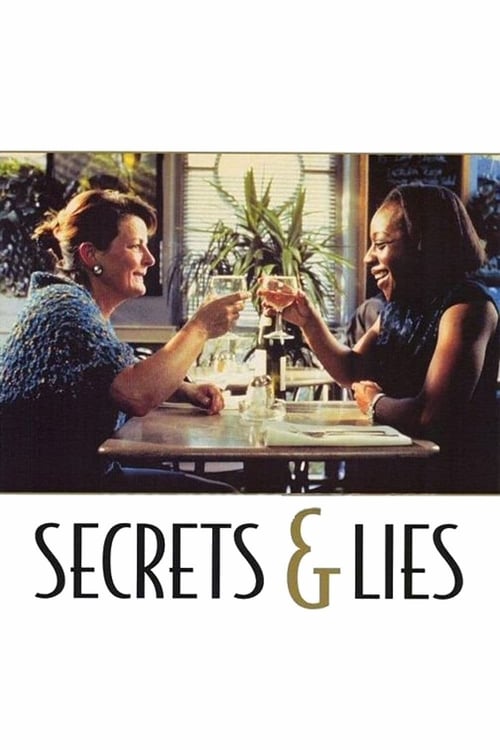
Secrets & Lies
1996 · Mike Leigh
For when you need a good cry that's earned — a film about family, forgiveness, and saying the unsayable. It's emotionally demanding but deeply warm underneath; you come out feeling more tender toward people, not less.
What it's about
After her adoptive mother dies, Hortense — a poised, successful Black optometrist in London — decides to trace her birth mother. The search leads her to Cynthia, a fragile working-class white woman living in barely managed chaos with her own grown daughter. As the two women cautiously get to know each other, the secrets Cynthia's extended family have spent years not talking about start pressing toward the surface, all of it building to one backyard birthday barbecue.
The experience
Funny, painful, and piercingly true — it feels less like watching actors than eavesdropping on real people. The emotion sneaks up on you; scenes of ordinary awkwardness suddenly open into something enormous, and you'll likely be in tears before you notice it happening.
Performances
Brenda Blethyn is astonishing as Cynthia — raw, needy, exasperating, and heartbreaking, often all in one take — and Marianne Jean-Baptiste matches her with beautiful stillness as Hortense. Their first long meeting, played out in a single unbroken shot in a café, is one of the great two-person scenes in modern film.
The craft
Mike Leigh builds his films through months of improvisation with the actors before a script exists, and it shows: the dialogue has a lived-in messiness no writer could fake. The camera simply holds and watches, trusting faces to carry scenes for minutes at a time — restraint that pays off in overwhelming intimacy.
Why it matters
It won the Palme d'Or at Cannes and stands as the peak of Leigh's improvisation-based method, securing his place among the great chroniclers of British life and influencing a generation of actor-driven realist filmmaking.
Snapshot
A middle-class Black optometrist traces her biological origins to a tearful, chaotic working-class white woman in South London, and the two women tentatively construct a relationship that will shatter everything the Purley family has spent years suppressing. Mike Leigh's Palme d'Or–winning drama is at once a chamber study of English emotional repression and an unflinching examination of race and class in post-Thatcher Britain. Its signal achievement is a form of cinematic intimacy so uncomfortable and so generous that it collapses the distance between screen and audience. Secrets & Lies stands as the fullest, most formally daring expression of Leigh's collaborative method and the film that secured his permanent place in the canon of world cinema.
Industry & production
The film was produced by Simon Channing Williams under the Thin Man Films banner, the production company Channing Williams established with Leigh to give the director creative autonomy within the British independent sector. Funding came principally from Channel 4 Films and CiBy 2000, the French company that backed several international art-film productions in the 1990s. This financing structure was typical of British quality cinema of the era: television money providing the bedrock, supplemented by European co-production capital. The arrangement gave Leigh the extended pre-production period his method demands — a span of months during which cast members individually develop their characters before any collective rehearsal takes place. The film was distributed in Britain by Guild Film Distribution and in the United States by October Films, the independent arthouse label that positioned it squarely within the foreign-language prestige market, even as it was shot entirely in English and in London.
The Cannes premiere in May 1996 transformed the film's commercial prospects. The Palme d'Or, awarded by a jury presided over by Francis Ford Coppola, announced Leigh as a major figure on the international festival circuit. The film went on to earn significant theatrical returns for a British arthouse production of its scale, and its six BAFTA nominations and two Academy Award nominations — Brenda Blethyn for Best Actress and Marianne Jean-Baptiste for Best Supporting Actress — extended its visibility through the following awards season. Jean-Baptiste's nomination was historically significant; she became one of the first Black British actresses nominated in that category.
Technology
Secrets & Lies was shot on 35mm film by Dick Pope, Leigh's long-standing director of photography. Pope's approach throughout the film favors available-light sources and practical lamp placement, giving interiors the particular quality of fluorescent offices and domestic tungsten bulbs rather than any cinematic idealization. The palette is low-saturation, slightly cool in the outdoor sequences and warm in the cramped sitting rooms of Cynthia's terraced house — a visual register that functions as a form of documentary truth-telling. No digital intermediary was involved in post-production, as was standard for theatrical releases of this period; the film's grain and textural depth are native to the photochemical process.
Leigh's productions of this era generally avoided extensive or elaborate technical apparatus, viewing it as antithetical to the spontaneity the method requires. Camera mobility is used selectively rather than systematically: long passages of the film are photographed from fixed positions, with movement reserved for moments where following an actor's sudden emotional shift demands it. The relative simplicity of the technology foregrounds performance as the primary expressive instrument.
Technique
Cinematography
Pope keeps the frame tight, preferring medium close-ups and two-shots that place characters in uncomfortable spatial proximity — a compositional correlate of Leigh's dramatic concern with the claustrophobia of family and secrets. The most celebrated sequence in the film, the café scene in which Cynthia and Hortense meet for the first time, is held almost entirely in a sustained two-shot over an extended duration that has been widely discussed in criticism of the film. The shot refuses conventional coverage — no reverse angles, no cutaway to relieve the accumulating emotional pressure — so that the audience is locked into Cynthia's heaving, barely controlled distress with the same inability to look away that Hortense herself experiences. This is not stylistic mannerism; it is Pope and Leigh's recognition that cutting away would constitute a betrayal of the scene's emotional stakes.
Editing
Jon Gregory, Leigh's editor from the 1990s, structures the film around parallel intercutting in its early reels, alternating between Hortense's composed, upwardly mobile life and the entropy of the Purley household. This parallelism establishes contrast without commentary: the editing never underlines irony or editorializes about the class divide it traces. As the film moves toward its climax at Maurice's garden party, the rhythm tightens — not through faster cutting but through the accumulation of pressure within longer scenes, until the dam breaks in a single sustained sequence.
Mise-en-scène / staging
Leigh and production designer Alison Chitty ground the film in exhaustively realized South London domesticity. Cynthia's house in Canley is furnished with the layered visual clutter of a life lived at the margins — decorative plates, stacked newspapers, an overwhelming sense of things never quite put in order. Against this, Maurice's slightly more prosperous home with Monica stands as an aspiration toward order that masks its own suppressions. The garden party that closes the film uses the outdoor space as a pressure cooker: characters trapped in a bounded, too-sociable setting when Cynthia's confession detonates.
Maurice's photography studio sequences deserve separate attention. Interspersed through the film, they show him photographing a succession of clients in brief, vivid vignettes — the sitting couples, the christening baby, the awkward professionals. These scenes are structured as miniature character études, and each pairing of photographer and subject enacts in miniature the film's central concern with what images reveal versus what they conceal. The studio becomes a kind of truth-machine, a counterpoint to the lies that circulate in the family.
Sound
Andrew Dickson, Leigh's regular composer, provides a score that works at the margins of the drama rather than underlining it — spare, chamber-scale passages that enter only at the film's most exposed emotional moments. The general sonic world of the film is naturalistic: the ambient noise of South London, the specific acoustics of small kitchens and cluttered sitting rooms, the way sound is muffled or deflected in crowded domestic space. Dialogue is recorded at a level of intimacy consistent with the cinematographic approach; mumbled exchanges, voices trailing off, the audible effort of characters suppressing what they are about to say.
Performance
This is the element the film is most celebrated for, and rightly so. Brenda Blethyn's Cynthia is a sustained feat of physical and emotional characterization: a woman whose coping mechanisms — laughter that borders on hysteria, a constant low-level performance of cheerfulness — are worn so transparently over her terror and shame that watching her is almost physically uncomfortable. Marianne Jean-Baptiste brings to Hortense a composed watchfulness, a measured warmth calibrated against self-protection, and the precision of her listening in scenes opposite Blethyn is as demanding as any more overtly expressive turn. Timothy Spall's Maurice is the film's quietly essential figure: generous, self-effacing, carrying his own weight of repressed grief in a performance that deepens with each rewatch. Phyllis Logan and Claire Rushbrook complete the ensemble, each given fully realized interiority by Leigh's method.
Leigh develops performances through an extended period of individual character work; actors build their characters alone with the director before they encounter one another in collective rehearsal. The result is the particular quality of these performances — the sense that characters are genuinely surprised by other characters, because the actors, to a significant degree, were.
Narrative & dramatic mode
The film works by accumulation and delayed revelation rather than conventional plot mechanics. Its dramatic architecture is structured around what is withheld: Cynthia's secret, Monica's private grief, Roxanne's alienation, Maurice's careful mediation of truths he has long known. The title functions as a programmatic statement rather than a metaphor. Leigh proceeds in the tradition of the well-made drama while dismantling its formal efficiency — scenes run longer than conventional dramatic economy requires, characters repeat themselves, moods shift without transition. This produces what some critics have called a "hyper-naturalism," a mimetic texture that creates the impression of life rather than story.
Genre & cycle
Secrets & Lies belongs to the lineage of British social realist drama, the mode that runs from the Free Cinema documentaries of the 1950s through the kitchen sink films of Richardson, Reisz, and Schlesinger, into Ken Loach's sustained engagement with working-class experience. Within this lineage, Leigh is distinguished by his refusal of political schematism: his films locate social forces in the textures of personality and family rather than in explicit ideological argument. The film also participates in the mid-1990s moment of British cinema's international visibility, a period bracketed commercially by Four Weddings and a Funeral (1994) and The Full Monty (1997), though Leigh's project is entirely distinct from the populist heritage cycle those films represent. Secrets & Lies is the signal film of the British social realist strand within that moment.
Authorship & method
Mike Leigh trained at RADA and the London Film School before developing his distinctive working method in the London fringe theater of the late 1960s and early 1970s. The method is now extensively documented: Leigh casts actors individually, each of whom spends weeks or months developing a character through conversations with Leigh and improvised exercises, without access to a script or knowledge of the larger narrative. Characters are introduced to one another gradually in the middle phase of rehearsal; a storyline emerges from these encounters. A final framework is agreed before shooting begins, but no written screenplay in the conventional sense exists prior to the performance. The approach produces the particular texture of surprise, of genuine discovery within scenes, that distinguishes Leigh's work from almost any other filmmaker's.
Dick Pope has been Leigh's director of photography since Life Is Sweet (1990); their collaboration is one of the most sustained and productive partnerships in contemporary British cinema. Jon Gregory, the editor, has worked with Leigh across multiple features. Composer Andrew Dickson has been associated with Leigh since the 1980s. Simon Channing Williams, as producer, was the enabling condition of the method's existence at feature scale, providing the administrative and financial structure within which the extended rehearsal process could operate. Channing Williams died in 2009, and his absence has measurably altered the conditions of Leigh's subsequent productions.
Movement / national cinema
Leigh is the most prominent figure in the British social realist tradition of the second half of the twentieth century, though his precise relationship to that tradition is complex. He emerged partly from the theatrical world of Wesker, Pinter, and the Angry Young Men, and partly from the influence of Cassavetes' American improvisational cinema — particularly Faces (1968) and A Woman Under the Influence (1974), whose extended, painful domestic scenes are clear antecedents. Within British cinema, the closest analog is Ken Loach, though Leigh's sensibility is warmer, more attentive to comedy, and more theatrically inflected. Secrets & Lies sits at the apex of the British realist tradition as an international art film: a work that brought a specifically English social world to global attention through a festival economy that is itself far from working-class.
Era / period
The film is set in the mid-1990s, in a Britain still processing the social transformations of the Thatcher and early Major years: the decline of industrial and manufacturing communities, the atomization of working-class social structures, the widening of inequality between the professional-managerial class and those left behind. Cynthia's world is one of those left behind; Maurice's tenuous middle-class stability is its own form of precarity. The presence of Hortense introduces a question that the film's race-conscious framing makes impossible to ignore: the specific histories of immigration, identity, and belonging that constitute Black British experience in the 1990s. The film does not reduce Hortense to a symbol, but it is entirely aware of the historical weight she carries into the Purley household.
Themes
The central preoccupation announced by the title — the secrets and lies that families construct to survive — is the film's organizing theme, but Leigh refuses to treat this as abstraction. The lies in this film are the product of shame: shame about poverty, about sexuality, about desire that crossed lines of race that Cynthia's world treats as categorical. The film's structural question is whether truth can be told without destroying the already fragile structures that people have built to keep themselves alive. Its answer — tentatively, guardedly affirmative — distinguishes it from the more unsparing tradition of European social realism.
The photography motif is developed with some care. Maurice's work as a photographer positions him as the character who sees others clearly and is seen least himself; the studio sequences ask what it means to be truly looked at. The photograph as document of truth is set against the family's active forgetting and concealment.
Race and class are present not as separate themes but as intersecting conditions. The film is unusual in British cinema for centering a Black professional woman without reducing her to a problem to be solved; Hortense's search for her origins is the film's engine, and her perspective is as fully developed as Cynthia's.
Reception, canon & influence
The Palme d'Or at Cannes 1996 established the film's canonical status immediately; the prize carried the imprimatur of the festival's historical authority at a moment when the Palme still functioned as a clear signal of international critical consensus. Reviews were largely celebratory, with particular attention paid to Blethyn's performance and to Leigh's humanist vision. Some critics, then and since, have noted a sentimentality in the film's resolution — a warmth that can seem earned or unearned depending on one's tolerance for Leigh's broader emotional register; this remains a live critical debate.
Looking backward, the film consolidates influences that Leigh had been developing for two decades: the Cassavetes tradition of performance-driven, improvisational cinema; the British kitchen sink drama; and the social-observation mode of his own television work for the BBC. The specific influence of Cassavetes — particularly the sustained, uncomfortable domestic sequences of Faces and the emotional exposure of A Woman Under the Influence — is widely acknowledged.
Looking forward, Secrets & Lies did not produce a school in any direct sense; Leigh's method is too specific to him to be easily replicated. But the film's success contributed to a legitimation of actor-centered, performance-driven cinema that has informed British independent practice in the years since. Jean-Baptiste's Oscar nomination, historically notable, opened conversations about representation and recognition in the awards ecosystem that have continued. The film is routinely included in assessments of the finest British films of the 1990s and of the postwar period more broadly, and it remains the entry point for most audiences discovering Leigh's larger body of work.
A Deleuzian reading
Cynthia has just done the arithmetic no part of her wanted to do.
The full Deleuzian reading of Secrets & Lies →
Reception
No reappraisal needed — it arrived a champion, winning the 1996 Palme d'Or and landing five Oscar nominations, and thirty years on it's still routinely called Mike Leigh's masterpiece. If anything its stature has only hardened, with a Criterion edition sealing the canonization.
How Secrets & Lies was received, from release to now →
Influences: the films it descends from and the films it influenced
- Shadows (1958) — Cassavetes' workshop-derived improvisation method and 16mm available-light cinematography around racial-identity revelation within a family provide Leigh's dual inheritance — the formal process and the racial-secret-within-family subject — that S&L directly reworks.
- Saturday Night and Sunday Morning (1960) — Freddie Francis's available-light cinematography in cramped working-class Nottingham interiors, refusing studio supplementation, established the visual ethics Dick Pope inherits: authentic domestic space as documentary truth-claim rather than designed mise-en-scène.
- Faces (1968) — Cassavetes holds living-room confrontations in sustained close-up through improvisational performance peaks without reverse-angle relief — the precise formal method Leigh and Pope replicate in the café scene, refusing to cut away from Cynthia's uncontrolled distress.
- Kes (1969) — Chris Menges's handheld available-light naturalism and Loach's workshop-based directing with mixed professional and non-professional casts established performance-as-documentary authenticity — real location texture replacing designed space — that Leigh formalizes into a systematic months-long pre-production method.
- Bleak Moments (1971) — Leigh's debut establishes the devised-character workshop method in its first sustained cinematic form: long takes of characters failing to communicate, photographed in unadorned available light, generating the sustained two-shot grammar for social paralysis that S&L scales to a full ensemble.
- A Woman Under the Influence (1974) — Cassavetes tracks Mabel's emotional disintegration through long takes in which the camera defers to the performer rather than to editing rhythm — the specific formal model Leigh and Pope adapt for Cynthia's barely-controlled eruptions and the refusal to provide cutting as relief.
- Naked (1993) — Dick Pope's available-light close-up work and Leigh's devised-performance method — refined immediately before S&L — include the extended monologue sequences in sustained close-up that test the audience's capacity to stay with a character in distress, directly feeding S&L's formal confidence.
- Autumn Sonata (1978) — Leigh inherits the structure of suppressed familial truth erupting in a domestic confrontation, calibrating scene rhythm to performance — sustained takes that give actors room to implode before the camera — rather than to plot mechanics; the film's climactic table scene is a direct application of Autumn Sonata's grammar of revelation-by-endurance.
- Life Is Sweet (1991) — Carries forward the delayed-revelation structure and the long, real-time co-authored two-hander built from buried family truth surfacing under emotional pressure.
- Meantime (1983) — Refines the same long-take, static-camera observation of devised characters into the celebrated unbroken two-shots, the mature flowering of the dramaturgy of subtext rehearsed in Meantime.
- High Hopes (1989) — The Palme d'Or winner is the fullest flowering of the same method — months of individual actor rehearsal fixed into long confrontation scenes — that High Hopes first demonstrated at feature scale.
- Career Girls (1997) — Dick Pope continues the identical available-light aesthetic with Leigh's devised-character workshop in the immediate follow-up, applying S&L's parallel-intercutting structure — here alternating two time periods rather than two class worlds — with the same editorial refusal of commentary or irony.
- Vera Drake (2004) — Dick Pope's available-light tungsten interiors in a period working-class drama extend the same cinematographic approach, with the devised workshop method sustaining a central family secret across an entire ensemble's pre-production — S&L's delayed-revelation structure reapplied to an abortion narrative.
- This Is England (2006) — Danny Cohen's available-light photography and Meadows's semi-improvisational directing with mixed professional and non-professional casts extend the kitchen-sink naturalist grammar into a new post-Thatcher generation, with Thomas Turgoose's devised characterization descending directly from the Leigh/Loach workshop tradition.
- Fish Tank (2009) — Robbie Ryan's sustained handheld available-light cinematography in Essex working-class domesticity and Arnold's casting of non-professional Katie Jarvis — found spontaneously rather than through audition — directly extend Leigh's performance-as-documentary authenticity as a core formal principle.
- Real Women Have Curves (2002) — Built a mother-daughter class melodrama through long improvisation-rooted rehearsal, the naturalist-ensemble method underneath Real Women's kitchen-table confrontation scenes.
- All Your Faces (2023) — Builds long, unbroken confrontation scenes out of rehearsed-into-naturalism performance, letting emotional exposure surface in real time — the actorly method behind Herry's 'documentary plainness.'
- Ghostlight (2024) — Buried family grief surfaced through gradual disclosure and an ensemble devised over months of actor-led rehearsal, the naturalist-ensemble method that underwrites Ghostlight's slow emotional reveals.
- About Elly (2009) — Constructs a performance-led naturalist ensemble around a buried family secret whose disclosure reorganizes every relationship, each character holding a defensible position.
- Together (2000) — The template for Moodysson's method: characters built from long improvised rehearsal so performances feel devised-from-life, staged in cramped domestic rooms where tragicomic emotional confrontations play out in near-real-time takes.
- Another Year (2010) — The unbroken devised confrontation scenes shot in Dick Pope's unforced naturalistic light are the ensemble template Another Year inherits directly.
- The Boy Who Harnessed the Wind (2019) — The Leigh–Pope pedigree of performance-first, unhurried framing that privileges faces and lived domestic space over coverage flourishes.
- Topsy-Turvy (1999) — Where the method is proven in modern dress — months of individual character construction distilled into fixed scenes, then shot by Dick Pope in unbroken two-shots like the café sequence, which Topsy-Turvy simply extends to a company of forty and a documented historical record.
- Beautiful Thing (1996) — Chris Seager's available-light location photography in South London's Thamesmead estate applies the same spatial grammar of cramped working-class domesticity as a pressure cooker for an identity revelation — sexual rather than racial — that must rupture family assumptions, sharing S&L's Channel 4 financing structure and domestic-realist mise-en-scène.
- Nil by Mouth (1997) — Ron Fortunato's available-light cinematography produces the same cramped tungsten-lit South London interiors and Gary Oldman elicits sustained naturalistic performances through rehearsal-heavy workshopping — the first proof of the Leigh method's portability beyond Leigh's own authorship.
- My Name Is Joe (1998) — Barry Ackroyd's available-light photography and Peter Mullan's workshop-derived performance in working-class Glasgow extend the British social realist grammar from the parallel Loach branch, with the same refusal of supplemental lighting and non-diegetic editorializing as moral markers of authenticity.
Similar films
- Bleak Moments (1971) — influence & lineage
- Vera Drake (2004) — influence & lineage
- Naked (1993) — influence & lineage
- Hard Truths (2024) — same viewing thread
- Hamnet (2025) — same viewing thread
- Life Is Sweet (1991) — shared sensibility
- High Hopes (1989) — shared sensibility
- Another Year (2010) — shared sensibility
All the films related to Secrets & Lies →
Watch it with: curated runs of related films
- When the Family Comes Undone — Watch these when you want intimate, one-household dramas where love and grief are the same thing — a parent fading, a marriage on trial, a child at the center of the wreckage.