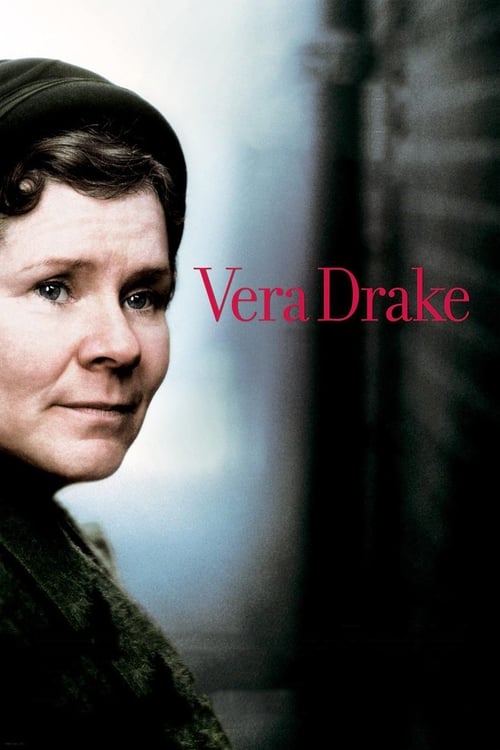
Vera Drake
2004 · Mike Leigh
For when you want a serious, humane drama that earns its heartbreak — a challenge, not a comfort, and one that will leave you thinking about class, law, and mercy long after. Not the pick for a light evening.
What it's about
In 1950 London, Vera Drake is a cheerful working-class cleaning woman who holds her family together with tea, kindness, and constant small acts of care. What her husband and children don't know is that she also quietly "helps out" desperate girls and women with unwanted pregnancies — unpaid, illegal, and never fully named even to herself. When one procedure goes wrong, the law arrives at the Drakes' door in the middle of a family celebration, and everything she has built begins to collapse.
The experience
Hushed, patient, and then quietly shattering — the film spends its first half wrapping you in the warmth of an ordinary household so that watching it come apart is almost unbearable. There's no melodrama, which is exactly what makes it devastating.
Performances
Imelda Staunton is extraordinary as Vera — a performance of bustling, birdlike warmth that drains from her face in real time when the knock comes; the change is so total it's like watching a different person. Phil Davis, as her husband, matches her with wounded, undemonstrative decency.
The craft
Mike Leigh built the film through his signature method of months of character work and improvisation with the cast, and it shows in how lived-in every kitchen, parlor, and awkward silence feels. The period recreation of postwar austerity London is meticulous without ever calling attention to itself, and the framing stays plain and close so nothing distracts from the faces.
Why it matters
It won the Golden Lion at Venice and earned Staunton the strongest acclaim of her career, and it remains one of the defining dramas about abortion — pointedly contrasting the dangerous back-room help available to the poor with the discreet paid route open to the wealthy.
Snapshot
Vera Drake is Mike Leigh's quietly devastating chamber tragedy about a working-class London cleaning woman in 1950 who, alongside her paid domestic labor, secretly performs abortions for desperate girls and women — "helping girls out," in her own euphemism — without payment and without fully naming to herself what she does. When one procedure goes badly wrong and a young woman nearly dies, the law arrives at the Drake family's modest flat mid-celebration, and the film becomes a study of how a single revelation collapses a life and a household. It is at once one of Leigh's most controlled films — formally austere, almost hushed — and one of his most politically pointed, drawing a deliberate line between the criminalised back-room help available to the poor and the discreet, expensive, quasi-legal route available to the daughter of privilege. Anchored by Imelda Staunton's performance, it won the Golden Lion at the 2004 Venice Film Festival and carried Leigh's social-realist project into the period film without sacrificing its intimacy.
Industry & production
The film was produced by Simon Channing Williams through Thin Man Films, the company he and Leigh had run together since the early 1990s, the partnership that had already delivered Naked (1993), Secrets & Lies (1996), Career Girls (1997), Topsy-Turvy (1999) and All or Nothing (2002). As with Leigh's other features of the period, financing was assembled from a coalition of British and European sources — the kind of public-service and broadcaster-backed funding (UK Film Council, regional and continental partners) on which Leigh's commercially unconventional, script-less productions depended. Precise budget figures are not something I can state with confidence, but the picture belongs unmistakably to the modestly resourced, artisanal end of British filmmaking rather than to studio production: a period reconstruction achieved through restraint, tight locations and careful art direction rather than spectacle.
The production's defining industrial fact is method rather than money. Leigh works without a screenplay in the conventional sense; he secures financing on the strength of his reputation and a broad premise, then develops the film over months of rehearsal and improvisation before a frame is shot. This makes his films institutionally peculiar — they are greenlit essentially on trust — and Vera Drake is a mature example of a financier-and-producer relationship (Channing Williams was central) built precisely to protect that process.
Technology
Vera Drake was shot photochemically on 35mm, consistent with Leigh and cinematographer Dick Pope's practice in this era, before the director's later moves toward digital capture. There is nothing technologically showy about the film; its tools are conventional for early-2000s arthouse production. The relevant "technology" is closer to craft infrastructure — period set dressing, costume, the reconstruction of austerity-era interiors — than to any innovation in camera or post. The film's effects are achieved through lighting, lens choice and physical staging rather than optical or digital intervention, and any visual-effects work is invisible by design. In short, this is a film whose ambitions are theatrical and observational, and whose technical signature lies in subtraction.
Technique
Cinematography
Dick Pope, Leigh's regular director of photography since Life Is Sweet (1990), gives the film a deliberately desaturated, low-key palette — browns, grays, ochres and institutional greens — that evokes post-war austerity without tipping into picturesque nostalgia. The camera is largely still and observant, favouring medium shots and patient framings that hold characters within their cramped domestic and institutional spaces. Where the film does move toward emphasis, it is through slow, almost imperceptible pushes and through the held close-up — most famously on Staunton's face — rather than through restless coverage. Pope lights interiors softly and naturalistically, letting the period's gloom register as a moral atmosphere as much as a visual one. The result is a cinematography of containment: the frame itself becomes one of the social walls pressing in on its characters.
Editing
The film was cut by Jim Clark, a veteran British editor whose career stretched back decades and included The Killing Fields. The editing is unobtrusive and rhythmically patient, built around the duration of scenes rather than their fragmentation. In the first movement, Clark cross-cuts between Vera's two secret economies — her cheerful domestic rounds and her clandestine visits to frightened girls — establishing parallelism without commentary; he also juxtaposes Vera's free, dangerous help for the poor against the moneyed, sanctioned arrangement that spares a wealthy young woman. After the arrest, the cutting tightens its grip on the family interior, letting silences and reaction shots play out at length. The editing's restraint is itself expressive: by refusing to hurry, it forces the audience to sit inside shame, fear and incomprehension.
Mise-en-scène / staging
Staging is the heart of any Leigh film, and Vera Drake is exemplary. The Drake flat — its kitchen table, its teapot, its narrow rooms — is constructed as a complete social world, and Leigh blocks his actors within it as an ensemble whose habitual gestures (the pouring of tea, the shared meals) carry enormous emotional weight precisely because they are ordinary. The famous structural turn occurs when the police interrupt a family gathering: the celebration and the catastrophe occupy the same room, and the staging makes the collision physical. Period detail is dense but never museum-like; objects are handled, worn, lived-in. The contrast between the Drakes' working-class interiors and the bourgeois spaces in the film's parallel abortion story is encoded directly into the décor and spatial scale.
Sound
Andrew Dickson, who had scored earlier Leigh films, provides a spare score dominated by strings — elegiac, restrained, deployed sparingly so that it punctuates rather than saturates the drama. Much of the film's most powerful passages play with little or no music at all, relying on the ambient sound of domestic life and, crucially, on silence: the dead air of a room after the truth has been spoken. The sound design privileges the small acoustic textures of period interiors and the muffled, embarrassed registers of speech under interrogation. When Dickson's strings do enter, they tend to mark grief and inevitability rather than suspense.
Performance
Performance is where Leigh's method becomes visible as artistry. Imelda Staunton's Vera is the film's center of gravity — a small, busy, relentlessly kind woman whose habitual cheer is, we come to see, partly a defense against the gravity of what she does. Staunton's most celebrated work comes after the arrest, when Vera's animating warmth drains from her face and she seems to physically shrink; the performance lives in trembling, in collapse, in the inability to meet others' eyes. Around her, Leigh's ensemble — including the actors playing her husband and children — delivers the kind of lived-in, unforced naturalism his process is built to produce. A widely reported feature of the production is that Leigh withheld the central secret from the actors playing Vera's family, so that their shock at the revelation would be discovered in real time; whatever the exact mechanics, the on-screen result is a family whose devastation feels genuinely unrehearsed.
Narrative & dramatic mode
The film operates in a realist, observational mode that withholds overt judgment while structuring its sympathies with precision. Its dramatic architecture is essentially two-part: a first movement of accretive everyday detail, in which Vera's double life is established through routine, and a second movement of consequence, in which the law, shame and the legal apparatus close around her. Leigh refuses melodrama's machinery — there is no villain, no courtroom catharsis of the conventional kind, no special pleading. Instead the drama is built from process: the procedural reality of arrest, charge and trial, and the slow social process by which a family absorbs a catastrophe. The mode is tragic in a near-classical sense — a fundamentally good person undone by the collision between private morality and public law — but its tragedy is rendered in the grammar of the domestic and the procedural rather than the operatic.
Genre & cycle
Vera Drake sits squarely within British social realism, the tradition running from the kitchen-sink dramas and Free Cinema of the late 1950s and early 1960s through to the work of Ken Loach and Leigh himself. It is simultaneously a period film, and its interest lies partly in marrying social realism's contemporary-observational ethos to historical reconstruction — a move Leigh had already explored in Topsy-Turvy. It also belongs, thematically, to a small cycle of films that confront abortion directly and unsentimentally; within that conversation it is frequently discussed alongside later European treatments of the same subject. As a Leigh film it is part of his own ongoing cycle of close studies of English class life, distinguished here by its historical setting and its overtly political frame.
Authorship & method
The film is unmistakably authored by Mike Leigh, and it crystallizes his signature method: no pre-written screenplay, but a long development built from intensive one-on-one and group improvisation, in which actors construct biographies for their characters and the narrative is discovered collaboratively before being fixed and shot. Leigh's authorship is total in the outcome and genuinely collaborative in the process — a paradox central to understanding his cinema. His key collaborators recur across the filmography and function almost as co-authors of the house style: cinematographer Dick Pope, whose muted naturalism defines the look; editor Jim Clark, whose patient cutting sustains the film's gravity; composer Andrew Dickson, whose stringed elegies supply its emotional undertow; and producer Simon Channing Williams, whose Thin Man Films made the unorthodox method financially possible. The "writer," in the credited sense, is Leigh himself, but the script is the residue of the ensemble's improvisatory labor rather than its blueprint.
Movement / national cinema
This is a definitively British film, and a self-conscious contribution to the lineage of British realist cinema. Leigh's project has long been understood as a continuation — and interrogation — of the social-realist tradition, with its commitment to working-class experience, regional and class-specific speech, and the dignity of the ordinary. Vera Drake extends that tradition backward into the historical past, using period reconstruction to make an argument about continuity: the inequities it depicts (who can buy safety, who cannot) are framed as structural rather than merely historical. Within the landscape of 2000s British and European art cinema, the film stands as one of the most internationally honored expressions of that national tradition.
Era / period
The film is set specifically in 1950 — not the broad "1950s" of cliché but the particular texture of post-war austerity Britain: rationing's long shadow, cramped housing, the recently arrived welfare state, and a rigid moral and legal order. This dating is essential to its politics, because it situates the action well before the 1967 Abortion Act that would legalise the procedure in Britain under specified conditions. Vera operates in a world where what she does is a serious crime, and where the only sanctioned escape is the one money can quietly arrange. The period is rendered with dense material specificity, but Leigh's purpose is never antiquarian; the past is reconstructed in order to illuminate the social arrangements — of class, gender and law — that govern women's bodies.
Themes
At its core the film concerns the criminalisation of abortion and the class injustice that criminalisation produces: the same act is a crime when performed for the poor and an arrangement when purchased by the rich. Around that spine cluster Leigh's enduring preoccupations — the dignity and fragility of working-class family life, the gulf between public respectability and private reality, kindness as both virtue and self-protective denial. Vera's refusal, or inability, to name what she does ("helping girls out") raises questions about conscience, complicity and the stories people tell themselves to survive. The film is also about shame as a social force — how it isolates, how it reorganizes a family's love — and about the asymmetries of a justice system that punishes the visible and protects the discreet. Crucially, Leigh declines to resolve the moral question of abortion itself; the film's argument is about justice and class, not a verdict on Vera's act.
Reception, canon & influence
Vera Drake was received as a major work and one of Leigh's finest. It premiered at the 2004 Venice Film Festival, where it won the Golden Lion for best film and where Imelda Staunton took the Volpi Cup for best actress — a rare double that confirmed both the film's stature and the centrality of its lead performance. It went on to substantial awards recognition, including multiple Academy Award nominations — notably for Staunton's performance, Leigh's direction, and Leigh's original screenplay — and prominent BAFTA recognition; Staunton's portrayal of Vera became, for many critics, the defining performance of her screen career. Critical reception was strongly positive, with particular praise for the controlled tragedy of its second half and for Leigh's refusal of sentimentality and easy polemic.
Its influences run backward into the British realist tradition — the kitchen-sink and Free Cinema lineage, and Leigh's own prior filmography — and into the period-reconstruction mode he had developed in Topsy-Turvy. Looking forward, the film consolidated Leigh's late-career standing as a master of the form and stands as a key reference point in cinema's serious engagement with abortion as a subject of class and law rather than mere moral debate; it is regularly invoked in discussions of that lineage. Its more diffuse legacy lies in demonstrating that the improvisational, ensemble-built realist method could be carried convincingly into the historical past, and in cementing the actor–director collaboration between Leigh and Staunton as one of the notable partnerships of 2000s British cinema. Where claims about precise figures or specific institutional details are concerned the public record is, in places, thinner than the film's reputation, but its critical standing and its place in the canon of British social realism are not in doubt.
A Deleuzian reading
She is always doing something with her hands.
The full Deleuzian reading of Vera Drake →
Reception
It arrived garlanded — the Golden Lion at Venice 2004 and three Oscar nominations, including Imelda Staunton for Best Actress — and its stock has only risen: after Roe v. Wade fell in 2022, it recirculated widely as one of cinema's essential, most humane films about abortion.
How Vera Drake was received, from release to now →
Influences: the films it descends from and the films it influenced
- Saturday Night and Sunday Morning (1960) — Establishes the Free Cinema-to-feature kitchen-sink template — location shooting in working-class interiors and unromanticized regional vernacular — that Leigh's British social realism directly inherits.
- A Taste of Honey (1961) — Pioneers the unsentimental, working-class woman's reproductive/domestic crisis as serious dramatic subject, photographed in austerity-era streets and cramped flats rather than as melodrama.
- Cathy Come Home (1966) — Models the documentary-inflected indictment of social policy crushing a decent working-class woman, the law-versus-class framing Vera Drake adopts for abortion.
- Kes (1969) — Codes the observational restraint and naturalist ensemble performance — minimal scoring, no directorial editorializing — that underwrites Leigh's refusal of polemic.
- A Woman Under the Influence (1974) — The foundational improvisation-derived performance built over long rehearsal, sustained by the held close-up on a woman's disintegrating face — the technique Leigh applies to Staunton's silences.
- Bleak Moments (1971) — Leigh's own origin point for the screenplay-less method: characters built through months of one-on-one improvisation before any scene is fixed.
- Secrets & Lies (1996) — Perfects the withheld-secret architecture and the long real-time two-shot held until a family revelation detonates — the dramatic engine reused in Vera's arrest.
- Topsy-Turvy (1999) — Proves the improvisational ensemble method can be carried into meticulous period reconstruction, the direct precedent for staging 1950 austerity Britain from the inside out.
- High Hopes (1989) — It extends High Hopes's period-and-class specificity built entirely through the actors' undisclosed backstory improvisation, with Dick Pope's framing reading social position through room, dress and gesture.
- Never Rarely Sometimes Always (2020) — Treats abortion as a matter of class logistics and bureaucratic obstacle, anchored by a single sustained held close-up (the title interview) that descends directly from the Staunton/Cassavetes face.
- Another Year (2010) — Extends the kitchen-table ensemble blocking and Andrew Dickson-style stringed elegy as emotional undertow over patiently observed domestic ritual.
- Mr. Turner (2014) — Carries the improvisation-built-into-period-reconstruction model forward with Dick Pope's painterly naturalism, the logical successor to the Topsy-Turvy/Vera Drake period strand.
- Fish Tank (2009) — Carries British social realism into the 2000s via non-professional naturalist performance and handheld observation of working-class women's constrained lives.
- Peterloo (2018) — Pushes the lived-in ensemble realism into large-scale historical reconstruction, applying the improvisation-built crowd of working-class voices to a period injustice.
- Belén (2025) — Stages the criminalization of a woman's body through restraint and a near-silent, reactive lead swallowed by legal machinery, letting institutional process rather than speeches carry the indictment.
- 4 Months, 3 Weeks and 2 Days (2007) — Renders clandestine abortion under a punitive legal regime through procedural, near-real-time realism and withheld tension rather than moral debate — the same law-as-tragedy treatment.
- Happy-Go-Lucky (2008) — Continues the house style with Dick Pope's muted naturalism and lived-in ensemble blocking generated from the same improvisation process.
- I, Daniel Blake (2016) — Sustains the tragic-mode social realism that indicts the state's treatment of a fundamentally decent working person, refusing sentimental uplift.
- Story of Women (1988) — Renders an ordinary backstreet abortionist through domestic-threshold staging and moral evenness rather than melodrama, indicting the system by refusing to flatter or vilify its agent.
- Hard Truths (2024) — The purest application of Leigh's compartmentalised rehearsal: the family cast were never told what Vera did, so their shock at the arrest is genuinely first-time, and the film's structure is built to capture it in one unbroken take.
Similar films
- Secrets & Lies (1996) — influence & lineage
- Bleak Moments (1971) — influence & lineage
- 4 Months, 3 Weeks and 2 Days (2007) — influence & lineage
- Breaking the Waves (1996) — same viewing thread
- Story of Women (1988) — shared sensibility
- Hard Truths (2024) — shared sensibility
- The Iron Lady (2011) — shared sensibility
- Brief Encounter (1945) — shared sensibility
All the films related to Vera Drake →
Watch it with: curated runs of related films
- The World Against Her — A run of women worn down or driven to extremity by a merciless community, marriage, or economy — watch them near each other and the sacrifice, the drift, and the violence start to rhyme.