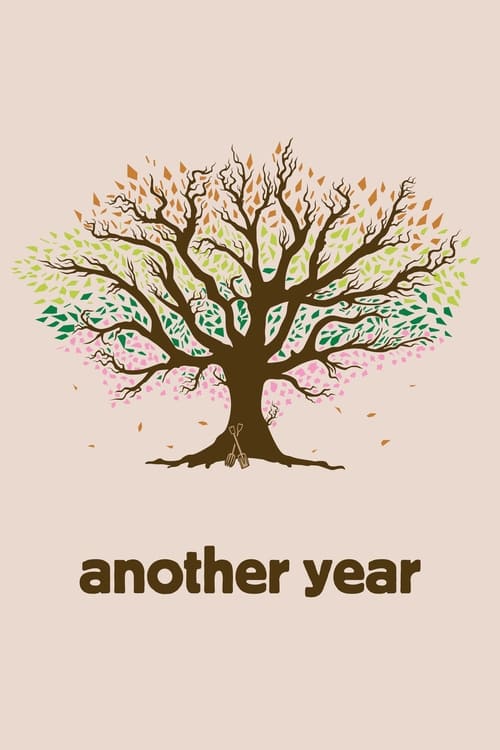
Another Year
2010 · Mike Leigh
For when you want something human-scaled and true rather than plotty — a film to watch slowly on a quiet evening, ideally with someone you can talk to after. It's warm company, but it will sneak up on you.
What it's about
Tom and Gerri are a long-married London couple nearing retirement — he's a geologist, she's a counsellor — who cook, tend their garden allotment, and open their home to whoever needs it. Over four seasons, the people who drift through their kitchen are mostly less lucky: above all Mary, Gerri's colleague, whose bright chatter barely covers a deepening loneliness. Nothing dramatic is announced; a year simply passes, and you watch what contentment looks like next to its absence.
The experience
Gentle on the surface and quietly devastating underneath — it's funny in a wincing, recognizable way, then suddenly very sad without ever raising its voice. It's the rare film that feels like sitting in a real kitchen with real people.
Performances
Lesley Manville's Mary is extraordinary — a performance of brittle vivacity slowly cracking, built from talk, wine, and hope in the wrong places. Jim Broadbent and Ruth Sheen make married contentment, one of the hardest things to act, completely believable.
The craft
Mike Leigh built the film through his signature months-long improvisation process with the actors, and it shows in dialogue that never sounds written. The four-season structure gives it shape without plot, each season shot with its own light and temperature, and the film trusts long, unhurried scenes around a table to carry everything.
Why it matters
Acclaimed at Cannes and widely counted among Leigh's finest late films, it sharpened his reputation as British cinema's great observer of ordinary lives — and made Mary a byword for a certain kind of heartbreaking screen loneliness.
Snapshot
Another Year is Mike Leigh's chamber study of contentment and its absence, organized around a single married couple — Tom, a geologist, and Gerri, a medical counsellor — and the friends and relatives who orbit their settled, generous household across four seasons. Where much of Leigh's earlier work dramatized eruption and crisis, this film is unusually static and observational: it watches happy people be happy and unhappy people fail to change, and finds in that asymmetry something quietly devastating. Its emotional center is not the stable couple but Mary, Gerri's colleague, whose loneliness curdles over the year from brittle vivacity into visible desperation. Premiered in competition at the 2010 Cannes Film Festival and released later that year, it stands as one of Leigh's most tender and least consoling late works — a "drama, comedy" in name whose comedy is largely the social comedy of people talking past one another.
Industry & production
Another Year was a British production made within the funding ecology that sustained Leigh throughout his career: backing came from Film4 and the UK Film Council's National Lottery money, with Focus Features International handling international sales and distribution — a continuation of the Universal/Focus relationship that had carried Leigh's work internationally since Vera Drake (2004). The film was produced by Georgina Lowe, who had risen through Leigh's production teams to become his regular producer, and made through Leigh's own company Thin Man Films, the vehicle he and producer Simon Channing Williams had established to protect his idiosyncratic development method (Channing Williams, Leigh's longtime producer, had died in 2009; Another Year falls at the threshold of that transition in Leigh's producing arrangements).
The budget was modest by any studio measure — Leigh's films are characteristically low-cost, their expense concentrated in the long paid rehearsal-and-improvisation development period rather than in spectacle. Precise budget and box-office figures I would not want to assert from memory; the film performed as a specialized arthouse title, respectable rather than commercial, consistent with Leigh's audience. Its festival launch at Cannes and subsequent awards-season visibility — culminating in an Academy Award nomination for Best Original Screenplay — provided the platform such a film depends upon.
Technology
Another Year was shot photochemically on 35mm film by Dick Pope, in keeping with Leigh's and Pope's preference for film stock and traditional lab finishing at a moment when digital acquisition was rapidly displacing celluloid in mainstream production. The precise capture format and lensing specifications I cannot confirm with certainty and will not invent, but the film's look — its restrained, naturalistic color and its seasonal shifts in palette and light — reflects a photochemical sensibility rather than the aggressive digital grading that was becoming common by 2010. Technologically the film is deliberately unshowy: no visual effects of note, no elaborate camera rigs, the whole enterprise built around actors in real, dressed interiors and a genuine allotment garden. Its significance in any technological history is essentially as a document of a director working in a resolutely analog idiom on the cusp of the industry's digital turn.
Technique
Cinematography
Dick Pope, Leigh's cinematographer since Life Is Sweet (1990), shoots Another Year with a discreet, watchful naturalism. The camera favours sustained framings that let scenes play in something close to real time, holding on faces during the long conversational passages that are the film's real events. Pope keys the four seasonal chapters to distinct qualities of light — the fertile greens and open skies of spring and summer at the allotment giving way to the flatter, colder, more enclosed light of autumn and winter — so that the photography itself charts the film's darkening. The signal cinematographic gesture is the final shot: a slow circular movement around the crowded dinner table that comes to rest on Mary's face amid the chatter, the framing quietly severing her from the warmth around her. It is a rare instance of the camera asserting an emotional judgment in a film otherwise committed to observation.
Editing
Jon Gregory, Leigh's regular editor, cuts the film to its four-season architecture, giving each chapter room to breathe and resisting the temptation to compress the long dialogue scenes. The editing is unhurried and legible, built to preserve the rhythm of performance rather than to impose a directorial tempo; cuts tend to come at the natural respiration of a conversation. The larger editorial decision is structural — the seasonal partition, with its ellipses of weeks and months between blocks — which lets the film register incremental deterioration (Mary's, and the peripheral figures') across a calendar year without ever narrating it.
Mise-en-scène / staging
The film is largely a domestic-interiors piece: Tom and Gerri's comfortable, book-and-plant-filled house, whose kitchen and dining table function as the gravitational center toward which every lonely character drifts. Against this the recurring allotment garden supplies both the seasonal clock and a governing metaphor — cultivation, patience, the slow yield of tended ground — set against the human lives that fail to grow. Leigh stages his scenes around the rituals of hospitality: cooking, pouring wine, laying a table, offering a bed for the night. The visitor is always at a slight disadvantage in the geometry of the room, and Leigh exploits this — the way Mary occupies a chair as a guest who never quite becomes family, the way the unhappy characters cluster near the door or the drinks.
Sound
Gary Yershon's score is spare and elegiac, leaning on small, plaintive instrumental colors rather than lush orchestration, and it deliberately withholds consolation — there is no swelling reassurance to soften the film's harder moments. This was among the earliest of Yershon's feature collaborations with Leigh (he would go on to score Mr. Turner), following Leigh's long prior associations with other composers. Beyond the score the film's sound design is dominated by talk — overlapping domestic conversation, the clink of glasses, the ambient hum of the garden and the city — and by pointed silences, the pauses in which a character's isolation becomes audible.
Performance
Performance is the film's true medium. Jim Broadbent and Ruth Sheen, both longtime Leigh collaborators, give Tom and Gerri an unforced, lived-in ease — a portrait of a good marriage that never tips into smugness, though the film leaves open the question of how much the couple's contentment depends on quietly managing the needy people around them. Peter Wight's Ken is a study in ruin by appetite; David Bradley, as Tom's grieving brother Ronnie, does a great deal with near-total inexpressiveness. But the film belongs to Lesley Manville as Mary, whose performance — voluble, flirtatious, self-deceiving, and finally shattered — was singled out by critics as among the finest screen acting of its year. Manville modulates Mary's decline in tiny increments, so that the gap between how she wishes to be seen and how she is seen widens almost imperceptibly until the final table sequence makes it unbearable.
Narrative & dramatic mode
The film's dramatic mode is observational and cyclical rather than plotted. Its organizing device — Spring, Summer, Autumn, Winter — is not a conventional arc toward resolution but a structure of return: the same house, the same table, the seasons turning while the characters largely do not. There is no protagonist in the traditional sense; Tom and Gerri function more as a stable frame against which others are measured. The "story," such as it is, is the slow revelation of how little the unhappy can change and how the happy quietly hold their ground. Leigh works in accretion — meaning gathers through accumulated small scenes of hospitality and disappointment — and the film's power depends on withholding catharsis, ending not on a resolution but on a held, unresolved image of exclusion.
Genre & cycle
Nominally a drama-comedy, Another Year belongs to the British social-realist and domestic-humanist tradition, and more specifically to Leigh's own late cycle of quieter, less confrontational ensemble portraits. It sits within his career-long project of anatomising English class, manners, and loneliness — kin to Life Is Sweet, Secrets & Lies (1996) and Happy-Go-Lucky (2008), but tonally more autumnal. Its comedy is the comedy of social embarrassment and self-delusion rather than of situation; its realism is of the observational, character-first kind rather than the issue-driven kitchen-sink mode with which British realism is often associated. In genre terms it is best understood as a chamber drama of everyday life.
Authorship & method
Another Year is unmistakably a Mike Leigh film, both in sensibility and in method. Leigh's process is famously unlike conventional screenwriting: he begins without a script, assembles a cast, and develops characters over months of private improvisation and rehearsal, each actor building a biography from scratch before scenes are devised and gradually structured into a film. The screenplay credit he carries reflects this collaborative devising rather than a pre-written text — a distinction central to understanding his authorship. His long-term collaborators are essential to the result: cinematographer Dick Pope, whose naturalistic photography had shaped Leigh's films for two decades; editor Jon Gregory; composer Gary Yershon, here early in his screen partnership with Leigh; producer Georgina Lowe; and a repertory company of actors — Broadbent, Sheen, Manville, Wight and others — who had internalized the method across multiple projects. The film's achievement is inseparable from that continuity of collaborators, which allowed the extended improvisatory development to proceed on trust.
Movement / national cinema
The film is a work of British national cinema and of its humanist-realist strand in particular. Leigh is one of the two or three directors most identified with sustaining that tradition into the twenty-first century, and Another Year exemplifies its virtues: attention to class and speech, refusal of glamour, and a moral seriousness about ordinary lives. It is not part of any formal "movement" in a manifesto sense, but it extends a lineage running from the British New Wave and the social realism of Ken Loach toward a more character-centred, less overtly political register. Within European art cinema more broadly, its seasonal structure and observational patience align it with a strain of contemplative realism, though its idiom remains distinctively English.
Era / period
Made and set contemporaneously around 2010, the film is a portrait of a certain stratum of middle-class and working-class England at the end of the New Labour years — a milieu of allotments, NHS work, modest homeownership and after-work drinking. It carries the texture of its moment without foregrounding topical politics; the social pressures are present in the grain (housing, aging, the loneliness of the unpartnered in late middle age) rather than in headlines. As a late-career Leigh film it also belongs to a specific authorial period: after the acclaim of Vera Drake and Happy-Go-Lucky, and before the biographical turn of Mr. Turner (2014), a phase in which Leigh's gaze grew notably more elegiac.
Themes
The film's governing theme is the contrast between contentment and its lack — between those who have made a life that sustains them and those who have not, and the uncomfortable question of what separates the two. Aging and the passage of time saturate the seasonal structure; the film is acutely concerned with loneliness, especially the loneliness of women without partners in middle age, embodied in Mary and, more grimly, in the abrasive Janet of the opening and the wrecked Ken. Hospitality and its limits form a running motif: the couple's kindness is real but finite, and the film is honest about the burden the needy place on the generous, and about the faint self-protection in the contented couple's warmth. Class, work, and English inarticulacy — the inability to say what is felt, dramatized in Ronnie's near-silence — thread throughout. Above all the film meditates on stasis: the human failure to change set against the garden's reliable renewal.
Reception, canon & influence
Critically, Another Year was warmly and widely admired, praised as one of Leigh's most mature and moving films, with near-unanimous acclaim for Lesley Manville's performance as Mary — frequently cited as among the year's best and gathering significant critics'-circle recognition, though I would not want to enumerate specific awards I cannot verify precisely. The film received an Academy Award nomination for Best Original Screenplay for Leigh, extending his long record of Oscar recognition, and featured prominently on year-end critical lists.
Its influences run backward through Leigh's own oeuvre and through the British humanist-realist tradition — the observational patience and class attention of Loach's and Leigh's earlier work, the chamber-drama concentration on domestic space, and the Chekhovian sensibility (people gathered, talking, failing to connect) that critics have long detected in Leigh's ensembles. The four-season structure invites comparison with a broader European lineage of calendar-organised films, though Leigh arrives at it through his own devising process rather than by homage.
Its forward legacy is best measured in reputation rather than imitation: the film consolidated Manville's standing and her ongoing partnership with Leigh, deepened critical appreciation of his late-career turn toward elegy, and stands as a touchstone for the possibilities of quiet, observational character cinema. Because Leigh's method is so personal and inimitable, the film founded no school; its influence is felt in the continued esteem for his way of working and in Another Year's standing as a benchmark example of ensemble screen acting and of drama built from the ordinary rhythms of hospitality, aging, and loneliness.
A Deleuzian reading
Watch where people sit.
The full Deleuzian reading of Another Year →
Reception
Acclaimed straight out of Cannes 2010 and never really dipped — but the awards-season buzz around Lesley Manville that fizzled into no Oscar nomination has aged into one of those snubs cinephiles still bring up, and the film's stock has only risen as a late-Leigh masterwork.
How Another Year was received, from release to now →
Influences: the films it descends from and the films it influenced
- Bleak Moments (1971) — Leigh's debut established the devised method's signature grammar of excruciating silence and thwarted teatime conversation that Another Year refines into elegy.
- Naked (1993) — Its repertory company building full biographies through months of private improvisation before scenes are structured is the identical authorship process credited as 'screenplay' here.
- Secrets & Lies (1996) — The unbroken devised confrontation scenes shot in Dick Pope's unforced naturalistic light are the ensemble template Another Year inherits directly.
- All or Nothing (2002) — Leigh's earlier elegiac study of working-class stasis and inarticulate loneliness prefigures Another Year's tonal turn toward contentment shadowed by isolation.
- Vera Drake (2004) — Dick Pope's controlled, desaturated naturalism and the trust-built repertory ensemble refined here carry straight into Pope's seasonal lighting on Another Year.
- Kes (1969) — Loach's observational patience and non-declamatory, class-rooted performance founded the British social-realist naturalism Leigh's ensemble descends from.
- A Woman Under the Influence (1974) — Cassavetes' actor-centered, improvisation-textured long takes on domestic emotional collapse are the ancestor of Manville's Mary as a descendant of Rowlands' Mabel.
- Vanya on 42nd Street (1994) — Its rehearsal-developed Chekhovian ensemble of people gathered, talking and failing to connect is the explicit template for Another Year's 'Chekhovian' facet.
- Tokyo Story (1953) — Ozu's static, patient framing of aging, hospitality and generational disconnection is the humanist stillness Leigh's late-career elegy echoes.
- Mr. Turner (2014) — Leigh's next feature extends the same devised process and Dick Pope photography, here pushed toward painterly light with the repertory-trained Timothy Spall.
- 45 Years (2015) — Haigh builds a long marriage's quiet rupture from accreted ordinary domestic rhythm and restrained ensemble intimacy, extending Leigh's naturalist chamber observation.
- The Souvenir (2019) — Hogg's memory-based, improvised-dialogue devising and observational fixed camera continue the British devised-realist lineage Leigh's practice anchors.
- Happy-Go-Lucky (2008) — The immediately preceding film launched Gary Yershon's screen scoring partnership with Leigh, whose elegiac chamber writing Another Year deepens.
- An Autumn Tale (1998) — From Rohmer's Tales of the Four Seasons, it shares the calendar-organised structure and talk-driven observation of middle-aged longing and mismatched pairing.
- Archipelago (2010) — Hogg's devised, improvisation-influenced study of middle-class awkwardness across shared meals and thwarted family connection runs parallel to Leigh's method.
- Hard Truths (2024) — Four seasonal panels, each a self-contained social gathering with no arc carrying between them — the episodic panel structure Jon Gregory cuts, and the refusal of an emphatic climax, that Hard Truths inherits wholesale.
Similar films
- Bleak Moments (1971) — influence & lineage
- Secrets & Lies (1996) — influence & lineage
- 45 Years (2015) — influence & lineage
- Life Is Sweet (1991) — shared sensibility
- Hard Truths (2024) — shared sensibility
- Little Forest (2018) — shared sensibility
- Meantime (1983) — shared sensibility
- Amour (2012) — shared sensibility