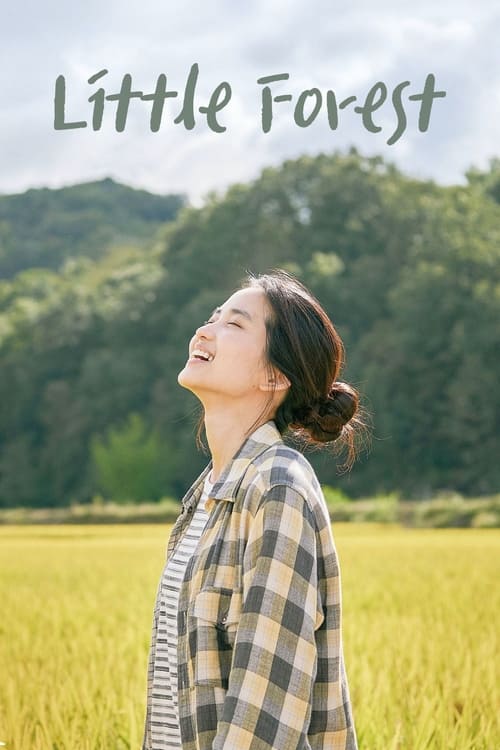
Little Forest
2018 · Yim Soon-rye
For a cozy night in when you're burnt out and want a film to lower your heart rate — comfort viewing that still has something real to say about starting over. Do not watch on an empty stomach.
What it's about
After a failed exam and a stalled life in Seoul, a young woman moves back to her mother's empty farmhouse in the countryside and cooks her way through a full year — kimchi buried for winter, flower pasta in spring, rice wine brewed for friends. Between meals she reconnects with two old friends and carries on a long-running argument, in her head, with the mother who left.
The experience
Calm, warm, and genuinely restorative — the cinematic equivalent of a slow meal with people you like. Nothing terrible happens and nothing needs to; you leave hungry and weirdly at peace.
Performances
Kim Tae-ri, fresh off The Handmaiden, anchors the film with easy, unforced charm — she makes chopping vegetables and sulking at an absent mother equally watchable.
The craft
The food is shot with documentary patience — real recipes, real steam, real dirt under the fingernails — and the film is structured around the four seasons, so the landscape itself does the storytelling. Its quiet radicalism is what it refuses: no villain, no romance mandate, no punishing lesson about returning to the city.
Why it matters
Adapted from Daisuke Igarashi's manga (already filmed in Japan), Yim Soon-rye's version became a touchstone of Korean healing cinema and a perennial rewatch for anyone dreaming of quitting the city.
Kim Tae-ri, fresh off The Handmaiden, plays Hye-won, who quits Seoul after a failed exam and returns to her mother's empty farmhouse to cook her way through a year — kimchi buried for winter, flower pasta in spring, makgeolli brewed for friends. Yim Soon-rye, whose career since her 1996 debut Three Friends makes her one of the most durable figures among Korean women directors, adapts Daisuke Igarashi's manga (already filmed in Japan as a four-season diptych) and compresses it into a single, airy Korean year, trading the Japanese versions' near-monastic solitude for friendship and a running argument with an absent mother. The food is shot with documentary patience — real recipes, real steam, real dirt under the fingernails. Its quiet radicalism is structural: no villain, no romance mandate, no return-to-the-city redemption, just a young woman calculating what a good life actually costs. In Korea it became the touchstone of so-called healing cinema; elsewhere it circulates like a seasonal ritual, taken down off the shelf when the ground thaws.
Reception
A modest sleeper hit in Korea in early 2018, embraced as a quintessential 'healing movie' — and its stock has only risen since, becoming a pandemic-era comfort-cinema staple that people rewatch seasonally like a ritual.
How Little Forest was received, from release to now →
Influences: the films it descends from and the films it influenced
- Little Forest: Summer/Autumn (2014) — The direct source film Yim compresses: its near-wordless, real-time cooking sequences (dough kneaded, vegetables blanched in unbroken takes) and the seasonal chaptering are lifted wholesale as the remake's structural spine.
- Little Forest: Winter/Spring (2015) — Supplies the winter-into-spring bookend and the recipe-as-scene-unit grammar — each dish given its own micro-episode of harvest, prep, and solitary eating — that Yim reorders into a single four-season loop.
- Tampopo (1985) — Originates food-as-narrative-engine in East Asian cinema: cooking treated not as backdrop but as the event the camera studies in loving procedural close-up, the template for Little Forest's dish-centric scenes.
- Eat Drink Man Woman (1994) — Its documentary-precise opening cooking montage — knife work, steam, plating shot with the rigor of a demonstration — established the tactile culinary realism Little Forest applies to farm-to-plate labor.
- Babette's Feast (1987) — Extends real-time food preparation into the film's emotional climax, proving a meal's making can carry a narrative's grace — the anti-dramatic, cooking-as-catharsis logic behind Little Forest's dishes.
- Still Walking (2008) — Its observational, documentary framing of a family kitchen — cooking and eating shot in patient wide masters — models the unforced domestic realism and the felt maternal absence Little Forest inherits.
- Kamome Diner (2006) — Codified iyashikei 'healing cinema' as a mode: unhurried pacing, food-making as quiet self-repair, and a refusal of conventional conflict — the genre grammar Little Forest transplants to rural Korea.
- Spring, Summer, Fall, Winter... and Spring (2003) — The canonical Korean four-season cyclical structure, using the turning year rather than plot as the organizing formal device Little Forest adopts for its narrative architecture.
- The Way Home (2002) — Korean rural-return template built on minimal dialogue, non-professional textures, and the countryside filmed as a healing space, prefiguring Little Forest's city-to-village retreat and generational quiet.
- Only Yesterday (1991) — Romanticizes agricultural labor as therapy — safflower harvest, farm rhythms rendered with near-documentary attention — the same dignifying of manual rural work central to Little Forest.
- Sweet Bean (An) (2015) — Shares the tactile macro close-up of ingredients being worked by hand (red-bean paste, here vegetables) paired with naturalistic ambient sound design, foregrounding process over dialogue.
- Our Little Sister (2015) — Structures memory and healing through seasonal rhythm and home-cooked ritual (plum wine, whitebait toast) among women across generations, the same slow-cinema domestic calendar Little Forest runs on.
- Microhabitat (2018) — A contemporary women-directed Korean rebuttal to hustle culture; opts out of the success narrative just as Little Forest does, sharing the anti-redemption, drop-out-and-live-small ethos of 2018 Korean cinema.
- The Handmaiden (2016) — Kim Tae-ri's screen debut, whose watchful, interior stillness Yim recruits and inverts — the same performer's unornamented naturalism carrying an entire near-solo film.
- Forever the Moment (2008) — Yim's own ensemble realism — undramatized, workaday performances and an eye for women's labor — is the authorial method carried forward into Little Forest's observational register.
- The Taste of Tea (2004) — Rural family life staged as episodic, plotless seasonal drift with lingering landscape compositions, the same anti-hustle slow-living tempo and countryside framing Little Forest embraces.
- Kim Ji-young: Born 1982 (2019) — A contemporary of the same Korean-feminist-culture wave, built on women-centered durational domestic naturalism and an accretion of seasonal routine over dramatic incident.
Similar films
- Our Little Sister (2015) — influence & lineage
- Spring, Summer, Fall, Winter... and Spring (2003) — influence & lineage
- Only Yesterday (1991) — influence & lineage
- Still Walking (2008) — influence & lineage
- The Way Home (2002) — influence & lineage
- Microhabitat (2018) — influence & lineage
- The Taste of Tea (2004) — influence & lineage
- Minari (2021) — shared sensibility