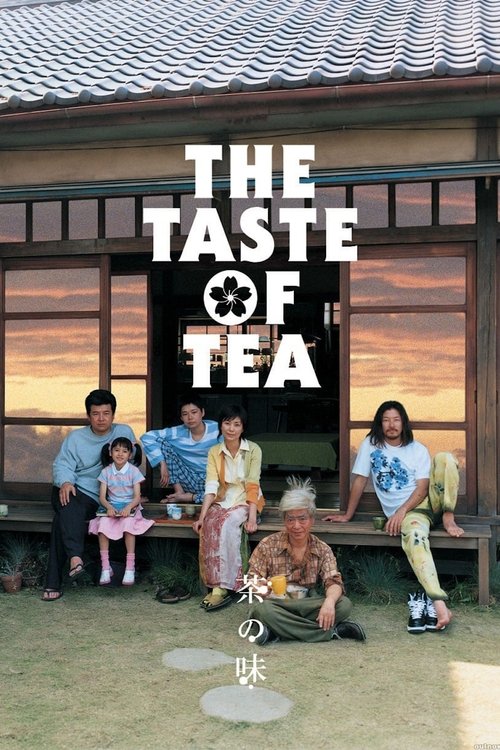
The Taste of Tea
2004 · Katsuhito Ishii
For a slow Sunday when you want to be soothed rather than gripped — comfort viewing with a streak of the genuinely strange. Reach for it when you miss your family, or when you want a film that makes doing nothing feel like the point.
What it's about
One long green summer with the Haruno family in rural Tochigi: a mother reviving her animation career at the kitchen table, an uncle back from Tokyo to clear his head after years in the music business, a grandfather who strikes strange poses when he thinks no one is watching, a teenage son quietly capsized by first love, and a small daughter calmly followed everywhere by a giant version of herself gazing over the rice fields. Nothing urgent happens; everything matters.
The experience
Unhurried, sun-warmed, and quietly hilarious — the impossible arrives with a straight face and the film never blinks. At two and a half hours it moves like a lazy afternoon, and by the end you feel oddly restored, like you've been on a small vacation.
Performances
Tadanobu Asano gives the uncle a lovely, rumpled melancholy — a cool Tokyo guy slowly remembering how to be a son and a brother — and the whole ensemble plays absurdity with perfect deadpan sincerity.
The craft
Katsuhito Ishii frames his surreal eruptions in long, level, patient shots, so a girl's giant double gets the same matter-of-fact weight as a train ride or a cup of tea. The countryside photography is gorgeous — big skies, green fields, real weather — and it rewards a big screen and a quiet room.
Why it matters
It opened Directors' Fortnight at Cannes and announced that Ishii, fresh from the anime interlude in Kill Bill Vol. 1, could trade pop mayhem for tenderness — becoming a touchstone of the gentle, eccentric strain of 2000s Japanese cinema.
In rural Tochigi, a family drifts through a green, unhurried summer: a hypnotist grandfather striking poses, a mother reviving her animation career at the kitchen table, a lovestruck teenage son, and a small daughter shadowed — placidly, enormously — by a giant version of herself gazing over the rice fields. Katsuhito Ishii, who had just directed the anime interlude in Kill Bill Vol. 1, opened Directors' Fortnight at Cannes with this two-and-a-half-hour reverie and confounded anyone expecting his earlier pop-yakuza mayhem. The mode is deadpan magic realism: surreal eruptions rendered matter-of-factly, framed in long, level shots that give the impossible the same weight as a train ride or a cup of tea. It belongs to that gentle strain of 2000s Japanese cinema — near Kore-eda's warmth and the slow-life comedies of the era — but nothing else has quite its mixture of doodle and epiphany. A cult has formed around it precisely because it resists synopsis; what people remember is a feeling, and one final image of the sky that earns every lazy minute preceding it.
Reception
It opened the Directors' Fortnight at Cannes in 2004 to warm but modest notice, then spent years as a hard-to-find import — before the streaming/Letterboxd era slowly turned it into one of the most beloved 'hidden gem' Japanese films of the 2000s.
How The Taste of Tea was received, from release to now →
Influences: the films it descends from and the films it influenced
- Tokyo Story (1953) — Establishes the tatami-level, static, level-eyed long take and the interstitial 'pillow shot' rhythm that Ishii adopts to observe a multi-generational household without dramatic cutting.
- My Neighbor Totoro (1988) — Models a lush pastoral-green rural setting where a child's matter-of-fact encounters with nature spirits are treated as everyday magic realism — a lineage Ishii extends in the boy's giant floating-self and mountain-forest visions.
- Playtime (1967) — Pioneers deadpan comedy staged in wide, deep-focus static compositions where gags accrue at the edges of the frame rather than through close-ups and reaction cuts.
- House (1977) — Splashes hand-drawn and optical animation directly into a live-action Japanese domestic space, the playful analog-collage surrealism Ishii revives for his interpolated animated interludes.
- Maborosi (1995) — Sets the slow-cinema template of held, distant, near-still long shots and contemplative dead time that Ishii's plotless family reverie inherits (the explicit 'Kore-eda-adjacent' debt).
- Kikujiro (1999) — Chapters a plotless rural summer into deadpan comic vignettes punctuated by surreal dream inserts and frozen static framing — the structural and tonal blueprint for Ishii's episodic countryside idyll.
- Shark Skin Man and Peach Hip Girl (1998) — Ishii's own debut that codifies his pop-surreal, deadpan, precisely designed visual grammar later softened into the pastoral register of The Taste of Tea.
- Funky Forest: The First Contact (2005) — Ishii's immediate follow-up pushes the same anime/live-action surreal-sketch hybrid into a full absurdist anthology, taking the interlude technique to its logical extreme.
- Kamome Diner (2006) — Carries forward the gentle, plotless slice-of-life built on static framing, comic stillness, and deadpan performance rather than narrative momentum.
- Still Walking (2008) — Distills the single-household, near-plotless family drama observed across one day in patient domestic long takes — the mature realization of the Kore-eda strand Ishii ran alongside.
- Symbol (2009) — Advances the deadpan surreal-absurdist Japanese comedy in which an ordinary reality is invaded by inexplicable magic-realist events staged with straight-faced restraint.
- One Million Yen Girl (2008) — Models the rural seasonal-episodic structure — chapters keyed to landscape and weather, stillness punctuated by small events — that organizes One Million Yen's summer-to-summer arc.
- Kill Bill: Vol. 1 (2003) — Ishii directed the O-Ren Ishii anime origin sequence for Tarantino, a direct collaborator link demonstrating the same technique — hand-drawn animation interpolated into live-action narrative — he deploys in his own film.
- Café Lumière (2003) — A contemporaneous Ozu homage built from slow, static long takes of quotidian Tokyo domestic life, sharing the same recovered-Ozu contemplative stillness.
- Survive Style 5+ (2004) — Same-year Japanese pop-surreal ensemble driven by highly designed, absurdist deadpan set-pieces — the parallel commercial-director aesthetic Ishii shares.
- Linda Linda Linda (2005) — Extends the unhurried, naturalistic long-take observation of a youth ensemble with deadpan comic stillness and minimal plot, the same slow slice-of-life patience.
- The Science of Sleep (2006) — Deploys handmade, low-tech animation erupting into a live-action domestic reality to externalize surreal inner epiphany, a Western cousin of Ishii's craft device.
- Little Forest (2018) — Rural family life staged as episodic, plotless seasonal drift with lingering landscape compositions, the same anti-hustle slow-living tempo and countryside framing Little Forest embraces.
Similar films
- Kikujiro (1999) — influence & lineage · same viewing thread
- Tokyo Story (1953) — influence & lineage
- My Neighbor Totoro (1988) — influence & lineage
- Still Walking (2008) — influence & lineage
- House (1977) — influence & lineage
- Our Little Sister (2015) — shared sensibility
- Late Spring (1949) — shared sensibility
- Only Yesterday (1991) — shared sensibility
All the films related to The Taste of Tea →
Watch it with: curated runs of related films
- Unlikely Companions, Gentle Roads — Watch these together for the way a mismatched pair — a yakuza and a lost boy, an old man on a lawnmower bound for his brother, a runaway kid and a grizzled uncle, two frontier drifters with a stolen cup of milk — becomes a whole small world; they rhyme on tenderness carried at walking pace.