Survive Style 5+
2004 · Gen Sekiguchi
For when you're craving something gleefully weird — a midnight movie to spring on friends who like their comedy absurd and their visuals cranked to maximum.
What it's about
Five stories with no apparent connection start to intertwine: a man keeps burying his wife only to find her waiting at home again, a hypnotist's act goes catastrophically unfinished, an advertising executive brims with terrible ideas, three petty burglars bumble along, and a British hitman demands of everyone he meets, 'What is your function in life?'
The experience
A candy-colored sugar rush — loud, absurd, joke-a-minute surreal — that keeps blindsiding you with tenderness. Just when you've settled in for pure mayhem, it sneaks up on grief and love.
Performances
Tadanobu Asano, all wounded silence and burning eyes, anchors the chaos in something like grief; Vinnie Jones is magnificently baffled as the hitman abroad.
The craft
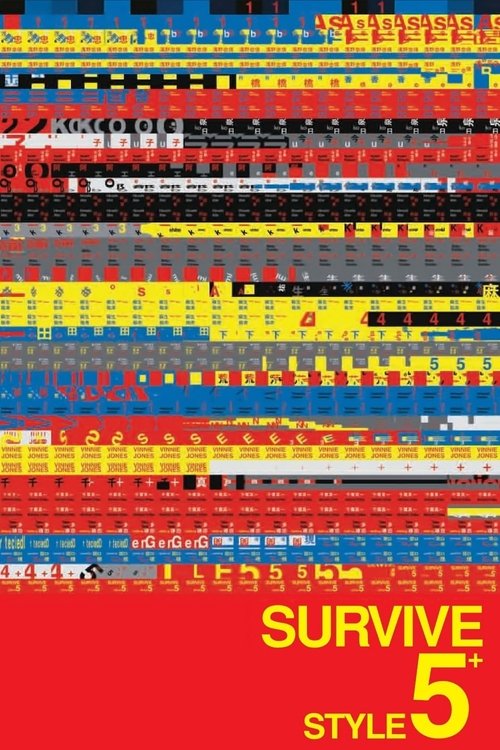
Director Gen Sekiguchi came from Japanese TV commercials and it shows in every frame — interiors of hallucinatory wallpaper and impossible color from production designer Takeshi Shimizu, each shot composed like a thirty-second spot with the pitch removed. See it big and loud if you can; the design is half the joke.
Why it matters
A beloved cult object of 2000s Japanese pop cinema, passed hand to hand by word of mouth — the kind of one-off that keeps winning converts decades on.
Five stories orbit one another in Gen Sekiguchi's candy-colored cult object: a man who keeps burying his wife only to find her waiting at home, a hypnotist whose act goes catastrophically unfinished, an advertising executive brimming with terrible ideas, three petty burglars, and a British hitman (Vinnie Jones, magnificently baffled) who demands of everyone he meets, 'What is your function in life?' Sekiguchi came from Japanese television commercials, and it shows in every frame — production designer Takeshi Shimizu builds interiors of hallucinatory wallpaper and impossible color, each shot composed like a thirty-second spot with the pitch removed. Tadanobu Asano, all wounded silence and burning eyes, anchors the mayhem in something like grief; the film's violence and whimsy keep resolving, unexpectedly, into questions about love and purpose. Never widely distributed in the West, it spread the old way, disc to disc and friend to friend, becoming a password among admirers of Japanese pop surrealism. Sekiguchi has never made another feature. One was apparently enough.
Reception
Barely distributed outside Japan in 2004, it spent years as a bootleg-and-import legend before Letterboxd word of mouth turned it into one of the platform's favorite 'why is this so hard to see?' cult discoveries.
How Survive Style 5+ was received, from release to now →
Influences: the films it descends from and the films it influenced
- Pulp Fiction (1994) — Established the interlocking multi-strand vignette architecture — separate crime stories that cross-cut and collide — plus the deadpan philosophizing hitman duo that Survive Style 5+ echoes in its Asano/Vinnie Jones assassin pair.
- Delicatessen (1991) — Pioneered the hermetic, over-designed production-design-as-engine approach where every prop, color and set surface is choreographed for surreal black comedy rather than realism.
- Amélie (2001) — Codified the heavily-graded, saturated storybook palette and hyperreal whimsical production design that reads like a feature-length advert — Sekiguchi's exact chromatic register.
- Hausu (House) (1977) — The foundational Japanese pop-surrealism: a commercial director importing anything-goes CM/collage optical trickery and toy-like artifice into a horror-comedy, licensing later films to treat cinema as playful advertising spectacle.
- Magnolia (1999) — Model for binding several unrelated ensemble strands under one shared thematic question (here, 'what is your purpose?') so the interweave pays off emotionally, not just structurally.
- Lock, Stock and Two Smoking Barrels (1998) — Commercial-director kinetic cutting laid over converging criminal strands, and the source of Vinnie Jones's transplanted British hard-man persona used as an imported comic object.
- Trainspotting (1996) — Advertising-trained propulsive style — saturated frames, freeze-frame captions, pop needle-drop montage — that made ad-aesthetic energy a legitimate feature-film grammar.
- Run Lola Run (1998) — Music-video velocity, formal repetition and mixed-media inserts driving a story on pure kinetic design, a template for Survive Style's ad-tempo editing.
- The Happiness of the Katakuris (2001) — The Japanese tonal-whiplash genre-blender — musical numbers, claymation, murder farce colliding without transition — that normalized Survive Style's radical mode-switching within a single film.
- Scott Pilgrim vs. the World (2010) — Inherits the comic-book/advertising kinetic grammar — on-screen graphics, sound-effect text, hyper-saturated maximalist staging — as the native syntax of a live-action pop-surreal romance.
- Wild Tales (2014) — Carries forward the advertising-polished anthology of interweaving black-comedy vignettes, each a self-contained escalation of absurd violence rendered with commercial gloss.
- Everything Everywhere All at Once (2022) — The current apex of maximalist pop-surrealist absurdism wrapped around a sincere love-and-grief core — tonal whiplash and design-anarchy in service of emotional purpose, Survive Style's exact wager.
- Ichi the Killer (2001) — Shares Tadanobu Asano and his method of playing hyper-stylized violence with impassive, cartoon-cool detachment — the same performance register he brings to Survive Style's hitman.
- Kamikaze Girls (2004) — Fellow ex-CM director deploying candy-colored maximalism, on-screen graphic captions and pop-art artifice as the primary storytelling surface, released the same year.
- Memories of Matsuko (2006) — Extends the advertising-slick, saturated musical-fantasy treatment of grief — a bleak subject rendered in dazzling CM color — that Survive Style pairs with love-and-death.
- Funky Forest: The First Contact (2005) — Peak Japanese pop-surrealist anthology absurdism — disconnected sketch-strands and design-driven nonsense — from the same mid-2000s CM-adjacent cohort.
- Save the Green Planet! (2003) — Korean tonal-whiplash black comedy that swings from slapstick to horror to pathos with the same over-art-directed frames and destabilizing genre collisions.
- Mind Game (2004) — The animated wing of 2000s Japanese pop-surrealism — mixed media, elastic style-shifting and a love-and-mortality core delivered as pure formal exuberance.
- The Taste of Tea (2004) — Same-year Japanese pop-surreal ensemble driven by highly designed, absurdist deadpan set-pieces — the parallel commercial-director aesthetic Ishii shares.
Similar films
- Mind Game (2004) — influence & lineage
- Ichi the Killer (2001) — influence & lineage
- Pulp Fiction (1994) — influence & lineage
- House (1977) — shared sensibility
- Gozu (2003) — shared sensibility
- The Garden of Sinners: Paradox Spiral (2008) — shared sensibility
- Last Life in the Universe (2003) — shared sensibility
- Branded to Kill (1967) — shared sensibility