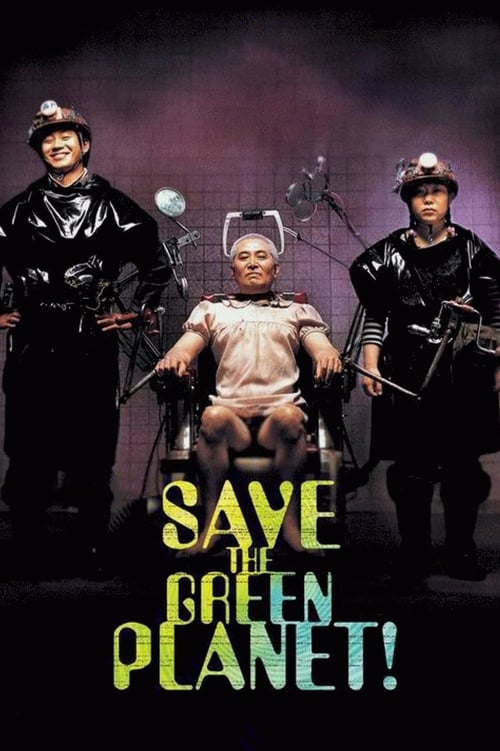
Save the Green Planet!
2003 · Jang Joon-hwan
For when you want something truly unpredictable — a wild, what-did-I-just-watch night where comedy and horror share the same room. Not a comfort watch; it goes to dark places and asks you to keep up.
What it's about
A lonely beekeeper is convinced that a chemical-company executive is secretly a reptilian alien from Andromeda, steering humanity toward ruin. So he kidnaps him, straps him into a chair in a basement rigged with cameras and torture gear, and sets out to extract a confession before the coming lunar eclipse. His devoted girlfriend, a former circus tightrope walker, helps; a washed-up detective starts pulling at the thread of vanished executives.
The experience
It whiplashes between slapstick, cruelty, and heartbreak — you're laughing at something absurd one minute and genuinely disturbed the next, never sure whether the captor is a lunatic or the only sane man alive. The tonal swerves are the point, and they keep you off balance right to the end.
Performances
Shin Ha-kyun makes the kidnapper both ridiculous and wrenching — a paranoid clown you slowly start to ache for — while Baek Yoon-sik, as his captive, keeps you guessing about who really holds the power in that basement.
The craft
Jang Joon-hwan's direction treats genre like a dial he can spin at will: candy-colored production design, kinetic camerawork, and a basement set that's half film studio, half nightmare. The film's structure keeps recontextualizing what you've seen, and the visual invention rewards close attention.
Why it matters
A commercial flop on release that became one of the defining cult films of the Korean New Wave, its reputation grew steadily until it earned a high-profile English-language remake two decades later.
Snapshot
A beekeeper named Lee Byeong-gu (Shin Ha-kyun) abducts Kang Man-shik (Baek Yoon-sik), the chief executive of a chemical company, straps him into a homemade chair in a basement wired for sound and video, shaves his head, smears it with menthol salve to jam his telepathy, and begins torturing him for a confession: that he is an alien from Andromeda, part of a reptilian cadre steering human history, and that a royal prince is due to arrive at the coming lunar eclipse. Byeong-gu's accomplice is Su-ni (Hwang Jeong-min), a former circus tightrope walker who loves him without reservation. Outside, a disgraced veteran detective works the pattern of vanished executives that his careerist colleagues have missed.
For roughly its first hour the film plays as grotesque slapstick — a delusional man and a fat cat, torture staged with kitchen implements and folk remedies. Then it turns. Byeong-gu's paranoia is progressively grounded in a biography of industrial injury: a father lost underground, a mother left comatose, a body broken on a factory floor, a strike put down. The captive, meanwhile, is revealed to be a fully competent predator in his own right. And in the last movement the film honors its own premise with a literalism that almost nothing in its genre attempts: the aliens are real, Byeong-gu is right, and the reward for being right is annihilation. Earth is written off as a failed experiment, and the final image is a small television floating in space, playing home-video footage of a boy and his mother.
Save the Green Planet! is Jang Joon-hwan's debut feature and, for two decades, his best-known film. It failed commercially in Korea in the country's greatest single year of cinema, acquired a durable international cult following, and in 2025 was remade in English by Yorgos Lanthimos as Bugonia.
Industry & production
The film arrives at the crest of the Korean industry's post-Shiri boom. After 1999, domestic production capital, multiplex screens and chaebol-affiliated distribution converged to produce an unusually permissive market for first features with strange shapes. Jang came up through the Korean Academy of Film Arts and was known within the industry chiefly for his 1994 short 2001 Imagine, a much-admired piece about a Korean student, John Lennon and the censorship regime of the dictatorship years — already a film about political violence refracted through pop-cultural fantasy. He wrote Save the Green Planet! himself, sole credit, and it was mounted through Sidus, the production house then run by Tcha Sung-jai (Cha Seung-jae), whose slate that same year included Bong Joon-ho's Memories of Murder. Sidus was the most aggressive backer of auteur debuts in the period; the film's existence is a direct function of that appetite. Precise distribution and below-the-line paperwork is inconsistently recorded in English-language sources, and I won't reconstruct it.
The commercial outcome is the film's second most famous fact after its ending. It opened in early 2003 and failed badly, in a year when Korean audiences were making hits of Silmido, Memories of Murder and Oldboy. The standard account — repeated by Jang himself in later interviews and by Korean trade coverage — is that the marketing sold it as a broad comedy, and audiences arriving for a wacky abduction farce were routed into torture, industrial trauma and cosmic nihilism. Whether that is the whole explanation or a convenient one, the failure was decisive for Jang's career: he did not direct another feature for a decade, returning with Hwayi: A Monster Boy (2013) and then 1987: When the Day Comes (2017). The gap is itself a data point about the Korean industry's tolerance for risk once the balance sheet closes.
Internationally the trajectory inverted. The film traveled the fantastic-film festival circuit, took a Best Director prize at the Moscow International Film Festival in 2003, and reached Anglophone viewers mainly through festival play and the mid-2000s DVD boom in Asian genre labels — the same pipeline that carried Oldboy, Audition and Battle Royale into Western cult consciousness.
Technology
The film is a late analog object made at the moment Korean post-production was digitising. It was shot on 35mm, and its effects economy is overwhelmingly practical: prosthetics, makeup, wire rigs, physical set construction, and a basement built to be lit and shot from every angle. Digital work is reserved for the final movement — the ship, the reveal, the destruction of the planet — and it carries the slightly handmade quality of early-2000s Korean VFX, before the industry's rapid maturation later in the decade. That unevenness is not a defect in effect. The plastic, storybook quality of the cosmic material reads as continuous with Byeong-gu's crayon diagrams and scrapbooks, so the film's most expensive images look like they were dreamed by its protagonist.
More interesting is the film's diegetic media stack. Byeong-gu's basement, as the synopsis says, doubles as a studio: he videotapes the interrogations, plays back tapes, consults his own archive. The film therefore contains video-texture inserts, home-movie footage of childhood, and a mock-documentary montage of alien intervention in human history assembled from archival material and animation. Save the Green Planet! belongs to the conspiracy-media culture of its moment — the post-X-Files, pre-YouTube world of photocopied dossiers, VHS dubs and cork-board string — and it renders that culture materially, as a physical accumulation of paper and tape. The floating television of the last shot is the logical end of this: the final surviving human technology is a playback device.
Technique
Cinematography
Hong Kyung-pyo shot the film, early in a career that would later include Mother, Snowpiercer, The Wailing, Burning and Parasite. Much of what he became known for is already legible here: the willingness to let a single controlled interior carry an entire film, and the capacity to shift a scene's genre by changing its light. The basement is worked exhaustively — high angles that make Byeong-gu look like a child in his own lair, low angles that make him a monster, wide masters that expose the pathetic domesticity of his equipment. The palette runs to sickly greens, jaundiced tungsten and hard practical sources; the honey-and-hive motifs give the film its few warm passages.
Crucially, the camera never adjudicates. It grants Byeong-gu's fantasies the same photographic seriousness it grants the police procedural, which is what allows the ending to land as revelation rather than twist.
Editing
The film's structural signature is register-switching at the cut. A gag lands and the next shot is a wound; a torture scene resolves into melodrama; the procedural strand intrudes to reframe everything just seen. The flashback material is administered in fragments, so the audience's model of Byeong-gu is rebuilt several times across the running time — first as clown, then as psychotic, then as casualty. English-language sources are thin and inconsistent on the editing credit, and I won't guess at it, but the cutting scheme is one of the film's two or three most consequential authorial decisions: the film is about the incompatibility of its tones, and the cut is where that incompatibility is staged.
Mise-en-scène / staging
The basement is a total environment — part torture chamber, part workshop, part shrine, part film set. It is furnished with the debris of a working-class life turned obsessive: agricultural and household tools repurposed as instruments, notebooks, clippings, jars, beekeeping equipment. The staging insists throughout on the domesticity of atrocity; almost nothing in the room was manufactured for cruelty. Against this, Kang Man-shik is introduced through corporate space — clean, cold, expensive — and the film's central visual argument is the collision of those two production designs, one of which quietly produced the other. The alien-history montage and the animated inserts open a third spatial register, the diagrammatic, where Byeong-gu's cosmology gets its own visual grammar.
Sound
Sound design does much of the tonal work the cutting doesn't. The torture sequences are built on close, wet, tactile detail — the film is far more graphic aurally than visually, which is why it is remembered as more violent than it shows. The score alternates between cartoonish scoring for the slapstick, romantic strings for Su-ni, and needle-drop irony; specific composer and cue credits are unevenly documented in English sources, so I'll describe the strategy rather than attribute it. The last movement drops to near-silence and cosmic room tone, an abrupt withdrawal of the film's noisiness that does most of the emotional damage of the ending.
Performance
Shin Ha-kyun's Byeong-gu is one of the great Korean screen performances of the decade, and it works because he refuses to modulate toward sympathy. He plays the character as a total system — twitchy, pedantic, ecstatic, tender toward Su-ni, briskly professional about mutilation — and lets the audience's revision of him happen entirely through information, not through softening. Shin had come off Joint Security Area and Park Chan-wook's Sympathy for Mr. Vengeance, and carries some of that film's affectless-victim charge here.
Baek Yoon-sik, a veteran then entering the career resurgence that would produce The President's Last Bang and Tazza, gives Kang the film's other axis: a man who begins as a bound object of farce and steadily reveals contempt, competence and predatory intelligence, until the question of whether he is an alien becomes almost secondary to the certainty that he is a monster. Hwang Jeong-min's Su-ni supplies the film's only uncomplicated feeling, which is why her fate is unbearable; Lee Jae-yong anchors the police strand as the burnt-out detective whose obsolescence is the only thing that makes him a good reader of obsession.
Narrative & dramatic mode
The film is built as a captivity two-hander with a procedural counterplot, and it uses the oldest engine in that form — will the captor be caught, will the captive escape — as cover for something else: a slow forensic reconstruction of why this man is in this basement. The dramatic mode is deliberately unstable, moving between farce, body horror, melodrama, police thriller and science fiction, and it never signals the transitions.
Its most radical structural choice is the refusal of the unreliable-narrator escape hatch. Nearly every comparable film — the paranoid fantasist whose delusion may be true — resolves toward psychiatric explanation, or leaves the ambiguity intact as a sophisticated shrug. Save the Green Planet! validates the delusion completely and then makes the validation worthless. Byeong-gu is right about the conspiracy and still dies; being right does not save him, his mother, Su-ni, or the planet. The result is a film whose comic structure and tragic structure are the same structure, run twice.
Genre & cycle
It sits inside the early-2000s Korean genre-hybrid cycle, whose premise was that tonal purity is a foreign convention rather than a law. Memories of Murder (2003) runs comedy into national trauma; The Host (2006) runs creature feature into family melodrama and pollution politics; Park Chan-wook's vengeance films run moral fable into farce. Jang's film is the most extreme instance of the tendency and the one that paid the highest commercial price for it.
Within genre history it belongs to several lineages at once: the single-location captivity thriller descended from Misery; the conspiracy film of the X-Files era; the mad-scientist basement film descended from Frankenstein; and the ecological-catastrophe science fiction whose reflex is a warning and whose subject here is an execution. Its retrospective placement in the "Asia Extreme" marketing category is a distortion — the film is far more interested in class injury than in transgression — but that category is how most Western viewers found it.
Authorship & method
Jang Joon-hwan wrote and directed, and the film is unusually complete as a statement of authorship for a debut: the interest in political violence entering ordinary bodies, the fluency with pop-culture citation, the refusal to let genre pleasure discharge the underlying anger. Those concerns recur across his later work — Hwayi as a violence-inheritance thriller, 1987 as a direct dramatization of the democratisation movement. His short 2001 Imagine had already set the template of authoritarian history refracted through fandom.
The decisive collaborator is Hong Kyung-pyo, whose contribution is the film's photographic seriousness — the reason a basement of homemade torture devices reads as a real place with real weather rather than a gag set. Among the cast, Shin Ha-kyun and Baek Yoon-sik function as co-authors of the tonal scheme; the film's whiplash only works because both performances are internally consistent under every register change. On music and editing, English-language documentation is genuinely thin and inconsistent, and I've described function rather than assign credit.
Movement / national cinema
Save the Green Planet! is a product of the Korean New Wave's second phase — the commercial-auteur period following the 1997 financial crisis and the industry restructuring around it. Its politics are specifically post-IMF: a protagonist destroyed by industrial labor, an antagonist who is a chemical-company executive, a mother poisoned by the developmental miracle, a strike broken by hired violence. The alien conspiracy is not an allegory pasted onto this material; it is what the material looks like from below, where the decisions that ruin you are made by people whose motives are literally unimaginable.
The film also participates in Korean cinema's long habit of encoding recent political history — colonial occupation, dictatorship, massacre, censorship — inside genre. The mock-history of alien manipulation is a joke about conspiracy culture and, simultaneously, a straight-faced proposition that the twentieth century behaved as though it were run by something inhuman.
Era / period
2003 is the pivot year: Memories of Murder, Oldboy, A Tale of Two Sisters, Untold Scandal, Silmido. Korean cinema was consolidating both domestic market share and international prestige, and the year's canon has been rewritten several times since. Save the Green Planet! is the great re-evaluated title of that cohort — a film that lost in the market it was made for and won the long argument, now routinely placed in critics' and filmmakers' lists of the era's best Korean films.
Culturally it is also of its moment in a narrower sense: it belongs to the last years before broadband and video platforms industrialized conspiracy belief. Byeong-gu is an analog conspiracist, alone with his paper, and the film's portrait of him — pitiable, dangerous, correct — has aged into something considerably less comic than it was in 2003.
Themes
The organizing theme is that paranoia is a reasonable epistemology for the structurally powerless. Byeong-gu's cosmology is wrong in every particular except its conclusion: that there exists a class of people whose decisions destroy him, who are not answerable, and who are, functionally, another species. The film's cruelty is that it grants him the literal truth and shows it purchasing nothing.
Around this sit several linked concerns. Industrial modernity and its bodies: mines, chemicals, coma, pesticide, the hive. Bees run through the film as its central figure — collective labor, an organism that produces sweetness and dies defending it, and a species whose collapse is the standard modern index of ecological failure. (Lanthimos's remake takes its title, Bugonia, from the ancient belief that bees generate spontaneously from a rotting carcass — an apt reading of this film's logic, in which something is born out of a body destroyed.) Then: victim and perpetrator as a single position, since Byeong-gu's torture chamber is a reproduction of what was done to him. Then: love as the only unironised value in the film, located entirely in Su-ni, and duly destroyed. And finally the title itself, an ecological slogan spoken by a man committing atrocities in its name — the film's compact statement about how righteousness metabolizes into violence.
Reception, canon & influence
Domestically, the film's reception was a split verdict: strong critical support, awards recognition for its new director, and an audience that did not come. Internationally it drew immediate enthusiasm at fantastic-film festivals, took the Moscow Best Director prize, and built its reputation over the following decade through DVD, repertory programming and word of mouth among filmmakers. It is now a fixture of Korean-cinema retrospectives and of the informal canon of great debut features.
Backward. The film wears its sources openly. Kubrick's A Clockwork Orange is present in the restraint apparatus and in the moral inversion of the tormentor; Misery supplies the captivity architecture; Gilliam's Brazil and 12 Monkeys supply the fantasist whose delusion has bureaucratic teeth; the Universal and Hammer mad-science traditions supply the basement; the tonal violence of Raimi and of Miike's Audition supplies the permission to break a comedy in half. Korean domestic melodrama supplies the mother, the coma and the home movies — the film's least ironic and most conventional register, deployed as a weapon. Behind all of it is 1990s conspiracy-media culture and the specific Korean historical experience of being governed by forces that did in fact operate covertly and lethally.
Forward. Its clearest legacy is normative rather than stylistic: it is one of the films most often cited when Korean cinema's genre-mixing license is described, and its rehabilitation became a case study in how a domestic flop can be canonized abroad and then re-imported. Its thematic template — ecological and industrial harm rendered as genre spectacle with a working-class casualty at the center — recurs across later Korean cinema, most visibly in The Host, though sibling influence and shared context are hard to separate here; Jang, Bong and Park were contemporaries drawing on the same conditions rather than a teacher and pupils.
The concrete forward line is Bugonia (2025), Yorgos Lanthimos's English-language remake, written by Will Tracy and starring Emma Stone and Jesse Plemons, which transposes the premise to an American corporate setting. That a film that failed in its home market in 2003 should be reworked twenty-two years later by one of the most prominent art-cinema directors working, for a major studio release, is the most economical possible summary of its afterlife — and a reminder that the film's central proposition, that the people making the decisions might not be people, has become steadily less allegorical since it was made.
A Deleuzian reading
A man shaves a captive's head and works menthol salve into the scalp.
The full Deleuzian reading of Save the Green Planet! →
Reception
One of Korean cinema's most famous flops-turned-classics: it tanked at the 2003 Korean box office — a failure widely blamed on marketing that sold it as a wacky comedy — even as critics raved and it picked up festival prizes abroad. Two decades on it's canonized as one of the boldest debuts of the Korean New Wave, a rise capped by Yorgos Lanthimos remaking it in Hollywood.
How Save the Green Planet! was received, from release to now →
How to watch Save the Green Planet!: what to notice on a first viewing
- Watch how many purposes the basement serves at once. It reads as workshop, shrine, torture chamber, and film set all together, furnished with ordinary household and farm tools repurposed as instruments. Almost nothing in the room was built for cruelty, which makes the space feel more disturbing, not less.
- Watch how seriously the camera lights the basement, like a real place. Hong Kyung-pyo shoots the lair with the same photographic weight he gives the police procedural outside it, never winking at its absurdity. The camera refuses to tell you whether to believe Byeong-gu, so you're left weighing it yourself.
- Notice how abruptly a joke turns into something painful. The film cuts from slapstick to injury and back without warning or a transition to soften the change. The whiplash is the point. The film wants you unsure which feeling is the right one.
- Watch the flashbacks arrive in pieces, not as one clean story. Each fragment revises what you think you know about Byeong-gu, so your read on him keeps changing across the film. You end up holding several versions of the same man at once instead of settling on one.
- Watch Byeong-gu shift from tender to clinical within the same scene. Shin plays him as twitchy, pedantic, and affectionate toward Su-ni, then briskly professional about mutilation, with no signal telling you which one is real. He never asks for your sympathy, so any sympathy you feel is entirely something you built yourself.
The whole guide to watching Save the Green Planet!, with the keys for a rewatch →
Influences: the films it descends from and the films it influenced
- Bride of Frankenstein (1935) — Supplies the basement-laboratory grammar Jang inverts — the hand-built apparatus photographed as functional machinery rather than decor, and the creator whose tenderness toward his subject is filmed in the same close-up register as his cruelty.
- A Clockwork Orange (1971) — The restraint rig is a direct citation — subject fixed facing the operator, head and eyes immobilised, torment staged as clinical procedure with a bright pop soundtrack — and Kubrick's mid-film transfer of victimhood from the tormentor's target to the tormentor is the moral pivot Jang runs on Byeong-gu.
- Brazil (1985) — Establishes the fantasist whose private cosmology is indistinguishable from real bureaucratic violence, and the analogue-clutter production design — ducts, hand-wired consoles, junk-shop futurism — that lets a delusion look load-bearing on screen.
- Evil Dead II (1987) — The register-switching cut itself: a single confined interior where a shot of genuine bodily damage is followed immediately by one timed as slapstick, teaching that gore and comic beat can share the same edit point without either canceling out.
- Misery (1990) — The captivity two-hander architecture — one immobilised professional, one devoted amateur, one house — where the dramatic engine is the captor's need to be believed rather than to inflict, and each escape attempt resets the room's geography.
- 12 Monkeys (1995) — The validated-delusion structure plus its editing method: fragmented, repeated flashback shards that the audience initially reads as psychosis and only retroactively accepts as evidence, with the confirmation withheld to the final beat.
- Peppermint Candy (1999) — Models the fragmented, chronology-breaking flashback as a forensic device for showing state and industrial violence lodging in one unremarkable working-class body — the structural precedent for Byeong-gu's factory, protest and hospital shards.
- Audition (1999) — The permission slip for breaking a film in half: an hour of gentle domestic comedy in ordinary rooms, then torture staged with the same unhurried framing and household props, atrocity kept at kitchen scale rather than gothic scale.
- Joint Security Area (2000) — The source of Shin Ha-kyun's tonal-whiplash technique — a performance that plays comedy and catastrophe with identical internal logic, so the register change comes from the film around him rather than from any visible gear-shift in the acting.
- The Host (2006) — Extends the template of industrial-chemical harm rendered as genre spectacle with a working-class family as the casualty — the monster as literal by-product of a documented pollution incident, exactly Jang's move of making ecological guilt a physical antagonist.
- Mother (2009) — Hong Kyung-pyo photographs another maternal-melodrama register deployed as a weapon — the sincere, unironic mother-and-damaged-son material shot with full melodramatic warmth so that its later collapse into complicity lands as betrayal rather than irony.
- 1987: When the Day Comes (2017) — Jang re-stages his own basement literally: the interrogation-room apparatus that was homemade parody in 2003 is rebuilt as documented state equipment, the fictional torture geography converted into procedural historical reconstruction.
- Burning (2018) — Hong Kyung-pyo's sickly, under-lit naturalism serving a validated-delusion structure held permanently unresolved — a class-injured young man's conspiracy about a wealthy man is neither confirmed nor refuted, the ambiguity Jang chose instead to detonate.
- Parasite (2019) — Hong Kyung-pyo's basement-as-total-environment — a concealed sub-level lit and mapped as a fully coherent dwelling with its own weather and acoustics — plus the mid-film tonal hinge from farce to atrocity executed on a single cut.
- Bugonia (2025) — Explicit remake: retains the abduction-and-shaving of a corporate executive by a conspiracy-literate worker in a rural basement, transposing the captivity two-hander and its alien-verification premise into American pharma-capital terms.
- Sympathy for Mr. Vengeance (2002) — Shin Ha-kyun again as a deaf, near-silent working-class casualty; shares the post-IMF craft problem of staging homemade retribution in unglamorous industrial and domestic interiors with long-lens stillness and near-absent score.
- Memories of Murder (2003) — Same-year twin in method: interrogation-basement brutality played for laughs one shot and horror the next, and an ending that withholds resolution and drops to silence rather than releasing the audience with a reveal.
- Sorry to Bother You (2018) — Independently arrives at the same detonation: a workplace comedy that swerves into practical-effects body horror on the revelation that the owning class is not biologically human, with the reveal staged in a private basement-tier space of the employer's house.
- Survive Style 5+ (2004) — Korean tonal-whiplash black comedy that swings from slapstick to horror to pathos with the same over-art-directed frames and destabilizing genre collisions.
- Castaway on the Moon (2009) — Shares the Korean high-concept-with-heart mode of tonal-whiplash absurdism grounded in real pathos, an absurd premise played for genuine emotion rather than quirk.
Similar films
- Bugonia (2025) — influence & lineage · often watched together
- The Host (2006) — influence & lineage
- Parasite (2019) — influence & lineage
- Burning (2018) — influence & lineage
- Sympathy for Mr. Vengeance (2002) — influence & lineage
- Memories of Murder (2003) — influence & lineage · often watched together
- Mickey 17 (2025) — often watched together
- A Bittersweet Life (2005) — often watched together
All the films related to Save the Green Planet! →
Watch it with: curated runs of related films
- When Everyone Finally Snaps — A run of films where an ordinary scene — a birthday dinner, a small town, a quiet house, a man at the end of his patience — gets pushed past its breaking point until the whole social order detonates.