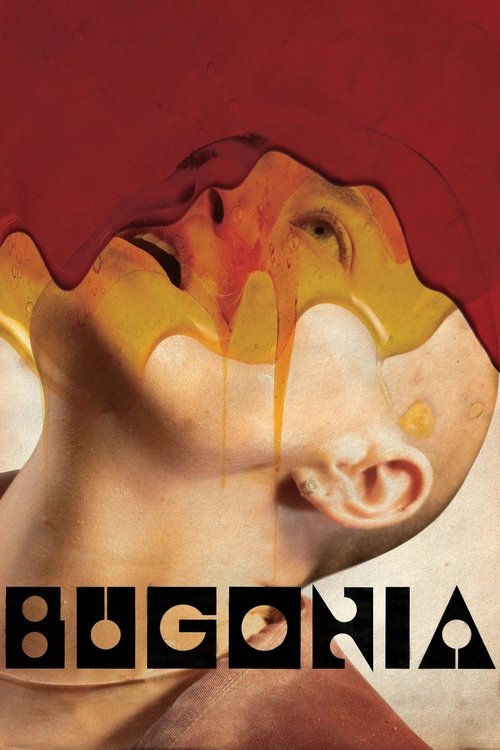
Bugonia
2025 · Yorgos Lanthimos
The Greek Weird Wave export who became an awards-season fixture; Poor Things ignited a genuine culture-war argument about whether its sex-positive fable was feminist or a male fantasy. His Emma Stone partnership is treated as the defining actor-director pairing of the decade.
For when you want something sharp and strange that starts arguments afterward — a film to dissect over drinks, not a switch-your-brain-off watch. Definitely challenge over comfort.
What it's about
Two conspiracy-obsessed young men kidnap the CEO of a powerful corporation, convinced she's an alien sent to engineer Earth's destruction — and now they just have to get her to admit it. What follows is a locked-room standoff between corporate polish and basement-forum certainty, where you're never quite sure who's playing whom.
The experience
Deadpan, squirmy, and blackly funny — the comedy and the dread arrive in the same breath. It keeps flipping your sympathies and your certainty, so you spend the runtime leaning forward, half laughing and half bracing.
Performances
Emma Stone and Jesse Plemons go at each other like duelists — she's all controlled, corporate composure under duress; he's terrifyingly sincere, a true believer you can't fully dismiss or fully trust.
The craft
Lanthimos stages most of it as a pressure-cooker chamber piece, wringing tension from framing, silence, and abrupt tonal swerves rather than action. The precision of the compositions and the needling score do a lot of the unsettling; it rewards close attention and good speakers more than a huge screen.
Why it matters
It caught the cultural moment of conspiracy thinking and anti-billionaire rage head-on, and confirmed Lanthimos as the rare director who can smuggle genuinely uncomfortable ideas into a starry mainstream release.
Snapshot
Yorgos Lanthimos's Bugonia is a dark science-fiction comedy in which two conspiracy-addled young men abduct the CEO of a powerful corporation, certain she is an extraterrestrial agent programming Earth's destruction. The film arrives as Lanthimos's most explicitly genre-coded work since The Killing of a Sacred Deer (2017), pressing his signature deadpan absurdism into the mode of paranoid thriller — a register with its own long Hollywood genealogy. Where Poor Things (2023) wore its surrealism as period costume, Bugonia locates its estrangement in a recognizably contemporary landscape of screen-mediated suspicion, online rabbit holes, and the manic confidence of the self-appointed truth-teller. The title is drawn from the ancient agricultural myth recorded most durably in the fourth book of Virgil's Georgics: bugonia (from Greek bous, ox, and gonos, offspring) denotes the belief that a colony of bees could spontaneously generate from the putrefying carcass of an ox. The metaphor is layered — corporate hive-mind, social paranoia breeding from institutional rot, the fatal confusion of death with origin.
Industry & production
Bugonia arrives immediately in the wake of Lanthimos's most commercially and critically successful period. Poor Things (2023) won the Golden Lion at Venice and four Academy Awards, including Best Actress for Emma Stone, transforming Lanthimos from a celebrated festival auteur into a genuine industry force. That elevation gave him unusual leverage for a project as tonally odd as Bugonia — a film whose premise sits at the intersection of the UFO-conspiracy subgenre and the social-satire mode Lanthimos has cultivated across his career.
Reports in trade coverage place the production through Film4 and other European co-production partners, consistent with Lanthimos's long-standing relationship with UK and European financing structures that have supported his English-language work since The Lobster (2015). The specific breakdown of production entities and budgetary figures had not been officially confirmed in detail at the time of this writing, and readers should consult updated industry sources for precise attribution. What is clear from the film's casting and scope is that Lanthimos commanded a studio-level production while retaining the creative control more typical of his earlier, leaner films.
The premise appears to draw significant inspiration from Jang Jun-hwan's 2003 South Korean dark comedy Save the Green Planet!, in which a similarly paranoid protagonist kidnaps a corporate executive he believes to be an alien vanguard. Jang's film was a cult object in South Korean cinema, admired for its genre hybridity — mixing horror, farce, and genuine pathos in ways that anticipated the international appetite for Korean genre filmmaking that would peak with Bong Joon-ho's Parasite (2019). Lanthimos's transposition of that premise into an English-language context and his own aesthetic idiom follows the logic of a filmmaker drawn repeatedly to pre-existing formal frameworks — the fairy-tale, the period drama, the Greek tragedy — which he then distorts from within.
Technology
Available production information suggests Bugonia was shot on digital, consistent with the workflows of Lanthimos's recent collaborators, though specific camera and lens package details were not confirmed in the publicly available record at the time of writing. His films since The Favourite (2018) have embraced wide-angle optics — including the use of ultra-wide and occasionally near-fisheye lenses — to produce the spatial distortion and geometric discomfort that have become hallmarks of his visual language. Whether Bugonia extended or modified that toolkit is a matter for frame-level analysis rather than press kit confirmation.
Post-production sound, visual effects work for any alien or supernatural elements, and the degree of in-camera versus digital composition were similarly unconfirmed in full at the time of writing. Given the film's science-fiction register, some degree of VFX work is presumed, though Lanthimos has historically preferred a grounded, tactile visual surface even in his most overtly fantastical films.
Technique
Cinematography
Lanthimos's working cinematographic methods — refined across his collaboration with Robbie Ryan (The Favourite, Poor Things) and earlier with Thimios Bakatakis (Dogtooth, Alps, The Killing of a Sacred Deer) — center on optical distortion as an epistemological statement. The wide-angle lens does not merely aestheticize the image; it warps space in a way that encodes the unreliability of the character's (and viewer's) perception. For a film about two men whose capacity to read the world correctly is radically in question, this visual grammar carries precise thematic weight. Objects at the edges of frame billow outward; bodies occupy a space that seems to resist them; authority figures loom with preternatural scale.
The cinematographic record for Bugonia specifically — including the identity of the director of photography and their particular approach to this film — should be verified against production credits, as full details were not confirmed in the accessible public record at the time of writing.
Editing
Lanthimos has worked across his English-language career with editor Yorgos Mavropsaridis, a collaboration that has produced one of the more distinctive rhythmic sensibilities in contemporary art cinema. Mavropsaridis's cuts tend to land with an unusual flatness — neither the propulsive energy of action editing nor the contemplative duration of slow cinema, but something more clinical, allowing scenes to overstay their comic welcome just long enough to tip absurdism into unease. In the conspiracy-thriller mode of Bugonia, this refusal of genre-normative rhythm would function as a continuous low-grade alienation effect, keeping the audience from settling into the comfortable dispositions the genre usually offers.
Mise-en-scène / staging
Lanthimos stages with an anthropologist's detachment. His characters inhabit spaces — institutions, houses, vehicles — that are visually coherent but behaviorally alien; they perform rituals whose logic is internally consistent but whose premise is wrong or withheld. The kidnapping scenario in Bugonia extends this principle into genre territory: the basement or interrogation room, a staple of thriller staging, becomes in Lanthimos's hands a space of genuinely uncertain power, where the captors' certainty does not translate into control and the captive's composure suggests resources neither the characters nor the viewer can fully account for.
Sound
Lanthimos's sound design has consistently worked against the comfort of genre scoring. His films tend toward diegetic silence punctuated by incidental sound — the physical world rendered in heightened, sometimes oppressive detail — and his musical choices have ranged from anachronistic classical selections (The Lobster) to the original score Jerskin Fendrix provided for Poor Things, which deployed orchestral dissonance as a kind of emotional weather system. For Bugonia, operating in a register closer to contemporary thriller-comedy, the sound palette likely negotiates between genre convention and the deliberate wrongness that Lanthimos's films cultivate. Specific sound design and score credits and their particular deployment in Bugonia should be confirmed against released production information.
Performance
Lanthimos is among the most demanding and particular directors working with actors today. His method — developed from the anti-naturalistic exercises of the Greek Weird Wave — requires performers to deliver text with a suppressed affect that reads as simultaneously robotic and volatile. The deadpan is not emotional blankness; it is a performance of the absence of the normal social lubricants of speech, and it places enormous pressure on micro-gesture, posture, and the timing of the beat. Actors who have worked with him describe intensive rehearsal processes in which the removal of conventional intonation is itself the work.
Bugonia features Jesse Eisenberg and Alden Ehrenreich as the two conspiracists, with Nicole Kidman as the kidnapped CEO. Eisenberg, whose screen persona has long trafficked in a particular strain of manic intellectual anxiety (The Social Network, 2010), represents an interesting match for Lanthimos's mode: the actor's tendency toward rapid, over-articulate speech and visible cognitive busyness must here be flattened and reconfigured rather than amplified. Ehrenreich brings a different register — looser, more physical — and the interplay between their styles within Lanthimos's affectless frame is one of the film's primary dramatic tensions. Kidman, who has demonstrated across her career a willingness to submit to directors' radical reimaginings of the star persona, is positioned as a figure whose composure may itself be the alien element — whether literally or metaphorically is a question the film presumably keeps productively open.
Narrative & dramatic mode
The film's narrative engine is a classic dramatic irony structure: the audience is placed in a position of uncertainty about whether the conspiracists are correct, which transforms a simple mockery of paranoia into something more unstable. Lanthimos has consistently favoured this kind of suspended judgment — The Killing of a Sacred Deer never definitively naturalizes or supernaturalises its central curse; The Lobster posits its absurd social law with a total deadpan that forbids ironic distance. In Bugonia, if the CEO is merely a CEO, the film is a satire of conspiratorial misogyny and class resentment. If she is something else, it becomes a different kind of film entirely. The productive refusal to resolve this question is where Lanthimos's dramatic method and the paranoid-thriller genre most fruitfully collide.
The comedy, as in all of Lanthimos's work, is not relief but pressure — laughter that catches in the throat because its premise is not comforting. The two men's certainty is both ridiculous and recognizable, and their relationship to each other — the mutual reinforcement of a shared delusion, the affective bond that belief in the same impossible thing creates — is treated with the same formal neutrality as everything else, which is to say: without condescension, and without comfort.
Genre & cycle
Bugonia enters a historically rich conversation. The paranoid conspiracy thriller has its classic American form in the post-Watergate cycle of the 1970s — Alan J. Pakula's Klute (1971), The Parallax View (1974), and All the President's Men (1976); Sydney Pollack's Three Days of the Condor (1975) — in which institutional power is figured as a malevolent, invisible system that individuals can glimpse but not survive confronting. The science-fiction inflection of corporate power as literal alien is most durably expressed in John Carpenter's They Live (1988), where the conspiracy is true and the monsters are already in the boardrooms. Bugonia operates somewhere between these poles, inheriting both the satiric potential of They Live and the epistemological anxiety of the Pakula films.
The specific comic mode of the obsessive amateur investigator who is both ridiculous and not entirely wrong has contemporary resonances in post-QAnon culture that Lanthimos, as a non-American filmmaker trained in theatrical abstraction, is perhaps better positioned than most to render without polemical heaviness. The cycle of films and television responding to conspiratorial culture in the 2020s gives Bugonia a clear industrial and cultural context without exhausting its formal interest.
Authorship & method
Yorgos Lanthimos (b. 1973, Athens) emerged from the Greek experimental theater scene before making his feature debut with Kinetta (2005) and achieving international attention with Dogtooth (Kynodontas, 2009), which won the Prix Un Certain Regard at Cannes and an Academy Award nomination for Best Foreign Language Film. The Greek Weird Wave — a loose grouping of Greek filmmakers including Athina Rachel Tsangari and Babis Makridis whose work emerged in the context of the Greek financial crisis — shares with Lanthimos a tendency toward clinical defamiliarisation of domestic and social ritual, though Lanthimos has consistently resisted sociological reduction of his work.
His English-language career, beginning with The Lobster (co-written with his long-time collaborator Efthymis Filippou) has maintained the formal principles of his Greek work while expanding the production scale and cast profiles. The script for Bugonia was written by Will Tracy, a writer whose previous work includes The Menu (2022), a film that shares with Lanthimos's output a interest in class, performance, and the horror latent in service-industry relations. This represents a departure from Lanthimos's previous practice of either writing alone, with Filippou, or (in the case of The Favourite and Poor Things) adapting existing scripts by Deborah Davis/Tony McNamara and Tony McNamara respectively. The use of a North American writer with experience in satirical dark comedy suggests a deliberate modulation toward the contemporary American cultural landscape the film's premise inhabits.
Movement / national cinema
Bugonia belongs to what might be called Lanthimos's post-national phase — a body of work that is Greek in sensibility and training but English-language, transatlantically financed, and deliberately unmoored from any single national cinema. The Greek Weird Wave from which he emerged was itself an internationally legible movement rather than a narrowly national one; its filmmakers were trained on European art cinema as much as on any Greek tradition, and their formal strategies were informed by Haneke, Bresson, and Buñuel as much as by anything specific to Greek film history.
Lanthimos's increasing integration into the English-language prestige film economy — with its studio partnerships, Oscar campaigns, and star-driven packages — raises genuine questions about the relationship between the radical formal strategies of his early work and the institutional frameworks that now support it. Bugonia is not obviously a compromise, but it is a film made from inside an industry that the films of the Weird Wave were in many ways critiquing from outside.
Era / period
Bugonia is a film of the mid-2020s in ways that the period settings of The Favourite and Poor Things were not. The conspiracy-theory landscape it inhabits — algorithmically amplified, community-structured, productive of genuine political consequence — is a post-2016, post-COVID phenomenon whose cultural weight is specific to this historical moment. The corporate CEO as a figure of alien, incomprehensible power is a recognizably contemporary anxiety: the gap between ordinary experience and the scale of institutional decision-making has rarely felt wider, and the conspiratorial imagination fills that gap with narrative.
At the same time, the film participates in the broader early-2020s phenomenon of prestige cinema's renewed engagement with genre — the art-horror, the elevated thriller, the literary science-fiction film — in which filmmakers trained in the festival circuit have found in genre mechanics a set of structures that can carry thematic and formal ambition without losing audience contact.
Themes
The title's classical reference — bugonia, the mythological generation of bees from a dead ox — opens onto several of the film's thematic preoccupations. The most direct concerns origin and misrecognition: the conspiracists have identified a source, a cause, a generating force for the destruction they perceive around them, and they are likely wrong about what that source is, even if the sense of damage that drives them is real. The ancient practice of bugonia was itself a misreading of process — bees were not generated by the carcass but drawn to it — and Lanthimos's use of the term suggests a film interested in the epistemology of conspiracy: how certainty is confected, how evidence is misread, how the desire for legibility produces the most baroque illegibilities.
Corporate power and its gendering is another central preoccupation. The CEO as target — specifically a female CEO, whose authority is apparently experienced by the conspiracists as unnatural, alien — connects Bugonia to a long tradition of misogynist conspiracy thinking in which female power is coded as Other, as not-quite-human, as requiring extraordinary explanation. Whether the film endorses, interrogates, or ironises this dynamic is a question whose answer depends on execution, but the structure of the premise makes the interrogation available.
Lanthimos's recurring interest in the social contract — the arbitrary rules that bind communities, the violence that enforces compliance, the strange grief of those who cannot or will not inhabit the prescribed forms — finds here a specifically American-inflected form. The two men are bound by shared belief rather than shared institution, and their bond is precisely as conditional, as potentially lethal, as any of the community formations in his earlier work.
Reception, canon & influence
Bugonia arrives after a period of sustained critical elevation for Lanthimos, and critical reception will inevitably be calibrated against the high watermark of Poor Things. The question critics will likely pursue is whether the explicitly genre-coded premise of Bugonia represents a productive expansion of his vocabulary or a concession to commercial legibility. His previous genre engagements — The Killing of a Sacred Deer's horror mode, The Lobster's dystopian science fiction — maintained formal intransigence under genre clothing; the comedy register of Bugonia may invite more debate about tonal control.
Specific critical reception figures, review aggregates, and box-office data were not available for incorporation into this account and should be sourced from current critical databases.
Looking backward, the film draws on: the Greek Weird Wave's defamiliarising social satire; the 1970s paranoid American thriller; Carpenter's They Live and its tradition of satirical science fiction as class commentary; Jang Jun-hwan's Save the Green Planet! as probable source material; the post-Altmanesque tradition of the ensemble dark comedy; and Buñuel's long shadow over any art cinema that locates the absurd within the quotidian.
Looking forward, Lanthimos's influence on a younger generation of filmmakers working in what has been called elevated genre or art horror — Ari Aster, Robert Eggers, and their peers — is already well-documented. Bugonia's engagement with conspiracy culture specifically may prove prescient or timely depending on how that cultural formation evolves through the latter half of the decade. The more durable legacy is likely formal: Lanthimos has demonstrated, across now a substantial body of English-language work, that the systematic suppression of naturalistic affect in performance and visual style can generate states of viewer unease that conventional genre mechanics cannot, and that the audience for such states is larger than the art-cinema establishment once assumed.
A Deleuzian reading
Start in the basement.
The full Deleuzian reading of Bugonia →
Reception
Premiered at Venice 2025 to some of the strongest reviews of Lanthimos's career, then hit wide release and promptly split general audiences — within months it was the 'you either rode with the ending or you didn't' movie of its year.
How Bugonia was received, from release to now →
Influences: the films it descends from and the films it influenced
- They Live (1988) — Establishes the genre template Bugonia inherits: a device-mediated conspiracy reveal (sunglasses expose alien ideology) that makes class critique legible through genre mechanics, encoding Marxist ideology-critique as literal science-fiction paranoia.
- Save the Green Planet! (2003) — Likely source material; introduces the sincere-paranoid-protagonist structure where a lower-class conspiracist's delusion and an actual corporate-alien threat are held in tonal suspension through genre-blending dark comedy — the precise narrative ambiguity Bugonia adopts.
- The Parallax View (1974) — Establishes the 1970s paranoid-thriller visual grammar — wide-angle surveillance framing, institutional conspiracy architecture — and the formal device of withholding epistemological certainty from protagonist and viewer simultaneously.
- The Discreet Charm of the Bourgeoisie (1972) — Anthropological staging that observes bourgeois social ritual from clinical remove, refusing to anchor audience sympathy or moral resolution — establishing the deadpan-absurdist mode Lanthimos channels for class observation.
- Network (1976) — Corporate media apparatus rendered as paranoid conspiracy through satirical dark comedy; uses genre hybridization and anti-naturalistic performance (Dunaway's cold executive register) to encode class resentment, anticipating Bugonia's corporate-paranoia register.
- Funny Games (1997) — Systematic suppression of genre catharsis through clinical staging; deadpan performance that weaponizes viewer genre-expectation against emotional release — the formal strategy Lanthimos inherits for deploying genre mechanics without genre payoff.
- Dogtooth (2009) — Origin document of Lanthimos's formal system: wide-angle clinical staging by Thimios Bakatakis, deadpan anti-naturalistic ensemble performance, anthropological camera detachment from domestic ritual — the complete vocabulary Bugonia deploys at genre scale.
- The Lobster (2015) — Thimios Bakatakis's wide-angle distortion cinematography and anti-naturalistic ensemble performance deployed within a dystopian science-fiction frame; establishes the English-language formal vocabulary and proves audience viability for suppressed-affect performance inside genre.
- The Killing of a Sacred Deer (2017) — First prominent Yorgos Mavropsaridis editing collaboration, establishing the clinical temporal rhythm — extended pauses, withheld cuts — that inflects Bugonia; Bakatakis wide-angle distortion pushed into horror register with systematically suppressed emotional affect.
- The Favourite (2018) — Consolidates the Mavropsaridis editing collaboration and Robbie Ryan's fisheye/wide-angle distortion cinematography as Lanthimos's sustained visual signature; anti-naturalistic ensemble performance within period genre context directly anticipating Bugonia's genre modulation.
- Poor Things (2023) — Mavropsaridis editing and Robbie Ryan cinematography at maximum production scale; demonstrates that the anti-naturalistic performance system achieves mainstream traction — the platform from which Bugonia's more commercially legible genre-coded premise operates.
- Force Majeure (2014) — Clinical wide-angle staging of bourgeois crisis with deadpan performances that withhold emotional resolution; the camera-as-ethnographer methodology that treats class behavior as specimen rather than subject, parallel to Lanthimos's anthropological staging.
- The Menu (2022) — Written by Will Tracy — Bugonia's screenwriter — deploying class-resentment horror-comedy through service-industry ritual as satirical frame for corporate critique; the deadpan performance register and satirical architecture Tracy brings directly into the Lanthimos collaboration.
- Triangle of Sadness (2022) — Anthropological wide framing and deadpan ensemble performance sustaining satirical class observation without moral closure; genre hybridization for corporate critique in the same contemporaneous register as Bugonia, sharing Östlund's ethnographic staging methodology.
- The Substance (2024) — Body-horror genre deployed as vehicle for corporate and class satire through clinical staging and anti-naturalistic performance escalation that refuses emotional naturalism — a parallel art-genre hybrid exploiting the same contemporary appetite for elevated genre that Bugonia addresses.
Similar films
- The Killing of a Sacred Deer (2017) — influence & lineage · same viewing thread
- Save the Green Planet! (2003) — influence & lineage · often watched together
- Poor Things (2023) — influence & lineage
- The Lobster (2015) — influence & lineage
- Dogtooth (2009) — influence & lineage
- The Substance (2024) — influence & lineage
- The Favourite (2018) — influence & lineage
- Parasite (2019) — often watched together
All the films related to Bugonia →
Watch it with: curated runs of related films
- Whatever's Wearing That Face — A run of horror-thrillers where the real terror is that you can't trust what a person appears to be — a double, a shapeshifter, a smiling stranger, the one you desire.