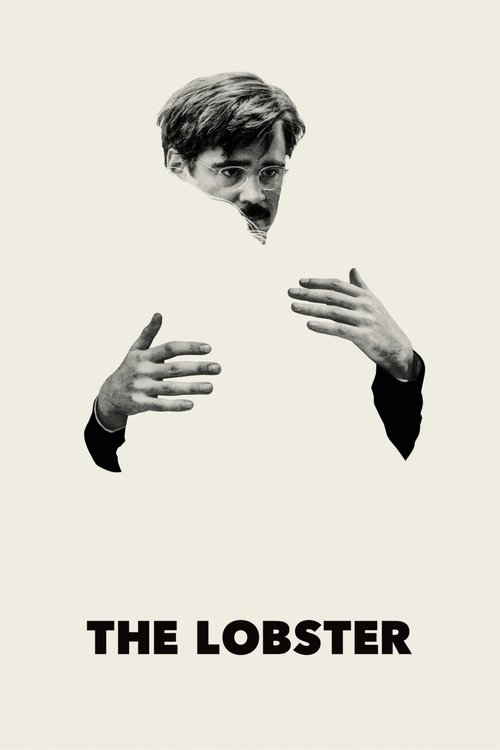
The Lobster
2015 · Yorgos Lanthimos
The Greek Weird Wave export who became an awards-season fixture; Poor Things ignited a genuine culture-war argument about whether its sex-positive fable was feminist or a male fantasy. His Emma Stone partnership is treated as the defining actor-director pairing of the decade.
For when you want something strange — a film to laugh at nervously with a friend and then argue about over drinks. Absolutely not a comfort watch; it's for nights when you're up for having your ideas about love poked with a stick.
What it's about
In a near-future society where being single is against the law, the newly abandoned David checks into a seaside hotel where guests have forty-five days to find a romantic partner — or be surgically transformed into an animal of their choosing. David picks a lobster. Between the hotel's regimented courtship rituals and a band of militant loners hiding in the woods who have outlawed romance entirely, he searches for a place where love might actually be allowed to happen.
The experience
Deadpan to the point of vertigo — everyone speaks in flat, polite sentences while the world does monstrous things, and you find yourself laughing at moments that also make you wince. It's very funny, genuinely unsettling, and quietly sad, often in the same scene.
Performances
Colin Farrell, paunchy and mustached into total anonymity, gives a career-redefining performance of sad-sack sincerity — his flat delivery is the film's comic engine and its broken heart.
The craft
Yorgos Lanthimos builds his dystopia through tone rather than effects: symmetrical compositions, sudden slow motion, screeching strings, and dialogue delivered like instructions from a manual. The world-building is done entirely with a straight face — no exposition dumps, just rules everyone obeys — which makes the absurdity land harder. The Irish coastal locations give it a damp, gray beauty.
Why it matters
The film that brought Lanthimos and his signature deadpan style to English-language audiences, earning an Oscar nomination for its screenplay and opening the path to his later awards-circuit triumphs; it became the modern reference point for absurdist dystopian satire.
Snapshot
The Lobster is the first English-language feature by Greek director Yorgos Lanthimos, a deadpan dystopian satire in which adult singlehood is criminalized. In an unnamed society, unattached people are checked into a coastal hotel and given forty-five days to pair off with a compatible mate; those who fail are surgically transformed into an animal of their choosing. David, the film's recently abandoned protagonist (Colin Farrell, thickened and mustached into anonymity), elects to become a lobster should he fail. The film cleaves into two halves — the regimented absurdity of the Hotel, then the inverse tyranny of the Loners, a guerrilla band in the woods who have outlawed romance with equal severity — and in that diptych structure lies its argument: that both compulsory coupledom and compulsory solitude are coercions that deform the self. Premiering in competition at Cannes in 2015, where it won the Jury Prize, the film consolidated Lanthimos's signature mode — flat affect, ritualized social rules, sudden violence rendered with administrative calm — and carried it to an international audience. It became a defining text of a 2010s art-cinema sensibility variously labeled "absurdist," "deadpan dystopia," or, more dismissively, the "Greek Weird Wave" exported abroad.
Industry & production
The Lobster was a multinational co-production, financed across Ireland, the United Kingdom, Greece, France, and the Netherlands, with backing that included the Irish Film Board, the BFI, Eurimages, and the Greek Film Center, and produced by Element Pictures (Ed Guiney and Andrew Lowe), the Dublin-based company that would become Lanthimos's primary creative home for the films that followed. The pan-European financing model is itself characteristic of the period: a director with festival pedigree but no commercial track record in English, assembled from a patchwork of national subsidies and co-production treaties rather than a single studio. Shooting took place largely in Ireland — the hotel interiors and the surrounding woods were filmed in and around County Kerry, with Parknasilla Resort serving as a principal location — which lent the film its particular damp, gray-green Atlantic palette.
The casting reflects this hybrid financing: an internationally legible ensemble (Colin Farrell, Rachel Weisz, Léa Seydoux, Ben Whishaw, John C. Reilly, Olivia Colman) deployed against Lanthimos's anti-naturalistic method. Several of these performers — Colman especially — would recur in his later work. The film was acquired for U.S. distribution by A24, then a young company building its identity precisely on this kind of formally adventurous, hard-to-categorize import, and the partnership proved mutually defining. Budget figures reported in the trade press are modest by Anglophone standards, in the low millions of euros; precise accounting is not reliably documented in public sources, so specific numbers should be treated with caution. The film's commercial performance was strong for an art-house title, aided by its Cannes laurels and a marketing campaign that leaned into its high-concept strangeness.
Technology
The Lobster is not a technologically showy film, and that restraint is deliberate. It was shot digitally — Lanthimos and cinematographer Thimios Bakatakis worked in a register that favors available and naturalistic-seeming light, overcast exteriors, and a muted, desaturated grade rather than spectacle. There are no elaborate visual-effects set pieces; the central conceit of human-to-animal transformation is almost entirely withheld from view, treated as bureaucratic procedure rather than body-horror spectacle. The film's few animal appearances — a camel, flamingos, a Shetland pony in a forest, a dog revealed to be David's transformed brother — are achieved through straightforward on-set animal work and placement, their uncanny power deriving from context rather than from any digital intervention. This withholding is a technological-aesthetic choice as much as a budgetary one: by refusing the money shot of metamorphosis, the film keeps its premise in the realm of the conceptual and the everyday, which is precisely where its dread lives.
Technique
Cinematography
Thimios Bakatakis, Lanthimos's regular cinematographer through this phase of his career, shoots in a style that has become inseparable from the director's authorial signature: wide and medium compositions that hold characters at a slight remove, frequent use of symmetry and centered framing, and a recurring deployment of slow zooms and unusual lensing that subtly defamiliarize ordinary spaces. Faces are often kept at a distance or framed off-center, denying the conventional close-up's invitation to identification. The palette is dominated by grays, slate blues, and the wet greens of the Irish woods, lending even interior scenes a chilly institutional uniformity. Slow-motion is used sparingly but pointedly — most memorably in the Loners' woodland skirmishes set incongruously to lush classical music — to estrange violence and desire alike. The camera's general detachment is the visual correlate of the film's emotional register: it observes the absurd rituals of its world with the neutrality of a surveillance system.
Editing
Yorgos Mavropsaridis, Lanthimos's longtime editor, cuts the film to sustain its peculiar tempo — unhurried, with scenes allowed to extend past comfort so that the deadpan can curdle into unease. The film's two-part architecture (Hotel, then Woods) is the largest editorial gesture: a structural rhyme in which the second movement mirrors and inverts the first, so that the audience recognizes the same machinery of enforced conformity operating under an opposite ideology. Within scenes, the editing favors duration and stillness over coverage-heavy cross-cutting, holding on awkward pauses and the mechanical delivery of dialogue. The pacing is a key part of the comedy: jokes land not on a cut but in the dead air a beat too long.
Mise-en-scène / staging
The Hotel is the film's central designed environment — a faded grand resort whose dated luxury (patterned carpets, formal dining rooms, a managerial staff in matching dress) becomes the architecture of soft totalitarianism. Costuming enforces the theme: guests wear near-uniform dress, the Hotel issues rules through demonstrations and tannoy announcements, and the rigid blocking of bodies in lobbies and ballrooms visualizes a society organized entirely around the institution of the couple. Staging is frequently frontal and tableau-like, performers arranged with a stiffness that reads as both comic and sinister. In the Woods, the mise-en-scène shifts to camouflage, raincoats, and the practical clutter of survivalism, but the same logic of regimented behavior persists. Lanthimos stages intimacy with the same flatness as bureaucracy, so that a marriage proposal and a disciplinary punishment occupy the same affective plane.
Sound
The sound design favors a clinical quiet — muffled interiors, the ambient hum of institutional spaces, the flat report of dialogue delivered without inflection. Against this, the film's needle-drops and score function as violent intrusions of feeling. The soundtrack draws heavily on pre-existing classical and contemporary-classical music — string works that swell with an emotional intensity the characters themselves are forbidden, creating an ironic gap between the lush music and the affectless action. This juxtaposition of soaring strings against deadpan brutality is one of the film's defining techniques, the music supplying the romantic yearning that the screenplay systematically denies its people.
Performance
The performances operate under a strict anti-naturalistic regime that has become Lanthimos's hallmark. Actors deliver lines in a flattened, affectless monotone, often stating emotional or physical facts with the toneless precision of people reciting from a manual. Colin Farrell, cast against his usual charisma, plays David as a stooped, passive, defeated everyman; Rachel Weisz, who also voices the film's detached narration, brings a guarded tenderness to the Short Sighted Woman; Olivia Colman's Hotel Manager and Léa Seydoux's Loner Leader embody the bureaucratic and insurgent faces of the same authoritarian impulse. The ensemble's uniform flatness is not a failure of feeling but its displacement — emotion is legible precisely because it is so consistently suppressed, surfacing in small cracks. This collective performance style, sustained across an entire cast, is among the film's most distinctive achievements.
Narrative & dramatic mode
The Lobster operates in a mode best described as allegorical absurdism. Its world is governed by literalized social rules — the couple as legal mandate, compatibility reduced to a shared trait (a limp, nosebleeds, short-sightedness) — and the narrative proceeds by following those rules to their logical, deadpan extremes. The first-person retrospective narration, delivered by Weisz's character, lends a fable-like, once-upon-a-time framing that distances events further. The structure is bipartite and symmetrical: the Hotel half satirizes compulsory coupledom; the Woods half satirizes its supposed opposite, militant singlehood, revealing both as systems of control. The film withholds resolution — its final scene, in which David contemplates blinding himself to match his beloved, cuts away before the act, leaving the audience suspended between consummated love and self-mutilation. This refusal of catharsis is integral to the dramatic mode: the film stages dilemmas rather than resolving them, and its comedy is inseparable from its cruelty.
Genre & cycle
The film sits at the intersection of dystopian science fiction, romantic comedy, and absurdist satire, deliberately deranging the conventions of each. It belongs to a broader 2010s cycle of "literary," concept-driven dystopias that use a single estranging premise to anatomize a contemporary social anxiety — here, the cultural pressure to couple and the policing of relationship status. Within Lanthimos's own filmography it forms a clear cycle with Dogtooth (2009) and Alps (2011): all three concern closed social systems governed by arbitrary, strictly enforced rules, and all three treat the family or the couple as a site of authoritarian control. The Lobster extends that project from the domestic enclosure of Dogtooth to society at large. It also participates, more loosely, in a lineage of speculative satire about institutionalized romance and reproductive control.
Authorship & method
The Lobster is the product of a stable authorial team that recurs across Lanthimos's work. The screenplay was co-written by Lanthimos and Efthymis Filippou, his regular writing partner since Dogtooth; their shared method — building films from a high-concept rule-system and a flattened, oddly literal idiom of dialogue — is the connective tissue of the early Lanthimos canon. Cinematographer Thimios Bakatakis and editor Yorgos Mavropsaridis are likewise longtime collaborators whose contributions are inseparable from the director's recognizable style. The film notably uses pre-existing music rather than an original score, a choice that distinguishes it from Lanthimos's subsequent English-language films (The Killing of a Sacred Deer, The Favourite), where original and curated scoring play a larger role. Lanthimos's method with actors — rehearsal-driven, demanding a depersonalized delivery, treating the body as material to be arranged — is central to the film's effect, and the casting of well-known Anglophone stars willing to submit to that method was itself a significant authorial gambit in his transition to English-language production.
Movement / national cinema
Lanthimos emerged from what international critics dubbed the "Greek Weird Wave," a loose grouping of Greek filmmakers (including Athina Rachel Tsangari, a producer and collaborator on his earlier work) who, in the years around the Greek financial crisis, produced formally austere, allegorically charged films marked by deadpan performance and disturbing family dynamics. Dogtooth's international breakthrough — an Academy Award nomination for Best Foreign Language Film — made Lanthimos the movement's most visible figure. The Lobster marks the moment that sensibility migrated out of the Greek-language national context and into a transnational European art-cinema framework: shot in Ireland, performed in English, financed across several countries. It is therefore a hinge film, both continuous with the Weird Wave's preoccupations and an exit from its national specificity into a more cosmopolitan, festival-circuit mode of authorship.
Era / period
Produced and released in the mid-2010s, The Lobster is legible as a film of its moment in several respects. Its satire of compulsory coupling speaks directly to a culture saturated by dating apps, algorithmic matchmaking, and the quantification of romantic compatibility — the film's reduction of love to a single matching "trait" reads as a parable of the swipe. Its dystopian register belongs to a decade rich in speculative fiction about social control and surveillance. And its production circumstances — a European auteur crossing into English-language cinema with American indie-distributor backing and an international cast — exemplify the globalized art-film economy of the 2010s, in which festival prestige (Cannes, in this case) functions as the primary engine of a film's commercial and cultural life.
Themes
At its core the film interrogates the social tyranny of the couple — the cultural insistence that to be unpartnered is to be incomplete, deviant, or in need of correction. Its central irony is structural: the rebel Loners who reject the Hotel's mandate merely invert it, banning love as absolutely as the Hotel demands it, so that both regimes are revealed as machineries of conformity that abolish individual freedom. Adjacent themes radiate outward: the absurd basis of compatibility (love reduced to a matched defect); the violence latent in social belonging; the body as a site of discipline and transformation; and the question of whether genuine connection is possible inside coercive systems, or whether the lovers' final, agonizing act of self-mutilation to "match" one another is itself the ultimate capitulation to the matching-logic the film critiques. Loneliness and the fear of it are treated not as private feelings but as instruments of political control.
Reception, canon & influence
The Lobster premiered in competition at the 2015 Cannes Film Festival, where it won the Jury Prize, and was met with substantial critical acclaim, particularly for the audacity of its premise and the commitment of its performances; it divided some viewers, with a recurring critical observation that the film's woodland second half is less tonally controlled than its tightly satirical first. The screenplay by Lanthimos and Filippou received an Academy Award nomination for Best Original Screenplay — a notable mark of mainstream recognition for so unconventional a film, and a milestone in Lanthimos's Anglophone ascent.
Looking backward, the film's influences are wide: the airless allegorical societies of literary dystopia (the deadpan totalitarianism of the institution recalls a tradition running from Kafka through Orwell and Huxley); the absurdist theatrical lineage of writers like Beckett and Ionesco, with their flattened idiom and characters trapped in arbitrary rule-systems; the cool, alienated formalism of European modernist cinema; and most directly Lanthimos's own Dogtooth and Alps, whose closed rule-bound worlds The Lobster scales up. The deadpan-surrealist register also sits in dialogue with filmmakers like Roy Andersson and Aki Kaurismäki.
Looking forward, The Lobster was the breakthrough that established Lanthimos as a major international auteur and enabled the run of English-language films that followed — The Killing of a Sacred Deer (2017), The Favourite (2018), Poor Things (2023), and Kinds of Kindness (2024, a reunion with co-writer Filippou) — several of which brought the deadpan-absurdist mode to far larger audiences and to the center of the awards conversation. More diffusely, the film helped cement a 2010s art-cinema aesthetic — high-concept allegory, affectless performance, ironic classical scoring — that has been widely imitated and parodied. Its very title and premise entered the cultural shorthand for a certain kind of clever, melancholy absurdism, and it remains, for many viewers, the gateway text into Lanthimos's distinctive and influential body of work.
A Deleuzian reading
A dog wanders the corridors of the Hotel.
The full Deleuzian reading of The Lobster →
Reception
It won the Jury Prize at Cannes in 2015 and instantly split audiences — walkouts and raves in equal measure — but a decade on it's settled in as the gateway Lanthimos film, the one that took Greek Weird Wave deadpan mainstream and set up The Favourite and Poor Things.
How The Lobster was received, from release to now →
Influences: the films it descends from and the films it influenced
- Dogtooth (2009) — Establishes the Lanthimos–Filippou template that The Lobster scales up: a hermetically sealed world governed by arbitrary rules, delivered in flat, oddly literal dialogue and frontal, body-as-object tableau staging.
- Alps (2011) — Refines the affectless-monotone performance direction and role-play-by-rulebook premise — actors enacting prescribed behaviors with depersonalized delivery — that The Lobster inherits wholesale.
- A Clockwork Orange (1971) — Model for the ironic deployment of pre-existing classical music against institutional cruelty, plus the centered, symmetry-anchored framing of a regimenting dystopian institution.
- Last Year at Marienbad (1961) — Source of the cool, alienated modernist formalism — gliding camera through ornate symmetrical spaces, hypnotic detached voiceover, characters as posed figures — that The Lobster's hotel sequences echo.
- The Discreet Charm of the Bourgeoisie (1972) — Pioneers the deadpan-surrealist allegory in which characters obey absurd social rituals with unbroken straight-faced seriousness, the satirical register The Lobster applies to coupledom.
- Songs from the Second Floor (2000) — Defines the desaturated, sickly-pale palette and rigid frontal tableau — static wide compositions of deadpan figures arranged across the frame — that The Lobster's institutional scenes adopt.
- The Match Factory Girl (1990) — Establishes the minimalist deadpan idiom of emotionally muted characters speaking in clipped, affectless registers against drab interiors, a key strand of The Lobster's performance style.
- Playtime (1967) — Originates the comic frontal-tableau staging of human beings dwarfed and regimented by modern institutional architecture, captured in held wide shots that invite the eye to scan the frame.
- Dogville (2003) — Pairs an allegorical rule-bound community with a detached, ironically omniscient narrator (John Hurt) — the same droll explanatory voiceover device The Lobster uses to gloss its social mechanics.
- The Exterminating Angel (1962) — Confined institution with inexplicable coercive codes, deadpan ensemble performance refusing emotional commentary — Lanthimos replicates Buñuel's entrapment structure wherein the social prison is enforced by no visible authority and escaped by no visible means.
- The Cook, the Thief, His Wife & Her Lover (1989) — Deploys deadpan allegorical structure and rigidly composed staging to deliver grotesque social critique, extending the seed's marriage of formal control to moral grotesquerie.
- The Killing of a Sacred Deer (2017) — Carries forward the affectless monotone and Thimios Bakatakis's slow, ominous push-in zooms and centered framing, deepening The Lobster's clinical formalism into outright dread.
- The Favourite (2018) — Extends the cast-against-type gambit and symmetry-anchored framing while pushing the lens to wide-angle and fisheye, evolving the deadpan-cruelty register for a period setting.
- Kinds of Kindness (2024) — Reunites Lanthimos with co-writer Filippou for an anthology of arbitrary rule-systems delivered in the flat, literal idiom and emotionally blank performances pioneered in The Lobster.
- Vivarium (2019) — Directly transposes The Lobster's tyranny-of-the-couple allegory into a closed, inescapable rule-world, trapping a pair in an absurd system that literalizes the pressure to pair off and reproduce.
- Dual (2022) — Builds an entire deadpan dystopia from The Lobster's affectless monotone and oddly formal dialogue, staging a high-concept institutional premise with the same straight-faced satirical flatness.
- The Menu (2022) — Lanthimos's clinical performance register — actors delivering absurdist social compliance with flat affect, no wink at the audience — is the direct theatrical ancestor of The Menu's service-staff choreography, choral recitations, and the deadpan precision with which the ensemble inhabits a surrealist social system without breaking its internal logic.
- Bugonia (2025) — Thimios Bakatakis's wide-angle distortion cinematography and anti-naturalistic ensemble performance deployed within a dystopian science-fiction frame; establishes the English-language formal vocabulary and proves audience viability for suppressed-affect performance inside genre.
- Force Majeure (2014) — Shares the clinical, symmetrically composed satire of the heterosexual couple, using cold static framing and excruciating held duration to dissect coupledom as a social performance.
- The Square (2017) — Extends the same deadpan absurdist-satire mode — escalating high-concept social scenarios played with straight-faced discomfort and precise, detached compositions.
- Triangle of Sadness (2022) — The satirical-fable thought-experiment mode: a single absurd social rule enforced with deadpan literalness to reveal the arbitrary nature of social contract, performed by a mixed-affect ensemble that refuses psychological interiority.
- Poor Things (2023) — Lanthimos's first English-language feature deploys the same wide-angle anamorphic grammar, behavioral deadpan, and invented social system whose arbitrary rules defamiliarize normative institutions, making it a direct formal sibling that exercises the same defamiliarization toolkit at a different target.
- Dream Scenario (2023) — Deadpan ensemble performance and affectless, symmetrical clinical staging that render absurd social rules as bone-dry satire.
- I Am Not a Witch (2017) — Extends the same deadpan-absurdist strategy of literalizing a social coercion (conform-or-be-punished) into a concrete rule, played completely straight for satirical effect.
- On Becoming a Guinea Fowl (2024) — Deadpan-surrealist social satire built on flat vocal affect and absurd rule-bound worlds, sharing Nyoni's tonal register where horror is delivered without inflection.
- Asteroid City (2023) — Flattened, affectless deadpan line-delivery within rigidly symmetrical framing, using performance drained of naturalism to make artifice legible as content.
- The Drama (2026) — Deadpan, affectless performance and clinical symmetrical staging deployed to satirize the social mandate to couple.
- You, the Living (2007) — Sustains an entire feature in a flat, affectless line-delivery register where the horror and comedy come from the mismatch between absurd content and deadpan performance — Andersson's tonal signature scaled to narrative.
Similar films
- Dogtooth (2009) — influence & lineage
- The Killing of a Sacred Deer (2017) — influence & lineage
- The Favourite (2018) — influence & lineage
- Bugonia (2025) — shared sensibility
- Die My Love (2025) — shared sensibility
- Poor Things (2023) — shared sensibility
- I Lost My Body (2019) — shared sensibility
- Ivy (2015) — shared sensibility
All the films related to The Lobster →