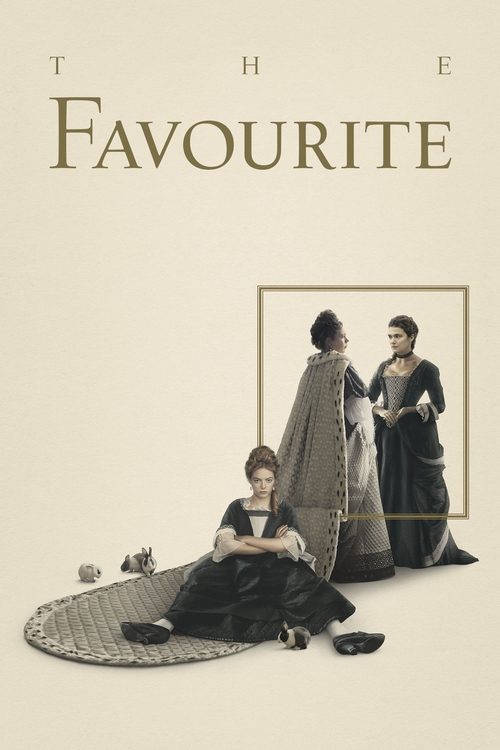
The Favourite
2018 · Yorgos Lanthimos
The Greek Weird Wave export who became an awards-season fixture; Poor Things ignited a genuine culture-war argument about whether its sex-positive fable was feminist or a male fantasy. His Emma Stone partnership is treated as the defining actor-director pairing of the decade.
For when you want a costume drama with fangs: sharp, mean, quotable comedy about power and jealousy. Great for a night when you want to cackle at terrible people being brilliant at it.
What it's about
England in the early 1700s, with a war on and a fragile, gout-ridden Queen Anne on the throne. Her fierce confidante Sarah Churchill effectively runs the country — until Sarah's penniless cousin Abigail arrives at court as a servant and starts climbing. What follows is a three-way contest for the Queen's affection in which love, sex and national policy are the same currency.
The experience
Wickedly funny and genuinely cruel — you laugh at a filthy one-liner and wince a beat later when you see what it cost someone. It's fast, profane and unpredictable, and under the powdered wigs there's real loneliness.
Performances
Olivia Colman's Queen Anne is astonishing — petulant child, wounded lover and grieving woman in a single scene — while Rachel Weisz's withering command and Emma Stone's sweet-faced scheming make the triangle crackle from every corner.
The craft
Lanthimos shoots candlelit palace corridors with fisheye lenses and sudden whip pans, making the court feel like a gilded aquarium, and the script trades period politeness for gloriously crude, razor-edged dialogue. Duck races, rabbits and an unhinged dance number keep knocking the genre off balance. The natural-light photography is sumptuous on a big screen.
Why it matters
It carried Yorgos Lanthimos from cult art-house strangeness into mainstream prestige without dulling his edge, and it reset expectations for what a period film could sound and feel like.
Snapshot
The Favourite is a period chamber piece reimagined as a savage comedy of power, staged inside the court of Queen Anne during the War of the Spanish Succession. Three women — the gout-ridden, grief-haunted Queen (Olivia Colman); her formidable confidante and de facto regent Sarah Churchill, Duchess of Marlborough (Rachel Weisz); and the fallen-gentlewoman cousin Abigail Hill (Emma Stone), who claws her way back to status — circle one another in a contest for intimacy that is simultaneously erotic, political, and predatory. It is the film with which Yorgos Lanthimos moved from the hermetic Greek-language allegories of his early career toward English-language prestige cinema without surrendering his clinical strangeness. The result is a costume drama scrubbed of reverence: bunny rabbits and duck races, a vocabulary of crude obscenity set against gilded paneling, and a camera that bends the rooms of the palace into fish-eyed cages. The film earned ten Academy Award nominations and won one, Best Actress for Colman.
Industry & production
The Favourite had an unusually long gestation. The original screenplay was written by Deborah Davis roughly two decades before production, and the project drifted for years before Lanthimos became attached and the playwright-screenwriter Tony McNamara was brought in to rework the dialogue. It was Lanthimos's first feature directed from material he did not originate himself — a meaningful departure for a filmmaker whose reputation rested on premises (a family raised in linguistic captivity; a society that turns the single into animals) of his own devising. The film was produced by companies including Element Pictures (Lanthimos's frequent Irish producing partner, via Ed Guiney and Andrew Lowe) and Scarlet Films, with financing and distribution through Fox Searchlight Pictures, the speciality label then transitioning into Disney ownership. The budget was modest by studio standards, consistent with a single-location chamber piece.
Principal photography took place largely at Hatfield House in Hertfordshire, the Jacobean estate standing in for Anne's palace, which gave the production real paneled interiors, long galleries, and grounds rather than built sets — a choice that shaped the film's reliance on existing architecture and natural light. The film premiered at the Venice Film Festival in 2018, where it won the Grand Jury Prize (the festival's runner-up award) and Colman took the Volpi Cup for Best Actress, launching an awards campaign that carried it through the season.
Technology
The film was photographed on 35mm celluloid by Robbie Ryan, a deliberate embrace of photochemical grain and the tonal latitude of film stock over digital capture, suited to candle-lit interiors. Its most discussed technological choice is lensing: Ryan and Lanthimos used extreme wide-angle and fish-eye lenses, including very short focal lengths that distend the geometry of rooms, so that walls curve and figures shrink within cavernous spaces. Equally important was a commitment to available and practical light — vast windows by day and banks of real candles by night — rather than conventional film lighting, which required fast lenses and the sensitivity that film stock and modern processing allowed. The production design and the cinematography were thus technically interdependent: the look depends on real candlelight and real architecture as much as on the glass in front of the camera.
Technique
Cinematography
Ryan's camerawork is the film's signature. The wide and fish-eye lenses do conceptual work, not merely decorative: they make the palace feel like a fishbowl, its inhabitants observed and warped, grandeur curdling into claustrophobia. The camera moves restlessly — slow, mechanical pans and sudden whip-pans that swing across a room to catch a reaction, snap-zooms, and gliding tracking shots down corridors. Many interiors are lit to a chiaroscuro that recalls candlelit painting; the natural-light night scenes give faces a flickering warmth while the corners of frames fall into darkness. The visual scheme refuses the stately, locked-off compositions of conventional heritage cinema; instead it estranges the period, keeping the viewer slightly off balance, which is precisely Lanthimos's aim.
Editing
The film was cut by Yorgos Mavropsaridis, Lanthimos's longtime editor across his major work. The editing favors rhythm and tonal control over invisible continuity: scenes are partitioned by intertitle chapter cards bearing fragments of dialogue, a device that both organizes the narrative and adds a wry, literary distancing. Cutting within scenes can be abrupt, letting the camera's own movement carry duration in some passages while elsewhere clipping exchanges into brittle comic beats. The pacing balances long, held humiliations against quick reversals of fortune.
Mise-en-scène / staging
Fiona Crombie's production design and Sandy Powell's costumes are central to the film's meaning. Powell's costumes are pointedly not strict historical reconstruction: she worked in a restricted palette and used unexpected materials and patterns — denim, laser-cut fabrics, modern textures rendered in period silhouette — so that the clothes read as period at a glance but feel subtly anachronistic and theatrical. The interiors combine the genuine grandeur of Hatfield House with staged tableaux of decadence and rot. Staging exploits the architecture's depth: figures are placed deep in long rooms, dwarfed by walls of portraits and paneling, and Lanthimos repeatedly frames the women within doorways and corridors as if caged. Recurrent motifs — Anne's seventeen rabbits standing in for her dead children, the grotesque court entertainments — give the mise-en-scène an emblematic, almost allegorical charge.
Sound
The Favourite has no original orchestral score in the conventional sense; its music is a compiled soundtrack of baroque and classical works — composers associated with the era and after, including Handel, Bach, Vivaldi, and Purcell — alongside more astringent and modern pieces by twentieth- and twenty-first-century composers used to unsettle rather than ennoble. The juxtaposition of grand period music with cruelty and farce is a deliberate ironic strategy. Sound design heightens the bodily and the architectural: footsteps echoing in stone galleries, the rustle of fabric, the wet sounds of illness and appetite. The compiled approach lets music comment on the action with a knowing modern intelligence rather than swelling sentiment.
Performance
Performance is where the film's tonal control is most visible. Colman plays Anne as a volatile compound of childishness, agony, neediness, and sudden imperial menace — a woman ruined by grief and illness who nonetheless holds absolute power. Weisz's Sarah is all blade and command, her affection for Anne genuine but inseparable from control. Stone's Abigail performs ascending calculation beneath a mask of wounded sweetness. The three pitch their work at a register that is at once heightened and exact, delivering McNamara's profane, anachronistic dialogue with deadpan precision. The acting is theatrical without tipping into camp, and the film's comedy depends on actors playing humiliation and cruelty straight.
Narrative & dramatic mode
The film is structured as a triangular power struggle — a love triangle whose currency is access to the Queen's body and ear, and through her, to the governance of a nation at war. Its dramatic mode is tragicomedy bordering on farce, with the architecture of a court intrigue: favor granted and withdrawn, allies and rivals, a poisoning, a fall, a marriage of convenience, and a final reversal that leaves no one victorious. McNamara's contribution gave the script its distinctive voice — caustic, contemporary, obscene — which collides productively with the period setting. The chapter-card structure lends the whole a fabular shape, and the famously ambiguous, disquieting final image refuses the satisfactions of either comeuppance or triumph: power is shown to be a trap that closes on whoever wins it.
Genre & cycle
The Favourite belongs to the costume drama / period film, but as a revisionist, anti-heritage entry in that genre. Where the British heritage tradition tends toward visual reverence and emotional uplift, this film weaponizes the costume drama's own grandeur against it, exposing the bodies, appetites, and brutality the genre usually decorously omits. It sits within a broader contemporary cycle of irreverent period revisions and female-centered historical dramas, and it pairs naturally with Lanthimos's later Poor Things (2023) as part of an emerging body of work that fuses period spectacle with absurdist and grotesque sensibilities. Its comedy is closer to the cruel and the absurd than to the romantic.
Authorship & method
Lanthimos's method here adapts his established sensibility — emotional flatness curdled into menace, social rituals exposed as cruelty, the body as a site of power — to material not his own and to a historical setting. Working from a script by Deborah Davis (the original screenwriter) and Tony McNamara (who supplied the modern, profane dialogue), Lanthimos retained authorial control through staging, lensing, and tone. His key collaborators define the film as much as he does: cinematographer Robbie Ryan, whose wide-angle, natural-light photography is inseparable from the film's identity; editor Yorgos Mavropsaridis, his long-standing cutter; production designer Fiona Crombie and costume designer Sandy Powell, who built the anachronistically inflected world. The film notably has no credited composer of an original score, the music instead being curated; in that sense its "score" is an act of selection rather than composition. Lanthimos's authorship is thus best understood as orchestration — imposing a consistent estranging vision on a large ensemble of specialist contributors.
Movement / national cinema
Lanthimos emerged from the so-called Greek Weird Wave, the loose cluster of austerity-era Greek films (his own Dogtooth, 2009, being a defining example) characterized by deadpan affect, allegorical premises, and clinical cruelty. The Favourite is the point at which that sensibility crosses fully into Anglophone, transnational prestige production: a British-set, English-language film with international (Irish, British, American) financing and a Greek auteur's sensibility presiding over it. It is therefore difficult to assign to a single national cinema; it is best read as Lanthimos transplanting a Greek Weird Wave temperament into the British heritage tradition, and in doing so deforming both.
Era / period
The film is set in the early eighteenth century, during the reign of Queen Anne (who reigned 1702–1714) and the War of the Spanish Succession, with the political conflict between Tory and Whig factions — and the question of whether to continue or end the costly war — providing the backdrop against which the personal intrigue plays out. The figures are historical: Anne, Sarah Churchill (Duchess of Marlborough and ancestor of Winston Churchill), and Abigail Masham (née Hill) were real, and the broad outline of Sarah's fall from favor and Abigail's rise is grounded in the historical record. The film treats this history freely, however, foregrounding the speculative intimate dimension and making no claim to documentary fidelity; the personal motivations and many specifics are dramatic invention.
Themes
The film's central theme is power and its dependence on intimacy: in an absolute monarchy filtered through a sick and emotionally dependent queen, political authority flows through whoever can command the sovereign's affection, so that love, sex, manipulation, and statecraft become indistinguishable. Bound up with this are the cruelties of dependency and care — Sarah and Abigail both nurse and exploit Anne, and tenderness is never separable from control. Grief saturates the film: Anne's seventeen rabbits, each standing for a lost child, render her power inseparable from private devastation. Class and precarity drive Abigail's arc, her ruthlessness framed as the rational response of a woman who has fallen and refuses to fall again. The film also interrogates the spectacle of femininity and the body — illness, vanity, appetite, humiliation — refusing to sanitize its historical women. Underlying all of it is a bleak vision of victory as a cage: to win the contest is to be imprisoned by the dependency one fought to secure.
Reception, canon & influence
The Favourite was received as a critical triumph and a commercial success for a speciality release, widely praised for its three central performances, its photography, and its tonal audacity. After its Venice debut (Grand Jury Prize; Volpi Cup for Colman), it accumulated awards through the 2018–2019 season and received ten Academy Award nominations — among the most of any film that year — including nods across acting, directing, screenplay, and craft categories. It converted one: Colman's Best Actress, a result widely registered as an upset. Weisz and Stone were both nominated in the Supporting Actress category. The film has since settled into the canon as one of the defining English-language auteur works of the late 2010s and as the hinge between Lanthimos's Greek-language period and his fully international career.
Its influences backward lie in two directions: the British heritage costume drama it revises, and an earlier strain of formally aggressive period filmmaking — Stanley Kubrick's candlelit, painterly Barry Lyndon (1975) is a frequent and apt comparison for the natural-light eighteenth-century imagery, and Peter Greenaway's mannered, painterly historical films are another touchstone for its artificiality. Lanthimos's own Weird Wave aesthetic supplies the deadpan cruelty.
Its legacy forward is already visible. The film helped legitimize a mode of irreverent, profane, female-driven period revisionism and is a clear forerunner of subsequent costume productions — including McNamara's own television series The Great, which extends the same anachronistic, scabrous approach to Catherine the Great's Russia. Within Lanthimos's filmography it set the template he expanded in Poor Things (2023), which reunited him with Stone and with the wide-angle, grotesque-baroque sensibility. More broadly, it confirmed the viability of the auteur-driven period film as a vehicle for major performances and craft recognition, and it remains a reference point for filmmakers seeking to estrange the historical past rather than embalm it.
A Deleuzian reading
The room curves.
The full Deleuzian reading of The Favourite →
Reception
No redemption arc needed — it premiered at Venice 2018 to raves (Grand Jury Prize, Volpi Cup for Colman) and rode that wave to 10 Oscar nominations. If anything has shifted, it's that it now reads as the hinge point where Lanthimos went from arthouse cult figure to mainstream awards fixture.
How The Favourite was received, from release to now →
Influences: the films it descends from and the films it influenced
- Barry Lyndon (1975) — Established the eighteenth-century natural-light, candle-lit painterly aesthetic — shooting interiors with fast lenses and available light to make period interiors read as living tableaux — the direct template for Robbie Ryan's lensing here.
- The Draughtsman's Contract (1982) — Modeled the mannered, architecturally framed Restoration costume picture in which symmetrical compositions and verbal cruelty expose aristocratic power games as ritualized artifice rather than naturalistic drama.
- The Cook, the Thief, His Wife & Her Lover (1989) — Pushed the deadpan-grotesque tableau and stylized profanity-as-power into baroque period staging, prefiguring the film's anachronistic obscenity layered over painterly excess.
- Dogtooth (2009) — Originated Lanthimos's Greek Weird Wave grammar — affectless line delivery, wide framing of bodies in controlled domestic space, social ritual curdled into menace — carried wholesale into the palace.
- The Lobster (2015) — His first English-language work fixing the deadpan ensemble performance register and the fish-eye/wide-angle distortion of formal interiors that The Favourite extends to court architecture.
- Marie Antoinette (2006) — Pioneered the anachronistically inflected, female-centered costume revision — compiled pop-adjacent scoring and modern sensibility inside a rigorously designed court — that The Favourite radicalizes with profanity and fish-eye.
- The Killing of a Sacred Deer (2017) — The Favourite is the first post-Filippou test of Sacred Deer's grammar: Lanthimos retains wide-angle distortion and institutional symmetry while replacing flat-affect performance with grotesque expressivity, revealing which elements of the system were collaborative and which authorial.
- Darkest Hour (2017) — Lanthimos borrows the British prestige biopic's amber candlelit chiaroscuro and takes the confinement-framing-as-political-arena to a formal extreme — fish-eye wide-angle in enclosed palace rooms makes spatial enclosure itself the political argument, pushing the grammar Darkest Hour consolidates into open distortion.
- Dangerous Liaisons (1988) — Modernizes sexuality-as-warfare into a triangular court power-game, using candlelit wide-angle interiors and a comedy-of-manners cruelty where intimacy is pure tactical maneuver.
- The Lion in Winter (1968) — Lanthimos weaponizes deliberately anachronistic, profane dialogue inside a period court, turning royal intimacy into vicious three-way power combat — Goldman's anachronism-against-period-stone pushed to its extreme.
- The Portrait of a Lady (1996) — Formally subversive anti-heritage costume drama using wide and distorting lenses to make the period interior claustrophobic and cruel, weaponizing form against heritage comfort.
- Kind Hearts and Coronets (1949) — An acidly Wildean period court comedy where genteel manners mask murderous ambition, extending the class-satire-with-poison-underneath tone Hamer perfected.
- Poor Things (2023) — Reunites Lanthimos, Emma Stone and the wide-angle fish-eye grotesque-baroque sensibility, expanding the chapter-structured, anachronistic period estrangement into full Victorian-fantastical excess.
- Kinds of Kindness (2024) — Carries forward the chapter-intertitle, triptych narrative architecture and deadpan-cruel ensemble that The Favourite organized around its three-way power struggle.
- The Great (2020) — McNamara's own series transplants the scabrous, profane, deliberately anachronistic court-dialogue method he wrote for The Favourite onto Catherine the Great's Russia.
- Spencer (2021) — Extends auteur-driven, estranging revisionist royal portraiture — subjective wide-lens claustrophobia and compiled/dissonant scoring over a single woman trapped in court ritual.
- Catherine Called Birdy (2022) — Inherits the legitimized mode of irreverent, female-driven period comedy using anachronistic voice and modern attitude to de-embalm the medieval/historical past.
- Bugonia (2025) — Consolidates the Mavropsaridis editing collaboration and Robbie Ryan's fisheye/wide-angle distortion cinematography as Lanthimos's sustained visual signature; anti-naturalistic ensemble performance within period genre context directly anticipating Bugonia's genre modulation.
- Orlando (1992) — Earlier queer-inflected, ironic period revisionism using direct estrangement and arch performance to interrogate gendered power across English history rather than embalm the past.
- The Madness of King George (1994) — Shares the bodily-grotesque, court-intrigue chamber drama centered on a physically failing monarch manipulated by attendants and rivals, the same triangular palace-power mechanics.
- Persuasion (1995) — Part of the British heritage costume tradition the film revises — naturalistic light and restrained interiority — used here as the genre baseline being deliberately violated.
- American Honey (2016) — Robbie Ryan's other signature collaboration, showcasing the same restless natural-light, lens-distorting handheld immediacy he transposes onto the candlelit palace.
- The Death of Stalin (2017) — Applies the same modern-profane, anachronistic dialogue register to historical autocracy, treating palace power as venal farce in period dress.
- The Lighthouse (2019) — Contemporary formally aggressive period filmmaking using period-correct optics and chiaroscuro extremity — squarish framing, lantern-light — to estrange rather than reconstruct history.
- Love & Friendship (2016) — Revisionist costume comedy foregrounding verbal cruelty and triangular social manipulation among women maneuvering for security, a wit-driven cousin to The Favourite's power games.
- Conclave (2024) — Institutional intrigue conducted entirely within a closed architectural space whose geometry encodes power — chambers, corridors, throne rooms — with proxemics of approach and retreat as the primary political language, and restricted palette reinforcing the hermetic claustrophobia of the succession contest.
- The Handmaiden (2016) — Descendant/sibling in the lavish period costume-drama recast as a triangulated female power game of manipulation, servitude, and desire among women.
- Napoleon (2023) — A contemporaneous revisionist court drama using natural/candle-lit chiaroscuro and an anti-heroic, pettily human treatment of sovereignty, sharing Napoleon's project of anatomizing the vanity and need behind authority.
- Cruella (2021) — Shares co-writer Tony McNamara's barbed, anachronistic-feeling wit and a cruel-comic court of rivals, rendered with restless wide-angle mobile camerawork.
- Emma. (2020) — Shares the revisionist-period-comedy mode: formally aggressive wide framing, acid social satire, and bodily indignity deployed to needle the dignified heritage costume drama from within.
Similar films
- Poor Things (2023) — influence & lineage · same viewing thread
- Orlando (1992) — influence & lineage · same viewing thread
- Dogtooth (2009) — influence & lineage
- The Lobster (2015) — influence & lineage
- Marie Antoinette (2006) — influence & lineage
- Barry Lyndon (1975) — influence & lineage
- "Wuthering Heights" (2026) — same viewing thread
- Bram Stoker's Dracula (1992) — same viewing thread
All the films related to The Favourite →
Watch it with: curated runs of related films
- Drunk on Design — Watch these together for the rush of maximalist, color-drenched cinema where a woman is made, remade, or consumed by an art form — ballet, fashion, gothic desire — and the production design does half the storytelling.