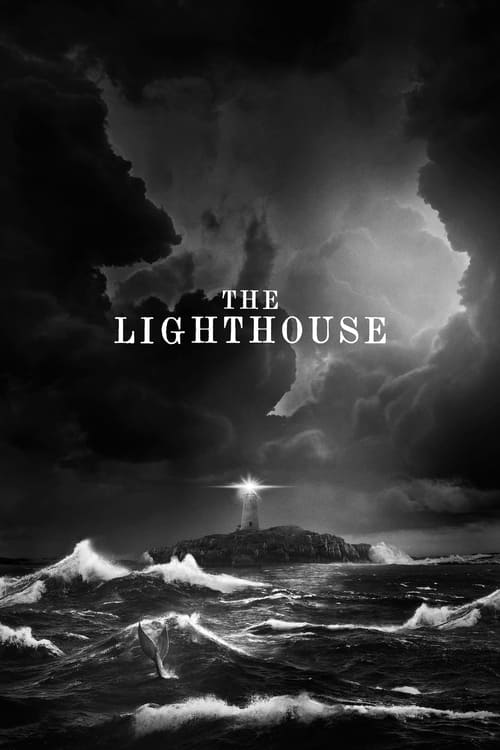
The Lighthouse
2019 · Robert Eggers
Letterboxd-core auteur of obsessive historical authenticity; Nosferatu became a surprise Christmas blockbuster and a goth-culture moment, and his announced Werwulf (in Middle English) is pre-emptively memed as "the most Eggers thing possible." Shorthand for "real cinema" among younger cinephiles.
When you want something genuinely strange: part psychological horror, part pitch-black two-man comedy. Great with a crowd that's game for it; a challenge that's also a riot.
What it's about
The 1890s, a bare rock off the New England coast: two lighthouse keepers, alone. The old one is a flatulent, superstitious tyrant who keeps the lamp room to himself; the young one is a tight-lipped drifter stuck with the scrubbing and hauling. When a storm strands them past the end of their posting, drink, secrets, and the sea's strangeness start to dissolve the line between the two men — and between what's real and what isn't.
The experience
Claustrophobic, deliriously funny in a filthy, salt-caked way, and increasingly unhinged — a pressure cooker that keeps ratcheting until you're laughing and squirming at once. Loud, briny, and proudly weird.
Performances
Willem Dafoe delivers barnacled sea-dog monologues like a man possessed, and Robert Pattinson matches him with a ferocious slow unraveling — a two-hander played at absolute full pitch.
The craft
Shot on 35mm in stark black and white and a near-square frame that boxes the men in, with a sound design built on foghorn drones and shrieking gulls, and dialogue written in dense, musical period sailor-speak. It's a sensory object first — see it big and loud if you possibly can.
Why it matters
Confirmed Robert Eggers as one of the defining stylists of the modern arthouse-horror wave and became an instant cult object, endlessly quoted and memed.
Snapshot
The Lighthouse is Robert Eggers's second feature, a hermetic two-hander about a pair of wickies — lighthouse keepers — marooned together on a granite spit off the New England coast in the 1890s. The elder, Thomas Wake (Willem Dafoe), is a peg-legged tyrant who hoards the lantern room for himself; the younger, Ephraim Winslow (Robert Pattinson), is a closed-off drifter with a buried past, set to scrubbing, hauling, and emptying chamber pots. As a storm strands them past the end of their four-week rotation, drink, isolation, masturbation, mutual suspicion, and possibly the supernatural dissolve the two men into a single delirious antagonism. The film is photographed in stark black-and-white on 35mm in a near-square aspect ratio, scored to foghorn drones, and written in a dense pastiche of period maritime and Melvillean idiom. It is at once a chamber drama, a horror film, a black comedy, and a myth — and it deliberately refuses to resolve which. After a Directors' Fortnight premiere at Cannes in May 2019 and an A24 release that autumn, it became a critical landmark of the late-2010s "elevated horror" moment and earned Blaschke's cinematography an Academy Award nomination — the only Oscar nod the film received.
Industry & production
The film was produced by A24 and RT Features (Rodrigo Teixeira's company), with New Regency and Parts and Labor among the backing entities, on a budget widely reported in the low-to-mid single-digit millions; precise figures have not been authoritatively published, so any number should be treated as approximate. It followed Eggers's 2015 debut The Witch, which A24 had distributed to surprise commercial success, and the studio's continued backing gave Eggers room to make an aggressively uncommercial object — monochrome, boxy, and linguistically forbidding — on a modest scale.
Principal photography took place over roughly five to six weeks in early 2018 in Nova Scotia, chiefly at Cape Forchu near Yarmouth, where the production built a functioning, to-scale lighthouse tower and keepers' cottage rather than relying on an existing structure or substantial digital extension. The remote, weather-battered location was integral to the method: the cast and crew endured genuine wind, rain, and cold, and the physical hardship is legible on screen. The shoot was, by multiple accounts from the principals, grueling — the conditions and the demands of the roles produced real exhaustion that the film absorbs into its texture. It is a production whose smallness (two actors, one set, one storm) is its strategic strength.
Technology
The Lighthouse is, technologically, a study in deliberate regression. It was shot on 35mm black-and-white film stock — Eastman Double-X (5222), a classic monochrome negative — at a moment when even celebrated directors had largely abandoned photochemical black-and-white. The negative was paired with vintage glass: cinematographer Jarin Blaschke sourced antique uncoated lenses, including Bausch & Lomb Baltar lenses from the 1930s, whose lower contrast, flaring, and softness at the edges produce the slightly diseased, silvery image that defines the film. To push tonal separation in skin and sky toward the look of orthochromatic stock used in early cinema — which renders skies dark and skin coarse — Blaschke shot through a custom cyan filter, sacrificing light (and thus requiring more illumination) to recover the harsh, blanched faces of pre-1920s photography. The aspect ratio is the unusual 1.19:1 "Movietone" frame, the nearly square format of the earliest sound films, which boxes the men into a vertical, claustrophobic column and lends the tall lighthouse its looming verticality. The combination — old stock, old lenses, old ratio, old filtration — is not nostalgia for its own sake but a tool to make 2019 audiences see with a turn-of-the-century eye.
Technique
Cinematography
Jarin Blaschke's photography is the film's signature achievement and the basis of its Oscar nomination. Working in monochrome with vintage lenses, he builds an image of extreme contrast — gleaming wet rock, blown-out lamplight, faces carved by hard sidelight — that recalls both German Expressionist cinema and the documentary photography of the period. Much of the film is lit to feel sourced: oil lamps, the lighthouse beam, storm-gray daylight. The square frame is composed with great rigor, stacking the two men vertically, isolating eyes and mouths in the cramped cottage, and turning the spiral stair and the lantern room into vertiginous, near-abstract spaces. Blaschke's camera alternates between locked-off, painterly stillness and sudden handheld violence as the men's control disintegrates. The flares and softness of the uncoated glass keep the image from ever feeling clean or modern; it seems exhumed.
Editing
Louise Ford, Eggers's editor since The Witch, cuts the film for mounting derangement. The early sections are measured and procedural — the daily round of labor rendered in patient, repetitive rhythm that establishes the tedium and hierarchy of the island. As alcohol and time collapse, the editing fractures: durations become unreliable, days blur, and the same gestures (drinking, fighting, the lantern's glow) recur with dreamlike insistence so that the viewer, like Winslow, loses track of how long the men have been trapped. The cutting is essential to the film's central ambiguity — it withholds the stable temporal ground that would let us separate event from hallucination.
Mise-en-scène / staging
The single principal location is exploited for maximum oppression. The keepers' quarters are low, dark, and crammed with period-correct objects; the lantern room above is forbidden, radiant, and sexualized. Eggers and his team are obsessive about material accuracy — the tools, the food, the foghorn, the clothing — and this density of correct detail anchors the increasingly unreal events. Staging emphasizes the rigid master-servant choreography of the men's labor and meals, which the film then breaks down into drunken dancing, wrestling, and embrace. Recurring images — a one-eyed seagull, a tentacled apparition, a mermaid, the glowing light itself — are planted in the realist surface and allowed to bloom into myth.
Sound
The sound design is arguably as important as the image. A near-constant low foghorn drone, mechanical groans, wind, surf, and the clang of the bell saturate the track, producing a state of relentless aural pressure with few moments of silence. Mark Korven's score is built largely from this same sonic world — brass and drones that are difficult to separate from the diegetic foghorn — so that music and environment fuse into one oppressive texture. The blurring of score and source sound is a deliberate destabilizing tactic, of a piece with the film's refusal to mark the boundary between the real and the imagined.
Performance
The film rests entirely on two performances. Willem Dafoe's Thomas Wake is a torrent of salt-crusted, Melvillean monologue — most famously a curse invoking Neptune's wrath, delivered as a sustained tirade — played with theatrical relish, menace, and pathos. Robert Pattinson's Winslow is more interior and coiled, a study in suppressed rage and dread that erupts into physical and verbal breakdown; the role is punishing, mud-caked, and frequently abject. The two actors play in different registers — Dafoe operatic, Pattinson naturalistic and clenched — and the friction between those registers is the drama. Both reportedly committed to the physical ordeal of the shoot, and the exhaustion reads as performance and condition at once.
Narrative & dramatic mode
Structurally the film is a chamber play: unity of place, a tiny cast, a rising pressure that has nowhere to escape. Its dramatic mode is one of calculated unreliability. The narrative is anchored to Winslow's point of view, and as his grip loosens — through drink, guilt over a possibly violent past, and sexual frustration — the film withholds any objective vantage from which to verify what we see. Is there a mermaid, a tentacled god, a murder, a transformation, or only delirium? Eggers refuses to adjudicate. The screenplay, co-written with his brother Max Eggers, layers in mythic scaffolding (Prometheus stealing fire, Proteus the shape-shifting sea-god) beneath a hyper-naturalist surface, so the film can be read simultaneously as psychological case study and as allegory. The dialogue itself is a constructed dramatic instrument: a period idiom assembled from 19th-century sailors' slang, lighthouse-keeper records, and the prose of Melville and others, dense enough to estrange the audience and pull them into another century's speech.
Genre & cycle
The Lighthouse sits at the intersection of several genres and belongs squarely to the late-2010s art-horror cycle associated with A24 — the wave often labeled "elevated horror" that includes The Witch, Hereditary, Midsommar, and others. But it resists the cycle as much as it joins it: it is also a black comedy (the flatulence, the drunken bickering, the absurdist farce of two men driving each other mad), a psychological thriller, and a mythological fantasy. Its closest formal lineage is the chamber two-hander of psychic disintegration, and it openly courts comparison with the existential isolation dramas of European art cinema. The film's genre instability — horror that is funny, naturalism that turns mythic — is itself the point.
Authorship & method
Robert Eggers is a former production and costume designer, and his authorship is defined by an almost archival commitment to historical reconstruction in the service of dread. As with The Witch's Puritan New England, here he builds the 1890s lighthouse world from primary sources — keepers' logs, period speech, real labor — then lets the supernatural seep through the seams of that realism. He wrote the screenplay with his brother Max Eggers, who reportedly brought an early interest in a ghost-story premise and the Romantic/literary frame that the brothers developed together.
His key collaborators form a repertory. Cinematographer Jarin Blaschke is his essential visual partner, responsible for the monochrome, vintage-lens, square-frame conception described above. Editor Louise Ford shapes the film's temporal collapse. Composer Mark Korven — who had given The Witch its harrowing score — supplies the brass-and-drone soundscape that fuses with the foghorn. Across these collaborations Eggers's method is consistent: extreme period fidelity, practical and location-driven production, formal constraint (here the aspect ratio and stock), and the refusal of clean explanation.
Movement / national cinema
The film is an American independent production, but its aesthetic affiliations are emphatically European and historical. It draws directly on German Expressionism — Murnau, the chiaroscuro and looming forms of Nosferatu and Faust — and on the Scandinavian art cinema of Ingmar Bergman, whose island-bound, two-or-three-character chamber films (Persona above all, with its merging identities) are a clear forebear. It also reaches back to the silent and very early sound era through its format and stock. Within contemporary American cinema it belongs to the A24-fostered school of director-driven art horror. It is, in short, a work of deliberate transnational and trans-historical citation rather than a product of any single living movement.
Era / period
Set in the 1890s, the film is a period piece whose period is both subject and method. The turn-of-the-century New England maritime world — manual lighthouse-keeping before automation, the hard labor and superstition of sailors — supplies its texture, its language, and its anxieties. The film's technological choices (Double-X stock, Movietone ratio, orthochromatic-style filtration) reach toward the visual era of early cinema, so that the 1890s setting and the 1900s–1920s film grammar reinforce one another. The result is a self-conscious collision of historical moment and cinematic past.
Themes
The film's themes are dense and overlapping. Foremost is power and its inversion: the rigid master-servant hierarchy between Wake and Winslow, the petty tyranny of the lantern room, and the way labor and humiliation curdle into rebellion. Closely bound to this is homosocial intimacy and repression — the two men's antagonism shades constantly into desire, dependency, and a near-erotic doubling. Madness, isolation, and unreliable perception drive the form: the film is a study in how solitude, drink, and confinement erode the self. Forbidden knowledge and transgression organize the mythic layer — the lantern's light is a Promethean fire Winslow is barred from and ultimately seizes, with the implication of divine punishment. There is the shape-shifting sea (Proteus, mermaids, Neptune) and the long tradition of maritime superstition, including the seagull as the soul of a dead sailor, killing which brings ill luck. And running beneath all of it is guilt and identity — the question of who Winslow really is, the doubling of the two men's names, and the suggestion that they are versions of the same drowning self.
Reception, canon & influence
Critical reception was strong and, for an aggressively difficult film, remarkably broad. Reviewers singled out Blaschke's cinematography, the twin performances of Dafoe and Pattinson, and Eggers's command of mood, and the film was widely placed on year-end best-of lists; it became one of the most discussed art films of 2019. Its sole Academy Award nomination was for Best Cinematography. (Specific aggregate scores and award tallies should be checked against current sources rather than asserted from memory here.)
The influences on the film are unusually legible because Eggers and his collaborators have been candid about them: German Expressionist lighting and form; Bergman's island chamber dramas and the identity-dissolution of Persona; the maritime literature of Herman Melville (and the broader 19th-century sea narrative); Greek myth (Prometheus, Proteus); the cosmic dread associated with H.P. Lovecraft; the spectral imagery of early photography and silent cinema; and an unfinished Edgar Allan Poe fragment about a lighthouse that supplied an initial spark for the project's development. The film synthesizes these into something distinctively its own.
Its influence forward is still consolidating, but already discernible. The Lighthouse helped legitimize photochemical black-and-white and academy/boxy aspect ratios as live options for contemporary auteurs, and it strengthened the case that demanding, formally austere art horror could find a real audience under the A24 model. It cemented Eggers as a major American stylist — paving the way to The Northman and his subsequent Nosferatu — and it played a significant part in re-establishing Robert Pattinson as a serious dramatic actor in the post-Twilight phase of his career. More broadly, the film stands as a touchstone for a strain of period-precise, myth-soaked, ambiguity-embracing horror, and its imagery — the beam, the seagull, the curse, the two faces lit by lamplight — has entered the contemporary cinephile vocabulary.
A Deleuzian reading
Winslow stands at the bottom of the spiral stair and looks up at a light he is forbidden to touch.
The full Deleuzian reading of The Lighthouse →
Reception
No flop-to-classic arc needed — it landed hot out of Cannes' Directors' Fortnight (winning the FIPRESCI prize) and went straight from arthouse curiosity to instant cult object, with its lone Oscar nod (cinematography) widely seen as underselling it, especially Dafoe's snub.
How The Lighthouse was received, from release to now →
Influences: the films it descends from and the films it influenced
- Persona (1966) — The island two-hander whose chamber confinement dissolves two identities into one, with Sven Nykvist's hard facial sidelight and the literal lap-dissolve merging of two faces that Eggers cites directly for the lamplit double-portraiture.
- The Passion of Joan of Arc (1928) — Orthochromatic emulsion (the cyan-filter look Blaschke reverse-engineered) that darkens skies and renders skin as raw, pore-level texture under makeup-free hard light.
- Nosferatu (1922) — German Expressionist hard-shadow modeling and silent-cinema spectral imagery — the looming chiaroscuro figure — that underwrites the film's lamp-and-beam lighting grammar.
- The Cabinet of Dr. Caligari (1920) — Expressionist painted-light chiaroscuro and unstable, askew framing as an externalization of a deranged unreliable narrator's perception.
- Sunrise: A Song of Two Humans (1927) — The Fox-Movietone near-square (~1.20:1) sound-era frame that Eggers and Blaschke revived as their boxy aspect ratio, paired with Murnau's mobile expressionist mood.
- Eraserhead (1977) — Continuous low-frequency industrial drone sound design welded to monochrome image so that ambience becomes score — the model for the foghorn/brass drone that never lets the soundtrack rest.
- Repulsion (1965) — Single-location confinement filmed from inside a disintegrating mind, where domestic space warps to dramatize subjective, unreliable perception.
- Moby Dick (1956) — Oswald Morris's deliberately desaturated, near-monochrome photochemical sea-palette married to Melvillean declamation — the 19th-century maritime monologue Dafoe channels in his curse speech.
- The Witch (2015) — Eggers's prior application of the same method — archival period-fidelity (logs, period speech, real labor) with Mark Korven's harrowing drone score, letting the supernatural seep through realism's seams.
- Cold War (2018) — Łukasz Żal's Academy-ratio (1.37) photochemical black-and-white, part of the same revival of boxy monochrome austerity as a serious arthouse register.
- Aguirre, the Wrath of God (1972) — Punishing location-driven production used as the engine that drives a performer to genuine derangement on camera — the method by which real labor and place produce on-screen unraveling.
- Barton Fink (1991) — Seals two men (one a hearty, dread-concealing Goodman analog) inside a claustrophobic decaying structure descending into madness, with foregrounded foghorn/insect sound-design as psychological pressure.
- The Northman (2022) — Extends the Eggers–Blaschke repertory: location-driven long-take staging and mythic scaffolding (here Norse rather than Greek) built from primary-source reconstruction.
- Nosferatu (2024) — Carries forward Blaschke's vintage-lens, hard-sidelit expressionist chiaroscuro and silent-cinema spectral lineage into a near-monochrome period palette.
- Possession (1981) — The two-hander built on violently clashing performance registers — naturalism colliding with operatic hysteria — that legitimizes Dafoe and Pattinson playing in incompatible keys.
- The Tragedy of Macbeth (2021) — Bruno Delbonnel's boxy black-and-white Expressionist soundstage chiaroscuro, treating monochrome and a near-square frame as live formal options for a contemporary auteur — the path The Lighthouse reopened.
- Saint Maud (2019) — A24-era elevated horror staged inside a single deluded consciousness, where mythic/religious scaffolding and unreliable perception collapse the line between vision and madness.
- Rose of Nevada (2026) — A monochrome maritime two-hander shot on vintage format and lenses with a sea-madness sound design built around foghorn drones — a parallel 2010s–20s return to analog texture for ghost-of-the-sea storytelling.
- The Revenant (2015) — Endurance performance in an elemental environment-as-antagonist, with dense environmental sound texture dominating over score and physical ordeal deployed as the formal strategy for psychological disintegration—parallel craft logic to The Revenant's bear-country isolation.
- Phantom Thread (2017) — Eggers builds a two-person psychological chamber drama in a constrained aspect ratio using 35mm photography, heightened diegetic sound (mechanical rhythm deployed as structural scoring), and ritualized domestic repetition as the formal language of obsession and mutual control — sharing Anderson's Bressonian precision within enclosure.
- The Banshees of Inisherin (2022) — Two men confined on an island where the promised departure never materializes — a Beckettian waiting structure in which escalating physical violence substitutes for the resolution that will not come; island as hermetic theatrical set; performance escalating from controlled withdrawal to full physical expressiveness as the confinement corrodes restraint.
- The Master (2012) — The same two-men-locked-in-a-power-struggle that neither can win, staged in extreme confinement with anti-dramatic repetition and intimate held close-ups on warring faces.
- The Favourite (2018) — Contemporary formally aggressive period filmmaking using period-correct optics and chiaroscuro extremity — squarish framing, lantern-light — to estrange rather than reconstruct history.
- Pearl (2022) — Practices the same fastidious archival counterfeiting — period aspect ratio and vintage optics as the medium of horror — anchored to a sustained, extreme two-hander performance.
- Ivy (2015) — A confined maritime two-hander of collapsing rank and mutual madness, using boxed architectural framing and genre slippage to erode a narrator's reliability as Ivy does.
- A Twelve-Year Night (2018) — Shares chiaroscuro low-light photography and the two-hander of confinement dissolving into shared hallucination, using darkness and constrained framing as the engine of psychological unraveling.
Similar films
- Nosferatu (2024) — influence & lineage
- Rose of Nevada (2026) — influence & lineage
- Dogtooth (2009) — shared sensibility
- Shutter Island (2010) — shared sensibility
- The Witch (2016) — shared sensibility
- Godland (2022) — shared sensibility
- Hour of the Wolf (1968) — shared sensibility
- The Cabin in the Woods (2012) — shared sensibility
All the films related to The Lighthouse →