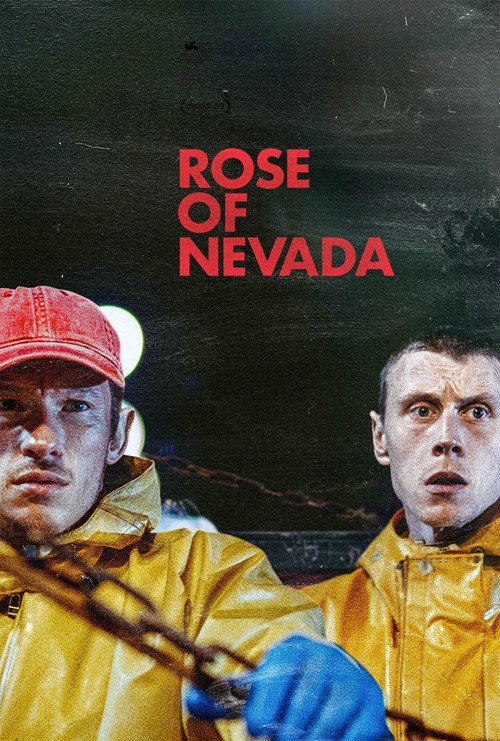
Rose of Nevada
2026 · Mark Jenkin
For when you want something strange and handmade — a moody, atmospheric puzzle for a quiet night, best watched with full attention and no phone. Challenge over comfort, but richly rewarding if you give in to its rhythm.
What it's about
A fishing boat that vanished at sea thirty years ago reappears intact in the harbor of a fading Cornish village. Two men sign on for her next voyage — Nick, desperate to provide for his family, and Liam, a drifter outrunning his past — and come back to find the calendar has slipped: it's decades earlier, and everyone takes them for the boat's original, doomed crew.
The experience
Hypnotic and uncanny — a slow-burning sea story where the dread comes from texture as much as plot, all salt, grain, and creaking timber. It feels like a folk tale being remembered rather than told, and it lingers.
The craft
Mark Jenkin writes, directs, shoots, edits, and scores in his hand-built analog style, and the physical grain of the image does half the storytelling — the past doesn't just appear, it feels materially different. The soundscape is its own character; this one genuinely rewards a dark room and good speakers.
Why it matters
Jenkin's third narrative feature, premiering in Venice's Orizzonti competition in 2025, and further proof that his handcrafted Cornish cinema is one of the most distinctive projects in current British film.
Snapshot
Rose of Nevada is Mark Jenkin's third narrative feature, a maritime time-slip story written, directed, photographed, edited and scored by the Cornish filmmaker in the hand-built analog idiom that has become his signature. The premise is a piece of folkloric science fiction: a fishing vessel, the Rose of Nevada, lost at sea three decades earlier, reappears intact in the harbor of a depressed coastal village. Two men — Nick (George MacKay), desperate to provide for his family, and Liam (Callum Turner), a drifter outrunning his past — sign on for a voyage, and return to find themselves slipped backward in time, mistaken for, and gradually absorbed into, the identities of the crew who originally vanished. The film premiered in the Orizzonti competition at the 82nd Venice International Film Festival on 30 August 2025 and was released theatrically in the United Kingdom by BFI Distribution on 24 April 2026. It marks Jenkin's largest production to date and his first to be built around recognizable movie stars, while preserving the rigorously limited tools — a wind-up 16mm Bolex, post-synchronised sound, hand-processed stock — that define his practice. Critically it was received as his most accomplished and most legible work, an intensification rather than a softening of his method.
Industry & production
Rose of Nevada sits within the ecology of British public-service film finance that has sustained Jenkin's career since Bait (2019): the BFI, Film4, and his long-standing Cornwall-based production partnership with Early Day Films (producers Kate Byers and Linn Waite), who shepherded both Bait and Enys Men (2022). The exact budget has not been publicly disclosed, but Jenkin and his collaborators have been explicit in interviews that the film represents a meaningful step up in scale and resources from the cottage-industry economics of his earlier work — while insisting, as Jenkin put it, that "you don't want to be luxuriating too much." The decisive industrial shift is casting: where Bait was built on non-professionals and Cornish performers and Enys Men on a near-solo turn from Mary Woodvine, Rose of Nevada is anchored by two internationally bankable leads in MacKay and Turner. That visibility, together with the Venice Orizzonti berth and a wide BFI release, positions the film as Jenkin's bid to carry an avant-garde regional aesthetic into a larger commercial and festival arena without abandoning its means. The supporting ensemble knits in returning faces from his repertory company — Edward Rowe (the lead of Bait), Mary Woodvine, and Francis Magee — alongside Rosalind Eleazar and Adrian Rawlins, signaling continuity of a recognizable Jenkin stock company even as the marquee names change.
Technology
The film is the product of a deliberate, near-archaeological commitment to obsolete technology. Jenkin shoots on 16mm with a clockwork Bolex H16 — a spring-wound mechanical camera that physically limits each take to roughly 28 seconds before it must be rewound. There is no sync sound: image and audio are captured entirely separately, and the entire soundtrack — dialogue, foley, atmospheres, score — is constructed afterward in post-production. Jenkin hand-processes his own film, a practice that introduces the scratches, blooms, chemical blotching and "blotchy irregularity" that read as the visible fingerprint of the medium. This is technology used against the grain of its era: in a moment of frictionless digital capture, Jenkin retains a toolset whose constraints — short takes, no live sound, unpredictable emulsion — are the generative engine of his style. As he has repeatedly stated, "I couldn't do it without the limitations… the creativity comes from being forced to do something in a way that is difficult or limiting." On a larger production, the persistence of these methods is itself the artistic statement: the increased budget bought scale and stars, not a smoother, more conventional capture pipeline.
Technique
Cinematography
Jenkin acts as his own cinematographer, and the 16mm image is the film's primary expressive instrument. The look is grainy, tactile and luminous, with faces and surfaces rendered in close, textural detail — reviewers described "pores shimmering through the film stock." The analog process foregrounds the material substrate of the picture: weather, water, metal and flesh acquire a worn, hand-touched quality that no digital simulation reproduces. Composition is emphatic and graphic, organized around strong lines and isolated objects; one notable strategy cuts "ominous shots of fish guts" so that their compositional vectors rhyme into the metal beams of the dock, turning the brute matter of the fishing trade into designed spectacle. The short-take ceiling imposed by the Bolex pushes Jenkin toward a cinema of fragments and inserts rather than sustained camera movement, making framing and juxtaposition — rather than the long take — the seat of meaning.
Editing
Editing is where Jenkin's debt to Soviet montage is most legible, and Rose of Nevada extends the aggressive, associative cutting that distinguished Bait. The film is assembled from short shots — eyelines, hands, objects, faces, fragments of labor — collided in an Eisensteinian montage that generates tension, dread and dramatic emphasis through juxtaposition rather than coverage. Critics singled out this as his most controlled deployment of the technique: the most heavily plotted of his films, yet one where the cutting drives narrative momentum rather than merely texturing atmosphere. The editing also carries the film's central conceit — the slippage between two time-frames and two sets of identities is enacted in the cut, where repetition, rhyme and substitution let one man dissolve into another across the splice.
Mise-en-scène / staging
The staging is rooted in the material culture of a working fishing community: nets, winches, gutting tables, the deck of the boat, the harbor wall. Jenkin's world is one of labor and weather, and the Rose of Nevada herself — the reappeared vessel — functions as the film's uncanny central object, a haunted machine around which the drama organizes. The period-slip premise demands a doubled mise-en-scène, the "now" of the failing village and the recovered "then" of thirty years prior, distinguished through detail and texture rather than spectacle. The setting is the Cornish-coastal milieu that Jenkin has made his territory, though the production's specific locations are not exhaustively documented in the public record.
Sound
The post-built soundtrack is one of the film's most striking and divisive elements. With every sound fabricated after the fact, Jenkin sculpts an artificial, heightened sonic world rather than a naturalistic one: a "drone-y," enveloping atmosphere punctuated by aggressively amplified effects — the "thunderous sound of fish hitting the floor" was loud enough, one critic reported, to leave his "ears still ringing four hours later." This deliberate desynchronisation and exaggeration produces uncanniness (voices that float slightly free of bodies) and visceral impact in equal measure, turning a lo-fi method into what reviewers called "legitimate spectacle." The score, also Jenkin's own, threads drones and motifs through the mix as part of a single, authored sound-image.
Performance
The casting of MacKay and Turner is itself a performance gambit. Both deliver work reviewers called "excellent," asked to move with "real gruffness" and physical weight appropriate to men of the sea. Their star presence carries a metatextual charge: critics described them as "two celebrities isekai'd into a regional, experimental tradition," and that displacement of recognizable faces into an austere, non-naturalistic register doubles the film's own theme of men unmoored from their proper time and identity. The performances are necessarily shaped by the method — dialogue post-synced, takes constrained to seconds — which favours stillness, gesture and face over the rhythms of conventional naturalistic acting.
Narrative & dramatic mode
Rose of Nevada is, by Jenkin's standards, conventionally plotted — described as the most heavily narrativised of his features and the first that does not "slack or stall" in justifying its runtime. Its dramatic mode is that of the eerie genre parable: critics repeatedly reached for the Twilight Zone as a touchstone, the story turning on a single uncanny inversion — the lost boat returns, and the men who board it are pulled into the place of the dead. The structure is one of slippage and substitution, building dread through the slow recognition that Nick and Liam are being conscripted into a repeating fate rather than escaping their circumstances. It is a mystery in form (what happened to the original crew, and what is happening to these men) wrapped around an existential and economic core, with the science-fiction time-loop functioning less as puzzle than as metaphor.
Genre & cycle
The film braids several cycles. It is a maritime ghost story drawing on the deep folklore of the cursed and returning vessel — the Flying Dutchman, the Mary Celeste — recast as time-slip science fiction. It belongs equally to the contemporary British folk-horror revival that Jenkin's Enys Men helped consolidate, with its emphasis on landscape, ritual, repetition and the persistence of the past. And it participates in the time-loop/temporal-displacement strand of speculative cinema, in which characters are caught in cycles they cannot break. By routing these genres through an austere art-cinema sensibility, Jenkin places the film at the intersection of folk horror, anthology-style speculative fiction, and the social-realist drama of a declining fishing economy — a genre hybrid characteristic of his refusal to sit cleanly in any single tradition.
Authorship & method
Rose of Nevada is an auteur work in the most literal sense: Jenkin wrote, directed, photographed, edited and composed it, and hand-processed the film. This near-total authorship is the defining fact of his cinema and aligns him with a lineage of one-person British filmmaking. The method is inseparable from the meaning — the limitations of the wind-up Bolex and the post-built soundtrack are not nostalgic affectation but the constitutive grammar of his style. The principal collaborators on a Jenkin film are therefore his producers (Early Day Films' Kate Byers and Linn Waite within the BFI/Film4 framework) and his repertory of performers, several of whom recur across his filmography (Edward Rowe, Mary Woodvine). On Rose of Nevada the crucial new collaborators are his stars, MacKay and Turner, whose presence Jenkin folds into rather than against his system. The interviews around the film stress his insistence on keeping the production "aesthetically threadbare" despite more money — a directorial signature defended at the level of process, not just look.
Movement / national cinema
Jenkin is the most prominent figure in what has come to be discussed as a distinct strand of Cornish cinema, and more broadly of a regional, analog, and folk-inflected British art film. His work descends recognizably from a national tradition of materially handmade, regionally rooted filmmaking: Bill Douglas's stark autobiographical trilogy, Derek Jarman's Super 8 hand-processing, Terence Davies's textural memory-cinema, and the experimental landscape work of figures such as Andrew Kötting. The maritime subject also places Rose of Nevada in dialogue with two canonical British and Irish island films — Michael Powell's The Edge of the World (1937) and Robert Flaherty's Man of Aran (1934) — both studies of hard sea-bound labor and isolated coastal community. Jenkin's specific contribution to this national cinema is to fuse its regional, documentary-rooted realism with avant-garde montage and an unapologetically constructed soundtrack, producing a recognizably Cornish cinema of work, weather and the uncanny.
Era / period
The film is a product of the 2020s analog revival — a counter-movement, visible across photography and music as well as film, that reasserts the value of obsolete material processes in a fully digital era. It also rides the post-2010s folk-horror resurgence (Ben Wheatley's A Field in England, the international success of Robert Eggers, and Jenkin's own Enys Men), with its interest in landscape, ritual and historical recurrence. Thematically, Rose of Nevada is legible as a film of its moment of economic precarity and de-industrialisation: the collapse of small-boat fishing, the hollowing-out of coastal communities, and a wider cultural preoccupation with nostalgia as both comfort and trap. Its time-slip conceit gives narrative form to a contemporary anxiety that the future is being sacrificed to a romanticized past.
Themes
At its center the film concerns labor and economic desperation — men driven onto a cursed boat by the need to provide — and the way that need delivers them into repetition and entrapment. From this base it opens onto grief, memory, and the seductions of nostalgia: reviewers read it as an interrogation of "our relationship with objects of nostalgia" and of "humanity's sacrifice of the future for nostalgic ideals." The time-loop structure carries themes of fate, doubling and dissolving identity, as two men are absorbed into the lives of the dead. There is a strong current of spiritual imprisonment — the boat as a vessel of damnation as much as livelihood — and a meditation on how the textures of history are reimagined and reinhabited across successive lives. The fishing trade grounds all of this in the dignity and brutality of physical work, the recurring Jenkin subject of communities shaped, and consumed, by the sea and the economy.
Reception, canon & influence
Critical reception was strongly positive and, by Jenkin's standards, near-unanimous. Following its Venice Orizzonti premiere, the film accumulated acclaim through its 2026 UK release, holding a 99% rating on Rotten Tomatoes (with a consensus praising its "hypnotic tapestry of bold analog imagery, spellbinding storytelling, and mesmeric sound") and a Metacritic score of 84 ("universal acclaim"). Reviewers at RogerEbert.com, IndieWire and ScreenAnarchy, among others, framed it as Jenkin's most accomplished and "least indulgent" feature — the rare instance where his method serves a fully realized story rather than mood alone — while a minority found the aggressive sound design punishing.
The influences on the film run backward into Soviet montage theory (Eisenstein above all) for its editing; into maritime and ghost-ship folklore; into the British folk-horror and landscape traditions; into the handmade analog lineage of Jarman and Douglas; and into the anthology speculative fiction of the Twilight Zone. The doubling, premonition and grief of Nicolas Roeg's Don't Look Now, and the harsh sea-labor realism of Man of Aran and The Edge of the World, are apt comparative touchstones even where direct influence cannot be documented.
As for the film's own forward legacy — what it shapes — the record is genuinely too early to assess: released in 2026, Rose of Nevada has not yet had time to influence other filmmakers, and any claim about its downstream impact would be speculative. What can be said with confidence is its significance within Jenkin's own trajectory: it is the film in which his uncompromising analog method scales up to stars and a larger budget without dilution, consolidating his standing as one of the most distinctive directorial voices in contemporary British cinema and strengthening the case for a recognizably Cornish art-cinema entering the international conversation.
Sources: Wikipedia, Irish Times interview, IndieWire review, RogerEbert.com, The Playlist, Rotten Tomatoes.
A Deleuzian reading
Start with the fish guts.
The full Deleuzian reading of Rose of Nevada →
Reception
Premiered at Venice 2025 to near-unanimous acclaim (a 99% on Rotten Tomatoes), then rode TIFF, NYFF and the LFF into its 2026 release — no reappraisal needed, it arrived as Mark Jenkin's most celebrated film out of the gate.
How Rose of Nevada was received, from release to now →
How to watch Rose of Nevada: what to notice on a first viewing
- Watch fish guts cut against the iron beams of the dock. Jenkin collides short shots so the wet diagonals of gutted fish rhyme visually with the dock's iron girders, building meaning from the collision rather than from either image alone. Brute matter turns into architecture just from what shot gets cut next to what.
- Count how few seconds any single shot lasts. Jenkin shoots on a wind-up Bolex that physically cannot run past about 28 seconds, so the film is built entirely from short fragments collided together rather than sustained takes. The camera's own limit forces the whole style; the fragments aren't a choice, they're the machine talking.
- Listen for voices that sound slightly detached from the bodies speaking. Every sound in the film, dialogue, foley, score, is fabricated after shooting with no sync recording at all, so voices float a half-inch free of the mouths they come from. The men on screen never quite own their own voices, and you can hear it before you know why.
- Watch nets, winches, and gutting tables fill nearly every scene. Jenkin roots the film in the material culture of a working fishing community, so the harbor, the deck, and the tools of labor carry as much weight as the plot. You feel the economy these men are trapped in before you feel anything supernatural.
- Watch MacKay and Turner hold still instead of chatting naturally. Post-synced dialogue and takes capped at seconds push the performances toward stillness and gesture rather than the easy rhythms of conventional naturalistic acting. Two famous faces get held at arm's length from ordinary movie acting, which makes them feel just as displaced as their characters.
The whole guide to watching Rose of Nevada, with the keys for a rewatch →
Influences: the films it descends from and the films it influenced
- Bait (2019) — Established the exact system Rose scales up — hand-cranked 16mm Bolex on monochrome Kodak stock, hand-processed by Jenkin so chemical marks, scratches and flash-frames stay in the image, with every line of dialogue post-synced after the fact.
- Enys Men (2022) — The immediate template for Rose: color 16mm folk-horror built on a time-slip structure where past and present bleed via associative cutting, scored and Foley'd entirely in post to a heightened, artificial sound field.
- Battleship Potemkin (1925) — The source of Jenkin's dialectical montage — colliding shots of faces, hands and objects in graphic, near-abstract compositions to generate meaning from juxtaposition rather than continuity.
- Strike (1925) — Model for the 'montage of attractions' and associative cross-cutting Jenkin uses to splice labor, landscape and symbol into a rhythmic argument rather than a scene.
- Man of Aran (1934) — The heroic, staged-documentary framing of fishermen pitted against the Atlantic — silhouetted figures and breaking sea as graphic mass — feeding Rose's maritime sea-labor imagery.
- The Edge of the World (1937) — Location-shot drama of a remote island sea-community, composing cliff, surf and weathered faces into stark graphic tableaux that Jenkin's Cornish cinema inherits.
- Don't Look Now (1973) — Premonition and doubling rendered through elliptical, associative cross-cutting that fractures chronology — the editorial grammar behind Rose's time-slip and its grief-haunted foreshadowing.
- The Last of England (1988) — Hand-processed small-gauge film treated as a painterly, degraded surface, married to a collaged post-synced soundtrack and total single-author control — the handmade British auteur lineage Jenkin openly works in.
- My Childhood (1972) — Austere monochrome tableaux composed with sculptural sparseness and near-silence, the Douglas tradition of the solitary British artisan-filmmaker that Jenkin's method descends from.
- The Wicker Man (1973) — The folk-horror parable structure — an outsider drawn into the closed ritual logic of an isolated coastal British community — underpinning Rose's eerie maritime fable.
- The Blood on Satan's Claw (1971) — Rural English folk-horror that locates dread in soil, weather and landscape texture rather than monsters, the atmospheric tradition Rose extends to the sea.
- Eraserhead (1977) — Demonstrated post-built, heightened-artificial sound design — drones, room-tone and detached Foley — as the constitutive atmosphere of a monochrome film, the approach Jenkin's punishing soundtrack pursues.
- A Field in England (2013) — Contemporary monochrome English folk-horror driven by hallucinatory montage and stroboscopic associative cutting over a landscape, working the same revived-analogue genre seam as Jenkin.
- The Lighthouse (2019) — A monochrome maritime two-hander shot on vintage format and lenses with a sea-madness sound design built around foghorn drones — a parallel 2010s–20s return to analog texture for ghost-of-the-sea storytelling.
Similar films
- The Lighthouse (2019) — influence & lineage
- Don't Look Now (1973) — influence & lineage
- Dry Leaf (2026) — same viewing thread
- Close Your Eyes (2023) — same viewing thread
- Sound of Falling (2025) — shared sensibility
- La Chimera (2023) — shared sensibility
- Sirāt (2025) — shared sensibility
- Remarkably Bright Creatures (2026) — shared sensibility
All the films related to Rose of Nevada →
Watch it with: curated runs of related films
- The Land Holds Vigil — Watch these together for the way a thousand-year tree, a wandering donkey, a returned fishing boat, or an emptied countryside becomes the patient witness to human searching and loss.