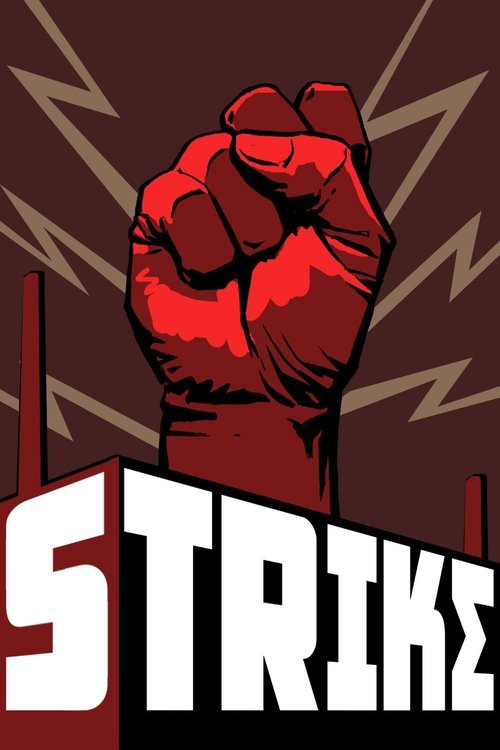
Strike
1925 · Sergei Eisenstein
For when you want cinema at full voltage — a film that grabs you by the collar rather than asks politely for your attention. This is a challenge, not a comfort watch, but a bracing and surprisingly fun one for a silent film.
What it's about
In a factory town in tsarist Russia, workers pushed past their limit organize a strike — and the film follows not one hero but the whole crowd: the organizers passing word on the shop floor, the owners in their offices treating the stoppage as a nuisance to be crushed, the spies and provocateurs sent in to break it. What begins as a demand for dignity becomes a siege, with hungry families on one side and mounted police on the other.
The experience
It moves like a fist — fast, jagged cutting that slams images together for maximum shock, swinging from biting caricature of the fat-cat bosses to sequences of real fury and horror. Nearly a century on, its anger still lands; the last stretch is genuinely hard to shake.
The craft
This is where modern editing was invented in public: Eisenstein cuts for collision, not continuity, splicing unrelated images together so the juxtaposition itself makes the argument. The compositions are astonishing — crowds moving like weather, machinery shot like sculpture — and it rewards a big screen with a good live or recorded score.
Why it matters
Eisenstein's debut feature and the founding document of Soviet montage; the editing ideas it road-tested reshaped how the whole world cut film, and it set up Battleship Potemkin the following year.
Snapshot
Strike (Stachka) is Sergei Eisenstein's debut feature film, released in the Soviet Union in April 1925. A dramatization of an unnamed factory workers' strike in pre-revolutionary Russia — loosely referencing conditions circa 1912 — the film follows a collective protagonist from the organization of the work stoppage through its brutal suppression by tsarist forces. It is the foundational document of Soviet montage cinema and the first full exposition of Eisenstein's theory of the "montage of attractions," making it indispensable to any account of twentieth-century film form. Formally radical and politically explicit, Strike announces a cinema in which editing is not a tool of continuity but a weapon of argumentation.
Industry & production
Strike was produced under the auspices of Goskino, the Soviet state film enterprise, in collaboration with the Proletkult (Proletarian Culture) Theater collective with which Eisenstein had been working as a stage director. The film was conceived as the first installment in a projected multi-part cycle titled Towards Dictatorship, intended to trace the history of the Russian revolutionary labor movement from its earliest stirrings to the Bolshevik seizure of power. In the event, the cycle was never completed as planned; Eisenstein was redirected to Battleship Potemkin (1925) almost immediately after Strike's release, and the broader series was effectively abandoned.
The production operated with the resources and organisational culture of the early Soviet film industry — constrained budgets, institutional support from a state that treated cinema as Lenin famously had, as "the most important of the arts," and a ready supply of workers, factories, and military personnel as extras. The Proletkult collective model meant that the film was shaped by a collaborative creative committee rather than a conventional directorial hierarchy, though Eisenstein was clearly the dominant aesthetic intelligence. The credited screenplay emerged from a Proletkult writing group, and the production's ethos was explicitly anti-individualist — an ideological stance that directly shaped formal choices about protagonist and narrative structure.
Technology
Strike was shot on standard 35mm orthochromatic film stock, the dominant medium of the mid-1920s. Orthochromatic stock, sensitive to blue and green light but relatively insensitive to red, produced the high-contrast, luminous quality characteristic of Soviet silent cinema and required particular discipline in lighting design to render faces and textures without blowout. The film was silent as released — dialogue and narrative information conveyed through intertitles — and designed for live musical accompaniment in exhibition, though no authorially sanctioned score exists from the period. Subsequent revivals have used scores by various composers, none of them original to the 1925 release.
The camera equipment available was standard European manufacture of the period. Eduard Tisse's facility with available and artificially augmented light, combined with location shooting in actual factory environments, meant that the technology was pushed toward expressive ends rather than merely documentary ones. Crane and low-angle setups that would have required custom rigs were achieved through the ingenuity of the production team working with limited resources.
Technique
Cinematography
Eduard Tisse, who would remain Eisenstein's cinematographer through Ivan the Terrible (1944/46), here establishes what would become one of the defining visual partnerships in cinema history. Tisse's work on Strike is characterized by extreme angles — steep overhead shots reducing workers to geometric patterns across factory floors, low angles that monumentalise machinery and crowd formations — and by compositions that echo Constructivist graphic design. The frame is treated as a field of force rather than a window: figures are massed, silhouetted, fragmented. Tisse frequently shoots into strong backlight, creating halation effects around industrial machinery that render the factory environment simultaneously oppressive and sublime. Close-up photography of faces is approached through the logic of "typage": the camera does not seek psychological interiority but legible social type, finding its subjects in the strong planes and characteristic features of actual workers and peasants.
Editing
The editing is the film's central argument. Eisenstein himself oversaw the cut, and Strike is the first cinematic demonstration of the theoretical program he had been developing in theater and in the essay "The Montage of Attractions" (1923). Montage here is not the classical continuity editing derived from Griffith — the invisible suturing of space and time to serve narrative — but a calculated collision of shots designed to produce an effect, idea, or emotion unavailable in any single image.
The film's climactic sequence, in which the cavalry massacre of striking workers is intercut with documentary footage of cattle being slaughtered in an abattoir, is the most celebrated and debated instance. The juxtaposition does not establish spatial or temporal continuity; it produces a conceptual equation — workers are slaughtered like cattle — and a visceral, affective shock. Eisenstein would theorize this mode as "intellectual montage" in later writings, distinguishing it from metric montage (cutting to rhythm), rhythmic montage (cutting to movement within the frame), and tonal montage (cutting to dominant emotional tone). Strike traverses all these registers, but the cattle sequence stands as the clearest early manifesto for cinema as a machine for producing meanings unavailable to individual shots.
The pace of the editing accelerates through the film's final acts in ways that prefigure the Odessa Steps sequence in Potemkin: rhythmic intensification as formal analog to political crisis.
Mise-en-scène / staging
Eisenstein's theatrical background — he had studied with and been profoundly shaped by Vsevolod Meyerhold, the great practitioner of biomechanics — is everywhere apparent in the staging of bodies. Actors move in stylized, physically exaggerated registers derived from Meyerhold's anti-naturalist theater, circus performance, and acrobatics. The Proletkult collective had incorporated clowning, juggling, and athletic physicality into its theatrical vocabulary, and this transfers to the film: the factory spies who surveil the workers are introduced with comedic, almost slapstick characterization, each nicknamed after an animal (Fox, Owl, Bulldog, Monkey) whose behavioral characteristics they embody.
The factory settings — shot largely on location — are integrated into the staging as active participants: gears, pulleys, pipes, and overhead structures are choreographed with the human figures to produce images of mechanical domination. Eisenstein's deployment of crowd choreography is extraordinary for 1925, managing masses of non-professional extras in complex, precisely timed formations.
Sound
Strike is a silent film. No original score was composed by Eisenstein or authorized for the initial release. The film was designed for the standard exhibition practice of live piano or orchestral accompaniment, with musicians selecting or improvising appropriate material. The question of a "correct" score remains open; various revivals have used music ranging from contemporaneous Soviet compositions to modern specially commissioned scores. Eisenstein's later theoretical writing on sound — particularly the 1928 Statement on Sound co-signed with Pudovkin and Alexandrov — would argue for asynchronous, contrapuntal use of sound rather than the illustrative synchronization that early sound cinema was adopting. The formal logic of Strike's editing already implies this: sound, had it been available, would presumably have functioned as another collision element.
Performance
In place of conventional psychological characterization, Eisenstein employs "typage" (tipazh): the casting of non-professional or carefully selected performers for their physiognomic and social legibility rather than their acting craft. Workers look like workers; foremen look like foremen; the factory owner and his associates are cast for the physical signs of bourgeois comfort and corruption. This is not documentary — it is a controlled semiotic system in which the body is a sign before it is a psychology. The approach derives philosophically from Constructivist ideas about the human as component within a larger social machine, and practically from the Proletkult theater's dismissal of individualist bourgeois acting styles.
The collective is the protagonist. No single character anchors the narrative arc, acquires interiority, or is mourned individually. This was a deliberate ideological and formal decision with significant consequences: Strike remains genuinely difficult to watch in the narrative modes most cinema had already established by 1925.
Narrative & dramatic mode
Strike radically subordinates narrative to argument. Where classical Hollywood cinema of the same period was refining the Aristotelian dramatic arc — individual protagonist, desire, obstacle, resolution — Eisenstein organizes his film as a political demonstration conducted in cinematic form. The structure is episodic: exposition of working conditions, organization of the strike, management's counter-moves, the informer network, escalation, and massacre. There is cause and effect, but the causal logic is collective and sociological rather than personal.
This is agitational cinema — agitprop in the precise Soviet sense — and the mode of address is direct. The film does not ask the viewer to identify with a character and thereby feel; it constructs images and juxtapositions calculated to produce understanding and outrage as a unified response. Intertitles function as polemical captions as much as narrative bridges.
Genre & cycle
Strike belongs to the Soviet revolutionary film cycle that flourished between roughly 1924 and 1930, a body of work including Battleship Potemkin (Eisenstein, 1925), Mother (Pudovkin, 1926), The End of St. Petersburg (Pudovkin, 1927), October (Eisenstein, 1928), Arsenal (Dovzhenko, 1929), and Earth (Dovzhenko, 1930). These films share ideological commitment, state patronage, and a broadly constructivist aesthetic orientation, but differ significantly in formal approach: where Eisenstein sought collision and intellectual shock, Pudovkin emphasized emotional identification with individual working-class protagonists, and Dovzhenko developed a lyrical, mythopoeic register indebted to Ukrainian folk culture.
The mass-protagonist film — in which a collective replaces the individual hero — is a subgenre Strike effectively inaugurates in sound cinema. It recurs in subsequent decades in various forms, though rarely with Strike's formal rigor.
Authorship & method
Eisenstein (1898–1948) came to film from engineering studies, theater design, and stage direction. His work with the Proletkult Theatre in the early 1920s, under the broad intellectual influence of Meyerhold, led him to formulate the "montage of attractions" as a theatrical concept — the calculated assembly of "shocks" to produce a desired audience response — before he had directed a feature film. Strike is the translation of this theater theory into cinema.
Eduard Tisse (1897–1961), Eisenstein's cinematographer, was a documentary cameraman with experience filming revolutionary events; his technical fluency and willingness to experiment made him an essential creative partner. The Proletkult writing collective (including figures such as I. Kravchunovsky among others) shaped the scenario, though the extent of individual contributions is not precisely documented in the scholarly record and the collective model of the production makes conventional attribution difficult. Eisenstein retained editorial control.
Movement / national cinema
Strike is a founding work of Soviet montage cinema and of Soviet national cinema broadly. The Soviet film movement of the 1920s represented one of the most theoretically self-conscious periods in film history: Eisenstein, Vsevolod Pudovkin, Lev Kuleshov (whose workshop experiments with editing had demonstrated that meaning arises between shots, not within them), Dziga Vertov, and Alexander Dovzhenko were simultaneously making films and writing extensive theoretical accounts of what they were doing. Kuleshov's earlier experiments — demonstrating that the same shot of an actor's face takes on different emotional coloration when juxtaposed with different images — provided a foundational proof of concept that Strike dramatically extends.
Era / period
Strike belongs to the period of the New Economic Policy (NEP) in the Soviet Union, a moment of relative cultural and economic openness before the Stalinist consolidation of the late 1920s and early 1930s. Soviet cinema of the NEP era was comparatively free to experiment formally, supported by state resources but not yet subject to the demands of Socialist Realism that would be codified from 1932 onward. Eisenstein's subsequent career — the troubled production of Bezhin Meadow, the compromised October, the long silence — would be shaped by the tightening of that political and aesthetic control. Strike exists in the brief window before it closed.
Themes
The film's explicit themes are the exploitation of labor, the solidarity of collective action, and the violence of capitalist-state suppression of organized workers. These are not submerged or metaphorical: the film announces them in its structure and intertitles. More formally interesting are the implicit themes: the relation between individual and collective; the semiotics of class (the body as social inscription); the nature of political cinema and its ethical claims on the viewer. The spy subplot — workers betrayed by an informer within their own ranks, the spies characterized through their animal analogs — introduces questions of legibility and deception that cut against the film's otherwise confident assertion that class position is visibly readable. The cattle/massacre intercutting raises the persistent question of whether emotional manipulation in the service of a just cause is distinguishable, formally, from manipulation in the service of an unjust one.
Reception, canon & influence
Backward influences. The most direct precursor is D.W. Griffith, whose parallel editing and management of crowd sequences in Intolerance (1916) and Birth of a Nation (1915) Eisenstein acknowledged as foundational even while rejecting their ideological content. Kuleshov's workshop experiments provided the theoretical scaffolding. The influence of Meyerhold's biomechanical theater is pervasive. Constructivist visual art — particularly the graphic design of Alexander Rodchenko and El Lissitzky — shapes the compositional vocabulary.
Initial reception. Strike was received warmly within the Soviet Union, where it was understood as a contribution to the revolutionary cultural project, though responses to its formal radicalism were not uniformly enthusiastic even within Soviet critical culture. International reception was more complicated: in Western Europe, the film was screened in left-wing and intellectual circles and was recognized as formally significant; in the United States, distribution was limited and politically fraught.
Legacy and forward influence. The film's influence on subsequent cinema is immense, operating through two partly separate channels: the direct influence of Eisenstein's montage theory on filmmakers who read his widely translated theoretical writings, and the visual and formal influence on those who saw the film. The cattle/massacre juxtaposition has become a canonical example in film education and is directly echoed in Francis Ford Coppola's baptism sequence in The Godfather (1972), where parallel editing creates a comparable ironic counterpoint between ritual and slaughter. Eisenstein's method of constructing meaning through collision rather than continuity influenced documentary filmmaking, the Soviet-derived Third Cinema of Latin America in the 1960s and 1970s, the essay film tradition, and music video editing. The mass-protagonist film and the treatment of political violence as a subject for formal argument (rather than dramatic identification) recurs across the work of filmmakers from Gillo Pontecorvo (The Battle of Algiers, 1966) to Peter Watkins.
Strike occupies a secure place in the canonical film historical account: it appears on nearly all significant academic syllabi concerned with film form or political cinema, and is routinely cited in theoretical writing on montage from Bazin's critiques onward. Bazin's famous distinction between editing that "adds" to reality (Eisenstein's cinema) and editing that "respects" reality (his preferred realism) was formulated substantially against Eisenstein's practice as exemplified in films including Strike. The film's canonical status is thus both celebrated and contested — central to the argument about what cinema is and ought to do.
A Deleuzian reading
A bull goes down.
The full Deleuzian reading of Strike →
Reception
Praised in the Soviet press as a genuinely revolutionary piece of cinema in 1925 but reportedly baffling to ordinary audiences, it was almost immediately eclipsed by Battleship Potemkin the same year — and has since been reappraised as the wilder, stranger debut that cinephiles love to champion over its famous sibling.
How Strike was received, from release to now →
Influences: the films it descends from and the films it influenced
- A Corner in Wheat (1909) — Griffith's parallel cuts between a wheat speculator's banquet and a breadline of starving poor construct political meaning through juxtaposition rather than narrative continuity, establishing the template for Strike's ironic cross-cutting between bourgeois machination and worker oppression.
- The Birth of a Nation (1915) — Griffith's methods for choreographing hundreds of extras as a unified visual mass in wide-angle long shots, punctuated by extreme close-ups, gave Eisenstein the compositional grammar he transformed into constructivist crowd staging.
- Intolerance (1916) — Griffith's intercutting across four non-continuous historical narratives to produce a thematic argument rather than suspense gave Eisenstein the structural precedent for using parallel editing as intellectual rhetoric.
- The Extraordinary Adventures of Mr. West in the Land of the Bolsheviks (1924) — Kuleshov's workshop demonstration that a shot's meaning is determined by its neighbors rather than its intrinsic content provided the theoretical scaffolding for collision montage, where juxtaposing worker bodies with animal carcasses generates meaning available in neither shot alone.
- Intolerance: Love's Struggle Throughout the Ages (1916) — Its intellectual montage—the slaughterhouse intercut with the massacre of workers—extends Griffith's metaphoric parallel cutting into pure conceptual juxtaposition.
- October (Ten Days That Shook the World) (1928) — Eisenstein systematized Strike's formal experiments into full intellectual montage, cutting between abstract symbols (medals, religious icons, bureaucratic regalia) to construct a Marxist-Leninist argument through pure associative collision.
- Salt of the Earth (1954) — Biberman cast actual striking miners as themselves (typage at documentary scale) and structured the film around a collective female protagonist, directly inheriting Strike's method of building political argument through the performed labor body rather than individual star identification.
- The Battle of Algiers (1966) — Pontecorvo cast non-professional Algerian participants as themselves, choreographed mass crowd sequences as collective political bodies, and intercutted colonial authority with resistance in the same dialectical structure Strike deploys between management and workers.
- The Hour of the Furnaces (1968) — Solanas and Getino assembled documentary footage, text, advertising imagery, and revolutionary speeches as a collision montage assault on the audience, directly applying Eisenstein's montage-of-attractions model — the calculated assembly of shocks to produce political consciousness — to Latin American Third Cinema.
- The Godfather (1972) — The baptism sequence intercuts a Catholic christening with the murders Michael orders, deploying the same ironic counterpoint structure as Strike's cattle/worker massacre cross-cut, where ritual solemnity and slaughter achieve their full meaning only through juxtaposition.
- Do the Right Thing (1989) — The direct-address racial slur montage assembles characters delivering ethnic slurs in rapid collision cuts, deploying Eisenstein's montage-of-attractions structure — the deliberate assembly of affective shocks to produce a desired audience response — as a diagnostic statement about American racism.
- JFK (1991) — Stone constructed the film's conspiracy argument through intellectual montage, intercutting documentary footage, dramatized reconstruction, and symbolic imagery in rapid succession so that the political claim emerges from collision rather than from any single evidential strand.
- Rose of Nevada (2026) — Model for the 'montage of attractions' and associative cross-cutting Jenkin uses to splice labor, landscape and symbol into a rhythmic argument rather than a scene.
- Alexander Nevsky (1938) — Pioneered typage — casting and framing non-actors by physiognomy as social types — the method Nevsky uses to make the Teutonic knights and Russian peasants legible at a glance.
- Hyenas (1992) — Eisenstein's intellectual montage — cutting slaughterhouse animals against human action to editorialize by juxtaposition — underlies Hyenas's recurring hyena/elephant/vulture inserts that gloss the townsfolk as scavenging predators.
- Touki Bouki (1973) — Eisenstein's intellectual montage intercutting cattle being butchered with human massacre is the direct precedent for Touki Bouki's graphic-match cuts between the abattoir and the human world.
- The Working Class Goes to Heaven (1971) — Originates the dialectical, percussive montage that syncs cutting rhythm to factory machinery and collective labor — the ancestor of Mastroianni's assembly-line editing cadence.
- Battleship Potemkin (1925) — In the Odessa Steps sequence Eisenstein refined Strike's collision grammar, using escalating cut rate and the intercutting of contrasting figures (soldier boots, mother's feet, runaway carriage) to extend the same dialectical editing toward maximum kinetic impact.
- Mother (1926) — Pudovkin adopted typage casting — non-professionals whose physiognomy signifies class position — and the collective labor body as dramatic protagonist, diverging from Strike only by subordinating montage to a more psychologically continuous narrative arc.
- The End of St. Petersburg (1927) — Pudovkin's intercutting between St. Petersburg Stock Exchange speculation and soldiers dying in WWI trenches directly applies Strike's intellectual montage structure — collision editing that generates a Marxist argument about capitalism and war rather than a narrative one.
- Arsenal (1929) — Dovzhenko used a collective protagonist structure and biomechanical staging of worker bodies within the Soviet montage framework Strike established, while introducing lyrical-mythological counterweights to Eisenstein's dialectical mechanics.
- Man with a Movie Camera (1929) — Vertov extended Strike's constructivist compositional vocabulary — extreme angles, graphic matching, accelerating collision cutting — into a self-reflexive formal essay that presents the urban working collective as cinema's proper subject.
- Fury (1936) — Model for Fury's associative intellectual montage — Eisenstein's shock cuts between people and animals directly license Lang's cut from gossiping townswomen to a row of clucking, cackling hens.
Similar films
- Battleship Potemkin (1925) — influence & lineage
- Man with a Movie Camera (1929) — influence & lineage
- The Birth of a Nation (1915) — influence & lineage
- Alexander Nevsky (1938) — shared sensibility
- Dear Comrades! (2020) — shared sensibility
- La Roue (1923) — shared sensibility
- The Red and the White (1967) — shared sensibility
- La Commune (Paris, 1871) (2003) — shared sensibility
All the films related to Strike →