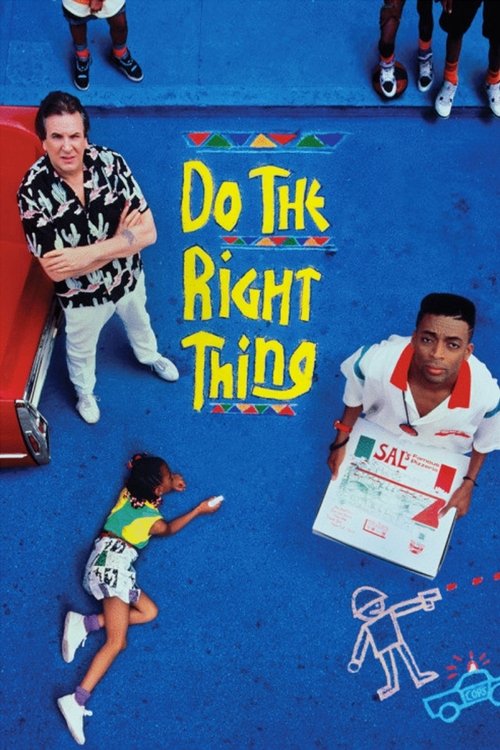
Do the Right Thing
1989 · Spike Lee
When you want a film with real heat — energy, humor, style — that also gives you something serious to chew on for days. It's a challenge wrapped in a block party, best watched when you're ready to talk about it after.
What it's about
One block of Bedford-Stuyvesant, Brooklyn, on the hottest day of the summer. Mookie delivers pizzas for Sal, the Italian-American owner of the corner pizzeria, whose Wall of Fame — all Italian stars, no Black ones — becomes a flashpoint when a local named Buggin' Out demands it change. Around that small dispute, the whole neighborhood simmers: stoop-sitters, corner men, Korean grocers, a radio DJ narrating the day, and a heat that keeps rising.
The experience
Vibrant, funny, and alive with talk and music for most of its running time — then the pressure it's been quietly building becomes impossible to ignore. It's a film that entertains you thoroughly and still leaves you arguing with yourself on the way out.
Performances
Danny Aiello gives Sal real warmth and real blind spots, so nothing about him is simple; Spike Lee is wry and watchful as Mookie; and Ossie Davis and Ruby Dee bring quiet gravity as the block's elders.
The craft
The colors run hot — reds and oranges saturating every frame — with tilted angles, characters talking straight into the camera, and Public Enemy's 'Fight the Power' pounding through the day like a pulse. The whole block was built and controlled like a stage set, and the film's rhythm, cut to music and rising temperature, rewards good speakers.
Why it matters
One of the most debated American films of its era, it made Spike Lee a major cultural force and set the terms for how movies talk about race, community, and police violence — conversations it still anchors decades later.
Snapshot
Do the Right Thing compresses a portrait of American racial tension into twenty-four hours on a single block of Bedford-Stuyvesant, Brooklyn, during the hottest day of a New York summer. Spike Lee — who wrote, produced, directed, and stars as Mookie, a pizza-delivery man drifting through his own neighborhood — builds the film as a mosaic of the block's residents: Sal (Danny Aiello), the Italian-American owner of the corner pizzeria; his sons Pino (John Turturro) and Vito (Richard Edson); the Korean grocers across the street; the cluster of stoop-sitting elders and corner men; Da Mayor (Ossie Davis) and Mother Sister (Ruby Dee); the DJ Mister Señor Love Daddy (Samuel L. Jackson), who narrates the day from his storefront radio booth. The plot's nominal engine is small — Buggin' Out (Giancarlo Esposito) demands that Sal put Black faces on the pizzeria's "Wall of Fame," and Radio Raheem (Bill Nunn) refuses to lower the volume on his boombox blaring Public Enemy's "Fight the Power." But the film's true subject is heat: the slow accumulation of grievance, micro-aggression, pride, and economic frustration until a confrontation at the pizzeria ends in Radio Raheem's death at the hands of police and the destruction of Sal's by a grieving, enraged crowd. Lee refuses to resolve the moral question he stages, closing on dueling epigraphs from Martin Luther King Jr. and Malcolm X. It is one of the defining American films of its decade — formally electric, deliberately provocative, and still argued over.
Industry & production
Do the Right Thing was Spike Lee's third feature, made through his own company, 40 Acres and a Mule Filmworks, and distributed by Universal Pictures. It followed his breakout independent debut She's Gotta Have It (1986) and the studio-backed musical School Daze (1988); by 1989 Lee had enough leverage to mount an original, racially charged ensemble drama with a major studio behind it — itself a notable fact in a Hollywood that rarely financed Black-authored work of this ambition. The film was made on a modest budget (commonly reported in the neighborhood of six to seven million dollars, though I'd flag the exact figure as something to confirm against production records), and Lee documented its making in a published companion journal, an unusually candid record of how the project was conceived and financed.
Production centered on a real block — Stuyvesant Avenue between Lexington and Quincy in Bedford-Stuyvesant — which the production effectively took over and transformed for the summer 1988 shoot, dressing storefronts, building Sal's Famous Pizzeria as a set, and working with the neighborhood through a period of intensive location filming in genuine heat. The ensemble fused respected veterans of Black American theater and film — Ossie Davis and Ruby Dee, a real-life couple and civil-rights-era icons — with a generation Lee was helping to launch: Rosie Perez made her screen debut, Martin Lawrence appears among the corner men, and Samuel L. Jackson took an early, indelible role. Danny Aiello's Sal and John Turturro's Pino gave the film its central white perspectives, written with more sympathy and dimension than the provocation around the film often acknowledged.
The film premiered in competition at the 1989 Cannes Film Festival and opened in the United States that summer. Its release was attended by a now-famous wave of anxious commentary — several prominent critics warned, in print, that the film might incite Black audiences to riot, a prediction that did not materialize and that Lee and many later writers identified as revealing more about the critics' assumptions than about the film. It earned two Academy Award nominations, for Lee's original screenplay and for Aiello's supporting performance, and its omission from the Best Picture and Best Director races — in a year when Driving Miss Daisy won Best Picture — became a durable touchstone in debates about the Academy and race.
Technology
Do the Right Thing is a photochemical 35mm production made with the conventional tools of late-1980s studio filmmaking; its innovations are aesthetic and procedural rather than technological. The relevant craft achievement is one of color and heat: cinematographer Ernest Dickerson and the production designed a visibly warm, saturated palette — reds, oranges, browns — and pushed lighting and color to make the audience feel the temperature of the day. Accounts of the production describe deliberate efforts to warm the image and stage the block as a kind of pressure cooker, with the recurring on-screen heat (open hydrants, sweat, the DJ's temperature reports) reinforced by the look of the film itself. I won't overstate the technical specifics beyond that the film's "technology" is essentially the expressive use of color photography and saturated lighting rather than any novel apparatus.
Technique
Cinematography
The photography is by Ernest Dickerson, Lee's NYU film-school classmate and the cinematographer of his first features, and it is one of the most assertive bodies of camerawork in late-'80s American cinema. Dickerson saturates the film in hot color and stages it with an unusually mobile, expressive camera: low and wide angles, canted "Dutch" framings that tilt the world off its axis as tensions rise, and a roving sense of the block as a connected, theatrical space. The most celebrated formal gesture is the direct-address montage of racial slurs, in which characters of each ethnic group on the block face the camera and hurl invective straight down the lens — a Brechtian rupture that breaks the fiction to confront the audience. Dickerson's images give the film both its sensual surface — the beauty and vitality of the neighborhood — and its mounting unease, the visual register sliding from warmth toward something hallucinatory and overheated as the day turns.
Editing
The film was cut by Barry Alexander Brown, a long-term Lee collaborator. The editing sustains a daylong rhythm that is leisurely and ensemble-driven for much of its length — drifting among vignettes, conversations, and comic interludes that establish the block's web of relationships — before tightening sharply in the final act. The pivot from mosaic to catastrophe is an editorial achievement: the cross-cutting of the confrontation at Sal's, Radio Raheem's death, and the eruption of the crowd accelerates the film from its loose, observational mode into a compressed, almost unbearable climax. The famous beat in which Mookie throws a trash can through the pizzeria window — the film's most debated single action — is staged and cut as a hinge on which the entire moral argument turns.
Mise-en-scène / staging
Wynn Thomas's production design makes the block itself the film's protagonist: Sal's pizzeria, the Korean market, the brick wall where the elders sit, the radio booth, the painted murals and signage all establish a complete, legible social geography. Lee stages the film with a theatrical respect for unity of time and place — one day, one block — that lends it the concentrated inevitability of classical tragedy. The Wall of Fame, the boombox, the open fire hydrant, and the heat are deployed as recurring objects that gather symbolic charge through repetition. The staging is choreographic: characters circulate, cross, and collide along the street in patterns that map the community's alliances and frictions, so that the physical space dramatizes the social one.
Sound
Sound is central to the film's meaning. The original score is by Bill Lee — Spike Lee's father, a jazz bassist — whose orchestral-jazz writing supplies a lyrical, melancholic counter-voice to the street's noise. Against it runs the film's other musical pole: Public Enemy's "Fight the Power," written for the film and functioning as Radio Raheem's anthem and the picture's recurring sonic motif, blasting from his boombox until the volume itself becomes a casus belli. The collision of Bill Lee's jazz and Public Enemy's hip-hop stages, in sound alone, a generational and political argument. Mister Señor Love Daddy's radio broadcast threads through the film as a continuous aural narrator, his temperature reports and song dedications binding the block into one listening community.
Performance
The ensemble performances are pitched between naturalism and a heightened, near-operatic theatricality. Danny Aiello gives Sal genuine warmth and contradiction — a man who believes he loves the neighborhood that feeds him and cannot see his own paternalism or the slur he reaches for under pressure. John Turturro's Pino carries the film's most undisguised racism, written and played with enough specificity to feel like a real and frightening character rather than a cartoon. Bill Nunn's Radio Raheem is monumental and largely silent, his "love/hate" knuckle monologue a set piece; Giancarlo Esposito's Buggin' Out supplies the comic-righteous spark. Ossie Davis and Ruby Dee lend gravitas and tenderness as Da Mayor and Mother Sister, and Lee's own Mookie is deliberately opaque — a watcher and intermediary whose climactic choice the film refuses to explain.
Narrative & dramatic mode
The film's dramatic mode is the ensemble "day in the life" raised to the structure of tragedy. It eschews a single protagonist and a conventional plot arc in favor of an accretive, episodic design: a long, warm, often comic first movement that establishes the community in all its texture, followed by a swift, violent collapse. Lee withholds the consolations of resolution. He does not tell the viewer whether Mookie did "the right thing" in throwing the trash can; he ends on two contradictory epigraphs — King's case against violence and Malcolm X's argument for self-defense — and a photograph of the two men together, leaving the moral question open as a deliberate provocation. The mode is dialectical rather than didactic: the film is built to argue with itself and with the audience, refusing to resolve the tension it so carefully constructs.
Genre & cycle
Do the Right Thing is at once a social-problem drama, an ensemble street comedy, and a tragedy, and it belongs to the cycle of Black American filmmaking that Lee himself was inaugurating at the end of the 1980s. It stands as a foundational text of the late-'80s/early-'90s wave of Black-authored cinema that would soon include Boyz n the Hood (1991), Juice (1992, shot by Dickerson, who also directed it), Menace II Society (1993), and Lee's own subsequent work. Against Hollywood's tradition of films about race made from outside the Black experience, it asserts an authored insider's perspective. Its fusion of comedy, music, and politics, and its formal audacity, also distinguish it from the more naturalistic urban dramas that followed in its wake.
Authorship & method
Do the Right Thing is among the purest expressions of Spike Lee as an auteur: he wrote, directed, produced, and acted in it, and it crystallizes the concerns and methods that define his career — race in America as the country's central, unresolved subject; the city block as a stage; the fusion of polemic, humor, and formal experiment; and the refusal to offer comfortable answers. His signature devices appear in mature form here: direct address to the camera, the "double dolly" floating-character shot he would use throughout his work, music as argument, and a willingness to break realism for rhetorical effect.
The authorship is, however, deeply collaborative within Lee's repertory company. Cinematographer Ernest Dickerson is the co-architect of the film's look and one of Lee's most important early creative partners. Editor Barry Alexander Brown would remain a career-long collaborator. Production designer Wynn Thomas built the film's world. Composer Bill Lee, the director's father, supplied the score, while Public Enemy provided its anthem — making the soundtrack itself a dialogue between generations and idioms. The casting of Ossie Davis and Ruby Dee consciously linked Lee's project to the lineage of the civil-rights generation. The result is a film unmistakably stamped by a single authorial vision yet realized through a tight ensemble of recurring collaborators.
Movement / national cinema
The film is a landmark of American independent and African-American cinema, made at the hinge where Lee moved from the margins of independent film into engagement with the studio system without surrendering authorial control. It is not affiliated with a formal movement, but it functions as the leading edge of the New Black Cinema of the late 1980s and 1990s — a body of work by Black American directors who claimed the resources of feature filmmaking to tell stories from within their own communities. Its aesthetic absorbs influences from European modernism (the Brechtian address, the expressive color) and from the American musical and the social-problem film, but its national-cinema significance is its insistence on a Black American authorial voice at the center of a mainstream-scaled production.
Era / period
Released in 1989, Do the Right Thing speaks directly to the racial climate of Reagan-era and late-1980s New York — a city marked by economic inequality, gentrification pressures, and a series of racially charged incidents of police and vigilante violence. The film's dedication to the families of real victims of racial violence, and Radio Raheem's death by police chokehold, register specific contemporary traumas; the chokehold and the crowd's response evoke the deaths of figures such as Michael Stewart and the broader pattern of conflict between Black New Yorkers and the police. The film captures a particular moment of urban tension on the eve of the 1990s, and its themes proved enduring: its imagery and its title have been repeatedly invoked across decades of subsequent debate over policing and race in America.
Themes
The film's governing theme is racism as a structural and atmospheric condition rather than a matter of individual villains — the way prejudice saturates ordinary interaction and erupts under pressure of heat, frustration, and economic powerlessness. Bound to it is the question of violence and its justification: the closing King/Malcolm X epigraphs frame the central, unresolved argument over whether the destruction of Sal's is a moral catastrophe, a legitimate response to a killing, or both. Property versus life is posed sharply — the film's structure asks why Radio Raheem's death registers, for some viewers, as less outrageous than the burning of a pizzeria. Economic relations across racial lines run throughout: who owns the businesses in a Black neighborhood, who works in them, and who merely passes through. Community — its warmth, its vitality, its surveillance and its fragility — is rendered with deep affection, making the final rupture a genuine loss. And the heat itself operates as a master metaphor for accumulating, finally combustible, social pressure.
Reception, canon & influence
Critical reception in 1989 was strong but charged. The film was widely praised for its formal energy, its performances, and its refusal of easy answers, and it earned Academy Award nominations for Lee's screenplay and Aiello's performance. It was also the object of the era's most-discussed critical anxiety: several prominent reviewers publicly worried the film would provoke real-world violence — a reaction Lee and later commentators read as exposing the very prejudices the film anatomizes. Its treatment at Cannes and at the Oscars — passed over for the directing and Best Picture races in a year that crowned Driving Miss Daisy — became a lasting emblem in arguments about how the film establishment recognizes Black work. Its canonical standing is now secure: it was selected for the Library of Congress National Film Registry in 1999 as a culturally significant American film and is routinely ranked among the great American films.
Backward — influences on the film: Lee draws on the structural discipline of classical tragedy — the unities of a single day and a single place — and on the American musical and social-problem traditions; the direct-address and anti-illusionist devices carry a Brechtian, modernist inheritance. The casting of Davis and Dee deliberately invokes the civil-rights generation and the history of Black American performance. Its political voice is continuous with the Black radical and hip-hop cultures of its moment, embodied in Public Enemy's anthem. (Lee has spoken about his influences in interviews and in his production journal; readers should consult those primary sources for his own account rather than rely solely on this summary.)
Forward — its legacy: Do the Right Thing helped open the door for the wave of Black-authored American features of the early 1990s and established Spike Lee as a major directorial voice and a model of the independent auteur working with studio resources. Ernest Dickerson's cinematography here advanced his own career into directing. The film's images, its title, and its King/Malcolm X framing have been continually recirculated in subsequent decades of public reckoning with policing and racial violence — Radio Raheem's death by chokehold has been repeatedly cited as eerily prophetic. Its formal influence is visible across later American cinema's willingness to fuse politics, comedy, music, and stylization, and it remains a fixed reference point in any account of how American film has confronted race. Few films of its era have proven so durable an instrument for thinking about the unfinished questions it refused to resolve.
A Deleuzian reading
Mister Señor Love Daddy leans into his microphone and says WAKE UP, and the block wakes up.
The full Deleuzian reading of Do the Right Thing →
Reception
In 1989 some critics literally warned it would incite riots, Cannes passed it over, and the Oscars didn't even nominate it for Best Picture — the year Driving Miss Daisy won. Now it's untouchable: National Film Registry in its first eligible year and a fixture near the top of the Sight & Sound poll.
How Do the Right Thing was received, from release to now →
Influences: the films it descends from and the films it influenced
- A Raisin in the Sun (1961) — Ossie Davis/Ruby Dee-era stage-rooted Black ensemble acting and the single-locale theatrical staging that Lee literalizes by casting that civil-rights generation and confining the drama to one block.
- Killer of Sheep (1978) — L.A. Rebellion neorealism that builds drama from a Black neighborhood's daily textures and music cues rather than plot, the day-in-the-life mosaic Lee adopts and heats up.
- Nashville (1975) — large overlapping ensemble mosaic that lets dozens of minor characters accrete across one place and time until a single act of violence detonates the whole social fabric.
- Sweet Sweetback's Baadasssss Song (1971) — the militant independent Black auteur model—self-financed, self-directed, scored to contemporary Black music as polemic—that licenses Lee's fusion of agitprop and stylization.
- Rashomon (1950) — the dialectical open ending that refuses a single moral verdict, leaving viewers to arbitrate competing truths—mirrored in Lee's closing King/Malcolm X quotations.
- The Battle of Algiers (1966) — documentary-pulse staging of a community boiling toward street violence, with crowd choreography and escalation that legitimize the political rather than psychologizing it.
- Touch of Evil (1958) — expressionist Dutch angles, wide-angle distortion and diegetic source music defining a hot, corrupt borderland—Welles's anti-realist tilt that Dickerson reanimates as heat and dread.
- She's Gotta Have It (1986) — Lee's own prototype for direct address to camera and the Brooklyn block as a stage—self-conscious anti-illusionist devices later matured here.
- Mean Streets (1973) — Lee absorbed Mean Streets' strategy of deploying a single licensed track as structural refrain and moral announcement — Public Enemy's 'Fight the Power' functions exactly as 'Be My Baby' does — and applies it to a similarly cramped, neighborhood-specific mise-en-scène where community space is both arena and cage.
- Strike (1925) — The direct-address racial slur montage assembles characters delivering ethnic slurs in rapid collision cuts, deploying Eisenstein's montage-of-attractions structure — the deliberate assembly of affective shocks to produce a desired audience response — as a diagnostic statement about American racism.
- The Night of the Hunter (1955) — Radio Raheem's LOVE/HATE brass knuckles directly reprise Powell's knuckle-tattoo sermon, importing the film's good-versus-evil emblem as character iconography.
- Mississippi Burning (1988) — The counter-model released the same season, recentering Black agency and interiority precisely against the marginalization Mississippi Burning was attacked for — defining itself by opposition to Parker's frame.
- Mo' Better Blues (1990) — carries forward the same repertory company—Dickerson's saturated lensing, Bill Lee's jazz score, the double-dolly floating shot—into a sustained study of jazz vs. idiom.
- Boyz n the Hood (1991) — directly inherits the day-in-the-neighborhood structure and the social-problem drama building inexorably to fatal street violence, the template Lee opened for hood cinema.
- Menace II Society (1993) — extends the mosaic-to-catastrophe rhythm and stylized neighborhood portraiture, fusing hip-hop scoring with kinetic, heightened violence as Lee modeled.
- Juice (1992) — Lee's own cinematographer graduating to director, transplanting the saturated palette and street-corner ensemble of Do the Right Thing into his debut feature.
- Crooklyn (1994) — another Brooklyn-block day-in-the-life ensemble using diegetic radio/pop music as period argument and Wynn Thomas's lived-in neighborhood design.
- Magnolia (1999) — inherits the heightened-ensemble mosaic across one city stretch built on diegetic music-as-argument, escalating polyphony toward a single cathartic eruption.
- Do the Right Thing's heir Crash (2004) — transplants the intersecting-strangers racial-tension mosaic detonating into violence, though it resolves the dialectic Lee deliberately left open.
- BlacKkKlansman (2018) — late-Lee return to the same toolkit—direct political address, archival King/Malcolm-style framing, and a closing montage that ruptures fiction to indict present-day racial violence.
- My Father's Shadow (2025) — Compresses a community to a single day threaded by diegetic radio broadcast, the on-air voice acting as the off-screen barometer of a tension building toward political rupture.
- Inside Man (2006) — The formal engine Inside Man runs on: Barry Alexander Brown's editing rhythms established here as Lee's collaborative baseline, Terence Blanchard's scoring relationship with Lee initiated here, and the Brechtian direct-address interrupt — a character speaking to camera from an indeterminate space — first deployed here as Lee's signature genre frame-break.
- La Haine (1995) — Lee's single-day dramatic compression within a racially segregated urban block, with hip-hop deployed as political narration and violence structurally deferred until it implicates the entire social system, is the direct template for La Haine's Aristotelian unities and its climactic withholding.
- Malcolm X (1992) — Lee and Dickerson's lateral floating-dolly shot — the subject gliding through urban space while the environment tracks behind, creating the impression of political buoyancy or exposure — was developed to its definitive form here and transplanted directly into Malcolm X as the visual signature of Malcolm's ascent and vulnerability.
- School Daze (1988) — the immediately prior Lee/Dickerson/Wynn Thomas experiment in musical-number stylization and color-coded factional staging, rehearsing the heightened ensemble and music-as-argument structure.
- A Bronx Tale (1993) — Compresses interracial racism into the theater-in-the-round staging of a single block, the same single-neighborhood pressure-cooker of ethnic tension A Bronx Tale dramatizes through Calogero's romance.
- I'm No Longer Here (2019) — The block rendered as a saturated subcultural mise-en-scène whose territory is defined by a character's diegetic boombox, the same music-marks-space logic cumbia rebajada performs for Frías's neighborhood.
- Fury (1936) — Modern sibling that revives Fury's core mechanism — an ordinary neighborhood incrementally pressured until it erupts into collective violence — with heat and staging engineering the crowd's tipping point.
Similar films
- Boyz n the Hood (1991) — influence & lineage · same viewing thread · often watched together
- BlacKkKlansman (2018) — influence & lineage · same viewing thread
- Crooklyn (1994) — influence & lineage
- She's Gotta Have It (1986) — influence & lineage
- Menace II Society (1993) — influence & lineage · same viewing thread
- American History X (1998) — same viewing thread · often watched together
- Malcolm X (1992) — same viewing thread
- Straight Outta Compton (2015) — same viewing thread
All the films related to Do the Right Thing →
Watch it with: curated runs of related films
- Reckoning with the Color Line — A run through a century of American film on race — from the movie that industrialized screen racism to the ones that talk back to it — best watched in rough chronological conversation.
Film essays and courses that include it
- Everybody Talks at Once: The Art of the Ensemble Film
- The Game and Those Outside It: A Century of Class on Film
- The City as Pressure: New York Cinema, 1948–2008
- Drop the Needle: Pop Music as Cinema's Beating Heart
- The Camera That Takes a Side
- The Organism Made of Strangers
- The Tilt That Says Something Is Wrong