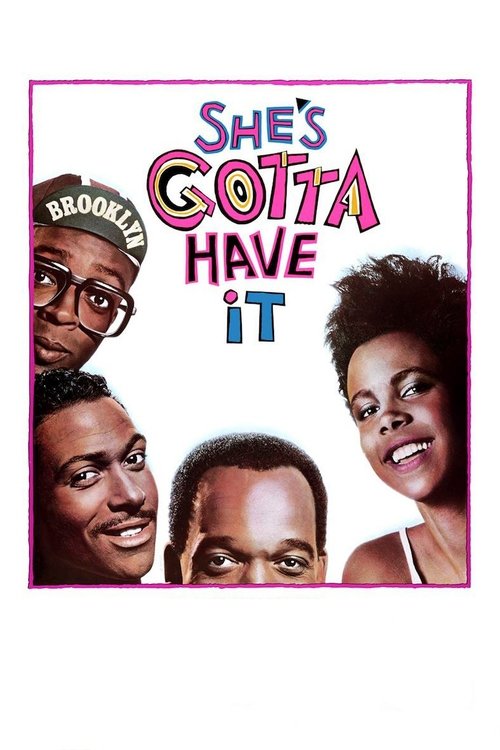
She's Gotta Have It
1986 · Spike Lee
For when you want something fresh, sexy, and a little scrappy — a film that flirts with you and picks a fight at the same time. Great for a night when polished won't cut it and you want personality.
What it's about
Nola Darling is a young artist in Fort Greene, Brooklyn, openly seeing three very different men — and refusing to choose, because choosing feels like being owned. Each lover, plus friends and Nola herself, testifies straight to the camera, and their accounts don't agree. What emerges is a funny, contentious group portrait of one woman's independence and everyone else's inability to handle it.
The experience
Talky, flirty, and fast on its feet — it plays like eavesdropping on the best argument at a party. The direct-to-camera confessions keep it playful even when the questions underneath (desire, ownership, who gets to define a woman) are dead serious.
Performances
Tracy Camilla Johns gives Nola a cool, amused self-possession that holds the whole film together, and Spike Lee steals scenes as Mars Blackmon, the motor-mouthed bike messenger whose pleading became instantly iconic.
The craft
Shot in crisp black and white on a tiny budget in Brooklyn, with one exuberant burst of color for a dance sequence, it turns its constraints into style. The fourth-wall-breaking testimony structure — characters deposed like witnesses — was a bold formal signature for a first feature.
Why it matters
The debut that launched Spike Lee and helped ignite the late-'80s American independent boom, proving a micro-budget film about Black life in Brooklyn could be a cultural event.
Snapshot
She's Gotta Have It is the debut feature of Spike Lee, a low-budget, black-and-white independent film shot in Brooklyn that announced one of the most consequential authorial voices of the American independent movement. Centered on Nola Darling, a young Black woman in Fort Greene who maintains simultaneous relationships with three men and refuses to subordinate her autonomy to any of them, the film is at once a sex comedy, a romantic roundelay, and a self-conscious essay on desire, ownership, and the politics of looking. Its formal signature is direct-address testimony: characters speak to the camera as if deposed, assembling a fractured, contradictory account of a woman whom none of them can fully possess or explain. Made for a reported sum in the low tens of thousands of dollars over a compressed shooting schedule, the film became a breakout success on the festival and arthouse circuit, won a notable prize at Cannes, and effectively inaugurated a new wave of Black American filmmaking in the late 1980s and 1990s. It established the template — economic, aesthetic, and institutional — for Lee's subsequent career and for a generation of filmmakers who followed.
Industry & production
The film was produced through Lee's company, 40 Acres and a Mule Filmworks, and stands as a paradigmatic case of guerrilla independent production. Lee had previously made the student thesis film Joe's Bed-Stuy Barbershop: We Cut Heads at NYU's Tisch School of the Arts, and She's Gotta Have It was conceived as a feature that could be realized on minimal capital. The budget was famously small — figures in the range of roughly $175,000 are commonly cited, with the shoot itself completed in about twelve days, financed through a patchwork of grants, deferments, personal funds, and contributions from family and supporters. (The precise financing breakdown is partly the stuff of Lee's own retelling, and exact figures should be treated as approximate rather than audited.)
The production exemplified the constraints-as-method ethos: black-and-white stock was cheaper than color; a single principal location and a small cast kept costs down; and the testimonial structure allowed scenes to be staged simply and quickly. After completion, the film was acquired for distribution by Island Pictures, the same outfit then active in releasing edgy independent and music-adjacent work, and it opened in 1986 to strong arthouse business, returning many multiples of its cost. Its commercial performance — outsized relative to budget — made it a proof of concept that a Black independent film addressing Black urban life could find a crossover audience, and it gave Lee the leverage to move toward studio-adjacent financing for subsequent projects.
Technology
She's Gotta Have It was shot on 16mm black-and-white film, a deliberate economic and aesthetic choice. The 16mm format kept stock and processing costs low and lent the image a grainy, intimate texture appropriate to its observational, quasi-documentary register. The film is overwhelmingly monochrome, with one celebrated exception: the "Dance of the Apache" / birthday sequence rendered in color, a burst of stylization that breaks the black-and-white frame for a choreographed interlude. This single color insert is the film's most conspicuous technological gesture, and it signals Lee's early willingness to rupture realist surfaces with overt artifice.
Production tools were correspondingly modest: available and practical lighting, lightweight camera setups suited to cramped interiors, and synchronous sound recorded under field conditions. There is nothing technologically advanced about the film's apparatus; its innovation lies in marshalling humble means toward a confident formal program rather than in any equipment novelty.
Technique
Cinematography
The cinematography was by Ernest Dickerson, Lee's NYU classmate and his most important early collaborator, who would shoot Lee's films through the early 1990s. Working in high-contrast black and white on 16mm, Dickerson gives the film a textured, expressive monochrome — chiaroscuro that flatters Brooklyn interiors and faces while keeping the budget visible as a virtue rather than a liability. The compositions favor frontality, particularly in the direct-address segments, where characters are framed in plain, confessional medium shots against simple backdrops. Nola's loft, with its ritual bed lit by candles, becomes the film's visual anchor, photographed with an intimacy that is by turns tender and clinical. Dickerson's eye for the specific surfaces of Black Brooklyn — brownstones, stoops, parks — grounds the film's stylization in a recognizable lived geography, and his work here is an early demonstration of the lyrical urban realism he would extend across Lee's subsequent films.
Editing
Lee edited the film himself, and the cutting is fundamental to its meaning. The testimonial structure depends on montage: the film assembles its portrait of Nola by intercutting the conflicting depositions of her three lovers — Jamie Overstreet, Greer Childs, and Mars Blackmon — along with secondary witnesses, so that narrative "truth" emerges only through juxtaposition and contradiction. The editing repeatedly cuts away from dramatized scenes to a character addressing the camera, breaking continuity to foreground the act of narration. Comic rhythm is also editorial: Mars Blackmon's rapid, repetitive verbal riffs ("Please baby, please baby, please baby baby baby please") are shaped in the cutting room into staccato runs. The color dance sequence functions as an edited set-piece interruption. Throughout, the editing prioritizes voice and perspective over spatial-temporal seamlessness, making structure itself a subject.
Mise-en-scène / staging
The film's staging is economical and theatrical, organized around a handful of intimate spaces — chiefly Nola's bed, which Lee treats as a near-ceremonial site. The bed becomes a recurring tableau, dressed and lit as a stage on which Nola receives and dismisses her suitors. Direct-address segments are staged with minimal furniture and a fixed frontal address, emphasizing testimony over environment. The compactness of the staging is partly budgetary but also expressive: it concentrates attention on bodies, faces, and talk. Brooklyn exteriors — Fort Greene Park, the neighborhood streets — open the film outward and locate Nola within a specific community, while the interiors keep the drama claustrophobically centered on the contest over her attention.
Sound
The score was composed by Bill Lee, the director's father, a jazz bassist, whose acoustic jazz underscoring gives the film a warm, idiomatically Black-musical texture that distinguishes it from the synthesizer-driven soundtracks common to mid-1980s cinema. The music situates the film within an African American cultural lineage and lends the romantic and comic material an unforced lyricism. The sound design otherwise reflects its low-budget origins — direct, unglamorous dialogue recording — but the dialogue is the point: the film is built on speech, on the rhythms of testimony and the comic cadences of Mars Blackmon. Diegetic music and the jazz score together knit the disparate voices into a coherent emotional fabric.
Performance
The film rests on a small ensemble. Tracy Camilla Johns plays Nola Darling with a guarded, watchful poise that resists the audience's — and the men's — attempts to define her; her performance withholds as much as it reveals, which is essential to a character constructed as a site of competing projections. Of the three suitors, Tommy Redmond Hicks plays the earnest, possessive Jamie; John Canada Terrell plays the vain, status-obsessed Greer; and Spike Lee himself plays Mars Blackmon, the fast-talking, bicycle-riding, sneaker-obsessed comic foil whose motormouth charm nearly steals the film. Lee's Mars became an instant cultural figure — so much so that the character was later revived in Lee's Nike advertising with Michael Jordan. The performances are pitched between naturalism and comic stylization, suited to a film that constantly reminds us we are watching constructed accounts of a person rather than the person herself.
Narrative & dramatic mode
She's Gotta Have It is structured as a polyphonic testimony, a Rashomon-like assembly of competing first-person accounts delivered largely through direct address to the camera. There is no single omniscient narrator; instead, Nola and the people around her each testify, and the viewer must reconcile their contradictions. This deposition structure makes the film a study in the unreliability and partiality of perspective, particularly the male perspectives that seek to claim Nola. The dramatic mode oscillates between romantic comedy and something more searching and essayistic. The central engine is not a conventional plot toward marriage but a sustained argument about autonomy: Nola's refusal to be "owned," and the men's varied inability to accept that refusal. The film's tone modulates from broad comedy (Mars) to wounded earnestness (Jamie) to satire of bourgeois vanity (Greer), and it culminates in a darker register — a coercive episode involving Jamie that has been the subject of significant critical reconsideration, and which Lee himself has publicly expressed regret about in later years. The ending leaves Nola's autonomy reasserted rather than resolved into coupledom, a refusal of romantic-comedy closure.
Genre & cycle
The film sits at the intersection of romantic comedy, sex comedy, and the talky, character-driven independent drama. It belongs to the mid-1980s American independent cycle that saw modestly budgeted, formally adventurous features break out of the festival circuit — a moment also associated with films like Jim Jarmusch's Stranger Than Paradise (1984), with which it shares black-and-white minimalism and a downtown sensibility. More importantly, it is the inaugurating work of a new cycle of Black American independent and studio filmmaking that would crest at the turn of the 1990s, and it helped define a strain of Black urban cinema attentive to community, vernacular, and sexuality. As a sex comedy told substantially from a woman's claim to her own desire, it complicated the genre's usual gendering of the libidinal gaze.
Authorship & method
The film is a near-total expression of Spike Lee's authorship: he wrote, directed, edited, and co-starred, and produced it through 40 Acres and a Mule. His method here — constraint-driven, vernacular, formally self-conscious, politically engaged, and rooted in a specific Black Brooklyn milieu — established the signature he would carry forward. The film also crystallized his most important early collaborations: cinematographer Ernest Dickerson, whose expressive monochrome defined the look; composer Bill Lee, the director's father, whose acoustic jazz scored this and several subsequent Lee films; and the nascent 40 Acres and a Mule production apparatus, including family members and a recurring company of collaborators. Lee's authorial method foregrounds the director-as-figure — both through his on-screen presence as Mars and through the film's reflexive structure, which keeps the act of storytelling visible. The screenplay is Lee's own, built around monologue and testimony rather than tightly plotted causality, a writing strategy well matched to low-budget shooting and to the film's thematic interest in perspective.
Movement / national cinema
She's Gotta Have It is a landmark of American independent cinema and, more specifically, the foundational text of the late-1980s/1990s renaissance in Black American filmmaking. It demonstrated that a Black filmmaker could finance, produce, and distribute a film on his own terms and reach a crossover audience, and it is routinely credited with helping open the door for the cohort that followed — among them John Singleton, the Hughes brothers, Mario Van Peebles, and others working in Black-centered narratives in the years after. Within the broader story of New York independent film, it belongs alongside the downtown 1980s scene, but it is distinguished by its specific rootedness in Black Brooklyn and African American vernacular culture, which it placed at the center rather than the margin of American screen life.
Era / period
The film is firmly of its mid-1980s moment in both production economics and cultural texture. Its sneakers, its bicycle, its jazz, its Fort Greene geography, and Mars Blackmon's hip-hop-adjacent patter capture a pre-gentrification Brooklyn on the cusp of major cultural shifts. It arrived at a juncture when American independent film was acquiring new institutional infrastructure — festivals, specialty distributors like Island, and an arthouse appetite for distinctive voices — and it exploited that infrastructure decisively. The film also anticipates the sexual-political conversations of its era, engaging questions of female autonomy and the male gaze in ways that the period's mainstream romantic comedies largely avoided, even as its handling of consent now reads as bound to, and partly compromised by, the attitudes of its time.
Themes
The film's central theme is female sexual autonomy and the resistance to being possessed: Nola insists on defining her own desire against three men who each, in different ways, want to own her. Around this core, the film develops a cluster of related concerns — the unreliability of perspective and the impossibility of fully knowing another person, dramatized through its contradictory testimonies; the vanity, insecurity, and proprietary impulses of masculinity, satirized across the three suitors as distinct masculine types; the politics of looking and the gendered gaze; and the specificity of Black community, class, and self-presentation, registered through dress, speech, and milieu. The film is also, reflexively, about storytelling itself — about who gets to narrate a woman's life. Its most fraught thematic element is its treatment of sexual coercion, which sits in tension with its liberatory premise; this contradiction has made the film a recurring case study in feminist and Black-feminist film criticism, and Lee's own later acknowledgment of the scene's failure has become part of the work's reception history.
Reception, canon & influence
On release in 1986 the film was a critical and commercial success for its scale, earning Lee wide attention as a major new talent and winning the Prix de la Jeunesse (Award of the Youth) at the Cannes Film Festival. Critics praised its wit, its freshness, its formal daring, and the arrival of a distinctive voice; it became one of the defining independent successes of its year and a touchstone in discussions of Black representation on screen.
Influences on the film (backward): Lee drew on a multiplicity of sources — the perspectival, contradictory storytelling associated with Kurosawa's Rashomon; the direct-address and reflexive strategies of European modernist cinema and the French New Wave; the black-and-white minimalism of contemporary downtown independents such as Jarmusch; and, crucially, African American cultural traditions in music, vernacular speech, and community life, channeled in part through his father's jazz score. The film synthesizes art-cinema technique with a specifically Black American idiom.
Legacy (forward): The film's influence is large and multidirectional. It launched Spike Lee's career and the 40 Acres and a Mule enterprise, leading directly to School Daze, Do the Right Thing, and the body of work that follows. It is widely regarded as a catalyst for the late-1980s/1990s wave of Black American filmmaking, expanding the industrial and imaginative space for Black-authored stories. Its character Mars Blackmon entered popular culture and the advertising mainstream through Lee's Nike/Air Jordan campaigns. In 2019 it was the subject of Lee's own Netflix series adaptation, which reworked Nola's story for a contemporary, more explicitly feminist frame and revisited the original's most criticized material. The 1986 film has been recognized as a culturally and historically significant work — including selection for preservation in the United States National Film Registry — and it remains a fixture in scholarship on independent cinema, Black film, and feminist screen studies. Its dual legacy — as a liberatory landmark and as a work whose treatment of consent its own maker came to disown — is precisely what keeps it actively discussed rather than merely commemorated.
A Deleuzian reading
A man sits down, looks straight at you, and starts explaining a woman he cannot explain.
The full Deleuzian reading of She's Gotta Have It →
Reception
An out-of-nowhere sensation in 1986 — a $175k indie that won the Prix de la Jeunesse at Cannes and kicked off both Spike Lee's career and a new wave of Black independent cinema. Today it's canonized as a landmark, though modern viewers watch one scene very differently, and Lee himself has said he regrets it.
How She's Gotta Have It was received, from release to now →
Influences: the films it descends from and the films it influenced
- Rashomon (1950) — Supplies the contradictory-witness architecture Lee rebuilds as Nola's lovers each narrate her differently, with no testimony granted final authority.
- Breathless (1960) — Models the New Wave reflexivity Lee adopts — characters addressing the lens and editing that flaunts its own seams rather than hiding them.
- Shadows (1959) — Establishes the location-shot, improvisation-driven New York independent built around Black characters and financed outside the studio system Lee inherits.
- Killer of Sheep (1978) — Precedes Dickerson's monochrome in using expressive 16mm black-and-white and a music-scored register to render Black everyday life lyrically.
- Sweet Sweetback's Baadasssss Song (1971) — Provides the write-direct-edit-star-and-self-produce auteur model that 40 Acres and a Mule operationalizes.
- Annie Hall (1977) — Pioneers the romantic comedy narrated through direct-to-camera address and talking-head testimony about an elusive love object.
- Reds (1981) — Cuts documentary-style witness testimonials into dramatic narrative, the testimonial-montage device Lee folds into Nola's chorus of speakers.
- Citizen Kane (1941) — Reconstructs an unknowable central figure through serial interviews, the withholding-protagonist-via-multiple-accounts strategy Lee applies to Nola.
- School Daze (1988) — Direct continuation carrying forward Dickerson's camera and Bill Lee's acoustic jazz score into a larger musical-comedy frame.
- Do the Right Thing (1989) — Extends the direct-address Brooklyn idiom and Dickerson collaboration into saturated color, hardening the reflexive vernacular style this film seeded.
- Clerks (1994) — Micro-budget black-and-white talk-driven indie that vindicates Lee's monologue-over-plot, shoot-cheap-and-local production method.
- The Watermelon Woman (1996) — Uses direct-address and mock-testimonial structure to interrogate Black female desire, inheriting Lee's reflexive first-person Black indie voice.
- Medicine for Melancholy (2008) — Near-monochrome Black indie romance set against a gentrifying city, extending Lee's pre-gentrification-neighborhood specificity and intimate two-hander craft.
- Frances Ha (2012) — High-contrast black-and-white New York portrait of a single woman that revives the New Wave-indebted indie register Lee localized in Brooklyn.
- Pariah (2011) — Expressive Black-authored independent centered on female sexual autonomy, carrying the Dickerson-school of saturated, character-defining cinematography forward.
- BlacKkKlansman (2018) — Lee's debut established his Brechtian direct-address grammar — characters who speak to camera and acknowledge the audience — and his Black independent 35mm New York aesthetic; BlacKkKlansman inherits both as foundational formal DNA, with no intervening reinvention.
- The Forty-Year-Old Version (2020) — Established the template Blank works in — a self-financed, black-and-white NYC indie where the Black multi-hyphenate directs, writes, and pushes their own comic voice through low-budget location shooting.
- Rye Lane (2023) — Template for the stylized Black romantic comedy built on direct-to-camera address, playful formal breaks, and specificity of a real neighborhood milieu.
- Chasing Amy (1997) — The template for a micro-budget indie romance organized around a woman's sexual autonomy and the men who demand exclusivity as the price of love — including the strategy of building the whole picture from talk in cheap interior locations rather than incident.
- Stranger Than Paradise (1984) — Shares the contemporaneous downtown-NY aesthetic of deadpan, minimalist, high-contrast black-and-white indie filmmaking shot on tiny budgets.
- Hollywood Shuffle (1987) — Self-financed Black independent comedy made the same moment, proving Lee's constraint-driven, vernacular-comic auteur model was a movement, not an outlier.
- Drylongso (1999) — The low-budget 16mm Black-indie feature blueprint — a self-financed debut whose scrappy monochrome/color economy proved this scale of authorship was viable outside the studio system.
Similar films
- Do the Right Thing (1989) — influence & lineage
- Paris Is Burning (1991) — shared sensibility
- Bamboozled (2000) — shared sensibility
- sex, lies, and videotape (1989) — shared sensibility
- Crooklyn (1994) — shared sensibility
- A Streetcar Named Desire (1951) — shared sensibility
- BlacKkKlansman (2018) — shared sensibility
- Precious: Based on the Novel 'Push' by Sapphire (2009) — shared sensibility
All the films related to She's Gotta Have It →