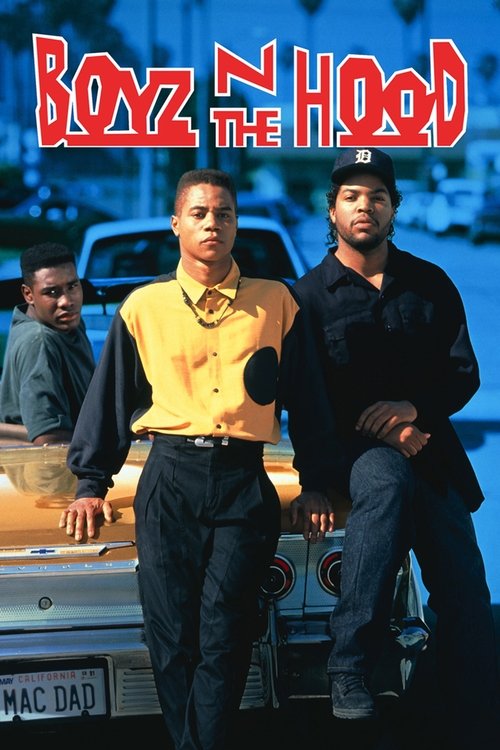
Boyz n the Hood
1991 · John Singleton
For when you want a film with real moral weight — one that makes you feel for its people before it makes you think about the world they're stuck in. This is a challenge, not comfort viewing, but it earns every hard moment.
What it's about
Tre Styles grows up in South Central Los Angeles, sent to live with his father Furious, a man determined to raise him with discipline and self-respect in a neighborhood where gunfire is background noise. Around him, his closest friends — half-brothers on very different paths — navigate the same streets with fewer guardrails. It's a coming-of-age story where the ordinary milestones of adolescence, first love, college applications, backyard barbecues, all happen under the constant pressure of gang violence and a system that has written the neighborhood off.
The experience
Warm and funny in its everyday scenes, then suddenly, sickeningly tense — the film keeps you aware that any night out could turn. It builds a slow dread that pays off in real heartbreak, and it leaves you angry in a useful way.
Performances
Laurence Fishburne gives Furious Styles a calm, magnetic authority — every lecture lands like scripture. Cuba Gooding Jr. carries the film's conscience in his first lead role, and Ice Cube, in his acting debut, is startlingly good as Doughboy: hard on the surface, wounded and fatalistic underneath.
The craft
John Singleton wrote and directed this at twenty-three, and the confidence is astonishing — the script moves from childhood to the edge of adulthood without a wasted scene, and the sound design keeps helicopters thrumming overhead like weather. The violence, when it comes, is staged for grief rather than thrill. It plays beautifully at home; what matters is the writing and the faces.
Why it matters
It made Singleton the first Black filmmaker and the youngest director ever nominated for the Best Director Oscar, and it became the defining film of the early-90s wave of Black American cinema — the template for a decade of hood dramas that followed.
Snapshot
Boyz n the Hood is the feature debut of John Singleton, who wrote and directed it at twenty-three, drawing on his upbringing in South Central Los Angeles. Released by Columbia Pictures in July 1991, it follows Tre Styles from boyhood to the brink of adulthood as he is shaped by his disciplinarian father, Furious, against a neighborhood where gang violence and structural neglect are the ambient weather. The film arrived at the crest of a wave of Black American filmmaking and became its defining statement: a coming-of-age drama whose stakes are survival itself. Singleton earned Academy Award nominations for Best Director and Best Original Screenplay, becoming the first Black filmmaker and the youngest person nominated for Best Director to that point. Equal parts intimate family drama, jeremiad on Black male endangerment, and act of geographic witness, the film fused a classical, almost old-fashioned dramatic architecture with the specificity of a place Hollywood had rarely filmed from the inside.
Industry & production
The film was produced by Steve Nicolaides for Columbia Pictures on a modest budget — figures commonly cited place it around $6 million, though precise accounting should be treated cautiously — and it became one of the year's most profitable studio releases relative to cost. Its origin is itself a notable industry story: Singleton, a graduate of the University of Southern California's film program, attracted attention through screenwriting awards there and was represented by the Creative Artists Agency. When studios expressed interest in his screenplay, Singleton reportedly insisted on directing it himself rather than selling it to an established filmmaker — a demand that, granted by Columbia, made him an unusually young writer-director entrusted with a studio feature.
The release sat within a brief, intense moment of studio investment in Black-authored film, following the commercial proof-of-concept of Spike Lee and the early-1990s appetite for "urban" dramas. Its theatrical opening was marred by outbreaks of violence at some screenings around the country, an event widely covered in the press and which prompted heightened security at theaters. Singleton and others argued pointedly that the violence reflected the very conditions the film depicted rather than the film's content, and the episode became part of a broader debate about how such movies were marketed and received. Commercially the film was a substantial success, and its profitability helped open, at least temporarily, studio doors for other young Black directors.
Technology
Boyz n the Hood was shot on 35mm photochemical film in a conventional early-1990s studio production pipeline; it does not represent a technological landmark, and its innovations lie in vision rather than apparatus. The relevant technologies are those of mainstream narrative cinema of the period — anamorphic-or-spherical capture, sync-sound shooting, optical and mechanical effects for its gunfire and night exteriors, and a music production process that integrated hip-hop and R&B into the soundtrack. The film's ambient sonic texture — the recurring drone of police helicopters over the neighborhood — depended on careful sound design rather than novel tools. In short, the picture's importance is cultural and authorial; claims of technical novelty would be overstated, and the honest assessment is that Singleton worked within, and mastered, the standard toolkit of his moment.
Technique
Cinematography
The cinematography is credited to Charles Mills. The visual approach is restrained and legible rather than flashy: the camera tends to observe the Styles household and the surrounding blocks with a steadiness that lends weight to ordinary domestic moments and refuses to aestheticize violence into spectacle. Singleton and Mills favor a warm, sunlit register for the daytime South Central exteriors — the recognizable hard California light on lawns, porches, and streets — which quietly insists on the normalcy and humanity of a place usually shown only as a war zone. Night scenes shift toward a cooler, more menacing palette, with the recurring searchlight of a police helicopter cutting through to underline surveillance and threat. Compositions frequently frame characters within the architecture of the neighborhood, binding them to place; the film's geography is a character, and the camera treats street corners, yards, and thresholds as a moral map.
Editing
The editing, credited to Bruce Cannon, serves the film's classical dramatic clarity. The structure divides cleanly into a 1984 childhood prologue and a 1991 main movement, and the cutting maintains a patient, scene-driven rhythm that lets performances and dialogue breathe rather than imposing momentum. Tension is built through duration and anticipation — the dread that accumulates in the back half of the film comes partly from a willingness to hold on scenes and let consequence approach slowly. When violence arrives it is often sudden and curtailed, the cut declining to linger, which heightens shock and grief rather than excitement. The film's emotional turns — particularly its devastating final act — are paced for maximum human impact, trusting the audience's investment in the characters built over the preceding hour.
Mise-en-scène / staging
Production design and staging are central to the film's authenticity. The Styles home, the street, the barbecue, the porch conversations — these spaces are dressed and inhabited with lived-in specificity, and Singleton stages much of the drama in everyday domestic and street settings that read as observed rather than invented. The famous scene of Furious lecturing Tre and Ricky beneath a billboard about gentrification and Black economic dispossession is a deliberate piece of staging-as-argument, positioning the characters within a landscape that literally bears the film's thesis. Singleton repeatedly uses thresholds — doorways, porches, car windows, yard fences — to dramatize the porous boundary between safety and danger. The handling of guns, cars, and bodies in space communicates a constant, low-grade vigilance that defines life in the neighborhood.
Sound
Sound is one of the film's most expressive dimensions. The persistent noise of helicopters and sirens functions as a near-continuous reminder of policing and containment, an aural correlate to the film's argument about a community under siege. The music supervision blends a score by Stanley Clarke — the veteran jazz and fusion bassist — with a soundtrack of contemporary hip-hop and R&B that situates the film firmly in its cultural moment and in the sonic world its characters inhabit. Diegetic music pouring from cars and houses roots scenes in place, while the score underscores the family drama with restraint. Crucially, the film modulates between dense ambient sound and sudden silence or quiet, using the absence of sound to mark dread and aftermath.
Performance
The ensemble is a defining strength. Larry Fishburne (later Laurence Fishburne) anchors the film as Furious Styles with a gravity and moral authority that make the character's lectures land as wisdom rather than lecture; it is among the performances that established his stature. Cuba Gooding Jr., in a breakout role, plays Tre with a vulnerability and reactive intelligence that hold the center. Ice Cube, the rapper making a major dramatic debut, gives Doughboy a watchful, wounded charisma, culminating in a final monologue about media indifference to Black death that became the film's most quoted moment. Morris Chestnut's Ricky embodies promise and its fragility; Angela Bassett, Nia Long, and Tyra Ferrell provide essential weight in roles that resist the period's tendency to marginalize women in such stories. Singleton drew naturalistic, unforced work from a young cast, several of them in early or first screen roles.
Narrative & dramatic mode
The film operates in a fundamentally classical dramatic mode — character-driven realism with a clear moral architecture — even as its content was radical for Hollywood. Its structure is a coming-of-age bildungsroman bracketed by a temporal leap: a prologue establishing the children and the decision to send young Tre to live with his father, then the main action seven years later. The dramaturgy is shaped around contrasts: Tre versus Doughboy, the disciplined path versus the abandoned one, the present father versus the absent one. Furious functions partly as a Greek-chorus figure of explicit thesis, voicing the film's sociopolitical analysis directly. This didactic strand — the film's willingness to argue openly about gentrification, the gun and liquor economy, and Black fatherhood — is deliberate, positioning the work as both story and address. The dramatic engine is the gathering inevitability of tragedy, and the film earns its catharsis through accumulated intimacy before delivering a grief that is meant to indict, not merely to move.
Genre & cycle
Boyz n the Hood is the foundational text of what came to be called the "hood film" cycle of the early-to-mid 1990s — a wave of films set in Black urban neighborhoods that combined coming-of-age narrative, social realism, and crime drama. It was followed and accompanied by works such as Juice (1992), Menace II Society (1993), and South Central (1992), and it set many of the cycle's conventions: the endangered young protagonist, the foundational friendships fractured by violence, the elegiac register, the integration of hip-hop culture. Within genre terms the film hybridizes the family melodrama and the crime/social-problem picture, but Singleton consciously foregrounded the domestic and the formative over the criminal spectacle, distinguishing his film from the more nihilistic entries in the cycle. Its commercial success is widely credited with catalyzing studio willingness to finance the cycle.
Authorship & method
The film is unmistakably a work of personal authorship. Singleton wrote and directed from autobiographical knowledge of South Central, and his method privileged authenticity of place, language, and relationship over genre sensation. His central thematic preoccupation — the formative necessity of present, responsible Black fatherhood — runs through his subsequent work and is the film's organizing idea. Among his key collaborators: cinematographer Charles Mills shaped the warm, legible visual world; editor Bruce Cannon gave the film its patient classical rhythm; composer Stanley Clarke supplied a restrained score within a contemporary music landscape; and producer Steve Nicolaides provided the studio-craft infrastructure for a first-time director. Singleton's relationship with Ice Cube, whose music and persona he admired, was essential to the casting of Doughboy. The documented record consistently emphasizes Singleton's insistence on directing his own material and his commitment to portraying his community with dignity and complexity rather than as backdrop for violence.
Movement / national cinema
The film belongs to American cinema and specifically to the early-1990s renaissance of Black American filmmaking — sometimes discussed alongside the work of Spike Lee, the Hughes brothers, Mario Van Peebles, and others. It is not part of a formal aesthetic movement with a manifesto; rather, it is a key node in a generational and cultural surge, enabled by the crossover success of hip-hop, by the precedent of Lee's independent-to-studio trajectory, and by a brief industry opening for Black voices. Geographically and culturally it is intensely localized — a Los Angeles film, a South Central film — and part of its historical significance is its insistence on the specificity of that place at a moment of national attention to the city's racial tensions, attention that would intensify with the 1992 uprising the following year.
Era / period
Boyz n the Hood is a quintessential artifact of its early-1990s American moment. It registers the aftermath of the 1980s crack epidemic and the escalation of gang violence, the militarization of urban policing, the politics of "law and order," and debates about the Black family that ran through the decade. Its 1991 release sat on the eve of the Los Angeles uprising of April 1992, and the film is often read retrospectively as a prescient document of the conditions and grievances that erupted then. The integration of hip-hop into its fabric likewise marks the era of rap's ascent to cultural centrality. The film's concerns — gentrification, disinvestment, the gun and liquor trade, the absence of opportunity — are presented as the specific machinery of a particular time and place.
Themes
The film's central theme is the endangerment of young Black men and the social forces arrayed against their survival — a concern announced by its opening statistic about Black male death and sustained to its closing titles about the characters' fates. Closely bound to this is the theme of fatherhood: Furious's presence in Tre's life is offered as the decisive variable, and the film argues, sometimes explicitly, for paternal responsibility as a form of resistance. Other major threads include the geography of containment and surveillance; the economics of dispossession, voiced in Furious's gentrification speech; the cycle of retaliatory violence and its grief; the divergent fates determined by circumstance and guidance; and the tension between rage and restraint. The film also attends, more than its successors, to questions of respectability, education, and aspiration as survival strategies, while remaining clear-eyed about their limits against structural force.
Reception, canon & influence
Critical reception in 1991 was strongly positive, with wide praise for Singleton's assurance, the performances, and the film's emotional and political force; the Academy Award nominations for direction and screenplay confirmed its status, making Singleton the first Black director and youngest nominee in that category to that date. Some contemporary debate concerned the theater violence at openings and the broader politics of such films' marketing, but the critical consensus held the film in high regard. Over time its canonical standing has only grown: it was selected for preservation in the United States National Film Registry by the Library of Congress as a culturally, historically, or aesthetically significant work, and it is routinely taught and cited as a landmark of American and African American cinema.
Influences on the film run backward to the social-realist and coming-of-age traditions of American cinema, to Spike Lee's recent demonstration that Black-authored films could be both personal and commercial, and to Singleton's autobiographical experience and USC training. Its forward influence is large. Most immediately, its success helped open studio financing for the hood-film cycle and for a generation of Black filmmakers in the 1990s. More lastingly, it established a template — the elegiac, place-rooted, hip-hop-inflected coming-of-age drama centered on Black male survival — whose echoes are widely traced in later work, including films concerned with South Central and with Black boyhood in subsequent decades. As both an artistic achievement and a cultural intervention, Boyz n the Hood remains the central reference point for understanding early-1990s Black American cinema and the durability of its central question: what it takes to grow up alive.
A Deleuzian reading
The sound comes first, before anyone can act on it.
The full Deleuzian reading of Boyz n the Hood →
Reception
An instant sensation — a Cannes premiere and rave reviews in 1991, though its opening weekend was overshadowed by headlines about violence at some theaters showing it. Time vindicated it completely: National Film Registry by 2002, and now the undisputed cornerstone of '90s Black American cinema.
How Boyz n the Hood was received, from release to now →
Influences: the films it descends from and the films it influenced
- Killer of Sheep (1978) — Burnett's L.A. Rebellion neorealism treats South Central/Watts as a lived geography rather than backdrop, the place-as-character observational mode Singleton inherits and re-stages with Charles Mills's warm, legible daylight.
- Cooley High (1975) — Supplies the template of episodic Black male coming-of-age friendship structured toward an elegiac death-of-the-friend climax, the same emotional architecture Singleton mounts around Ricky and Doughboy.
- The Learning Tree (1969) — First Black-directed Hollywood studio feature drawn from the director's own boyhood — the model of autobiographical, place-rooted Black coming-of-age authored from inside the community that Singleton claims at USC.
- Do the Right Thing (1989) — Lee's single-block, heat-and-geography-bound ensemble proved a Black-authored film could be personal and commercial; its didactic address-the-audience staging prefigures Furious Styles's billboard lecture.
- Mean Streets (1973) — Establishes the doomed neighborhood-bound male friendship between a cautious protagonist and a volatile, self-destructive partner whose violence the hero cannot save him from — the Tre/Doughboy dynamic in another idiom.
- American Graffiti (1973) — USC-school autobiographical youth ensemble compressed into a music-saturated slice of place and time, the wall-to-wall contemporary-soundtrack coming-of-age frame Singleton transposes to South Central hip-hop.
- Rebel Without a Cause (1955) — Codes adolescent male crisis as a crisis of fathering and the threshold to manhood, the absent/failing-father thesis Singleton inverts by making Furious the present, responsible father.
- Sounder (1972) — Foregrounds the dignity and moral instruction of a present Black father raising a son under hardship, the fatherhood-as-survival theme Furious Styles embodies.
- Nothing But a Man (1964) — Quiet social-realist study of Black manhood and the pressure to be a provider father, the unsensational classical-realist register Singleton chose over genre spectacle.
- Colors (1988) — Answers Colors from the inside, reversing the police vantage into community authorship while mapping the same South-Central gang geography and color-coded signifiers.
- Menace II Society (1993) — The most direct hood-film heir — South Central setting, first-person retrospective voiceover, and the doomed-protagonist arc — but pointedly strips Singleton's redemptive fatherhood thesis for fatalism.
- Fruitvale Station (2013) — Inherits the place-rooted, near-real-time elegy for an endangered young Black man, building dread toward a foreordained death the way Singleton frames Ricky's killing.
- Moonlight (2016) — Extends Black-boyhood coming-of-age through explicit temporal-leap chapter structure and a surrogate-father mentor figure, refining Singleton's age-jump construction and fatherhood thesis into a lyrical key.
- Dope (2015) — A later Inglewood/South Central coming-of-age that openly riffs on the hood-film geography and hip-hop scoring Singleton codified, while subverting its survival-tragedy conventions.
- Straight Outta Compton (2015) — Returns to South Central as character and to N.W.A's milieu — the very hip-hop landscape (and Ice Cube) Singleton drew on — extending the place-rooted, music-driven Black-male narrative into biopic form.
- Training Day (2001) — Singleton established South Central LA's specific visual grammar — actual Crenshaw geography, low-rider culture, police helicopters as ambient surveillance — as cinematic language; Fuqua shoots many of the same blocks and inherits the same spatial logic of a surveilled community.
- 8 Mile (2002) — Models deglamorized urban realism that foregrounds race-and-class boundaries through restraint and domestic specificity rather than spectacle or stylization.
- American History X (1998) — Fixes the Southern-California-geography social-realist template — neighborhood as moral map, an older brother trying to break a cycle of violence, elegiac framing — that Sightlines transplants from South Central to Venice Beach.
- Clockers (1995) — The hood-film coming-of-age template — a boy choosing between the corner and survival — that Clockers extends formally while rebuking its melodrama.
- Hustle & Flow (2005) — Singleton produced Hustle & Flow; his model of location-shot regional Black urban realism and his patronage of a young director are the direct industrial and stylistic ancestor.
- Precious: Based on the Novel 'Push' by Sapphire (2009) — Established the Sundance-to-mainstream pathway for unsparing Black American inner-city social realism led by a first-time nonprofessional-feeling cast.
- The Hate U Give (2018) — Originates 'the talk' as a staged family ritual — the father delivering survival protocol for a Black child facing police — which Tillman restages almost beat-for-beat as Maverick's driveway lesson.
- Juice (1992) — Parallel early-90s hood cycle entry casting a rapper (Tupac) as the volatile friend whose escalation destroys the group, the music-persona-as-casting strategy Singleton used with Ice Cube.
- Poetic Justice (1993) — Singleton's own follow-up extends his South Central authorship and rapper-as-lead casting (Tupac, Janet Jackson) while shifting the place-rooted survival drama toward a road-movie register.
- Friday (1995) — Reuses the same South Central porch-and-street geography and Ice Cube's persona but recodes the neighborhood into comedy, sibling answer to the hood film's tragic mode.
- Once Were Warriors (1994) — Frames community violence as a statistical/contextual cycle via an opening titled reveal, then grounds it in intergenerational household drama — a contemporaneous social-realist counterpart pairing data-frame openings with domestic stakes.
- A Bronx Tale (1993) — A coming-of-age-crime bildungsroman built on a father figure explicitly transmitting how-to-be-a-man wisdom to a boy amid neighborhood violence—the generational value-transmission spine shared with Lorenzo and Sonny.
Similar films
- Do the Right Thing (1989) — influence & lineage · same viewing thread · often watched together
- Menace II Society (1993) — influence & lineage · same viewing thread
- Straight Outta Compton (2015) — influence & lineage · same viewing thread
- Fruitvale Station (2013) — influence & lineage
- American History X (1998) — same viewing thread · often watched together
- The Hate U Give (2018) — same viewing thread
- BlacKkKlansman (2018) — same viewing thread
- The 400 Blows (1959) — often watched together
All the films related to Boyz n the Hood →
Watch it with: curated runs of related films
- Reckoning with the Color Line — A run through a century of American film on race — from the movie that industrialized screen racism to the ones that talk back to it — best watched in rough chronological conversation.