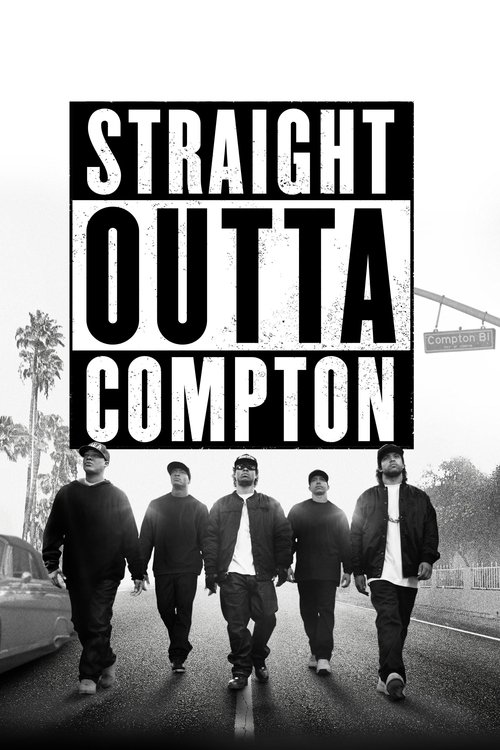
Straight Outta Compton
2015 · F. Gary Gray
When you want a big, electric true story with great music and real fury in it — crowd-pleasing enough for a group watch, pointed enough to leave you talking about policing and who gets to speak.
What it's about
Compton, 1987: five young men — Eazy-E, Dr. Dre, Ice Cube, MC Ren, and DJ Yella — turn their rage at police harassment and dead-end streets into music nobody had heard before, and N.W.A explodes out of Los Angeles. The film follows the group from drug-money beginnings through national notoriety to the money disputes and betrayals that tore them apart, and the losses that came after.
The experience
It moves like the music — swaggering, angry, alive — with concert scenes that hit like victories and a back half that turns genuinely mournful. Two and a half hours that rarely feel it.
Performances
O'Shea Jackson Jr. plays his own father, Ice Cube, with uncanny precision, and Jason Mitchell's Eazy-E gives the film its heart — cocky, wounded, and devastating by the end.
The craft
F. Gary Gray shoots the concerts and street confrontations with the same charged energy, so the line between performance and protest keeps dissolving. The soundtrack is wall-to-wall N.W.A and its offshoots, and it demands good speakers — the bass is half the storytelling.
Why it matters
One of the most successful music biopics ever made, it caught the Black Lives Matter moment head-on and became a flashpoint in the #OscarsSoWhite controversy when its cast went unrecognized. It reset expectations for what a hip-hop story could do at the box office.
Snapshot
Straight Outta Compton dramatizes the rise, fracture, and afterlife of N.W.A — Eazy-E, Dr. Dre, Ice Cube, MC Ren, and DJ Yella — from the drug-money origins of Ruthless Records in mid-1980s Compton through the group's commercial breakthrough, its dissolution over money and management, and Eazy-E's death from AIDS-related complications in 1995. Directed by F. Gary Gray from a screenplay by Jonathan Herman and Andrea Berloff, produced with the direct participation of Ice Cube, Dr. Dre, and Eazy-E's widow Tomica Woods-Wright, the film arrived from Universal in August 2015 as both a music biopic and a period statement about policing and Black expression in Los Angeles. It became one of the most commercially successful music biopics to that point and, in the same season, a flashpoint in the #OscarsSoWhite controversy after receiving a single Academy Award nomination — for Original Screenplay, credited to two of its four writers.
Industry & production
The film had a long gestation. A biopic of N.W.A circulated in development for the better part of a decade, moving between studios before landing at Universal Pictures with F. Gary Gray attached to direct. The producing structure is essential to understanding the film's texture and its limits: Ice Cube and Dr. Dre served as producers alongside Tomica Woods-Wright (representing the Eazy-E estate), Matt Alvarez, Scott Bernstein, and Gray himself. Two of the three surviving principal members thus held authorial and financial stakes in how their own story would be told — a fact critics returned to repeatedly, since the film is notably softer on Dre and Cube than on absent or deceased parties, and largely omits documented allegations of violence against women connected to Dre's past.
The production was mounted on a comparatively modest budget widely reported around $28 million and shot on location in and around Los Angeles and Compton, lending the film geographic authenticity that a soundstage recreation could not. Casting foregrounded relative unknowns: O'Shea Jackson Jr. — Ice Cube's own son, cast after an extended audition process — plays his father; Corey Hawkins plays Dr. Dre; Jason Mitchell plays Eazy-E; Aldis Hodge plays MC Ren; and Neil Brown Jr. plays DJ Yella. Paul Giamatti, as manager Jerry Heller, supplies the film's most prominent established-star presence (the same year he played a music-industry figure in Love & Mercy), with R. Marcos Taylor as Suge Knight.
The production was also shadowed by real-world violence: in January 2015, at a shoot in Compton connected to promotion for the film, Suge Knight struck two men with his vehicle, killing Terry Carter — an incident that led to Knight's arrest and became part of the film's surrounding news narrative. Released theatrically in mid-August 2015 with an R rating, the film substantially out-earned its budget and posted one of the strongest openings then recorded for a music biopic; it was frequently cited afterward as among the highest-grossing films in that subgenre until Bohemian Rhapsody (2018). Precise final figures are best confirmed against studio and trade records rather than restated from memory.
Technology
Straight Outta Compton was made with mainstream mid-2010s digital-cinema tools; the specific camera package is a matter of record best verified against production documentation rather than asserted here. What the film does technologically distinctive lies less in capture than in sound and archival integration. Its recreation-heavy approach depends on precise music clearance and remastering of the N.W.A catalog, and on digital compositing to fold period television footage — most consequentially the Rodney King beating and the 1992 Los Angeles uprising — into the dramatized timeline. Concert and recording-studio sequences rely on contemporary sound-post techniques to marry actors' on-camera performance to the original masters, a standard but demanding requirement of the music-biopic form.
Technique
Cinematography
The film was photographed by Matthew Libatique, best known for his long collaboration with Darren Aronofsky (Requiem for a Dream, Black Swan, Iron Man). Libatique gives Compton a warm, sunlit naturalism in its street and domestic scenes that shades toward harder contrast and mobile, kinetic coverage in the performance set-pieces. The concert sequences — particularly the group's defiant on-stage performance of "Fuck tha Police" in Detroit and the ensuing police intervention — are staged with handheld energy and crowd-level immediacy, while the studio scenes favor a more contained, observational grammar. Libatique's presence signals the film's ambition to be read as serious cinema rather than televisual reenactment.
Editing
Cut by Billy Fox and Michael Tronick, the film compresses roughly a decade of overlapping careers into a propulsive, music-driven structure. The editing's central task is rhythmic: matching cut patterns to the beats and verses of N.W.A tracks so that the creative process reads on screen, and orchestrating the ensemble's fragmentation into parallel storylines once Ice Cube and then Dr. Dre depart Ruthless. The film's considerable running time (the theatrical cut runs well over two hours, with a longer director's cut later released) reflects a deliberately expansive, saga-scaled approach rather than tight economy.
Mise-en-scène / staging
Period reconstruction is the film's dominant design register: late-1980s and early-1990s Los Angeles rendered through cars, wardrobe, hairstyles, and the iconography of the group — Compton caps, Raiders gear, the Straight Outta Compton album stencil. The staging repeatedly contrasts interior spaces of creation and negotiation (the studio, Heller's office, hotel rooms) with exterior spaces of exposure and danger (the street, the concert, the police stop). A recurring staged motif is the police encounter: officers ordering young Black men to the pavement outside their own workplace, a tableau the film returns to as both lived experience and thematic thesis.
Sound
Sound is the film's raison d'être. The N.W.A catalog functions not as underscore but as diegetic argument — the songs are events in the plot, composed and performed on screen. Joseph Trapanese supplies the original orchestral score that bridges the needle-drops. The sound design gives particular weight to the sonic textures of the era's production — the drum machines, samples, and low-end that defined West Coast hip-hop — and to the aural violence of the police and riot sequences.
Performance
The ensemble carries the film. Jason Mitchell's Eazy-E is the standout, tracing the character from swaggering street entrepreneur to a man betrayed, isolated, and finally dying — the performance most consistently singled out by critics as the film's emotional center. O'Shea Jackson Jr.'s uncanny physical resemblance to his father anchors Ice Cube's arc of principled defection, and Corey Hawkins gives Dre a watchful reticence. Paul Giamatti's Jerry Heller supplies moral ambiguity as a manager who is by turns genuinely protective and self-servingly exploitative.
Narrative & dramatic mode
The film adopts the "rise-and-fall-and-reckoning" architecture standard to the music biopic, but distributes it across an ensemble rather than a single protagonist, producing something closer to a group saga. Its first movement is a collective origin story; its second is a story of fracture, as contract inequities and Heller's management split the group; its third is elegiac, converging on Eazy-E's illness and death and the partial reconciliation it prompts. The dramatic mode is earnest and celebratory — the film wants its subjects understood as truth-tellers and artists — and it uses documentary intrusions (the King footage, the uprising) to frame the group's music as prophecy validated by history. Critics who admired the film's energy nonetheless noted that its producer-subjects' involvement tilts the drama toward exculpation at key moments.
Genre & cycle
The film sits at the intersection of two cycles. As a music biopic, it belongs to the 2000s–2010s wave that includes Ray (2004), Walk the Line (2005), Notorious (2009), and Get On Up (2014), and it shares that cycle's conventions: the origin scene, the creative-breakthrough montage, the industry-betrayal turn, the substance-or-illness decline. As a hip-hop and Los Angeles film, it descends from the early-1990s South Central cycle — Boyz n the Hood (1991), Menace II Society (1993) — whose imagery of policing and neighborhood peril N.W.A both soundtracked and shaped, and from the comedic register of Gray's own Friday (1995), co-written by and starring Ice Cube. The film effectively narrates the origin of a sensibility that those earlier films dramatized.
Authorship & method
F. Gary Gray is the decisive authorial figure, and his prior relationships with the subjects are inseparable from the project. Gray began as a music-video director in the early 1990s, shooting videos for West Coast hip-hop artists including Ice Cube — his direction of Cube's "It Was a Good Day" video predates his feature career — before making Friday and studio pictures such as Set It Off (1996), The Italian Job (2003), and Law Abiding Citizen (2009); he would go on to The Fate of the Furious (2017). That insider standing gave him both access and, critics argued, a stake in a flattering account.
Key collaborators define the film's craft: cinematographer Matthew Libatique; editors Billy Fox and Michael Tronick; composer Joseph Trapanese. The screenplay is credited to Jonathan Herman and Andrea Berloff, from a story developed with earlier writers S. Leigh Savidge and Alan Wenkus — the credited screenwriters (Berloff and Herman) received the film's sole Oscar nomination. The producing method — with Ice Cube, Dr. Dre, and Tomica Woods-Wright as producers — is itself a form of authorship, granting the surviving principals substantial control over emphasis and omission.
Movement / national cinema
The film is a product of the American studio system (Universal) but is best understood within a specifically Los Angeles, and specifically Black American, cinema — the tradition of films that treat South Central and Compton not as backdrop but as subject, from the L.A. Rebellion filmmakers' earlier social realism through the commercial "hood film" of the 1990s. It is not an avant-garde or movement film in the formal sense; its significance is as a mainstream, industrially scaled account of a regional cultural moment that had previously been narrated mostly from within the music itself.
Era / period
Two eras are in play. The film depicts the late 1980s through mid-1990s: the crack era, aggressive LAPD anti-gang policing (Chief Daryl Gates's regime and tactics), the 1991 Rodney King beating, the 1992 uprising, and the early rise of Death Row Records and Suge Knight. It was made in the mid-2010s, and its 2015 release landed amid the Black Lives Matter movement and national attention to police killings of Black Americans following Ferguson and other cases. That coincidence sharpened the film's reception: "Fuck tha Police" and the film's police-stop tableaux read to many audiences as directly continuous with the present, and the film was frequently discussed as a period piece that refused to feel like the past.
Themes
The film's governing theme is art as testimony — the claim that N.W.A's confrontational music was a form of documentary journalism about lives the wider culture preferred not to see, and that its obscenity was a truthful response to obscene conditions. Around this cluster: policing, surveillance, and Black masculinity, dramatized in the recurring forced-to-the-pavement encounters; the exploitation of Black artists by the music industry, embodied in the contract disputes and in Jerry Heller's ambiguous stewardship; brotherhood and betrayal, as the group's chosen family fractures under money and ego; and mortality and legacy, concentrated in Eazy-E's death. A theme the film is frequently faulted for not engaging — its near-total elision of misogyny and violence against women in the group's history and lyrics — became central to its critical afterlife, and is worth naming honestly as a limit of its account.
Reception, canon & influence
Critically, the film was well received, with particular praise for its momentum, its performances (Mitchell's Eazy-E above all), and its emotional force, alongside recurring reservations about its running time and, more pointedly, its self-serving omissions given the producers' involvement. Commercially it was a major success, substantially exceeding its modest budget and standing for years among the top-grossing music biopics — a performance that helped confirm studio appetite for the form.
Influences on the film (backward): the music-biopic template of Ray, Walk the Line, and Notorious; the South Central cinema of Boyz n the Hood and Menace II Society; Gray's own music-video and Friday-era grounding in West Coast hip-hop; and, foundationally, the historical record and mythology of N.W.A itself, mediated by the surviving members' memories.
Legacy (forward): the film's success is widely credited with helping revive studio investment in the music biopic later realized in Bohemian Rhapsody (2018) and Rocketman (2019). It launched O'Shea Jackson Jr. and Jason Mitchell as screen actors and raised Corey Hawkins's profile. Its single Academy nomination — Original Screenplay, for a script whose credited writers did not match the story's Black subjects in the way many expected — made it one of the defining reference points of the January 2016 #OscarsSoWhite protest, feeding a sustained industry reckoning over Academy membership and representation. And by re-narrating N.W.A's confrontation with the LAPD for a Black Lives Matter–era audience, the film re-canonized "Fuck tha Police" and the group's police critique as living political text rather than historical artifact — arguably its most durable cultural effect.
Reception
A monster hit in summer 2015 — a rap biopic outgrossing superhero movies — but its afterlife is more complicated: the omission of Dr. Dre's assaults on women (notably journalist Dee Barnes) drew heavy criticism, and Dre publicly apologized while the film was still in theaters.
How Straight Outta Compton was received, from release to now →
How to watch Straight Outta Compton: what to notice on a first viewing
- Count how often the film puts men face down on pavement. Officers order young Black men to the ground outside their own studio, on their own street, in front of their own building. Gray stages the same tableau repeatedly with small variations each time. The repetition is the argument. The film treats this as a condition rather than an incident, and it shows you instead of explaining.
- Compare the street scenes with the concert footage. Libatique shoots Compton in warm sunlit naturalism, and the studio scenes stay contained and observational. On stage the camera goes handheld at crowd level with harder contrast. The photography separates making the music from performing it. One register watches work. The other stands inside a crowd.
- Watch the songs get built in the studio on screen. The N.W.A catalog is not underscore. Tracks are written, argued over, and performed as events in the plot, and Trapanese's orchestral score fills the gaps between them. Drum machines and low end carry the period. The music is plot rather than atmosphere. You watch an argument become a record and the record become a problem.
- Notice when the cutting starts following the beat. Fox and Tronick match cut patterns to the beats and verses so the creative process reads on screen. Later, as members leave Ruthless, the film splits into parallel storylines and the cutting keeps them running together. The edit does two jobs. It makes music legible as work, then it makes a group coming apart legible as structure.
- Watch Jason Mitchell's face while a deal is being explained. He plays Eazy as a street entrepreneur first and a man being handled second. Jackson Jr. carries his father's physical presence, Hawkins plays Dre watchful and quiet, and Giamatti keeps Heller genuinely hard to read. The ensemble is built on who is being told what. Watch who actually understands the contract in any given room.
The whole guide to watching Straight Outta Compton, with the keys for a rewatch →
Influences: the films it descends from and the films it influenced
- Boyz n the Hood (1991) — Establishes the South Central hood-film grammar Compton inherits — the neighborhood block staged as moral geography and the recurring police-stop as the scene where black masculinity is criminalized on sight.
- Menace II Society (1993) — Its handheld, in-close naturalism and abrupt eruptions of street violence model the you-are-there camera and unsentimental block texture Gray and Libatique reconstruct for late-80s Compton.
- Do the Right Thing (1989) — Supplies the template of policing-and-black-masculinity building to a chokehold killing, plus the idea of music (Radio Raheem's boombox) as diegetic testimony — the same 'art as political record' logic behind 'Fuck tha Police.'
- Friday (1995) — Gray's own directorial origin: the comic South Central street texture and his working partnership with Ice Cube, the insider access that shaped Compton's casting, sound, and neighborhood authenticity.
- Ray (2004) — Sets the modern music-biopic template of struggle-to-stardom built around performance mimicry, where an actor's embodiment of the icon (Foxx/Charles) is the film's central engine — the model for Mitchell's Eazy-E.
- Walk the Line (2005) — Codifies the rise-fall-reconciliation arc and live-performance staging where actors physically perform numbers rather than merely lip-sync, the approach Compton takes to its studio and stage scenes.
- Notorious (2009) — The immediate rap-biopic precedent — recreating recording-booth sessions, group formation, and stage sets for hip-hop, the exact craft playbook Compton scales up for N.W.A.
- Purple Rain (1984) — A music-video director's concert-driven narrative that lets diegetic performance carry the story and organizes editing to the beat — the antecedent for Compton's music-driven cutting and handheld concert coverage.
- Requiem for a Dream (2000) — Establishes Matthew Libatique's kinetic, close, naturalistic cinematography — the collaborator whose visual method Gray recruited to give Compton its grain and immediacy.
- 8 Mile (2002) — Stages rap itself as live diegetic performance (the battle scenes) and proves a rapper can anchor a studio drama as an actor — the rapper-as-screen-lead credibility Compton builds its ensemble on.
- Malcolm X (1992) — Gray deploys period-color-taxonomy distinguishing late-1980s Compton from mid-1990s commercial success, costume as cultural-political argument (Jheri curls, Starter jackets, then suits marking NWA's ideological fracture), and the inverse-bildungsroman arc of group formation and corruption — inheriting Lee's template for the prestige Black biopic as a form organized around transformation-under-pressure.
- American Gangster (2007) — Gray applies the blaxploitation-revision biopic structure to Black enterprise in the music industry, using period-authentic source music as the primary vehicle for cultural-historical annotation — the technique AG inherited from GoodFellas and restrained — while maintaining the capitalism-as-drug-trade thesis in a context where the analogy is explicit.
- All Eyez on Me (2017) — Directly extends the West Coast rap biopic into the same Death Row milieu Compton depicts, riding the studio appetite Compton reopened and reusing its period-reconstruction and performance-mimicry method.
- Bohemian Rhapsody (2018) — The studio music biopic Compton is widely credited with reviving — reconstructing signature concerts (Live Aid) as the emotional climax with the same beat-synced, momentum-over-completeness assembly.
- Rocketman (2019) — Extends the post-Compton biopic revival, again built on an actor's embodiment of the icon and music-driven staging, with the subject (Elton John) producing his own myth as Cube and Dre did.
- Elvis (2022) — Carries the music-driven editing rhythm and propulsive-momentum-over-biographical-completeness ethos forward, foregrounding the exploitation-and-control tension between artist and handlers that Compton's producing method dramatized.
- Get Rich or Die Tryin' (2005) — A hip-hop artist's own violent origin story dramatized with the producing-subject controlling the myth — the same producer-as-author dynamic that shapes (and softens) Compton's account.
- Judas and the Black Messiah (2021) — Shares the meticulous period reconstruction of late-20th-century black radicalism confronting the police/state, re-narrated for a Black Lives Matter audience as living political text rather than historical artifact.
- Michael (2026) — The authorized, principals-as-producers narrative that openly negotiates which allegations survive the final cut — the same conflict-of-interest architecture as estate-controlled Michael.
- Kneecap (2024) — The hip-hop group-origin biopic scaffolding — performers channeling real artists through a formation-to-fame arc — that Kneecap adopts and critics flagged as its familiar structure.
- Gully Boy (2019) — Stages the writing and tracking of a verse as a real-time scene and turns the concert into political confrontation; Gully Boy's 'Azadi' does the same work by folding Dub Sharma's sampled protest chant into a montage of found political audio.
Similar films
- Boyz n the Hood (1991) — influence & lineage · same viewing thread
- Menace II Society (1993) — influence & lineage · same viewing thread
- Do the Right Thing (1989) — influence & lineage · same viewing thread
- Judas and the Black Messiah (2021) — influence & lineage
- American History X (1998) — same viewing thread
- The Hate U Give (2018) — same viewing thread
- Hustle & Flow (2005) — shared sensibility
- Gully Boy (2019) — shared sensibility
All the films related to Straight Outta Compton →
Watch it with: curated runs of related films
- Reckoning with the Color Line — A run through a century of American film on race — from the movie that industrialized screen racism to the ones that talk back to it — best watched in rough chronological conversation.