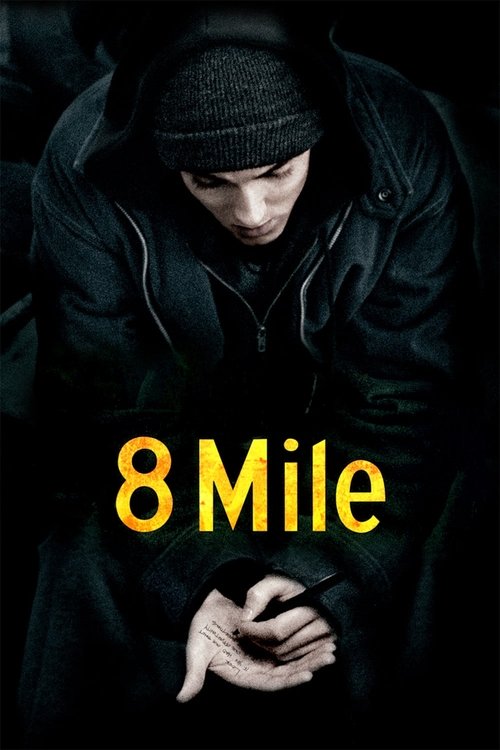
8 Mile
2002 · Curtis Hanson
For when you need an underdog story that earns it — the film to put on when you want to get fired up without being lied to about how hard the climb is. Crowd-pleasing, but with grit under its nails.
What it's about
Detroit, 1995. Jimmy "B-Rabbit" Smith works a punishing stamping-plant job and lives in a trailer park with his mother, while everything he actually is comes out in rhymes he's too choked to perform. The film follows a rough week in his life — dead-end work, unraveling family, loyal and unreliable friends — as he fights toward the nerve to step into the freestyle battles that decide who matters in the city's hip-hop underground.
The experience
Gritty and grounded, then electric — the battle scenes hit with the crowd-roar adrenaline of a title fight. Between them it's a bruising, unglamorous portrait of being broke and hungry for more.
Performances
Eminem, essentially playing a version of his own story, is startlingly good — sullen, watchful, and volcanic when the mic is finally in his hand. The battles work because you believe every word is his.
The craft
Curtis Hanson shoots working-class Detroit with unromantic, wintry realism, which makes the battle sequences land like eruptions — tightly cut, crowd-driven, and thrillingly performed live-wire filmmaking. "Lose Yourself" running through it gives the film a pulse that demands good speakers.
Why it matters
It turned the most controversial figure in American pop into a movie star on his own terms, and "Lose Yourself" became the first hip-hop song ever to win the Best Original Song Oscar.
Snapshot
8 Mile is a Detroit-set drama about Jimmy "B-Rabbit" Smith Jr. (Eminem), a young white aspiring rapper working a stamping-plant job and living in a trailer park with his mother, who over the course of a few days fights toward the courage to perform in the freestyle battles that govern status in the city's hip-hop underground. Directed by Curtis Hanson and written by Scott Silver, the film is best understood as a classical underdog narrative — a backstage musical and a boxing picture in structure — recast through the idiom of 1995 Detroit rap. Its enduring cultural footprint rests on two facts: it gave Eminem, then the most controversial figure in American popular music, a vehicle that both exploited and reframed his persona, and it produced "Lose Yourself," which became the first hip-hop song to win the Academy Award for Best Original Song. The film matters because it took a marginalized, still-suspect musical form and routed it through a prestige Hollywood apparatus — a respected Oscar-winning director, a major studio, a name-brand cinematographer — without sanding off the regional specificity that made the milieu legible.
Industry & production
8 Mile was produced by Imagine Entertainment (Brian Grazer and Hanson among the producers) in partnership with Universal Pictures, with record-industry figure Jimmy Iovine, head of Interscope, central to the project — a logical alignment given that Interscope and its affiliated Aftermath/Shady labels were Eminem's commercial home. The collaboration of a film studio with the artist's own label infrastructure is itself significant: the movie functioned as part of a larger media ecosystem in which the soundtrack album, released on Interscope/Shady/Aftermath, operated as both promotion for and product of the film.
Casting Eminem — a first-time lead actor at the absolute peak of his notoriety, two years after The Marshall Mathers LP — was the central commercial gamble. The film hedged the risk by surrounding him with experienced performers: Kim Basinger, an Academy Award winner, as his mother Stephanie; Brittany Murphy as love interest Alex; Mekhi Phifer as his friend and battle promoter Future; and a deep bench of then-emerging actors including Anthony Mackie (as rival Papa Doc) and Michael Shannon. Production took place largely on location in and around Detroit, lending the film an authenticity of place that studio reconstruction could not have matched. The title refers to 8 Mile Road, the literal boundary between the city of Detroit and its suburbs and a long-standing marker of racial and economic division — a geography the film treats as thematic spine rather than mere setting.
Hard financial specifics — exact budget and grosses — I am not certain of and will not invent, but the film was unambiguously a major commercial success and a cultural event, and it is widely credited with demonstrating that a rap-centered drama could open as a mainstream studio release rather than a niche product.
Technology
8 Mile is not a technologically experimental film, and its tools serve a documentary-leaning realism rather than spectacle. Photographed by Rodrigo Prieto, the film uses a gritty, desaturated, largely handheld aesthetic consistent with the early-2000s vogue for "rough" naturalism in American drama — a look Prieto had helped define internationally with Amores Perros (2000). The precise camera negative and stock choices I cannot confirm with certainty, but the image is built around the texture of real Detroit locations, available and practical light, and a cold, industrial palette. The more consequential technology is arguably the recording and sound infrastructure behind the music: the film's credibility depends on its rap performances reading as live, and the production's relationship with Interscope's recording apparatus allowed the battle sequences and the original songs to be developed to professional musical standard rather than treated as incidental score.
Technique
Cinematography
Prieto's photography is the film's most distinctive formal element. He shoots Detroit in a chilled, gray-brown register — overcast skies, snow, the orange sodium glow of the stamping plant — that visually equates the city's climate with its economic exhaustion. The camera is frequently handheld and close, riding shoulders, which serves two functions: it lends the dialogue scenes a nervy immediacy, and, crucially, it makes the freestyle battles legible as performance and as combat. In the climactic battle sequences at the Shelter, the camera works the space like a fight film, isolating Rabbit and his opponents, reading the crowd, and using proximity to register the micro-expressions on which a battle is won or lost. The desaturation is purposeful: when color does arrive — the warmth of a fleeting tender scene, the heat of the plant — it registers against the surrounding cold.
Editing
Cut by Jay Rabinowitz and Craig Kitson, the film's editing is most ambitious in the battle scenes, where the challenge is to make rapped wordplay both audible and dramatically suspenseful. The cutting must hold on a performer long enough to land a punchline, then register its impact in the crowd and on the opponent's face — a rhythm closer to stand-up comedy or a boxing round than to conventional musical performance. Across the body of the film, the editing favors observational patience in the dramatic scenes and accelerates into the battles, giving the structure a clear pulse that builds toward the final confrontation.
Mise-en-scène / staging
The film's staging is grounded in deglamorized environments: the trailer, the assembly line, the parking lots and abandoned houses, the cramped club. The production design refuses aspiration — there is no fantasy of escape rendered visually, only the texture of the place the characters are trying to leave. The battle venue is staged as an arena in miniature, with the crowd functioning as chorus and jury. Costuming and physical staging place Eminem's Rabbit deliberately at the racial seam the title invokes: a white performer in a predominantly Black art form, his outsider status made visible in nearly every frame.
Sound
Sound is, unsurprisingly, the film's defining technical domain. The battle raps are the dramatic climaxes, and the sound design treats them as such — foregrounding the voice, the beat, and the crowd's reaction as a three-way dynamic. The film's original songs, most famously "Lose Yourself," function diegetically and non-diegetically at once, expressing Rabbit's interior state in a form the character himself practices. The decision to let the music carry emotional argument — rather than relying on an orchestral score to instruct the audience how to feel — is the film's smartest sonic choice.
Performance
Eminem's performance is the film's load-bearing element and its greatest surprise. Cast essentially as a fictionalized, fractionally softened version of his own biography, he underplays — withholding the verbal aggression for the battle scenes and reading the dramatic material with a guarded, watchful minimalism that proved far more controlled than skeptics expected. Kim Basinger brings real pathos to Stephanie, refusing caricature in a role that could easily have curdled. Mekhi Phifer supplies warmth and momentum as Future, and Brittany Murphy plays Alex with a restless ambition that mirrors Rabbit's own. The ensemble of Rabbit's crew grounds the film's humor and grief, particularly in a late-act tragedy that gives the climax its stakes.
Narrative & dramatic mode
Structurally, 8 Mile is a textbook three-act underdog story, and its power comes partly from how unapologetically it embraces that template. The opening establishes humiliation — Rabbit chokes, unable to rap, at an early battle. The middle accumulates pressure: family dysfunction, a dead-end job, a betrayal in love, the loss of a friend. The climax delivers redemption through performance: the final battle at the Shelter, where Rabbit pre-empts his opponent's attacks by confessing his own vulnerabilities, weaponizing his shame before it can be used against him. The film's most interesting structural choice is its ending, which resolves the dramatic question (can he win the battle and find his voice?) while deliberately declining the conventional payoff (a record deal, escape, fame). Rabbit walks back to work having won self-respect, not stardom — a restraint that distinguishes the film from the wish-fulfillment of the genre it inhabits.
Genre & cycle
The film sits at the intersection of the musical, the boxing/sports underdog film, and the urban social drama. Its closest formal ancestors are the backstage musical and the fight picture — the battle rap operating exactly as the prizefight does in Rocky (1976), a recurring touchstone in discussions of the film. Within the narrower cycle of hip-hop cinema, 8 Mile belongs to a lineage that runs from Wild Style (1983), Beat Street (1984), and Krush Groove (1985) through Juice (1992), but it differs from most of these in being a studio prestige production built around a single superstar persona. It helped license a subsequent wave of music-biopic and hip-hop-adjacent dramas, and its template — fictionalized self-portrait of a rapper's origin — would be revisited in later artist-driven projects.
Authorship & method
The film's authorship is a genuinely interesting collision. Curtis Hanson, coming off L.A. Confidential (1997) and Wonder Boys (2000), was a director associated with literate, well-crafted, character-driven cinema rather than music or street milieu — and that incongruity is precisely what gives 8 Mile its discipline. Hanson treats the material as a classical drama, not a music video, insisting on performance and structure. Scott Silver's screenplay supplies the underdog architecture and grounds the rap milieu in domestic and economic specifics. Rodrigo Prieto's cinematography, discussed above, supplies the realist visual grammar. The score and song work is inseparable from Eminem himself, whose "Lose Yourself" — credited to Eminem with collaborators Jeff Bass and Luis Resto — became the film's authorial signature, an instance of the star functioning as a creative author of the work, not merely its subject. Editors Jay Rabinowitz and Craig Kitson shaped the crucial battle rhythms. The throughline is a deliberate marriage of old-Hollywood craft values to a contemporary, still-disreputable subculture.
Movement / national cinema
The film belongs to mainstream American studio filmmaking, but it draws on the early-2000s strain of gritty social realism that crossed over from independent and international cinema — Prieto's presence is the clearest conduit, importing the kinetic naturalism of the Mexican New Wave into a Universal release. More specifically, 8 Mile is a work of regional American cinema: it is a Detroit film, attentive to the post-industrial Midwest in a way few studio productions of its moment were, and its sense of place is inseparable from its meaning.
Era / period
Released in 2002, the film is set in 1995, and the gap matters. The mid-1990s setting situates the story before Eminem's own ascendancy, locating it at a moment when Detroit's particular hip-hop scene was forming and when the racial politics of a white rapper's legitimacy were still being negotiated from scratch. The film arrived at a cultural inflection point — hip-hop had become the dominant force in American popular music, and 8 Mile is partly a story about that ascent told retrospectively through its margins. The early-2000s production context, with its handheld realism and desaturated palette, also stamps the film firmly in its moment.
Themes
The governing theme is voice — the literal acquisition of the ability to speak, perform, and be heard, dramatized through a protagonist who begins the film mute with fear and ends it by turning confession into power. Closely bound to this is authenticity and its policing: who is permitted to claim a Black art form, and how legitimacy is earned rather than asserted. The 8 Mile Road of the title makes race and class boundary literal, and the film is unusually direct about whiteness as a condition that must be acknowledged rather than ignored. Other persistent threads include economic entrapment and the dignity of labor (the stamping plant as both prison and proving ground), family dysfunction and the burden of caretaking, and the gap between aspiration and the realism of staying put. The ending's refusal of escapist fantasy reframes the central theme: self-possession, not success, as the achievable victory.
Reception, canon & influence
Critically, 8 Mile was received considerably more warmly than the gamble of casting Eminem might have predicted; reviewers repeatedly singled out the discipline of Hanson's direction and the restraint of Eminem's performance, and the comparison to Rocky recurred as both praise and shorthand. Its single most consequential honor was the Academy Award for Best Original Song for "Lose Yourself" — a landmark as the first hip-hop song to win the category, and a moment that registered rap's full arrival in the most traditional of American cultural institutions.
The influences on the film are clear: the underdog architecture of Rocky and the boxing genre; the backstage-musical tradition; the lineage of hip-hop cinema from Wild Style onward; and Prieto's imported realist grammar. The film's legacy forward is twofold. Culturally, "Lose Yourself" became one of the defining anthems of its era, a self-standing artifact that outgrew the film. Industrially, 8 Mile demonstrated that a rapper-led drama could function as mainstream studio cinema and prestige Oscar contention simultaneously, helping clear ground for later artist-driven hip-hop narratives and music biopics. Its final battle has entered the broader vocabulary of popular culture as a reference point for the rhetorical move of disarming an opponent through self-exposure. The fuller scholarly assessment of the film's place in the canon remains comparatively thin relative to its cultural ubiquity — it is more often invoked than analyzed — but its status as the moment hip-hop and Hollywood prestige fully converged is secure.
A Deleuzian reading
Open on the bathroom mirror.
The full Deleuzian reading of 8 Mile →
Reception
A critical and commercial hit on release — Curtis Hanson fresh off L.A. Confidential lending prestige to what skeptics assumed was a vanity project — and it's since settled in as a millennial touchstone whose battle-rap finale gets rewatched far more than the film around it.
How 8 Mile was received, from release to now →
Influences: the films it descends from and the films it influenced
- Rocky (1976) — Supplies the three-act underdog architecture and, crucially, the anti-triumphalist climax — Rabbit winning the final battle but walking back to the night shift rather than to stardom directly rewrites Rocky going the distance yet losing the decision.
- On the Waterfront (1954) — Brando's mumbled, interiorized Method underplaying in a working-class milieu is the template for Eminem's withheld, glowering restraint — performance built on what the non-actor refuses to externalize.
- Saturday Night Fever (1977) — Establishes the deglamorized outer-borough working-class backdrop against which a single performance arena (the dance floor / the battle stage) becomes the only available avenue of transcendence.
- Mean Streets (1973) — The handheld, location-shot naturalism in real working-class neighborhoods scored to diegetic music is the street grammar 8 Mile adopts for its Detroit milieu.
- Wild Style (1983) — Founding hip-hop cinema: casts real MCs and stages ciphers and battles as semi-documentary diegetic performance, the authenticity template 8 Mile inherits for its rap-battle set pieces.
- The Harder They Come (1972) — The precedent for Eminem-as-author — casting a real recording musician (Jimmy Cliff) as a semi-autobiographical aspirant inside his own regional music subculture.
- Purple Rain (1984) — The semi-autobiographical star vehicle in which a musician plays a fictionalized self and the narrative resolves on a make-or-break stage performance — the structural blueprint for the closing battle.
- Amores Perros (2000) — Rodrigo Prieto's handheld, grainy, desaturated realist cinematography is imported wholesale here — the Mexican-new-wave grammar carried directly into 8 Mile's visual look.
- L.A. Confidential (1997) — Hanson's own classically structured, character-first direction of disreputable material is the discipline he reapplies — treating the rap milieu as a classical drama rather than a music video.
- Boyz n the Hood (1991) — Models deglamorized urban realism that foregrounds race-and-class boundaries through restraint and domestic specificity rather than spectacle or stylization.
- House Party (1990) — Formalizes the rap-battle set piece House Party staged as comedy into dramatic climax using the same coverage logic — establishing wide for crowd geography, alternating tight singles on the MCs, cutaways cut to the beat — with a rapper cast as a fictionalized self.
- Hustle & Flow (2005) — A DIY-recording Southern-rapper underdog drama greenlit in 8 Mile's commercial wake, sharing its anti-glamour realism, performance-as-deliverance structure, and Oscar-winning original rap song.
- Get Rich or Die Tryin' (2005) — The most direct heir — a chart rapper (50 Cent) cast in a semi-autobiographical rise narrative built explicitly on 8 Mile's star-as-author formula.
- Patti Cake$ (2017) — A regional white working-class rapper underdog (New Jersey) whose battle set pieces and granular economic specificity directly echo Rabbit's Detroit.
- The Wrestler (2008) — Extends the handheld vérité-from-behind tracking of a deglamorized performer and the anti-wish-fulfillment ending that refuses the triumphant payoff.
- Straight Outta Compton (2015) — The mainstream-prestige hip-hop narrative whose studio viability and Oscar-contender posture 8 Mile cleared the ground for.
- A Star Is Born (2018) — The artist-as-author musician vehicle anchored by a real recording star (Lady Gaga) in a performance-driven drama — the lineage of artist-led narratives 8 Mile reopened for prestige cinema.
- Blindspotting (2018) — The film's cathartic third act, in which a working-class protagonist channels rage into a rhymed verbal confrontation of his antagonist, gives Blindspotting the battle-rap logic of its climactic verse aimed at the officer.
- Kneecap (2024) — The hip-hop origin film built around a real MC playing a heightened version of himself, with the rap-battle set piece staged as narrative climax — Kneecap's core genre chassis.
- Southpaw (2015) — Southpaw began as an Eminem vehicle and keeps its DNA: a protagonist whose class rage is articulate only in performance and mute everywhere else, with a curated hip-hop soundtrack doing the interior monologue the character cannot speak.
- Gully Boy (2019) — Supplies the battle-rap ladder as three-act spine, including the opening choke and the closing verse that pre-empts the opponent by naming the protagonist's own humiliations first — a structural template Gully Boy reproduces beat for beat while relocating the shame from trailer park to servant's quarters.
- Whiplash (2014) — Cuts musical performance as combat — escalating, percussive editing that builds tension from a head-to-head duel — extending the battle-rhythm montage Rabinowitz and Kitson built for the final showdown.
- Chappie (2015) — Precedent for Chappie's defining casting gambit: building a film around a real musician (Eminem / Die Antwoord) playing a quasi-autobiographical version of themselves and importing their subculture as the film's texture.
Similar films
- Hustle & Flow (2005) — influence & lineage
- Boyz n the Hood (1991) — influence & lineage
- Straight Outta Compton (2015) — influence & lineage
- Paid in Full (2002) — shared sensibility
- Gully Boy (2019) — shared sensibility
- Blindspotting (2018) — shared sensibility
- Slumdog Millionaire (2008) — shared sensibility
- Scarface (1983) — shared sensibility