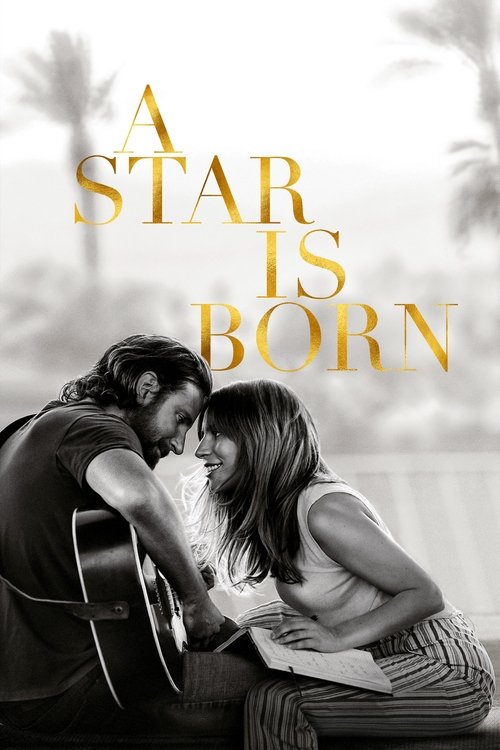
A Star Is Born
2018 · Bradley Cooper
For when you want to be swept up in a big romantic tragedy and don't mind crying — a date-night pick with a bruise in it, best when you're ready to feel something.
What it's about
Jackson Maine, a roots-rock star drinking his way through fading hearing and fading relevance, wanders into a drag bar and hears Ally sing. He falls for her voice, then for her, and pulls her onto stages she'd given up dreaming about. As her career ignites into pop stardom, his addiction and his demons pull the marriage the other way — a love story where one star rises exactly as the other falls.
The experience
Sincere, swooning, and increasingly devastating — the concert scenes hit with real electricity, and the intimate scenes ache. It builds slowly toward heartbreak and doesn't flinch.
Performances
Bradley Cooper transforms his voice and body into a weathered, gravel-throated rocker, and Lady Gaga is a revelation in her first lead film role — raw, unguarded, and singing live in every frame. Their chemistry is the whole movie.
The craft
Cooper's directorial debut recorded its musical performances live at real festivals, and you can feel it — the concerts have a sweaty, from-the-stage immediacy that studio lip-sync never achieves. The songs, led by the global hit 'Shallow,' are woven into the storytelling rather than pasted on. Worth good speakers, genuinely.
Why it matters
A massive commercial and critical hit that produced an Oscar-winning, chart-topping single, proved Lady Gaga as a screen actress, and established Cooper as a serious director.
Snapshot
A Star Is Born (2018) is the fourth Hollywood feature to carry the title and the latest iteration of a story the American film industry has told about itself roughly once a generation. Bradley Cooper, directing for the first time, casts himself as Jackson Maine, a roots-rock star sliding into alcoholism and hearing loss, and Lady Gaga as Ally, the songwriter he pulls from a drag bar into stardom even as his own light fails. Premiering at the Venice Film Festival in August 2018 and released by Warner Bros. that October, the film became a substantial commercial and critical success and generated a global hit single in "Shallow." It is at once a faithful remake, a vehicle for a pop superstar's screen arrival, and an unusually sincere, craft-forward directorial debut whose signature is the decision to record its musical performances live.
Industry & production
The project sits atop one of the longest development histories in recent studio memory. The title descends from a durable Warner Bros. property: William A. Wellman's 1937 original (itself reworking George Cukor's 1932 What Price Hollywood?), Cukor's 1954 Judy Garland musical, and Frank Pierson's 1976 rock-world version with Barbra Streisand and Kris Kristofferson. A new remake circled Warner Bros. for years, at one stage attached to Clint Eastwood as director with Beyoncé reported as the intended lead; that configuration never came together. Cooper, who had worked with Eastwood on American Sniper, took over as director and star in the mid-2010s and brought Lady Gaga aboard as his co-lead. Jon Peters, producer of the 1976 film, retains a producer credit on the 2018 version, a legacy of the property's rights history.
Cooper produced through his own banner alongside partners including Lynette Howell Taylor and Bill Gerber, with Warner Bros. financing and distributing. The reported production budget was modest by tentpole standards (commonly cited around the mid-thirty-million-dollar range), and the film went on to earn several hundred million dollars worldwide — I flag that I cannot verify a precise global gross here, but its status as a major box-office success is well documented. Its release landed inside a commercial revival of the music-driven film: Bohemian Rhapsody opened weeks later in 2018 and Rocketman followed in 2019, with Damien Chazelle's La La Land (2016) having reopened the awards-season door for the musical.
Technology
The film's most consequential technical decision was procedural rather than hardware-based: Cooper and his team recorded the songs as live vocal performances on set rather than pre-recording studio tracks for the actors to lip-sync. This inverted the long-standing musical convention (Cukor's 1954 film, like nearly all classical musicals, was built on playback) and required the production to treat concert staging, sound capture, and camera work as a single integrated problem. Several performance sequences were captured at real festivals and events — Cooper's team famously shot at Glastonbury and at U.S. festivals such as Coachella and Stagecoach — meaning the crew worked within tight, non-repeatable set-length windows in front of actual crowds. That gambit shaped everything downstream, from the mixing to the editing to the vocal preparation. Beyond this, the film uses conventional contemporary digital capture and post; I won't overstate specifics of camera format that I cannot confirm.
Technique
Cinematography
Matthew Libatique, long associated with Darren Aronofsky, shot the film and earned an Academy Award nomination for it. His approach favors handheld intimacy and a warm, naturalistic palette — practical stage lighting, backlit haze, and shallow focus that isolates faces within the noise of a venue. The visual grammar is built around the human close-up: the film repeatedly frames Ally and Jack in tight, slightly unstable shots that keep the actors' eyes and mouths central, an aesthetic that dovetails with the live-vocal method. The concert photography alternates between the performer's vantage — Cooper's Jack looking out at Ally, or the reverse — and immersive on-stage positions that place the camera inside the act rather than in the audience. The result reads as documentary-adjacent realism rather than the polished spectacle of the classical musical.
Editing
Jay Cassidy edited the film. The cutting has to reconcile two registers: the loose, overlapping-dialogue naturalism of the dramatic scenes and the rhythm-bound demands of full musical numbers captured live. In the performance set-pieces the editing tends to hold longer than a conventional concert film, letting a song play closer to real time so that the emotional arc of a number lands as a single event — most famously the Shrine Auditorium performance of "Shallow," staged as Ally's threshold crossing from bystander to star. Elsewhere the film compresses time aggressively to chart Ally's rise, so that career acceleration and relational decline are made to run in parallel.
Mise-en-scène / staging
The film's design opposes two worlds. Jack's is analog and worn — tour buses, desert light, the Arizona ranch, an aesthetic of denim, whiskey, and vintage amplification. Ally's ascent moves her toward the high-gloss apparatus of contemporary pop: styling teams, dyed hair, choreography, television studios, the Saturday Night Live–style promotional machine. Cooper stages the couple's early scenes in cramped, warmly lit private spaces (the parking-lot, the grocery store, a bathtub) to build intimacy, then progressively surrounds Ally with managers and handlers who physically crowd Jack out of the frame. The staging thus dramatizes the story's central tension — authenticity versus manufacture — as a spatial and material argument.
Sound
Sound is the film's true subject and its proudest craft achievement, recognized with an Academy Award nomination for sound mixing. The live-recording method meant the mix had to knit on-set vocals, band, and crowd into something that reads as a professional record while retaining the imperfection of a real performance. The film also foregrounds hearing itself as a theme made audible: Jack's tinnitus and progressive hearing loss are rendered through the sound design, so that the mix periodically inhabits his damaged perception. The songbook — "Shallow," "Maybe It's Time" (written by Jason Isbell), "Always Remember Us This Way," "I'll Never Love Again," and Ally's deliberately slick later pop material — functions dramatically, charting each character's trajectory through genre and production style.
Performance
The performances anchor the film's reputation. Cooper reconceived Jackson Maine partly through voice: he lowered his speaking register substantially and worked extensively with a dialect coach to build a weathered Southern-inflected baritone, modeled in part on Sam Elliott, who plays Jack's older brother and manager, Bobby — a casting choice the film openly acknowledges within the story. Cooper also learned guitar and sang live. Lady Gaga, in her first leading film role, plays against her own iconography: the film introduces Ally largely without pop artifice and stages her stardom as something imposed rather than sought. The supporting cast — Elliott, Andrew Dice Clay as Ally's doorman father, and Dave Chappelle as Jack's friend — grounds the melodrama in lived-in textures. Both leads and Elliott received Oscar acting nominations.
Narrative & dramatic mode
Structurally the film is a melodrama of crossed trajectories: one star ascends as another descends, and the film's engine is the tragic asymmetry between them. It follows the inherited A Star Is Born template closely — discovery, romance, marriage, the woman's eclipsing success, the man's addiction and public humiliation, and his self-destruction so as not to burden her — and derives much of its power from the audience's foreknowledge of that shape. The dramatic mode is intimate realism grafted onto operatic emotion; dialogue is naturalistic and often improvisational in texture, while the song performances serve as heightened arias that carry feeling the characters cannot speak. Its treatment of Jack's alcoholism and its ending are handled with a directness that pushes the material toward tragedy rather than the more redemptive inflections of some earlier versions.
Genre & cycle
The film belongs to several overlapping cycles: the backstage musical, the Hollywood-and-fame self-portrait, and the addiction drama. Most specifically it is the latest entry in the A Star Is Born remake lineage, a rare case of a single narrative being reauthored across roughly nine decades, each version updating the industry it depicts — silent-to-sound Hollywood in 1937, the studio musical in 1954, the rock business in 1976, the streaming-era pop-industrial complex in 2018. It also participates in the late-2010s resurgence of the music biopic and musical drama, though unlike Bohemian Rhapsody or Rocketman it invents its stars rather than dramatizing real ones.
Authorship & method
The film is most legibly a directorial statement by Cooper, who co-wrote (with Eric Roth and Will Fetters), produced, starred, and sang. His method is notable for its insistence on doing rather than simulating — live vocals, real festival stages, a self-transformed voice — an actor-director's belief that authenticity of process yields authenticity on screen. Key collaborators shape that vision: Libatique supplies the handheld, close-up-driven realism; Cassidy the parallel-track structure; and the music team is central to authorship in a way unusual for a drama. Lady Gaga co-wrote and performed much of the score; Lukas Nelson (with his band Promise of the Real) helped build Jackson Maine's roots-rock sound and backed Cooper's performances; Mark Ronson, Andrew Wyatt, Anthony Rossomando, and Jason Isbell contributed to the songbook. "Shallow" is credited to Gaga, Ronson, Rossomando, and Wyatt. The screenplay's lineage runs back through Pierson's 1976 script and the 1937 Dorothy Parker–assisted original, making the writing itself an act of adaptation across generations.
Movement / national cinema
This is mainstream American studio filmmaking in a classical mode — a Warner Bros. prestige release working within Hollywood's oldest habit of narrating its own machinery of fame. It belongs to no art-cinema movement; its lineage is industrial and generic rather than national-avant-garde. If it has a "movement," it is the recurring American impulse toward the reflexive show-business fable, from What Price Hollywood? through Sunset Boulevard to the present.
Era / period
The film is a document of the late-2010s entertainment economy. Set in the contemporary moment of festival touring, viral performance clips, and television-driven pop stardom, it registers how fame is now manufactured and distributed. Its release coincided with the fall-2018 awards season and the broader #MeToo reckoning, and its portrait of a woman's talent being simultaneously discovered and repackaged by industry gatekeepers acquired added resonance in that climate. It also marks the streaming-era theatrical event film — a mid-budget adult drama that still commanded a large theatrical audience, increasingly rare by 2018.
Themes
The governing theme is authenticity versus manufacture: the film repeatedly asks whether Ally's ascent is a fulfillment or a corruption of her gift, staging her later, glossier pop persona as an open question rather than a simple betrayal. Around this cluster addiction and self-destruction (Jack's alcoholism and drug use), disability and decline (his hearing loss, rendered through sound), and the corrosive mathematics of unequal fame within a marriage. The film is also about voice in every sense — literal singing, the courage to be heard, and Jack's insistence that having "something to say" is what separates an artist from a product. Codependency, mentorship shading into possession, and the tension between love and career recur as the story's emotional through-lines.
Reception, canon & influence
Critically the film was received as a strong, sincere directorial debut and a revelatory dramatic showcase for Lady Gaga, with particular praise for its first act, its performances, and its live-music craft; some critics noted the familiar melodramatic machinery of its later stretches. It earned eight Academy Award nominations — Best Picture, Actor (Cooper), Actress (Gaga), Supporting Actor (Elliott), Adapted Screenplay, Cinematography, Sound Mixing, and Original Song — winning for "Shallow." Cooper's omission from the Best Director category was among the season's most-discussed snubs.
Looking backward, the film's influences are overwhelmingly its own predecessors — the 1937, 1954, and 1976 films and their shared DNA — filtered through the roots-rock and contemporary-pop worlds Cooper and his collaborators drew on for texture. Cooper has spoken of the influence of working with Eastwood; more broadly the film's naturalistic, performance-first ethos owes to a New Hollywood strain of actorly realism.
Looking forward, its clearest legacy is "Shallow," which became a genuine cultural event and standard, and its confirmation of Lady Gaga as a serious screen actor, a repositioning that shaped the rest of her film career. It reinforced the commercial viability of the live-recorded musical performance and, alongside the surrounding 2018–19 music films, helped sustain the era's musical revival. Whether the 2018 version becomes the definitive entry in the A Star Is Born cycle or simply its latest is a judgment history has not yet settled — but it demonstrably renewed a nearly century-old property for a new generation, which is precisely what each version of this film has been built to do.
A Deleuzian reading
The Shrine Auditorium.
The full Deleuzian reading of A Star Is Born →
Reception
It premiered at Venice 2018 to a rapturous reception and spent the fall as the presumed Best Picture frontrunner — then went one-for-eight on Oscar night, winning only Best Original Song for 'Shallow.' The awards deflation barely dented it: it settled almost immediately into beloved-modern-melodrama status.
How A Star Is Born was received, from release to now →
How to watch A Star Is Born: what to notice on a first viewing
- Watch Ally's face in the wings before she walks out. Matthew Libatique shoots handheld and close, eyes and mouth centered, the venue behind her dissolved into backlit haze. Cooper spends his most expensive minute on a face making up its mind. The drama is moved down to the scale of an inch or two of a face.
- Listen for the imperfections in the singing. The songs were sung live on set, some inside real festival windows at Glastonbury, Coachella and Stagecoach, in front of crowds who were never going to wait around for a second take. You hear breath being budgeted and a throat under strain, which a playback musical cannot give you.
- Watch how many people stand between Ally and Jack. The early scenes are cramped and warm: a parking lot, a grocery store, a bathtub. As her career moves, managers, stylists and handlers fill the frame and push him toward its edge. The argument about manufacture gets made by who is allowed into the shot.
- Listen to how low Cooper pitched Jack's speaking voice. Cooper dropped his register substantially and worked with a dialect coach, modeling the weathered baritone on Sam Elliott, who then plays Jack's older brother. The film says so out loud. A man is speaking in a voice he took from someone else, and you can hear it once you know.
- Notice how long a whole song is allowed to run. Jay Cassidy holds the performance set pieces longer than a concert film would, so a number lands as one event instead of a montage of angles. Elsewhere he compresses months into seconds. The songs get to be scenes and the career gets to be a blur, which is the shape of the story.
The whole guide to watching A Star Is Born, with the keys for a rewatch →
Influences: the films it descends from and the films it influenced
- A Star Is Born (1937) — The Dorothy Parker–assisted screenplay set the crossed-trajectory melodrama skeleton — ascending ingénue meets self-destructing star, the name change, the self-erasing suicide walk into the sea — that Cooper's script inherits nearly beat-for-beat.
- What Price Hollywood? (1932) — The ur-template every version reworks: an alcoholic industry mentor discovers and elevates a newcomer whose rise runs inversely to his own decline.
- A Star Is Born (1954) — Fused the musical number into the melodrama so songs carry narrative — Garland's 'The Man That Got Away' staged as a near-single-take club performance — the model for Cooper treating diegetic performance as dramatic scene, not interlude.
- A Star Is Born (1976) — Pierson's script is the direct source Cooper adapts; it relocated the story into the live-rock-concert world and shot numbers on real stages before real crowds, the precedent for Cooper's Glastonbury/Coachella festival-stage capture.
- Les Misérables (2012) — Pioneered recording lead vocals live on set to an earpiece piano rather than lip-syncing to prerecords — the exact technique Cooper adopted so every song is a real, unrepeatable take.
- Nashville (1975) — Naturalistic on-location music milieu where performers write and sing their own material amid overlapping live sound, the roots-authenticity ethos Cooper chases with Lukas Nelson's band backing live performances.
- Tender Mercies (1983) — Duvall's understated, self-sung portrait of a recovering-alcoholic country singer established the actorly-realism-first, do-not-perform-the-performance approach to the musician in decline.
- American Sniper (2014) — Cooper absorbed Eastwood's economical, few-takes, trust-the-actor directing method as its star and carried that low-coverage, performance-first discipline into his own debut.
- 8 Mile (2002) — The artist-as-author musician vehicle anchored by a real recording star (Lady Gaga) in a performance-driven drama — the lineage of artist-led narratives 8 Mile reopened for prestige cinema.
- Rocketman (2019) — Extended the live-performance-as-actor's-craft premise by having Taron Egerton sing Elton John's catalog himself inside a full jukebox-musical fantasia.
- Judy (2019) — Renée Zellweger performed Garland's numbers live on camera, looping the live-vocal-craft lineage back to the very star (Cukor's 1954 Garland) the property was built around.
- Maestro (2023) — Cooper's own follow-up extends his do-don't-simulate method and long-take performance authorship, conducting Mahler's Second in a real cathedral in an unbroken six-minute take.
- A Complete Unknown (2024) — Timothée Chalamet sings Dylan live within a roots-music milieu, working directly in ASIB's wake where live-vocal authenticity is treated as the core acting task.
- Elvis (2022) — Carries forward the stardom-and-decline arc with blended live/archival performance capture, pushing the authenticity-vs-manufacture theme through a maximalist staging of the star as product.
- Crazy Heart (2009) — Jeff Bridges as a broken-down alcoholic roots musician performing live-recorded original songs (T Bone Burnett's craft), the immediate template for Jackson Maine's sound and decline.
- Black Swan (2010) — Matthew Libatique's handheld, close-following, shallow-focus grammar pinned to a performer's body and face — the exact close-up-driven intimacy he brings as ASIB's cinematographer.
- The Wrestler (2008) — Handheld behind-the-shoulder immersion tracking a self-destructing performer across the backstage-to-stage threshold, the staging logic Cooper echoes walking Jackson and Ally from wings to spotlight.
- Vox Lux (2018) — A same-year anatomy of manufactured pop stardom that stages a full concert as its climax, interrogating the authenticity-vs-manufacture question from the opposite, synthetic pole.
- Bohemian Rhapsody (2018) — Part of the same 2018–19 music-film cycle, reconstructing a live set (Live Aid) through meticulous shot-for-shot staging of an audience-facing performance.
- The Broken Circle Breakdown (2012) — Stakes a musical melodrama on lead actors performing songs live, using performance sequences as the load-bearing emotional narration for a love-and-loss arc, parallel to Broken Circle's bluegrass numbers.
- Trap (2024) — Stages full diegetic original pop performances as concert setpieces within a narrative film and binds the movie to a real music release, the model for Saleka's tie-in.
Similar films
- Bohemian Rhapsody (2018) — influence & lineage
- Rocketman (2019) — influence & lineage
- Elvis (2022) — influence & lineage
- Nashville (1975) — influence & lineage
- La La Land (2016) — shared sensibility
- The Greatest Showman (2017) — shared sensibility
- "Wuthering Heights" (2026) — shared sensibility
- Once Upon a Time... in Hollywood (2019) — shared sensibility