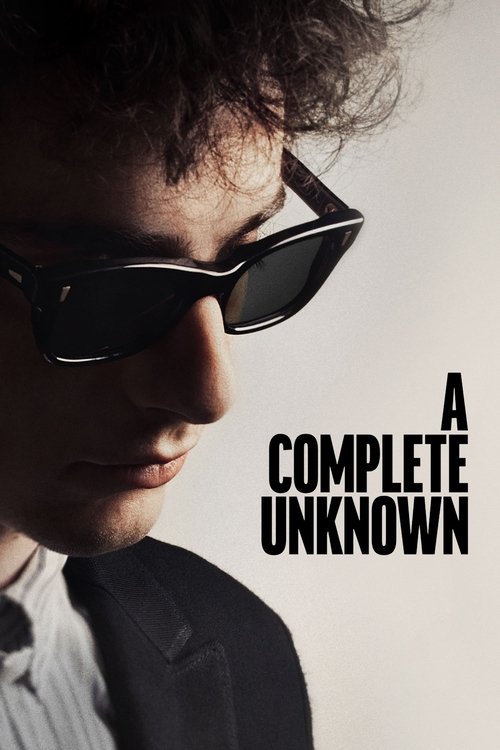
A Complete Unknown
2024 · James Mangold
For a night when you want great music and a story to go with it — a crowd-pleaser with an edge, equally right for Dylan devotees and people who only know the hits. Comfort viewing that still gives you something to argue about after.
What it's about
A nineteen-year-old nobody from Minnesota turns up in Greenwich Village in 1961 with a guitar, a borrowed repertoire and an unnerving gift, and within four years Bob Dylan has upended American music. The film follows him through the coffeehouse folk scene that adopts him — the mentors, lovers and true believers — as his talent outgrows the movement that made him, building toward his infamous decision to plug in an electric guitar at the Newport Folk Festival.
The experience
It plays warm and alive — smoky clubs, songs performed in full, the thrill of watching a scene discover its genius in real time — with a growing undertow of friction as everyone around Dylan realizes they can't hold him. Less a tortured-artist drama than a study in charisma and evasion; you leave humming and slightly stung.
Performances
Timothée Chalamet does his own singing and playing and disappears into Dylan's mumble and swagger without tipping into impression — it's the committed, risky kind of biopic performance. Edward Norton brings real tenderness to Pete Seeger, the movement's gentle conscience.
The craft
Mangold recreates early-'60s New York with loving texture and, crucially, treats the songs as scenes — performed live and at length, so you feel why this music detonated. It rewards good speakers; the Newport sequence is built like a thriller set piece.
Why it matters
It brought Dylan's origin story to a generation that knew him only as a monument, and reconfirmed Mangold as the modern master of the music biopic. The Newport electric moment it dramatizes remains shorthand for the artist who chooses betrayal over belonging.
Snapshot
A Complete Unknown traces the emergence of Bob Dylan from anonymous Minnesota teenager to countercultural icon across roughly four years — 1961 to 1965 — that transformed American popular music. Anchored by Timothée Chalamet's physically and vocally committed performance, James Mangold's film is structured around a single dramaturgical question: how does a young man who arrived in New York with little more than borrowed songs and uncanny instinct survive long enough to betray, and thereby liberate, everything that first sheltered him? The title, drawn from Dylan's own lyric in "Like a Rolling Stone," names the paradox at the film's center — identity as permanent evasion. The narrative culminates at the 1965 Newport Folk Festival, where Dylan's decision to perform with an electric band cleaved the folk movement in two and announced the rock era's full cultural dominance.
Industry & production
A Complete Unknown is a Searchlight Pictures production, placing it within the Disney ecosystem's specialty-film arm rather than in the prestige independent space where such material might once have found a home. The film adapts Elijah Wald's Dylan Goes Electric! (2015), a revisionist history that argued the 1965 Newport controversy had been mythologized into a simplistic folk-vs.-rock conflict, when the actual tensions were subtler and more deeply rooted in the politics of authenticity within the folk revival. Mangold and his co-writer Jay Cocks — who has collaborated with Martin Scorsese on The Age of Innocence (1993) and Gangs of New York (2002), and whose ear for American vernacular and period texture is well established — developed the screenplay over several years.
The production is unusual within the modern biopic landscape for having received a degree of acquiescence from Dylan himself, who is famously protective of his image and has historically resisted authorized biographical treatments. The extent of Dylan's direct involvement has not been publicly detailed, and the film is careful to present Sylvie Russo (Elle Fanning), the composite character standing in primarily for Suze Rotolo, under a pseudonym — a standard legal precaution that also signals the film's fidelity to emotional rather than strictly documentary truth. Joan Baez and Pete Seeger appear under their actual names, with the estate cooperation or at least non-opposition this implies. Johnny Cash appears as portrayed by Boyd Holbrook in a warm, historically grounded cameo that establishes Cash as one of Dylan's earliest and most consequential champions.
Chalamet undertook extensive preparation — learning to play guitar and replicate Dylan's vocal idiosyncrasies over a reported period of years. All vocal performances in the film are Chalamet's own, a decision with significant artistic and commercial implications that distinguishes the film from biopics (such as Bohemian Rhapsody) that rely on the original artist's recordings. Licensing Dylan's published compositions required negotiation with his respective rights holders — the publishing catalog was acquired by Universal Music Group in 2020 in a landmark deal — representing a significant component of the production's arrangement.
Technology
The film was shot on 35mm film rather than digitally, a choice with both aesthetic and ideological valence for a story set in the early 1960s. Shooting on film introduces grain structures and tonal ranges that digital capture continues to approximate rather than replicate, and for a period piece about acoustic-era recording and analog musical culture, the decision carries a coherence beyond nostalgia. The choice to photograph on film is consistent with a broader tendency in prestige period filmmaking of the early 2020s — films like Oppenheimer (2023) and TÁR (2022) made similar choices — suggesting an industry-wide reassertion of photochemical technique as a marker of artistic seriousness.
The sound design and music mixing are necessarily central. Integrating live-recorded vocal and guitar performances by Chalamet with period-authentic backing arrangements required careful work in post-production to achieve the impression of presence without the slickness of contemporary recording. The film's music supervisor and sound team faced the challenge of making songs instantly recognizable to audiences while calibrating the sonic world to approximate what these performances would have felt like in 1961–65 — before the studio techniques that now define how Dylan's catalog sounds in memory were fully established.
Technique
Cinematography
Rodrigo Prieto, who served as director of photography, brings to the film a sensibility developed across a career that includes Brokeback Mountain (2005), Silence (2016), and Barbie (2023) — an unusually wide range suggesting a technician who subordinates style to the demands of the material. For A Complete Unknown, the approach is restrained: a muted, slightly underexposed palette that evokes the grainy monochrome documentary photography of the early 1960s (the work of photographers like Don Hunstein and Daniel Kramer who documented Dylan's early career) without literalizing it into a black-and-white aesthetic. Prieto favors close-up and medium-close shooting during performance sequences, placing the camera at the level of the audience rather than surveying from above, which reinforces the film's interest in Dylan as a figure being watched, interpreted, and projected upon by those around him rather than understood from the inside.
Editing
The editing maintains a deliberate pace consistent with the biographical drama tradition: it is not a fast film, and it resists the quick-cut montage that lesser biopics use to compress time. The structural problem of any four-year chronicle — the management of ellipsis, the suggestion of months passing without dramatizing them — is handled largely through transitional title cards and subtle changes in mise-en-scène (hair, clothing, the visible maturation of its star) rather than through elaborate temporal devices. Individual performance scenes are allowed to run at something approaching real time, a decision that pays dividends in the Newport climax, which lands with the weight that comes from the film having refused to rush.
Mise-en-scène / staging
The Greenwich Village of the early 1960s is reconstructed with attention to period detail — the coffeehouses, the Washington Square Park folk sessions, the cramped apartments — without tipping into the kind of fetishized production design that turns period recreation into theme-park spectacle. Mangold keeps the spaces legible as functional environments where people work, argue, and sleep rather than as backdrops. The crowded, smoke-filled rooms of the Village folk scene create a social texture from which Dylan is always slightly withdrawn — physically present but internally elsewhere — and Mangold's blocking consistently stages Chalamet at a slight angle to the other figures, reinforcing the sense of a consciousness that cannot fully engage with its surroundings because it is always, partly, transcribing them.
Sound
The decision to record Chalamet's vocals live rather than dubbing over Dylan originals is the most consequential technical choice the film makes, and it is also a thematic one. The slightly imperfect, unmistakably human quality of Chalamet's voice situates Dylan's music as something made by a specific body in a specific room at a specific moment rather than as a received cultural monument. The film's sound design uses natural room acoustics for the folk club sequences — the resonant mid-range frequencies of a wooden room filled with people — contrasting with the harsher, more confrontational sonic environment of the Newport electric performance. The moment when the band hits the first electric chord is handled not as spectacle but as rupture: the sound fills the frame in a way that the acoustic sequences never quite do.
Performance
Chalamet's performance is the film's engine and its central achievement. Rather than impersonating Dylan — capturing the external tics and vocal mannerisms as an end in themselves — Chalamet builds from those mannerisms toward a characterization of withholding, of a person whose social performances are always slightly theatrical, always aware of being observed. Monica Barbaro's Joan Baez is a revelation: she locates in Baez a complex mix of generosity and pride, commercial instinct and genuine artistic conviction, that resists the supporting-character simplification such roles often receive. Edward Norton's Pete Seeger, earnest and politically principled, functions partly as a moral foil — the film's clearest embodiment of what Dylan is refusing when he refuses folk orthodoxy.
Narrative & dramatic mode
The film operates in the retrospective-ironic mode common to biopics of figures whose endings are already known: the audience is always watching Dylan become Dylan, aware of a destination the young man on screen cannot yet see. Mangold and Cocks resist the redemption arc structure that Walk the Line and the mainstream biopic tradition depend on — Dylan does not overcome a flaw so much as he persists in one, his resistance to being fully known presented not as failure but as the condition of his art. The film's dramatic tension is thus horizontal rather than vertical: not whether Dylan will become great (this is stipulated) but at what cost to others and to his own capacity for ordinary human relation.
Genre & cycle
A Complete Unknown enters a biopic cycle that has been one of the dominant modes of prestige filmmaking since the early 2010s: Bohemian Rhapsody (2018), Rocketman (2019), Elvis (2022), and Back to Black (2024) all concern rock and pop figures from the mid-twentieth century, reflecting an industry calculation that IP-adjacent biographical subjects carry pre-sold audiences. What distinguishes Mangold's film from most entries in this cycle is its investment in historical and sociological texture — the folk revival as a political movement with its own ideological fractures — rather than in the mythology of rock stardom as such. The film is closer in spirit to Todd Haynes's I'm Not There (2007), which scattered Dylan's identity across six fictional avatars, than to the straightforward rise-and-fall structure of most music biopics, though it is considerably more legible and commercially oriented than Haynes's experimental treatment.
Authorship & method
James Mangold has built a career around character studies of American figures operating at the border between mythology and human limitation: Johnny Cash in Walk the Line (2005), Logan/Wolverine in Logan (2017), Ken Miles in Ford v Ferrari (2019). His directorial instincts tend toward the classical — wide compositions, space for performance, resistance to stylistic intrusion — and toward a thematic preoccupation with men (almost always men) who are simultaneously exceptional and damaged, whose gifts and their costs are inseparable. The Dylan project represents a natural extension of these concerns into the specific terrain of American musical mythology. Jay Cocks's contribution to the screenplay is worth noting: his historical instincts and period ear, developed across decades of collaboration with Scorsese, bring a density of cultural reference that grounds the dialogue in something more than generic period flavor.
Rodrigo Prieto's consistent subordination of his own style to the demands of each director and project means that his contribution here is harder to characterize than it would be for a cinematographer with a more assertive signature, but the evidence of the film suggests a conscious conversation between Prieto and Mangold about documentary photographic traditions of the early 1960s.
Movement / national cinema
The film is unambiguously American cinema in its preoccupations: the relationship between individual genius and collective cultural tradition, the mythology of self-invention, the instrumentalization of folk art within a commercial entertainment system. The folk revival itself — and the specific tensions it generated around authenticity, commercialism, and racial appropriation (the folk movement's selective memory of blues and gospel sources is not the film's subject but haunts its margins) — is a peculiarly American cultural formation, and the film situates Dylan's breakthrough within that formation with enough precision to resist simple universalization.
Era / period
The early 1960s in Greenwich Village constitutes one of the most mythologized micro-environments in American cultural history, and Mangold walks the difficult line between honoring that mythology and interrogating it. The film is set during a specific historical rupture — the transition from late-1950s Cold War conformism to early-1960s protest politics — and Dylan's career is positioned within that rupture without being reducible to it. The Cuban Missile Crisis hovers at the edges of the film, a reminder that the cultural stakes of the folk revival were understood by participants as genuinely political.
Themes
Artistic authenticity and its impossibility. The central irony Mangold and Cocks sustain throughout is that Dylan's most influential act — going electric — is legible as both a betrayal of authenticity (abandoning the folk tradition's claim to unmediated directness) and an assertion of it (refusing to be owned by an audience's expectations). The film does not resolve this irony; it holds it open.
Identity as performance and evasion. Dylan's refusal to disclose, to commit, to remain still — evident in his relationships with Sylvie, with Baez, with the folk movement itself — is presented neither as pathology nor as heroism but as the constitutive condition of his creativity. The complete unknown of the title is a description and also a method.
The ethics of influence. The film is interested in the costs that Dylan's passage through other people's lives — Sylvie's, Baez's, Seeger's — exacts, without reducing this to a simple moral indictment. What a talent of that order requires from its human surround is one of the film's uncomfortable persistent questions.
American mythology and its instruments. Dylan is himself a myth-maker — from his Minnesota origins through his adopted name — and the film observes him constructing that myth with a self-consciousness that does not quite add up to cynicism.
Reception, canon & influence
Critical reception was strongly positive, with Chalamet's performance receiving near-universal acclaim as among the finest work of his generation. The film's approach to the biopic form — its classical restraint, its resistance to hagiography, its historical specificity — was widely praised relative to the broader cycle of music biopics with which it inevitably competed. Monica Barbaro's Baez received particular critical attention as a performance that exceeded the usual supporting-character compression. The film performed well commercially for a prestige biographical drama, generating significant awards-season momentum and multiple major nominations.
Looking backward, the film's most obvious precursor is Mangold's own Walk the Line, to which it is inevitably compared: both films concern enormously influential American musicians of the postwar era, both emphasize a defining romantic relationship, and both climax in a legendary performance. But A Complete Unknown is a more formally ambitious film than Walk the Line precisely because it refuses the redemption structure that Johnny Cash's biography readily supplied. I'm Not There (Todd Haynes, 2007) occupies a parallel genealogy — more experimental, more theoretically sophisticated — and the two films together represent the poles between which any serious treatment of Dylan must navigate.
The film enters the record at a moment when the music biopic is under scrutiny for formula and hagiography; its reception suggests that the genre still commands significant cultural attention when executed with sufficient historical rigor and performing talent. Whether A Complete Unknown will be understood in retrospect as a renovation of the form or as a distinguished entry within a declining cycle remains, as of its release, genuinely open. Its most certain legacy may be Chalamet's performance, which establishes him as one of the principal American actors of his generation capable of sustaining a major biographical role across the full running time of a serious film.
A Deleuzian reading
Watch the face in the folk clubs.
The full Deleuzian reading of A Complete Unknown →
Reception
A Christmas Day crowd-pleaser that rode Chalamet-mania to eight Oscar nominations — and then went home with zero, a snub-night footnote that's already become part of its story. A year and a half on it sits as the rare music biopic that both casual audiences and Dylan obsessives will actually defend.
How A Complete Unknown was received, from release to now →
Influences: the films it descends from and the films it influenced
- Don't Look Back (1967) — Pennebaker's handheld available-light close-ups of Dylan in performance and confrontation — filming an evasive subject who performs identity for the camera — establish the vérité visual grammar that Prieto's underexposed 35mm palette consciously quotes.
- Nashville (1975) — Altman's pioneering 24-track live sound recording, capturing overlapping acoustic and amplified performances simultaneously across competing spaces, is the production-sound methodology ACU's real-time Newport performance sequences inherit.
- The Last Waltz (1978) — Scorsese's multi-camera concert grammar — extreme close-ups of hands and faces during solos, editing locked to the musical phrase rather than the dramatic beat — is the formal template for ACU's performance sequences.
- Raging Bull (1980) — Michael Chapman's high-contrast performance close-ups and the film's withholding of psychological explanation for LaMotta's self-destruction establish the prestige biopic grammar of refusing sympathetic interiority that ACU's withholding characterization of Dylan inherits.
- Coal Miner's Daughter (1980) — Sissy Spacek's live on-set vocal performance — songs recorded in character rather than lip-synced to playback — established authentic vocal capture as the prestige music-biopic standard that Chalamet's preparation and Mangold's insistence on performance-recorded sound directly inherits.
- Amadeus (1984) — Salieri's retrospective-ironic narration formalizes the music biopic's consciousness problem — a witness who cannot explain genius, whose account is structurally partial — that ACU's title-card retrospective structure performs without the explicit unreliable narrator.
- Walk the Line (2005) — Mangold's own structural template — a defining romantic relationship as biographical spine, climaxing in a legendary live performance — is the framework ACU deliberately refuses its redemption arc from, sharpening Mangold's formal instincts against his own prior solution.
- No Direction Home (2005) — Scorsese's archival-footage documentary construction frames the acoustic-to-electric rupture at Newport 1965 as biographical pivot, and his editorial grammar for live performance sequences as cultural rupture is the documentary ground ACU fictionalizes — the film ACU must either absorb or distinguish itself from.
- I'm Not There (2007) — Haynes's formal device of fragmenting Dylan's biography across six actors is the theoretical limit ACU navigates against — both films share the thesis that Dylan's identity is constitutively evasive, but Mangold's classical unity of character is meaningful only against Haynes's experimental dispersal.
- Elvis (2022) — Austin Butler's immersive vocal preparation occupies the same performance tradition as Chalamet's, but Luhrmann's maximalist formal approach — rapid editing, stylistic intrusion, biographical compression — positions ACU's classical restraint as a deliberate formal argument against this contemporaneous treatment of the same music-biopic material.
- A Star Is Born (2018) — Timothée Chalamet sings Dylan live within a roots-music milieu, working directly in ASIB's wake where live-vocal authenticity is treated as the core acting task.
- Almost Famous (2000) — John Toll's 35mm period rock cinematography — backstage close-ups of musicians' faces during performance, existing-light authenticity in rehearsal sequences — establishes the visual register for the music biopic performance close-up that Prieto's approach inherits and extends into folk-revival muting.
- Capote (2005) — Philip Seymour Hoffman's immersive-preparation withholding performance — a central presence that deflects psychological explanation while remaining fully inhabited — is the performance methodology Chalamet's Dylan directly inhabits; Miller's classical restraint in staging an iconic figure whose private methods remain opaque is ACU's formal model.
- There Will Be Blood (2007) — Robert Elswit's off-axis two-person staging in confrontational scenes and Daniel Day-Lewis's withholding performance methodology — refusing sympathetic legibility while sustaining screen charisma — are direct formal siblings to ACU's blocking and Chalamet's approach; both films refuse the redemption arc for a figure whose genius and damage are inseparable.
- The Social Network (2010) — Fincher's retrospective-ironic framing — flashback dramatizations in permanent tension with competing testimonial accounts — formalizes the biographical gap between action and explanation that ACU's title-card structure performs, and Eisenberg's withholding characterization of Zuckerberg as constitutively evasive American genius is the performance model Chalamet's Dylan inhabits.
- Inside Llewyn Davis (2013) — T Bone Burnett's live acoustic folk performance recording in the Greenwich Village scene directly preceding Dylan's emergence is the sound-production methodology ACU's folk-scene sequences inherit; the Coens' withholding protagonist who refuses commercial compromise — his talent and self-destructiveness inseparable — is the direct formal sibling of Mangold's Dylan.
- Judy (2019) — Renée Zellweger's live on-set vocal recording — all songs captured in character — and the film's extreme close-up coverage of the performance face as emotional unit are formal siblings to ACU's performance methodology; both films refuse hagiography about a self-destructive figure without supplying a redemption arc.
- Maestro (2023) — Cooper's documented immersive preparation — years of conducting study, live orchestral performance on set — and the film's refusal to psychologize its subject's private life while insisting on the costs of genius are formal siblings to ACU's approach; both films locate authenticity as impossible to fix and resist the redemption arc.
- Michael (2026) — The current wave's insistence on the lead performing the catalog live on camera, the same authenticity bet Michael places on Jaafar Jackson's vocal and dance recreations.
Similar films
- Walk the Line (2005) — influence & lineage · same viewing thread · often watched together
- I'm Not There (2007) — influence & lineage
- Inside Llewyn Davis (2013) — influence & lineage
- Nashville (1975) — influence & lineage
- The Last Waltz (1978) — influence & lineage
- Elvis (2022) — influence & lineage · same viewing thread
- The Testament of Ann Lee (2025) — same viewing thread
- The Doors (1991) — same viewing thread
All the films related to A Complete Unknown →
Watch it with: curated runs of related films
- The Making of a Legend — A run of biopics that watch private people get forged into public icons — the ambition, the pressure, and the loneliness of becoming somebody the world can't stop looking at.