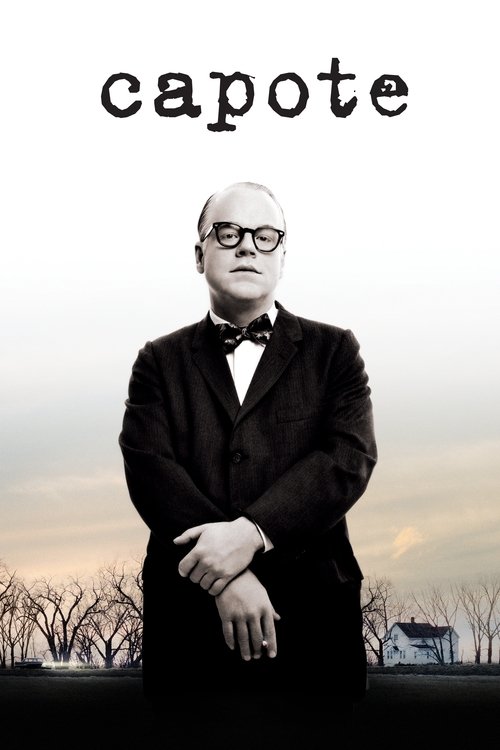
Capote
2005 · Bennett Miller
For when you want a serious, absorbing character study to think about for days — a challenge, not a comfort watch, best with your full attention and a quiet room.
What it's about
In 1959, writer Truman Capote reads a short newspaper item about a Kansas farm family murdered in their home and decides it will be his next story. He travels from Manhattan's literary parties to small-town Kansas with his friend Harper Lee, talks his way into the investigation, and grows dangerously close to one of the accused killers. What starts as a magazine assignment becomes a six-year obsession — and the book that will make him immortal, at a price he keeps refusing to look at.
The experience
Quiet, wintry, and slow-burning, it tightens like a hand closing — you watch a charming man do something morally queasy in plain sight and can't stop watching. It leaves you unsettled rather than uplifted, chewing on where sympathy ends and exploitation begins.
Performances
Philip Seymour Hoffman won the Oscar for a transformation that goes far past the famous voice — he plays Capote's charm, vanity, and self-deception all at once, often in the same sentence. Catherine Keener is his perfect counterweight as Harper Lee, the friend who sees exactly what he's doing.
The craft
Bennett Miller directs with enormous restraint: long silences, muted gray plains, rooms where what isn't said does the damage. The spare score and cold, beautiful landscapes make the Kansas scenes feel like another planet from Capote's glittering New York. It rewards patience more than a big screen — it's a film of faces.
Why it matters
One of the defining American indie prestige films of the 2000s, it launched Bennett Miller's directing career and gave Hoffman the role of his life. It also reframed a famous book as a moral crime scene of its own.
Snapshot
Capote is a chamber biopic built around a single creative act and its moral cost: Truman Capote's six-year pursuit of the book that became In Cold Blood. Directed by Bennett Miller from a screenplay by Dan Futterman, adapted from Gerald Clarke's 1988 biography Capote, the film narrows the sprawl of a famous life to the years 1959–1965 — from the moment Capote reads a brief New York Times item about the murder of a Kansas farm family to the executions that gave his "nonfiction novel" its ending. Philip Seymour Hoffman's central performance, which won the Academy Award for Best Actor, anchors a film less interested in literary celebrity than in the predatory intimacy between a writer and his subject. Released by Sony Pictures Classics, it became one of the defining American independent prestige films of its decade and the unlikely debut narrative feature of a director who had previously made a single documentary. It is a quiet, wintry, morally severe picture about the act of authorship itself — and about what is consumed to make a masterpiece.
Industry & production
Capote is a product of mid-2000s American specialty cinema, the ecosystem of low-budget, awards-oriented features financed and distributed outside the major studios but adjacent to them. The film was produced through Cooper's Town Productions, the company Hoffman co-founded, with Hoffman, Futterman, and the producing team of Caroline Baron, William Vince, and Michael Ohoven among the principals; financing came substantially through Canadian sources, which shaped where and how the film was made. It was shot largely in Manitoba, Canada, with the flat winter landscapes around Winnipeg standing in for the high plains of western Kansas — a practical choice driven by budget and tax incentives that nonetheless served the film's bleak visual register.
The budget was modest by any studio measure (widely reported in the low single-digit millions), and the production was correspondingly lean and fast, shot in a matter of weeks. Sony Pictures Classics, the specialty arm built for exactly this kind of acquisition, handled distribution; the film premiered on the fall-festival circuit (Telluride and Toronto in 2005) before a platform release calibrated to awards season. That strategy paid off: the film received five Academy Award nominations — Picture, Director, Actor, Supporting Actress (Catherine Keener), and Adapted Screenplay — winning Best Actor. The convergence of a charismatic literary subject, a transformative lead performance, and a disciplined specialty-distribution campaign made Capote a textbook case of how the independent prestige film functioned in the years before streaming reordered the field.
A notable industrial footnote: a competing production covering the identical material, Douglas McGrath's Infamous (2006), starring Toby Jones, was in development simultaneously and released roughly a year later. Capote reached audiences first, and its priority — and Hoffman's Oscar — effectively defined the cultural memory of the story, leaving Infamous to be received as the second telling.
Technology
Capote was made on 35mm film, the standard professional acquisition medium of its moment, and it is in most respects a technologically conservative production — deliberately so. There is little here that announces itself as technical innovation; the film's ambitions are dramatic and tonal rather than spectacular. It belongs to the last full generation of American features shot, finished, and largely distributed photochemically, before digital intermediate workflows and digital projection became ubiquitous. The widescreen anamorphic-scope framing, the available-light and naturalistic interior lighting, and the muted photochemical color all reflect a craft tradition more than any new tool. Where the film is "advanced" is in restraint: it withholds the visual augmentation — saturated grading, showy camera rigs, score-driven montage — that the technology of the period readily allowed. The period setting (1959–1965) is realized through production design, costume, and location rather than effects work; there are no significant visual-effects sequences. In short, technology in Capote is a servant kept deliberately out of view.
Technique
Cinematography
Adam Kimmel's photography is the film's most immediately expressive element and the clearest statement of its sensibility. Working in widescreen scope, Kimmel composes for stillness and isolation: figures pinned in the lower third of the frame beneath wide, empty Kansas skies; interiors lit low and cool, with faces emerging from shadow. The palette is desaturated and wintry — grays, browns, the bleached white of snow — a register that suits both the literal landscape and the emotional climate. Camera movement is sparing and motivated; the film favors held compositions and patient framing over coverage-driven cutting, which lends conversations a watchful, almost surveillant quality appropriate to a story about a writer observing his subjects. The prison scenes between Capote and Perry Smith are staged in tight, dim spaces that press the two men together visually even as the drama charts their moral distance. Kimmel's work converts a low budget into an aesthetic virtue, finding austerity rather than poverty in the limited means.
Editing
Christopher Tellefsen's editing is unhurried and controlled, built on the assumption that the audience will sit inside a scene long enough to register subtext. The film resists the accelerated rhythms of conventional biopic montage; it does not race through the years but lets time accumulate, marking the long delay of the killers' appeals as a source of suspense and of Capote's mounting impatience. Scenes are allowed to breathe to the point of discomfort, which is precisely the point — the viewer is made to wait alongside a man waiting for two executions. The cutting privileges performance and reaction, holding on Hoffman's face as calculation flickers beneath charm. The structural shape is a slow tightening: an episodic opening that follows Capote's research broadens the canvas, then the film progressively constricts toward the cell and the gallows.
Mise-en-scène / staging
Jess Gonchor's production design and the film's overall staging reconstruct two worlds in pointed contrast: the parlors and publishing salons of Capote's New York, all warm interiors and social performance, and the spare, cold institutional and rural spaces of Kansas. The film stages Capote as a man perpetually performing for an audience — at Manhattan dinner parties he is the center of every room — and then strips that audience away in the prison, where his performance must do real and dangerous work on a single listener. Period detail is handled with restraint rather than nostalgia; the 1959–1965 setting registers through silhouette, telephone, typewriter, and costume without tipping into pastiche. Staging consistently uses physical positioning to dramatize power: who sits, who stands, who is behind bars, who controls the door.
Sound
The sound design is quiet and naturalistic, dominated by the hush of cold interiors, the scratch of the writer's pen, and the low murmur of conversation. Mychael Danna's score is correspondingly spare — restrained piano and chamber textures that comment on the action without swelling to underline it. The music tends to enter in the gaps, voicing melancholy and unease rather than triumph; it refuses the heroic register a more conventional biopic of a famous artist might have invited. Silence is used structurally, particularly in the late prison and execution sequences, where the absence of score throws full weight onto event and face.
Performance
Performance is the film's center of gravity. Hoffman's Capote is a study in controlled contradiction — the high, reedy voice and mincing social manner rendered with precision but never caricature, set against a cold, watchful intelligence underneath. Crucially, Hoffman plays the calculation as well as the charm: we see Capote charm, flatter, and manipulate, and we see him register, behind the eyes, exactly what he is doing. The performance refuses to let us love him simply. Around him, Catherine Keener's Harper Lee functions as the film's moral ballast and the audience's surrogate conscience, grounded and watchful; Clifton Collins Jr.'s Perry Smith is wounded, intelligent, and genuinely sympathetic, which makes Capote's exploitation of him land as betrayal; Chris Cooper's lawman Alvin Dewey and Bruce Greenwood's Jack Dunphy fill out a register of restraint against which Capote's theatricality stands exposed. The ensemble plays in a minor key, ceding the spotlight to Hoffman while quietly judging his character.
Narrative & dramatic mode
Capote is a tragedy of authorship structured as a slow moral descent. Its dramatic engine is a single, agonizing contradiction: Capote needs Perry Smith alive and talking to gather his material, but he needs Perry dead — executed — to give his book an ending. The narrative makes this the source of its tension and its horror. The film adopts a restrained, observational mode rather than the explanatory, cradle-to-grave sweep typical of the biopic; it brackets a famous life to a single project and refuses voiceover, montage life-summary, or psychological exposition. Information is conveyed through behavior and conversation. The result is closer to character study and moral chamber drama than to conventional biography. The arc is ironic and closed: Capote gets his masterpiece and is, the film suggests, destroyed by the getting of it — a destruction the closing titles gesture toward by noting he never completed another book.
Genre & cycle
The film sits at the intersection of the biopic and the true-crime drama, and it complicates both. As a biopic it is anti-celebratory, using the form's machinery to indict rather than honor its subject. As true crime it is meta-generic: it is a crime story about the making of a crime story, foregrounding the ethics of turning real murder into art — a self-reflexive turn that connects it to the source material's own status as the founding "nonfiction novel." It belongs to a mid-2000s cycle of intelligent, performance-driven specialty biopics of artists and public figures (a wave that included films on musicians, writers, and other cultural figures), but it is among the most formally austere and morally skeptical of that group. Its closest companion is its own competitor, Infamous, which dramatizes the identical events in a more overtly emotional and comic register, making the two films an unusually direct study in how genre tone reshapes the same facts.
Authorship & method
The film is the product of a tight authorial collaboration among three figures who were, notably, longtime friends: director Bennett Miller, screenwriter Dan Futterman, and star-producer Philip Seymour Hoffman. Miller, whose only prior feature was the documentary The Cruise (1998), brought a documentarian's patience and observational eye to his narrative debut; his subsequent career (Moneyball, Foxcatcher) confirmed the interests visible here — repressed men, the cost of obsession, the gap between public performance and private damage. Futterman, an actor turned screenwriter, adapted Gerald Clarke's authorized biography, making the decisive structural choice to compress a whole life into the In Cold Blood years and to keep the writing tight, elliptical, and free of editorializing. Hoffman's contribution was both performative and entrepreneurial — Cooper's Town Productions helped will the film into existence — and the lead performance is inseparable from the film's authorship. Among key collaborators, cinematographer Adam Kimmel established the austere visual grammar, composer Mychael Danna supplied the spare emotional undertone, editor Christopher Tellefsen set the deliberate rhythm, and designer Jess Gonchor built the contrasting worlds. The film's method throughout is subtraction: strip the biopic of its conventional excesses and let behavior, framing, and silence carry meaning.
Movement / national cinema
Capote is firmly a work of American independent / specialty cinema, the prestige wing of the U.S. indie sector as it stood in the mid-2000s — auteur-adjacent, festival-launched, awards-targeted, and distributed by a studio specialty label. It does not belong to a formal movement in the avant-garde sense, but it exemplifies a recognizable strain of American filmmaking: restrained, literate, performance-forward realism descended from 1970s character drama and the American independent tradition. Its physical production in Canada (Manitoba) reflects the cross-border financing and runaway-production economics of the period, but its sensibility, subject, and address are wholly American. Culturally it is a film about American mythology — the heartland murder, the East Coast literary celebrity, the chasm between them — and about a distinctly American literary moment.
Era / period
The film occupies two periods at once. Diegetically it is set in 1959–1965, the years of the Clutter murders, Capote's research, and the killers' trial, appeals, and execution — a turning point in postwar American culture that the film treats with sober period fidelity. Industrially and stylistically it is a product of 2005, the late photochemical, pre-streaming moment of the American specialty film, when a small, serious, adult drama could still command national attention and major awards through theatrical platform release. The film's restraint reads as a corrective to the period's louder biopic conventions. Watched today, it also marks the high-water mark of a now-diminished ecosystem — the mid-budget, star-driven prestige drama — making it something of a period piece twice over.
Themes
At its core Capote is about the ethics of art-making: the writer as a being who consumes other lives to produce his work. It dramatizes the predatory intimacy of the artist-subject relationship, in which empathy and exploitation become indistinguishable — Capote's genuine identification with Perry Smith ("it's as if we grew up in the same house, and one day he went out the back door and I went out the front" is the kind of sentiment the film attributes to him) coexists with his willingness to let Perry die for the sake of an ending. Adjacent themes radiate outward: the corrosiveness of ambition; the relationship between self-invention and dishonesty (Capote is a man who has constructed himself, and the film asks what that construction costs); empathy weaponized; the loneliness beneath performance; and the moral hollowing-out that the film proposes as the price of the masterpiece. There is also a quieter theme of friendship and conscience, carried by Harper Lee, whose steady moral clarity measures how far Capote has strayed.
Reception, canon & influence
Critically, Capote was received as one of the most accomplished American films of its year, with near-universal praise concentrated on Hoffman's performance and on the film's intelligence and restraint; its five Academy Award nominations and Hoffman's Best Actor win confirmed its standing within the awards establishment, and it has retained a secure place in the canon of 2000s American prestige drama and of the biopic genre's more serious examples.
Looking backward, the film's influences are both literary and cinematic. Its foundational text is Capote's own In Cold Blood (1966) and the legend of its creation, by way of Gerald Clarke's biography; its preoccupation with the artist's moral compromise descends from a long tradition of films and literature about creators who exploit their material. Cinematically it draws on the restrained, character-driven American realism of the 1970s and on the observational ethos of documentary — fitting for a director who came from nonfiction film. The choice to dramatize the making of In Cold Blood rather than to adapt it again (Richard Brooks had filmed the book in 1967) is itself a critical gesture, turning attention from the crime to the conscience of its chronicler.
Looking forward, the film's most concrete legacy is the career it announced and the performance it canonized. It established Bennett Miller as a major American director of repressed-obsession dramas, a line continued in Moneyball (2011) and Foxcatcher (2014). It cemented Philip Seymour Hoffman's status as the defining American character actor of his generation, and the performance remains a reference point for biographical screen acting. More broadly, Capote helped model a mode of biopic — narrow in scope, morally skeptical, performance-driven — that influenced subsequent prestige biographical films that resisted cradle-to-grave sweep in favor of a single revealing episode. Its immediate cultural shadow over Infamous also stands as a case study in how priority and performance can decide which of two competing films a culture chooses to remember.
A Deleuzian reading
Watch Hoffman's face in the prison light.
The full Deleuzian reading of Capote →
Reception
A critical darling on release — five Oscar nominations and a Best Actor win for Philip Seymour Hoffman — it has since hardened into something more solemn: after Hoffman's death in 2014, it's increasingly watched as the monument to his talent.
How Capote was received, from release to now →
Influences: the films it descends from and the films it influenced
- Gods and Monsters (1998) — Inherits the queer-artist character study delivered through one definitive lead performance — the small, writerly, single-towering-turn prestige film whose awards success follows the path Gods and Monsters cut for McKellen's Whale.
- Midnight in the Garden of Good and Evil (1997) — Dramatizes the very In Cold Blood reportage tradition Midnight descends from — the writer-outsider extracting narrative from a real crime and a closed local world.
- Moneyball (2011) — Continues Miller's subtraction method and repressed-obsession portraiture, behavior and silence carrying a man defined by a single consuming pursuit.
- In Cold Blood (1967) — The film Capote dramatizes the making of; Conrad Hall's on-location, available-light anamorphic photography of the actual Kansas farmhouse and gallows is the direct visual ancestor of Adam Kimmel's austere widescreen plains.
- Badlands (1973) — Establishes the affectless Midwestern true-crime landscape — flat horizon, naturalistic light, violence drained of melodrama — that Capote inherits for its Holcomb scenes.
- Days of Heaven (1978) — Néstor Almendros's magic-hour, available-light naturalism on the open plains is the source of Capote's desaturated, light-led exterior grammar that refuses studio polish.
- All the President's Men (1976) — Models the patient writing-as-procedure drama — Gordon Willis's controlled, muted, withholding compositions making the pursuit of a story cinematic without action.
- Peeping Tom (1960) — Foundational study of predatory authorship: the artist who consumes his subjects through his own medium, the craft-level template for Capote's moral self-implication of the writer.
- Mishima: A Life in Four Chapters (1985) — The anti-cradle-to-grave artist biopic that compresses a life to a charged structure and stages contrasting worlds, prefiguring Futterman's single-episode compression.
- The Cruise (1998) — Miller's own documentary, the source of the observational patience and behavioral, non-editorializing eye he carries into his narrative debut.
- Infamous (2006) — The rival Capote film on the identical In Cold Blood years, the textbook sibling case of how priority and lead performance decide which of two competing films survives.
- Zodiac (2007) — Extends Capote's move of telling true crime through the obsessed chronicler rather than the act, with the same period-accurate restraint and procedural patience.
- The Assassination of Jesse James by the Coward Robert Ford (2007) — Roger Deakins's desaturated, available-light landscapes and contemplative long-take rhythm share Capote's austerity, both anatomizing the myth-maker who exploits his subject.
- The Social Network (2010) — A narrow-episode, morally skeptical biopic of a creator who mines his relationships for the work — the predatory-authorship study transposed to a single founding.
- The Master (2012) — Builds on the Hoffman character-study mode Capote canonized — exposition stripped away, meaning carried by performed behavior in anamorphic long takes.
Similar films
- In Cold Blood (1967) — influence & lineage
- Moneyball (2011) — influence & lineage
- Doubt (2008) — same viewing thread
- Spotlight (2015) — shared sensibility
- Synecdoche, New York (2008) — shared sensibility
- A Most Wanted Man (2014) — shared sensibility
- The Notebook (2004) — shared sensibility
- Boyhood (2014) — shared sensibility
All the films related to Capote →
Watch it with: curated runs of related films
- Judgment and Mercy — Watch these together for the way each puts a life on the scales — a jury room, a death-row block, a slave plantation, a gunfighter's conscience — and asks what mercy costs the people handing down the verdict.