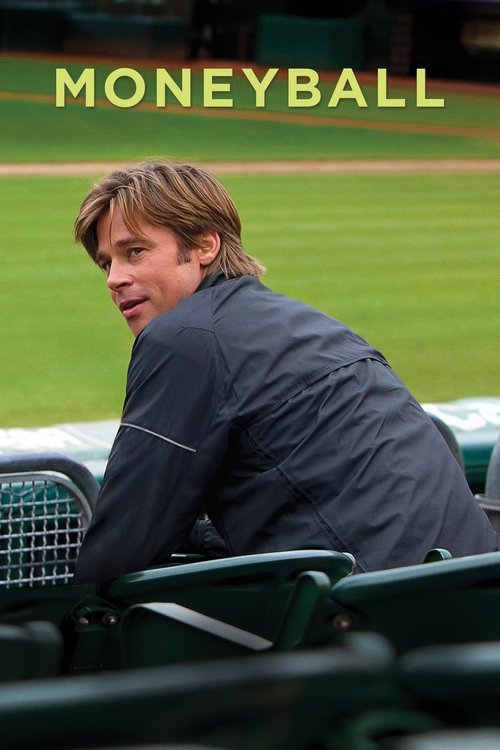
Moneyball
2011 · Bennett Miller
When you want something smart but easy to watch — a grown-up, dialogue-driven film for a weeknight when you'd rather be absorbed than assaulted. Comfort viewing for people who like watching competence.
What it's about
Billy Beane, general manager of the Oakland A's, has one of the smallest payrolls in baseball and keeps losing his best players to richer teams. With a young Yale economics grad at his side, he bets the franchise on statistics — buying undervalued players the scouts have written off — and goes to war with his own organization to prove the numbers right. It's a true story told almost entirely through meetings, trades, and phone calls rather than game-winning home runs.
The experience
Talky, wry, and quietly gripping — it turns spreadsheets and locker-room arguments into real drama, with a streak of melancholy about what winning actually costs. You don't need to care about baseball; it plays like an underdog story about an idea.
Performances
Brad Pitt gives one of his stillest, most lived-in performances — a man swallowing decades of disappointment — and Jonah Hill, cast against type as the shy numbers guy, matches him beat for beat; both earned Oscar nominations.
The craft
The Steven Zaillian and Aaron Sorkin script makes shop talk sing without ever feeling showy, and Bennett Miller directs with patience, letting silences and empty stadiums carry the feeling. The editing threads real game footage and quiet character beats into something closer to a character study than a sports movie.
Why it matters
A six-time Oscar nominee that put 'Moneyball' into everyday language as shorthand for data-driven thinking, and proof that a sports film could win big audiences with no on-field heroics at all.
Snapshot
Moneyball dramatizes the 2002 season of the Oakland Athletics, whose general manager Billy Beane (Brad Pitt) responded to one of Major League Baseball's smallest payrolls by embracing sabermetrics — the statistical analysis of player value pioneered by Bill James — over the intuition of veteran scouts. Adapted from Michael Lewis's 2003 nonfiction bestseller, the film is a rare thing: a sports drama with almost no on-field heroics, structured instead around meetings, phone calls, and arguments about undervalued assets. Directed by Bennett Miller in his second feature, written by Steven Zaillian and Aaron Sorkin, and anchored by a deliberately still, interiorized Brad Pitt performance, it became a critical success and a six-time Academy Award nominee, and it lodged the word "Moneyball" in the culture as shorthand for data-driven disruption of any tradition-bound field.
Industry & production
The film's route to the screen is one of the better-documented near-collapses of recent studio history. Columbia Pictures (Sony) developed the Lewis adaptation with Steven Zaillian writing and, by 2009, Steven Soderbergh attached to direct. Soderbergh's conception was formally radical for a studio picture — a hybrid that reportedly folded in documentary-style interview footage of the real players, blurring reenactment and reportage. Days before principal photography was to begin in June 2009, Sony executive Amy Pascal halted the production over budget and the script's unconventional shape, an unusually public shutdown of a project with a movie star (Pitt, also producing through Plan B) already committed.
The film was salvaged by reconfiguration. Bennett Miller, coming off the acclaim of Capote (2005), took over as director, and Aaron Sorkin — then cresting on The Social Network (2010) — was brought in to revise Zaillian's screenplay, yielding the shared "screenplay by" credit with story credited to Stan Chervin. The producing roster reflected the project's heavyweight backing: Brad Pitt, Michael De Luca, and Rachael Horovitz, with Scott Rudin associated in development. Shot largely in 2010 in the Bay Area and at the Oakland Coliseum and Dodger Stadium, the film opened in the United States in September 2011 through Columbia. Against a budget commonly reported in the range of roughly $50 million, it grossed on the order of $110 million worldwide — a solid commercial outcome for an adult drama, though I would treat the exact figures as approximate rather than authoritative.
Technology
Technology is not merely a subject of Moneyball; it is the film's antagonist-as-idea. The narrative pivots on the migration of decision-making authority from human scouts — men who read a player's "body," "swing," and intangibles — to the computer and the spreadsheet, where value is expressed as on-base percentage and expected runs. The film personifies this shift in Peter Brand (Jonah Hill), a composite figure drawn from Beane's real assistant Paul DePodesta, a Yale-educated analyst whose laptop becomes the story's emblem. (DePodesta declined to have his name used, which is why the character is fictionalized.)
Crucially, the film is dramatically honest about what the technology is and is not. The "computer-generated analysis" of the synopsis is really applied statistics and probability, and Moneyball stages it as unglamorous — data on screens, printouts, quiet certainty against loud tradition. The picture arrived at a moment when analytics were beginning to remake not just baseball but finance, politics, and journalism, and its lasting cultural utility owes to how legibly it dramatized a debate — expertise-by-feel versus expertise-by-measurement — that would recur across the 2010s.
Technique
Cinematography
Wally Pfister, best known for his work with Christopher Nolan, photographed the film, and his sensibility here is restrained and naturalistic rather than spectacular. The palette leans toward muted, desaturated institutional tones — the fluorescent greens and grays of clubhouses, offices, and stadium tunnels — and the camera favors patient, composed framing over kinetic sports coverage. Pfister has long been a public advocate for shooting on photochemical film, and the picture's grainless-but-warm texture is consistent with 35mm origination. The ballpark scenes are notable for what they withhold: rather than exalting the game with sweeping crane moves, the film often keeps Beane physically apart from play — pacing empty corridors, listening to the radio, unable to watch — so that cinematography enforces the story's thesis that this is a drama of the front office, not the field.
Editing
Christopher Tellefsen's cutting earned one of the film's Academy Award nominations, and it is central to how a talk-heavy story sustains momentum. The film interweaves present-tense scenes with flashbacks to Beane's own failed playing career — he was a heralded prospect whose measurables never translated to results — using these inserts to explain, without speechifying, why he distrusts scouting orthodoxy. Editing also carries the season's rhythm: montage compresses the long grind of a 162-game schedule, and the celebrated 20-game winning streak is built through accelerating cutting toward the record-setting game. Archival and broadcast-style material is integrated to lend documentary texture, a residue, perhaps, of the project's earlier hybrid ambitions.
Mise-en-scène / staging
The film's visual world is deliberately anti-glamorous: cramped offices, a spartan weight room where trades are executed by phone, draft-room tables ringed by aging scouts. Miller stages many key scenes as chamber pieces of argument, blocking Beane in motion — tossing a ball, chewing, pacing — against static, skeptical interlocutors, so that temperament reads through physical behavior. Production design grounds the story in early-2000s baseball infrastructure rather than gloss or nostalgia, and the recurring domestic scenes with Beane's daughter provide the only warm, lived-in register in an otherwise cool institutional environment.
Sound
Moneyball received an Academy Award nomination for Sound Mixing, and sound is used to sculpt the film's peculiar relationship to the game. Crowd noise, radio play-by-play, and the mediated audio of televised broadcasts frequently stand in for images of the action, reinforcing Beane's superstitious distance from the field. The mix privileges dialogue and quiet — the click of keyboards, the murmur of offices — punctuated by the swell of stadium sound at decisive moments, so that the game itself arrives largely as sound before spectacle.
Performance
The acting is the film's most praised element. Brad Pitt, nominated for Best Actor, gives a study in controlled restlessness — a charismatic man metabolizing anxiety through motion and appetite, playing a former golden boy who cannot bear to watch his own team. Jonah Hill, nominated for Best Supporting Actor in a significant departure from his comedic persona, plays Brand as watchful, soft-spoken, and quietly certain, the film's still center against Pitt's kinesis. Philip Seymour Hoffman, reuniting with his Capote director, plays manager Art Howe as a wall of institutional resistance in relatively few scenes. Robin Wright appears as Beane's ex-wife and Kerris Dorsey as his daughter, whose acoustic rendition of Lenka's "The Show" recurs as a motif and closes the film.
Narrative & dramatic mode
Moneyball belongs to the process drama — the mode of The Social Network or All the President's Men — in which the pleasures of plot are the pleasures of watching competent people work through a problem in rooms. Sorkin's contribution is audible in the verbal jousting and the rhythm of confrontation, though Zaillian's structural spine and Miller's restraint temper the usual Sorkin velocity into something quieter. The film makes an unorthodox choice for a sports story: it withholds ultimate triumph. The A's win their historic streak but lose in the playoffs, and the film explicitly reframes victory — Beane's real achievement is that his method, not his season, changes the game, dramatized by the coda in which the Boston Red Sox offer him a record salary he declines. The structure thus resolves emotionally rather than competitively, closing on the father-daughter relationship rather than a championship.
Genre & cycle
The film is a sports drama that pointedly subverts the genre's conventions. Where the classic baseball film trades in mythology, redemption, and the transcendent moment (The Natural, Field of Dreams), Moneyball is a workplace procedural about labor economics and institutional change, closer in spirit to the cycle of early-2010s "smart institutional dramas" — The Social Network, The Big Short (later), Margin Call — that dramatized systems and numbers. It sits alongside Miller's other films as part of an informal trilogy of American nonfiction adaptations about driven, isolated men (Capote, Moneyball, Foxcatcher), each cool in tone and skeptical of the myths its subjects inhabit.
Authorship & method
Bennett Miller's authorial signature is a restrained, observational realism applied to true stories of ambition and its costs, and Moneyball fits squarely within it: measured pacing, muted design, and performances built from behavioral detail rather than declaration. The screenplay's dual authorship is genuinely two-handed — Zaillian, a veteran adapter (Schindler's List, Gangs of New York), supplied structure and adaptive fidelity to Lewis's book, while Sorkin sharpened the dialogue and confrontations. Wally Pfister's photochemical naturalism, Christopher Tellefsen's rhythmically supple editing, and Mychael Danna's spare, unsentimental score together produce a film that resists the swelling uplift the genre invites. Danna's music, in particular, avoids triumphal cues, favoring restraint that matches the film's ambivalence about winning. Brad Pitt's role as both star and producer (Plan B) was decisive to the film surviving its production crisis and to its finished tone.
Movement / national cinema
Moneyball is a mainstream American studio film with no affiliation to a formal movement, but it can be read within a distinctly American strain of prestige nonfiction cinema — the fact-based, adult-oriented drama that Hollywood produced with increasing rarity in the 2010s as tentpoles consolidated. Its intellectual lineage runs through the American New Hollywood tradition of skeptical institutional filmmaking (Pakula, Lumet) more than through any sports-film canon, and its subject — the quantification of American baseball, a national mythology — gives it a particular resonance as a film about the disenchantment of an American pastime.
Era / period
Set almost entirely in the 2002 MLB season, the film is a period piece of the very recent past, and it treats that recency with restraint — early-2000s technology (the analyst's laptop, flip phones, desktop terminals) is present but not fetishized. As a 2011 release, it also belongs to a specific industrial moment: the post-Social Network appetite for talky, intelligent dramas about disruptive outsiders, and a late window in which a major studio would still finance a mid-budget adult drama with a star and no franchise potential. Its arrival amid the broader cultural ascent of "big data" gave a 2002 story an unusually timely 2011 charge.
Themes
The film's central theme is the contest between intuition and measurement — between institutional knowledge accumulated by experience and knowledge derived from data — and its refusal to treat that contest as cleanly won. Beneath it runs a study of value and its mismeasurement: undervalued players mirror Beane's own history as a prospect overvalued by the very scouting eye he now rejects, making the film as much about self-reckoning as about baseball. Loss and vindication are entwined — the film insists that being first and being right does not guarantee winning — and a quieter thread concerns fatherhood and legacy, with Beane's choice to stay in Oakland for his daughter reframing success in personal rather than professional terms.
Reception, canon & influence
Critically, Moneyball was warmly received, praised especially for Pitt's and Hill's performances, Sorkin and Zaillian's screenplay, and Miller's disciplined refusal of genre uplift; the consensus held it up as proof that a "boring" subject could yield gripping cinema. It earned six Academy Award nominations — Best Picture, Actor (Pitt), Supporting Actor (Hill), Adapted Screenplay, Film Editing, and Sound Mixing — winning none, a strong showing in a competitive year.
Its influences run backward to Michael Lewis's reportage and Bill James's sabermetric writing, and cinematically to the American process-drama tradition — All the President's Men, and most immediately The Social Network, whose success made Moneyball's greenlight and Sorkin's involvement plausible. Forward, the film's legacy is twofold. Within cinema, it confirmed a template for the intelligent, fact-based institutional drama and paved a path for the genre-adjacent explainer film — The Big Short most obviously shares its DNA of dramatizing numbers for a lay audience. Beyond cinema, its cultural footprint is arguably larger than its filmic one: "Moneyball" became durable shorthand for data-driven disruption applied far outside baseball — to other sports, business, and beyond — a case where a movie helped popularize a paradigm. It also decisively expanded Jonah Hill's range and cemented Bennett Miller's reputation as a director of austere American true stories. The film is widely regarded as a modern high point of the baseball genre precisely because it is skeptical of everything the genre usually celebrates.
A Deleuzian reading
A man walks a concrete corridor under a ballpark.
The full Deleuzian reading of Moneyball →
Reception
A critical hit on arrival — six Oscar nominations, zero wins — it has since quietly climbed from 'very good awards drama' to certified modern-rewatchable status, the rare sports movie that's grown warmer with every passing year.
How Moneyball was received, from release to now →
How to watch Moneyball: what to notice on a first viewing
- Listen to the scouts describe a player's body and swing. Around the draft table the old men talk about how a prospect looks, how he carries himself, whether he has a ballplayer's face. Brand's laptop counts every plate appearance instead. Two ways of reading a player sit at one table, and the fight is over which moments should count.
- Listen for the game arriving as sound, not picture. Radio play-by-play, flattened television audio, a roar coming through concrete. Beane paces a tunnel while something happens above him. The mix keeps dialogue and quiet in front, then lets the crowd swell. You infer the play from a face and a noise. The film keeps its big moments off screen on purpose.
- Watch Pitt move while everyone he argues with sits. Beane tosses a ball, chews, paces, drives. The scouts, the manager and the owner stay planted. Pitt metabolizes the whole film through motion and appetite rather than through speeches. The job took his body off the field and his body has not accepted it, and you see that in every scene.
- Notice the fluorescent greens and grays of the offices. Wally Pfister shoots on 35mm and keeps the palette institutional and muted: clubhouses, stadium tunnels, meeting rooms. Nothing gets exalted, and the ballpark gets no sweeping crane moves. The film looks like the job rather than like the sport, which is where it has decided the drama is.
- Count the scenes that happen in a room with a table. Meetings, phone calls, arguments about value. Zaillian built the structure and Sorkin sharpened the confrontations. The pleasure here is watching competent people work a problem out loud. This is a sports picture in which almost nothing gets decided by playing, and the talking is the action.
The whole guide to watching Moneyball, with the keys for a rewatch →
Influences: the films it descends from and the films it influenced
- All the President's Men (1976) — Establishes the process-drama grammar Moneyball inherits: building suspense from phone calls, paperwork, and patient two-hander scenes rather than action, in a muted institutional realism where the investigation itself is the plot.
- The Social Network (2010) — Sorkin's immediate template — overlapping legalistic dialogue and deposition-framed flashback interweaving that stages non-physical intellectual work as combat; its success is what made Moneyball's greenlight and Sorkin's involvement plausible.
- The Insider (1999) — Corporate-room chamber procedural driven by mediated broadcast and telephone audio, with performance built from interior pressure and hesitation rather than confrontation set-pieces.
- Capote (2005) — Miller's own founding austere-true-story method — muted production design, behavioral-detail performance, refusal of uplift, and Mychael Danna's spare unsentimental scoring — carried directly forward.
- Schindler's List (1993) — Zaillian's adaptive craft of turning ledgers, lists, and accounting into legible dramatic architecture — compressing dense nonfiction into structure — is the same screenwriting discipline he brings to Lewis's book.
- Broadcast News (1987) — Workplace-process ensemble where professional competence and its personal cost is the drama, staged with wry realism and anti-glamorous behavioral observation instead of romance or triumph.
- Charlie Wilson's War (2007) — Sorkin's method of compressing a dense factual book into a propulsive two-/three-hander of verbal sparring between a charismatic lead and a deadpan strategist extends the adaptation approach used on Crile.
- Jerry Maguire (1996) — Humanizes the front-office/business side of pro sports as adult drama, the sports-dramedy-meets-deal-making territory Jerry Maguire opened to mainstream prestige film.
- He Got Game (1998) — Builds a sports film around economics and front-office valuation rather than the play itself, extending the commodification-of-the-athlete thesis Lee foregrounded.
- Bull Durham (1988) — Rebuilds baseball drama as talk between professionals arguing about value — scouting-room and phone-trade scenes carrying the picture — and keeps Shelton's structural nerve by ending on a first-round playoff loss and a job offer declined.
- The Big Short (2015) — The clearest heir: an explainer film that dramatizes abstract numbers for a lay audience, extending Moneyball's method of making statistical insight both legible and dramatically charged.
- Foxcatcher (2014) — Miller extends his own anti-glamorous sports-ambition chamber piece — desaturated palette, controlled-restlessness performances, withheld catharsis — into an even bleaker key.
- Draft Day (2014) — Transplants Moneyball's front-office decision-drama — the war-room of phone calls, trades, and competing methods of valuing players — wholesale into an NFL setting.
- I, Tonya (2017) — Anti-glamorous sports true story that mistrusts the genre's heroics and its mismeasurement of an athlete's worth, using mediated broadcast and mock-interview framing to complicate the record.
- King Richard (2021) — Pioneers the displaced-protagonist prestige sports film that sidelines the athletes to center the strategist off the field, the structural gambit Baylin's script reuses by foregrounding the father over Venus and Serena.
- Zodiac (2007) — Shares the procedural of obsessive data accumulation — files, timelines, cross-referencing — that withholds resolution and finds tension in the labor of analysis rather than its payoff.
- Spotlight (2015) — Process-journalism drama of institutional investigation built from documents and door-knocking, with ensemble restraint and a deliberately un-triumphal climax in the All the President's Men lineage.
- Steve Jobs (2015) — Sorkin's dialogue-forward biopic structured as confrontational backstage set-pieces, dramatizing a systems-thinker's contested vision against his collaborators.
- Molly's Game (2017) — Sorkin's voiceover-and-numbers procedural about a data-literate operator reverse-engineering and gaming a closed system — the Moneyball outsider-analyst posture in another arena.
- Dark Waters (2019) — Desaturated corporate procedural assembled from boxes of documents and depositions, driven by institutional skepticism and a grinding, un-heroic accumulation of evidence.
- The Report (2019) — Institutional procedural built almost entirely from files and bureaucratic obstruction, with a desaturated palette and a pointedly withheld, joyless triumph.
- 42 (2013) — Shares the long-lens ballpark grammar — compressed telephoto coverage that observes the game from a fixed remove instead of staging it in cut-in inserts — and lets broadcast play-by-play do narration work a voiceover would otherwise carry.
Similar films
- Molly's Game (2017) — influence & lineage · same viewing thread
- The Big Short (2015) — influence & lineage
- Capote (2005) — influence & lineage
- I, Tonya (2017) — influence & lineage · same viewing thread
- Dark Waters (2019) — influence & lineage · same viewing thread
- Bull Durham (1988) — shared sensibility
- Margin Call (2011) — shared sensibility
- Ocean's Eleven (2001) — shared sensibility
All the films related to Moneyball →
Watch it with: curated runs of related films
- Beating a Rigged Game — A run of fact-based portraits of sharp outsiders who out-hustle the institutions built to keep them out — poker tables, front offices, corporate lawyers, and a class-obsessed sport.