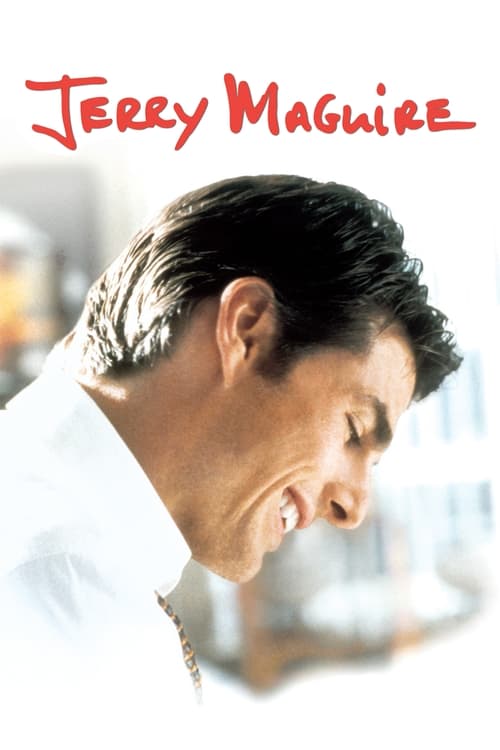
Jerry Maguire
1996 · Cameron Crowe
For a night when you want to feel good without feeling dumb — a grown-up crowd-pleaser about second chances. Reach for it when you're burned out on work and need a movie that believes people can change.
What it's about
A hotshot sports agent has a crisis of conscience, writes a late-night memo arguing his cutthroat business should treat clients like human beings — and gets fired for it. Left with one client, a loudmouthed wide receiver who demands total loyalty, and one believer, a young single-mother accountant who quits the firm to follow him, he has to rebuild his career from nothing and figure out whether he actually means any of the things he says. It's a romance, a workplace comedy, and a sports movie braided into one story about integrity.
The experience
Warm, fast-talking, and openly sentimental in a way that earns it — you laugh a lot, wince at the humiliations, and get blindsided by how much you care. It moves like a comedy but keeps landing quiet, sincere moments that catch in your throat.
Performances
Tom Cruise gives one of his best performances, letting the megawatt charm crack to show panic and neediness underneath. Cuba Gooding Jr. won an Oscar as Rod Tidwell, all swagger and wounded pride, and a young Renée Zellweger is quietly devastating as the woman who bets everything on him.
The craft
Cameron Crowe's screenplay is a machine for quotable lines — several entered the language permanently — but its real trick is making big speeches feel like things desperate people would actually blurt out. The film balances locker-room noise and living-room intimacy with unusual grace, and the soundtrack does a lot of emotional lifting.
Why it matters
One of the defining mainstream American films of the mid-1990s, it proved a star vehicle could also be a sincere character piece, minted catchphrases still quoted thirty years later, and launched Renée Zellweger's career.
Snapshot
Jerry Maguire is Cameron Crowe's third feature as writer-director, a romantic dramedy that dresses a moral-crisis story in the clothes of the sports picture and the workplace comedy. Tom Cruise plays a high-flying sports agent who, seized by a fit of conscience, writes a midnight "mission statement" calling for fewer clients and more human attention — and is promptly fired for it. Stripped of his roster save one demanding wide receiver (Cuba Gooding Jr.), and trailed by a single believer from the office, an accountant and young single mother (Renée Zellweger), Jerry has to rebuild a career and, more pressingly, learn to mean what he says. The film fused Cruise's star wattage with Crowe's earnest humanism and James L. Brooks's brand of adult comedy production. It became one of the defining mainstream American films of the mid-1990s, an awards contender, and a generator of catchphrases ("Show me the money," "You had me at hello," "You complete me") that long outlived the movie's plot in popular memory.
Industry & production
The film was produced through Gracie Films, the company of writer-director-producer James L. Brooks, and released by TriStar Pictures (a Sony/Columbia TriStar label) in December 1996, positioning it squarely as awards-season counter-programming and holiday adult fare. Brooks's involvement is central to understanding the project: his own work (Terms of Endearment, Broadcast News) had established a house style of character-driven comedy-drama for grown-ups, and Crowe had come up partly under his mentorship. Crowe both wrote and directed, and his preparation was famously immersive — he is reported to have spent extended time shadowing real sports agents and absorbing the culture of the representation business, drawing on figures in that world (the agent Leigh Steinberg is commonly cited as a touchstone) to give the film its texture of contracts, commissions, and locker-room politics.
Casting Cruise was the decisive commercial move. By 1996 he was among the most bankable stars in the world, and the role let him weaponize and then dismantle his own image of glossy confidence. The supporting ensemble proved equally consequential: Cuba Gooding Jr. was cast as Rod Tidwell, and Renée Zellweger — then largely unknown to mainstream audiences — was elevated from relative obscurity into a lead, a piece of casting that became part of the film's lore. Bonnie Hunt, Regina King, Jay Mohr, Kelly Preston, and the child actor Jonathan Lipnicki rounded out a cast in which secondary characters were given unusual warmth and specificity. The production was a substantial commercial success and a major awards player; precise figures aside, it functioned as both a hit and a prestige title, a combination that is the explicit ambition of the Brooks/Gracie model.
Technology
Jerry Maguire is not a technically experimental film, and the historical record reflects that — it is a mid-1990s studio production shot photochemically on 35mm and finished by conventional means for its moment. Its interest lies not in apparatus but in the deployment of mainstream tools toward intimacy. There is no signature visual-effects innovation, no format gambit; the football sequences rely on staged action and editing rather than novel imaging technology. Where the film is genuinely "of its technology" is incidental and cultural rather than cinematographic: the early-mobile-era texture of the agent's life (the perpetually ringing phone, the always-on connectivity that the mission statement implicitly rebukes) reads, in hindsight, as a portrait of a profession defined by being reachable. Beyond that, claims of technological distinction would be invented; the film's achievements are in craft and performance, not in tools.
Technique
Cinematography
The most striking craft decision is the hiring of Janusz Kamiński as director of photography. Kamiński was by then closely identified with Steven Spielberg and the severe monochrome of Schindler's List and would soon shoot Saving Private Ryan; bringing that sensibility to a romantic comedy-drama is itself a statement. The result is a film that looks warmer and more naturalistic than the slick gloss the material might have invited — soft, available-feeling light, an attention to faces, and a willingness to let domestic and office spaces feel lived-in rather than art-directed. The camera favors the human scale: close work on Cruise and Zellweger that lets micro-expression carry meaning, and a general restraint that keeps spectacle subordinate to feeling. The visual grammar serves the screenplay's interest in sincerity, photographing emotional turning points plainly enough that the actors, not the lens, do the work.
Editing
Joe Hutshing edited the film, and the cutting earned an Academy Award nomination — a meaningful marker for a comedy-drama, where editing is often invisible. The film's structural challenge is its length and its braiding of three arcs (Jerry's professional reinvention, his courtship of and marriage to Dorothy, and his combative partnership with Rod). The editing modulates between comic timing — where rhythm is everything for lines and reactions — and the slower breathing room demanded by the romance and the moral reckoning. Set pieces such as the football climax and the famous reconciliation are constructed to land on a single emotional beat, with the cutting holding back so that a pause or a look pays off.
Mise-en-scène / staging
Crowe stages for character revelation through environment. The agency world is rendered as a place of performed bonhomie and ambient anxiety; the contrast comes in the smaller, warmer spaces — Dorothy's home, her sister's support-group living room (a recurring set that quietly anchors the film's view of women's solidarity), the modest rooms where Jerry confronts what he has actually built. Tidwell's domestic life, with his wife and family, is staged as a rebuke to the transactional culture Jerry comes from: a man who, beneath the showboating, knows exactly what he values. The staging consistently positions the protagonist between two value systems and lets the rooms themselves argue the case.
Sound
Crowe's background as a rock journalist makes music dramaturgically central rather than decorative. The film's needle-drops are chosen for emotional commentary, and its dialogue is engineered for memorability — the script delivers phrases built to be repeated, and the sound design and performance let those phrases breathe. The original score was composed by Nancy Wilson of the band Heart, then Crowe's wife, contributing an intimate, melodic underscoring distinct from the pop selections. The interplay of song and score is part of how the film signals sincerity: music arrives to underline feeling at exactly the moments the characters risk being too guarded to speak.
Performance
Performance is the film's true medium. Cruise gives one of his definitive performances, calibrating from frictionless charm through unraveling panic to hard-won vulnerability; the role is, in part, a meta-commentary on his own stardom, and he plays the seams openly. Gooding Jr.'s Rod Tidwell is a high-wire turn — loud, demanding, and finally moving — that won him the Academy Award for Best Supporting Actor and produced the "Show me the money" exchange that entered the language. Zellweger's Dorothy is the film's emotional ballast, an open-faced sincerity that made her a star and that the film trusts to carry its most exposed moments. The ensemble — Bonnie Hunt's wary sister, Regina King's sharp, devoted Marcee Tidwell, Jay Mohr's careerist rival, and Lipnicki's preternaturally earnest child — is directed toward a naturalism that keeps the sentiment from curdling.
Narrative & dramatic mode
The dramatic mode is the redemption arc routed through romantic comedy and the sports-underdog template. Its engine is a moral conversion that the rest of the film must then test: the mission statement is an act of idealism that costs Jerry everything, and the narrative asks whether he can live up to a creed written in a moment of clarity. Crowe structures the story around the gap between saying and meaning — between performance and sincerity — and resolves it through two relationships that force authenticity: the marriage to Dorothy, which Jerry enters before he can honestly feel it, and the partnership with Rod, which demands he actually serve a client rather than manage one. The film is unusually willing to let its hero be unlikable and self-deceiving for long stretches, banking on the satisfaction of earned change. Its dual climax — Rod's on-field triumph and Jerry's verbal surrender to Dorothy — pays off the professional and personal arcs in tandem.
Genre & cycle
Jerry Maguire sits at the intersection of several cycles. It belongs to the 1990s adult dramedy associated with James L. Brooks and Gracie Films, a tradition that takes comedy seriously as a vehicle for feeling. It is also a sports film, though atypically one about the business of sport rather than the game, joining a small subgenre interested in agents, contracts, and the commodification of athletes. And it is a romantic comedy with the structural confidence to delay and complicate its central union. Its lasting generic contribution may be the "crisis-of-conscience professional" picture — the competent operator who repudiates the system that made him — a figure the film rendered so memorably that it became a reference point for later workplace-redemption stories.
Authorship & method
The film is the product of a tightly aligned authorial team. Cameron Crowe wrote and directed; his method blends journalistic research (the agent fieldwork), an autobiographically warm sensibility, and a faith in sincerity over irony that distinguishes him from many peers of the period. His path — from Rolling Stone writer to screenwriter of Fast Times at Ridgemont High to director of Say Anything… and Singles — fed directly into Jerry Maguire's mix of pop-cultural literacy and emotional directness, and the film stands between that early work and the more nakedly personal Almost Famous. James L. Brooks as producer brought the dramedy infrastructure and a comedy-drama lineage. Janusz Kamiński supplied a prestige cinematographer's eye tuned, unexpectedly, to warmth. Joe Hutshing edited (with an Oscar nomination), shaping the film's tonal modulations. Nancy Wilson scored it, integrating Crowe's music-first instincts into the underscore. The authorship is best understood as Crowe's vision executed by collaborators chosen to push the material toward earnestness rather than slickness.
Movement / national cinema
The film is firmly within mainstream American studio filmmaking of the 1990s — Hollywood's commercial-prestige center rather than any avant-garde or regional movement. If it belongs to a "movement" at all, it is the loose tradition of the American character-comedy-drama for adults associated with figures like Brooks: studio films that aim for emotional substance and broad appeal at once. It is not part of the independent surge of the same decade, nor of any national-cinema project beyond the dominant Hollywood idiom; it is, rather, a high accomplishment within that idiom.
Era / period
Jerry Maguire is deeply a product of the mid-1990s. It captures a moment of peak star-driven studio filmmaking, with Cruise at the height of his bankability, and a culture newly anxious about the dominance of money in arenas (sport, work, relationships) once imagined as governed by other values. The mission-statement plot reads as a 1990s reaction against the excesses of 1980s deal-making — a yearning for authenticity inside a system organized around the transaction. Its texture of constant connectivity and its preoccupation with personal "branding" of athletes anticipate concerns that would intensify in the following decades, making the film feel, in retrospect, like a hinge between an analog professional world and the always-on one to come.
Themes
The governing theme is the conflict between sincerity and performance — between "the things we think and do not say" and the polished scripts of professional life. From it radiate the film's other concerns: integrity versus success, and whether the two can be reconciled; loyalty as the currency that actually matters, dramatized through both the Jerry–Rod and Jerry–Dorothy bonds; the commodification of human relationships under capitalism, with the sports-agency world as a concentrated example; and the difficult labor of emotional honesty, especially for a man fluent in charm but illiterate in feeling. The film also quietly foregrounds the strength of its women — the support group, Dorothy's clear-eyed self-respect, Marcee Tidwell's partnership in Rod's career — as the standard against which Jerry's growth is measured. Its final claim is modest and humanist: that a life is justified less by what one wins than by whom one shows up for.
Reception, canon & influence
Critically, the film was warmly received as an intelligent, emotionally generous mainstream entertainment that gave Cruise one of his richest roles and announced both Zellweger and a newly serious Gooding Jr. It became a significant awards contender, earning Academy Award nominations including Best Picture, Best Actor for Cruise, Best Original Screenplay for Crowe, and Best Film Editing, with Cuba Gooding Jr. winning Best Supporting Actor — the ceremony at which his exuberant acceptance became its own piece of pop history. Where the detailed critical record is mixed, it is on the film's sentimentality: it has always had skeptics who find its sincerity overripe, and a fair account should note that this is a genuine and recurring line of objection rather than a settled consensus of acclaim.
Looking backward, the film draws on the James L. Brooks dramedy tradition, on the workplace-conscience picture, and on Crowe's own earlier romances of sincerity; its sports-business angle reflects research into the real agent culture of the period rather than a prior film model. Looking forward, its legacy is unusually verbal: the catchphrases "Show me the money," "You complete me," and "You had me at hello" entered everyday speech and have been endlessly quoted, parodied, and referenced, a level of linguistic penetration few films achieve. It also helped cement Zellweger's stardom and reframed what a Cruise performance could carry. As a template, the redeemed-operator narrative it crystallized has been widely echoed in later films and television about professionals who break from the systems that made them. Its standing in the broader canon is that of a beloved and influential popular film of its decade rather than a formal landmark — a movie remembered, fittingly for its themes, more for what it said than for how it was shot.
A Deleuzian reading
Start with the man who can't sleep.
The full Deleuzian reading of Jerry Maguire →
Reception
A smash hit and Best Picture nominee in 1996 — peak movie-star Tom Cruise — it's now routinely held up as the emblem of the vanished mid-budget adult studio movie: the crowd-pleasing dramedy for grown-ups that Hollywood supposedly doesn't make anymore.
How Jerry Maguire was received, from release to now →
Influences: the films it descends from and the films it influenced
- The Apartment (1960) — Establishes the workplace-conscience comedy-drama in which a decent operator forfeits career advancement for integrity and love, the exact moral architecture of Jerry Maguire's mission-statement crisis.
- Network (1976) — The conscience-stricken professional who drafts an idealistic manifesto denouncing his own industry — the direct dramatic prototype for Jerry's late-night 'mission statement' memo.
- Terms of Endearment (1983) — Brooks's signature method of swinging between broad comedy and tearjerker sincerity inside a single scene, the tonal grammar his Jerry Maguire production imposes on Crowe's material.
- Broadcast News (1987) — From the same producer, the talky naturalist workplace ensemble where professional ethics and romance are inseparable, modeling Jerry Maguire's office-and-heart dual track.
- Fast Times at Ridgemont High (1982) — Crowe's journalistic-immersion screenwriting — embedding in a subculture and transcribing its idiom — the same field-research method that produced the film's authentic agent culture.
- Say Anything… (1989) — Crowe's romance-of-sincerity grammar: the grand unembarrassed declaration (the boombox becomes 'you complete me') and the needle-drop used as emotional punctuation.
- Singles (1992) — Crowe's music-first construction and loose ensemble naturalism, the soundtrack-as-emotional-scoring approach Nancy Wilson formalizes in Jerry Maguire's underscore.
- Bull Durham (1988) — The literate adult sports romance that treats the unglamorous business and minor-league economics of athletics as a vehicle for grown-up love, a template Crowe ports to the agent's office.
- Almost Famous (2000) — Crowe pushes the autobiographical-sincerity sensibility and the Nancy Wilson/needle-drop scoring method even further into nakedly personal terrain.
- Vanilla Sky (2001) — Crowe reteams with Cruise to directly interrogate the constructed star persona Jerry Maguire had affectionately exploited.
- Bridget Jones's Diary (2001) — Built on the vulnerable-warmth screen persona and stardom Zellweger minted in Jerry Maguire, casting her as the new template romantic-comedy lead.
- Up in the Air (2009) — Extends the redeemed-operator narrative — a slick corporate professional whose emotional crisis breaks him from the very system that made him.
- Moneyball (2011) — Humanizes the front-office/business side of pro sports as adult drama, the sports-dramedy-meets-deal-making territory Jerry Maguire opened to mainstream prestige film.
- Silver Linings Playbook (2012) — The dual-redemption romance carried by jittery naturalist ensemble performance toward an earnest, unironic emotional climax in the Crowe/Brooks sincerity tradition.
- Playing for Keeps (2012) — Models the fusion of a sports milieu with a romantic-redemption arc for an arrested charming man, using the athletic world as the arena where emotional maturity is finally earned.
- As Good as It Gets (1997) — The same Brooks dramedy production line built around the redemption of a difficult man through love, released a year later as a parallel prestige-mainstream tearjerker.
- Magnolia (1999) — Weaponizes Tom Cruise's meta-stardom — Frank T.J. Mackey is the dark mirror of the slick, sincerity-selling alpha persona Jerry Maguire foregrounded and softened.
Similar films
- Magnolia (1999) — influence & lineage · often watched together
- Vanilla Sky (2001) — influence & lineage · often watched together
- Bridget Jones's Diary (2001) — influence & lineage
- Bull Durham (1988) — influence & lineage
- Almost Famous (2000) — influence & lineage
- The Apartment (1960) — influence & lineage · often watched together
- The Truman Show (1998) — often watched together
- The Princess Bride (1987) — often watched together