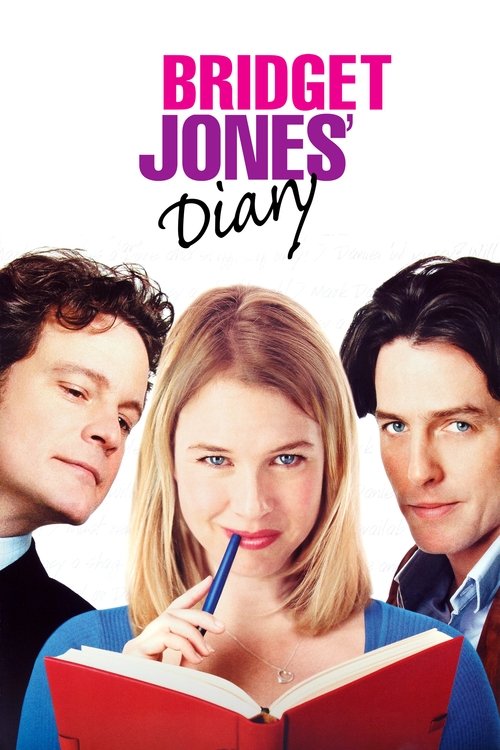
Bridget Jones's Diary
2001 · Sharon Maguire
The definitive wine-and-sofa comfort watch: for when you've had a rubbish week and want to laugh at someone else's disasters, then feel hopeful about your own. Zero challenge, maximum cozy.
What it's about
Bridget Jones is a thirty-something London publishing employee who rings in the new year by resolving to take control of her life — starting with a diary that records the whole embarrassing truth: the weight, the cigarettes, the wine, the disastrous men. Complicating the project are her charming rogue of a boss and a stiff, disagreeable lawyer she keeps running into, both of whom refuse to stay out of her diary.
The experience
Warm, self-deprecating, and genuinely funny — the humiliations land hard because they're so recognizable, and the film keeps rescuing them with real sweetness. It moves at a brisk clip and ends on a full heart.
Performances
Renée Zellweger, an American in one of Britain's most beloved roles, disappears into Bridget so completely that the casting controversy evaporated on release — she makes chaos and self-doubt feel heroic. Colin Firth and Hugh Grant, playing opposite poles of Bridget's love life, are both pitch-perfect: one all thawing reserve, the other weaponized charm.
The craft
The writing is the engine — Helen Fielding's diary voice survives the trip to the screen, so the jokes feel confessed rather than performed. Sharon Maguire keeps the tone honest: the film mocks Bridget's calamities without ever mocking her.
Why it matters
It turned the 'chick lit' publishing boom into a cinematic one, minted the millennial British romantic comedy at its commercial peak, and made 'singleton' a word — spawning sequels and countless imitators.
Snapshot
Bridget Jones's Diary is the film that crystallized the late-1990s phenomenon of "chick lit" into mainstream cinema and confirmed the romantic comedy as the signature export of British commercial filmmaking at the turn of the millennium. Adapted from Helen Fielding's enormously popular 1996 novel — itself grown from a newspaper column — it follows Bridget (Renée Zellweger), a thirty-something London publishing employee who resolves, in the dead air between one Christmas and the next, to take charge of her life by keeping a diary that records the unvarnished truth: her weight, her cigarette and alcohol intake, her romantic catastrophes, and the running terror of ending up, in the book's coinage, a "singleton" who dies alone and is eaten by Alsatians. The plot triangulates Bridget between her caddish, charming boss Daniel Cleaver (Hugh Grant) and the stiff, seemingly supercilious human-rights barrister Mark Darcy (Colin Firth) — a structure lifted, knowingly, from Jane Austen's Pride and Prejudice. The film was a substantial international commercial success and earned Zellweger an Academy Award nomination for Best Actress, vindicating a much-debated piece of casting. As the directorial debut of Sharon Maguire and a flagship production of Working Title Films, it stands as both the apotheosis and a key turning point of the British rom-com cycle, and as the founding text of a multi-film, multi-decade franchise.
Industry & production
The film was produced by Working Title Films, the London company run by Tim Bevan and Eric Fellner that had, across the 1990s, made itself the dominant force in British mainstream cinema through a run of romantic comedies beginning with Four Weddings and a Funeral (1994) and continuing with Notting Hill (1999). Working Title's relationship with Universal Pictures gave it Hollywood-scale financing and distribution while allowing it to make recognizably English films; Bridget Jones's Diary was a co-production involving Universal and the Miramax/StudioCanal orbit, and it represented the studio-backed industrialization of a formula the company had spent a decade refining.
The source was Helen Fielding's 1996 novel, which had originated as an anonymous, semi-autobiographical column in The Independent before becoming a publishing sensation that effectively named and defined the "chick lit" genre. The adaptation drew on the deepest bench of British romantic-comedy talent available: the screenplay is credited to Fielding herself together with Andrew Davies and Richard Curtis. The pairing is pointed. Davies had written the celebrated 1995 BBC television adaptation of Pride and Prejudice in which Colin Firth played Mr. Darcy — the performance Fielding's novel had openly fed upon — while Curtis was the principal architect of the Working Title rom-com house style, having written Four Weddings and Notting Hill. Casting Firth as Mark Darcy was therefore an act of deliberate intertextual mischief, importing the actor's earlier Darcy directly into a story that was already a sly commentary on Austen.
The film marked the feature directorial debut of Sharon Maguire, a documentary maker and a close friend of Fielding's from whom, by widely repeated account, the novel's brash friend "Shazzer" took her name and something of her character. The most contested decision was the casting of Renée Zellweger, an American, as the quintessentially English Bridget. Zellweger's preparation became part of the film's lore: she gained weight for the role and, by well-reported accounts, worked incognito for a period at a London publishing house to absorb the accent and milieu. The resulting performance disarmed most of the early skepticism. Hugh Grant, cast against his established floppy-haired nice-guy image as the seductive cad Daniel Cleaver, and Firth as the buttoned-up Darcy completed a triangle of marquee British and American star power.
Technology
Bridget Jones's Diary is a conventionally produced 35mm studio comedy of its period, and it lays no claim to technological innovation; its means are entirely conventional and in service of performance, comic timing, and a warm, accessible visual surface. If there is a "technology" worth naming, it is narrative-formal rather than mechanical: the film's reliance on confessional first-person voiceover, drawn directly from the diary conceit of its source, and its occasional use of on-screen text (the tallies of weight, units of alcohol, and cigarettes) to render the diary's bookkeeping visually. These devices belong to the apparatus of the literary adaptation rather than to any advance in cinematic technique. The record offers no indication of unusual technical apparatus, and it would be invention to claim otherwise.
Technique
Cinematography
The cinematography is by Stuart Dryburgh, the New Zealand cinematographer best known for his Academy Award–nominated work on Jane Campion's The Piano (1993) — a notably more austere and painterly assignment than this one. On Bridget Jones's Diary Dryburgh supplies the bright, legible, faintly burnished look characteristic of the upmarket commercial rom-com: a London of cozy pubs, glassy publishing offices, fairy-lit dinner parties, and snowy streets, photographed to flatter both the city and the stars. The visual strategy keeps Bridget herself relentlessly at the center, the camera staying close to Zellweger's expressive face so that the comedy of mortification — the registering of every social disaster in real time — can play. The film draws a soft visual contrast between the warm, slightly chaotic textures of Bridget's private world (her flat above a London pub, her chaotic kitchen) and the cooler, more composed spaces of professional and upper-middle-class life into which she keeps stumbling.
Editing
The editing is by Martin Walsh, who would win an Academy Award the following year for Chicago (2002). The cutting is built around comic performance and around the rhythm of Bridget's voiceover, which the picture must continually interleave with action without letting the narration smother the scenes. The film's signature set pieces — the public humiliations, the disastrous dinner party, and above all the much-quoted, deliberately graceless street fight between Daniel and Mark — depend on editorial timing: the fight is staged and cut for maximal awkwardness rather than action-movie fluency, the joke being precisely that these two men have no idea how to brawl. The overall structure follows the calendar of the diary, marking the passage of a year, and the editing manages the episodic, almost diaristic accumulation of incident into a satisfying romantic arc.
Mise-en-scène / staging
The film's staging maps a recognizable map of late-1990s London professional life: the publishing house where Bridget works, the television studio she moves to, the smug couples' dinner parties (the "Smug Marrieds" of Fielding's coinage), and the family gatherings in the Home Counties presided over by Bridget's mother. Production and costume design do a great deal of characterizing work. Bridget's wardrobe — culminating in the notorious oversized "big knickers" and the misjudged Playboy-bunny costume she wears to a party that turns out not to be fancy dress — is a sustained instrument of comic self-exposure, dramatizing her perpetual sense of being wrongly dressed for her own life. The staging repeatedly isolates Bridget as a figure of comic singularity amid coupled, composed, judging others, and it uses the iconography of millennial single womanhood — the bottle of chardonnay, the cigarettes, the karaoke, the solitary flat — as a recurring visual shorthand.
Sound
The film is, characteristically for its genre and moment, wall-to-wall with pop music, and its soundtrack functions almost as a second narrator. The most celebrated cue is the opening image of Bridget alone in her pajamas miming to a power-ballad recording of "All By Myself," a needle-drop that establishes the film's tone of affectionate mockery toward its heroine's self-pity. Songs such as "It's Raining Men" and a closing rendition associated with the soundtrack punctuate the emotional beats, the popular standards carrying meaning the way the Nat King Cole record does in an earlier kind of film. The original orchestral score is by Patrick Doyle, a composer with a substantial pedigree in literary and period adaptation, whose music underpins the romantic turns without crowding the comedy. The confessional voiceover, in Zellweger's carefully acquired English voice, is itself a central element of the soundtrack.
Performance
Performance is the film's center of gravity, and Zellweger's Bridget is its triumph: a fully inhabited comic creation, physically unguarded, self-deprecating, and warm, who earns the audience's sympathy precisely by being a catalog of small failures rather than a polished heroine. The Academy Award nomination registered how thoroughly the performance overcame the initial objections to her casting. Hugh Grant gives one of his most enjoyable performances as Daniel Cleaver, weaponizing his own established charm to play a genuine cad and visibly relishing the chance to subvert his nice-guy image. Colin Firth plays Mark Darcy as a study in repressed decency, his reserve a deliberate echo and gentle parody of his earlier television Darcy, so that the eventual thaw carries an extra charge of recognition for the audience. The supporting playing — including Bridget's circle of friends and her comically embarrassing parents — supplies the surrounding texture of a recognizable social world.
Narrative & dramatic mode
The film's dramatic mode is romantic comedy in its most classical, courtship-plot form, organized around the question of which suitor the heroine will end up with and structured, openly, on the template of Pride and Prejudice: a charismatic charmer who proves a deceiver (Daniel/Wickham) set against an initially off-putting, proud man who proves the worthier partner (Mark Darcy). The engine of the narrative is the diary itself — a first-person, confessional voice that grants the audience continuous access to Bridget's interior monologue, her resolutions and their immediate collapse, her self-criticism and self-justification. This confessional intimacy is the film's distinctive narrative strategy: comedy arises from the gap between Bridget's private commentary and her public performance, and the audience is positioned as the diary's reader, complicit in her secrets. The story unfolds across the calendar of a single year, an episodic accumulation of social embarrassments and romantic reversals that resolves into the genre's mandatory union. The dramatic stakes are deliberately ordinary — not life and death but loneliness, self-acceptance, and the fear of not being loved — and the film's achievement is to treat those everyday anxieties with both comic exaggeration and genuine sympathy.
Genre & cycle
Bridget Jones's Diary belongs squarely to the cycle of Working Title romantic comedies that defined British commercial cinema in the 1990s and early 2000s — the lineage of Four Weddings and a Funeral (1994), Notting Hill (1999), and, soon after, Love Actually (2003) — and the involvement of Richard Curtis as co-writer makes the kinship explicit. It is also the foundational screen text of "chick lit" and the so-called "chick flick": a female-centered romantic comedy that foregrounds a flawed, relatable everywoman and her circle of friends, and that addresses itself frankly to the anxieties of single, professional women. As an Austen adaptation-by-stealth it joins a turn-of-the-millennium wave of modernized literary romance (the period that also produced Clueless, a Emma update, and the lavish heritage Austen adaptations of the mid-1990s). Within its own franchise it inaugurated a cycle of sequels — Bridget Jones: The Edge of Reason (2004), Bridget Jones's Baby (2016), and a further installment in the 2020s — that extended the character across more than two decades. The film thus sits at the intersection of three currents: the Working Title house comedy, the literary-romance update, and the new commercial women's cinema of the postfeminist moment.
Authorship & method
Authorship here is genuinely collaborative and corporate rather than singularly auteurist, which is characteristic of the Working Title model. The defining creative voice is arguably Helen Fielding's: the novel's confessional first-person comedy, its vocabulary of "singletons" and "Smug Marrieds," and its Austen scaffolding are the film's DNA, and Fielding's participation in the screenplay kept that voice intact. Sharon Maguire, directing her first feature, brought a documentary-trained eye and a personal proximity to the material that lent the film its texture of lived-in friendship. The screenwriting collaboration is itself a piece of authorship-as-casting: Andrew Davies, who had written the Pride and Prejudice that Firth's Darcy descends from, and Richard Curtis, the presiding genius of the Working Title rom-com, between them braided the Austen intertext and the house comic style.
Among the key collaborators, cinematographer Stuart Dryburgh supplied the warm, star-flattering surface; editor Martin Walsh shaped the comic timing and the diaristic structure; and composer Patrick Doyle, working alongside an aggressively curated pop soundtrack, set the romantic-comic tone. But the film's authorship is, above all, inseparable from Renée Zellweger's performance: the decision to build the picture around an unglamorous, self-mocking, physically unguarded heroine, and Zellweger's total commitment to it, is the film's central creative act. It would overstate the record to attribute specific scenes to improvisation absent clear documentation, but the fusion of Fielding's voice with Zellweger's embodiment is the film's defining fact.
Movement / national cinema
The film is a flagship of the commercially confident British cinema of the New Labour era — a moment when Working Title, backed by Hollywood finance, was successfully exporting a glossy, aspirational vision of London and English middle-class life to a global audience. It belongs to no avant-garde or social-realist movement; on the contrary, it represents the mainstream, internationalist pole of British filmmaking, distinct from the social realism of Mike Leigh or Ken Loach that ran concurrently. Its England is a carefully curated, largely affluent metropolitan and Home Counties world — the publishing and television industries, the dinner-party class, the snowbound picturesque London street — designed for international legibility and affection. As national cinema it exemplifies a particular late-1990s British self-image: witty, self-deprecating, romantically optimistic, and commercially shrewd, the soft-power face of "Cool Britannia" cinema.
Era / period
Bridget Jones's Diary is a precise artifact of the turn of the millennium and of the cultural conversation that has come to be labeled "postfeminism." Bridget is a product of the late-1990s professional woman's predicament as the period understood it: economically independent and sexually free, yet beset by anxieties about appearance, age, weight, and the social pressure to partner and marry. The film's preoccupations — dieting, the self-surveillance of the diary's tallies, the dread of spinsterhood, the judgment of married friends — register the specific texture of that moment, and the picture became a touchstone for academic and journalistic debate about whether it represented a liberated heroine or a regression to older scripts of feminine insecurity. Its London is the pre-2008, pre-austerity city of a buoyant cultural economy, its single-woman iconography (chardonnay, cigarettes, the singleton's flat) so era-defining that it rapidly became shorthand for the period itself. The film captures, with affection and some critical ambivalence, the contradictions of a generation of women told they could have everything and uncertain whether they wanted, or could have, the conventional happy ending the genre nonetheless delivers.
Themes
The film's governing theme is self-acceptance: the diary begins as an instrument of self-improvement and self-criticism — a ledger of failings to be corrected — and the narrative gradually displaces that project with the recognition, voiced in Mark Darcy's celebrated declaration that he likes Bridget "just as she is," that the goal is not transformation but being loved without it. Around this orbit several interlocking concerns. There is the theme of singlehood and social pressure, the comedy and pain of being unpartnered in a world organized around couples, dramatized through the "Smug Marrieds" and the looming specter of dying alone. There is the theme of authenticity versus performance, embedded in the diary's premise of telling the "complete truth" and in the gap between Bridget's private voice and public self. There is the appearance-and-self-worth nexus — the weight, the wardrobe disasters, the bodily self-consciousness — that the film both mocks and treats with sympathy. And there is the inherited Austen theme of misjudgment: the first impressions, the deceptive charmer and the maligned good man, the slow correction of error in love. Beneath the comedy runs a genuine, sympathetic study of loneliness and the wish to be seen and accepted, which is the source of the film's durable warmth.
Reception, canon & influence
Bridget Jones's Diary was a substantial commercial success on its 2001 release and a broad critical one, with the response coalescing around Renée Zellweger's performance, which silenced most of the controversy over her casting and earned her an Academy Award nomination for Best Actress as well as other major nominations. Critics praised the film's warmth, its comic energy, and the supporting turns by Grant and Firth; some debate attended its sexual politics, and the film became a frequent reference point in academic discussions of postfeminism and the new women's cinema. It is now generally regarded as a defining romantic comedy of its era and a high point of the Working Title cycle.
Influences on the film run backward in clearly traceable lines: to Helen Fielding's novel and newspaper column; to Jane Austen's Pride and Prejudice, whose plot and character oppositions it openly adapts; to Andrew Davies's 1995 television Pride and Prejudice and Colin Firth's Darcy within it, which the film knowingly cites; and to the Working Title rom-com template established by Four Weddings and a Funeral and Notting Hill, with Richard Curtis carrying that style directly into the screenplay.
Its influence forward was considerable. The film helped to consolidate "chick lit" and the female-centered romantic comedy as a dominant commercial form of the 2000s, spawning a wave of imitators and adaptations of similar confessional, single-woman source material. It established a durable franchise, returning across more than two decades in The Edge of Reason (2004), Bridget Jones's Baby (2016), and a later sequel, and it kept Renée Zellweger, Hugh Grant, and Colin Firth associated with their roles across that span. The character of Bridget Jones entered the broader culture as a byword for the anxieties of single professional womanhood at the millennium, and the film remains a fixture in discussions of the romantic comedy, of the literary-update cycle, and of the gender politics of turn-of-the-century popular cinema.
A Deleuzian reading
Start with the image everyone keeps: Bridget, alone in flannel pajamas, a glass of something and a cigarette within reach, lip-syncing "All By Myself" into the dead air of a flat above a London pub.
The full Deleuzian reading of Bridget Jones's Diary →
Reception
A box-office smash and awards player in 2001 — Renée Zellweger's Oscar nomination for a rom-com was itself an event — it's since climbed from 'guilty pleasure' to canonized comfort classic, routinely cited as one of the last great studio rom-coms. The main thing that's aged into debate: Bridget being treated as overweight at 130-odd pounds now reads as pure early-2000s body-image madness.
How Bridget Jones's Diary was received, from release to now →
Influences: the films it descends from and the films it influenced
- Four Weddings and a Funeral (1994) — Established the Working Title rom-com template—Richard Curtis's mannered upper-middle-class British wit, ensemble of comic friends, and bumbling Hugh Grant persona—that Curtis carried directly into Bridget's screenplay.
- Notting Hill (1999) — Refined the Working Title formula of a warm London-set romance scored to a curated soft-pop soundtrack and built around Grant's self-deprecating charm, the immediate house style Bridget inherits.
- Pride and Prejudice (1995) — Andrew Davies's adaptation and Colin Firth's brooding Darcy are knowingly cited—casting Firth as Mark Darcy is intertextual casting that imports the prior performance as a built-in joke and reference.
- Annie Hall (1977) — Pioneered the neurotic, self-mocking confessional comedy in which a single protagonist narrates their romantic failures directly to the audience, the address mode Bridget's diary voiceover descends from.
- When Harry Met Sally... (1989) — Nora Ephron's talking-to-camera confessional interludes and its comedy of articulate single-woman anxiety set the template for the diaristic, monologue-driven heroine.
- Alfie (1966) — Codified the British direct-to-camera confessional protagonist whose running first-person commentary frames episodic romantic misadventure—the diaristic narration device Bridget gender-flips.
- Clueless (1995) — Modeled the contemporary update of a classic novel (Austen's Emma) narrated by a fashion-conscious heroine's wry voiceover, pairing literary scaffolding with pop needle-drops just as Bridget does with Pride and Prejudice.
- Jerry Maguire (1996) — Built on the vulnerable-warmth screen persona and stardom Zellweger minted in Jerry Maguire, casting her as the new template romantic-comedy lead.
- Bridget Jones: The Edge of Reason (2004) — Direct franchise continuation retaining the diary-entry voiceover, weight/calorie title cards, and the Zellweger-Grant-Firth triangle as established craft furniture.
- Bridget Jones's Baby (2016) — Maguire's return revives the confessional structure and intertextual returning cast, extending the same diaristic comic timing across two decades.
- How to Lose a Guy in 10 Days (2003) — Extends the magazine-columnist confessional heroine and the female-POV comedy of dating-as-reportage that Fielding's journalism-rooted voice popularized.
- The Devil Wears Prada (2006) — A direct product of the chick-lit adaptation wave Bridget consolidated—single professional woman, costume-as-character-arc, confessional first-person source novel transposed to screen.
- Confessions of a Shopaholic (2009) — Adapts a confessional single-woman chick-lit franchise with first-person voiceover and consumerist costume comedy, squarely the imitation cycle Bridget spawned.
- Easy A (2010) — Builds a teen comedy on a heroine's webcam-diary confessional narration layered over an overt literary intertext (The Scarlet Letter), the same voiceover-plus-canonical-source device.
- Fleabag (2016) — Pushes Bridget's self-mocking confessional single-woman address to its logical extreme with fourth-wall-breaking direct-to-camera asides as the structuring formal device.
- Love, Rosie (2014) — The template for diaristic first-person female VO over comic humiliation, and for casting a conventionally glamorous star and then staging her in deliberately unglamorous physical comedy — pratfalls, bad costume, public exposure — a bargain Love, Rosie makes with Lily Collins but only half-commits to.
- Legally Blonde (2001) — Same-year postfeminist chick-flick built on costume-as-comedy and an unguarded, underestimated heroine whose femininity is played for both gags and triumph.
- Sex and the City (2008) — Shares the columnist-narrator conceit—a writer-heroine's confessional voiceover anatomizing single womanhood—as a parallel pillar of millennial postfeminist romance.
- Love Actually (2003) — Curtis's directorial Working Title showcase deploys the identical braided ensemble, festive London settings, and pop-soundtracked sentiment from the same screenwriting hand.
- About a Boy (2002) — Adjacent Working Title release fusing first-person confessional voiceover with Hugh Grant's cad-redeemed persona, mining the same vein of contemporary London romantic comedy.
Similar films
- Annie Hall (1977) — influence & lineage
- The Devil Wears Prada (2006) — influence & lineage
- When Harry Met Sally... (1989) — influence & lineage
- How to Lose a Guy in 10 Days (2003) — influence & lineage
- Breakfast at Tiffany's (1961) — shared sensibility
- Pride & Prejudice (2005) — shared sensibility
- Juno (2007) — shared sensibility
- High Fidelity (2000) — shared sensibility